The FDIC pass-through insurance requirements are three. The bank's own deposit account records must expressly disclose that the account is held in a custodial, agency or other fiduciary capacity; each owner's identity and interest must be ascertainable from the bank's records or from records the custodian, or someone working for it, keeps in good faith in the regular course of business; and the relationship must be genuine, with the money actually owned by those people. When all three hold, each owner's share of an FBO account, the custodial deposit account a sponsor bank keeps for a fintech's customers, is insured as if that owner had deposited it directly. When they do not, the whole account is insured as one deposit of the custodian. The test is applied on the day the bank fails, from records that had to exist the day before. Botminds' FBO Reconciliation keeps the per-owner side of that evidence every business day.
Where the solution appears, it runs on a fictional sample bank, Tessaly Community Bank, with six fintech partners and 412,000 end users. The regulations and the FDIC's documents are linked where they appear.
Three conditions for pass-through insurance, and the record that proves each one
- The bank's records disclose the custodial relationship
Usually the account title and the account agreement: an account held by the fintech, or by the bank, for the benefit of the fintech's customers. 12 CFR 330.5(b)(1).
- Each owner's identity and interest can be traced
In the bank's records, or in records the custodian or its agent keeps in good faith and in the regular course of business: in practice, the partner's customer file, reconciled to the account. 12 CFR 330.5(b)(2).
- The relationship is genuine
The money is actually owned by the named customers, not by the fintech; the program agreement and the flows have to bear that out. The FDIC cites 12 CFR 330.3(h) and 330.5(b); under 330.5(a)(1) it can look past records that misstate ownership.
- Every layer is disclosed when there is more than one
Where a middleware firm or program manager sits between the fintech and the bank, the records must reveal each level of the chain. 12 CFR 330.5(b)(3).
What are the FDIC pass-through insurance rules? Three conditions in two sections
The FDIC pass-through insurance rules sit mainly in two sections of 12 CFR part 330. Section 330.7(a) gives the coverage: funds an agent, custodian or nominee deposits for their owners are insured as the owners' (12 CFR 330.7). Section 330.5 sets the conditions for recognizing it, and it is unusually specific about evidence.
The first condition is about the bank's records. The FDIC "will recognize a claim for insurance coverage based on a fiduciary relationship only if the relationship is expressly disclosed, by way of specific references, in the “deposit account records” (as defined in § 330.1(e)) of the insured depository institution" (12 CFR 330.5(b)(1)). The second is about the owners: the details of the relationship and each owner's interest must be traceable either in the bank's deposit account records or in records that the depositor, or someone it has engaged to keep them, maintains honestly as part of its ordinary business (12 CFR 330.5(b)(2)).
The FDIC restated all three in plain terms in April 2026, in a proposal about stablecoin reserves: the bank's records "must expressly disclose a basis for pass-through coverage, such as a custodial or agency relationship"; the owners' identities and interests must be ascertainable; and "the relationship that provides the basis for pass-through deposit insurance coverage must be genuine, with the deposited funds actually owned by the named owners" (FDIC, 91 FR 18534).
What is FDIC pass-through insurance, and what does it not cover?
FDIC pass-through insurance is the rule that lets money placed at a bank by one party for many owners be insured to each owner, not to the party that opened the account. The FDIC's April 2026 description is the shortest available: "Pass-through deposit insurance coverage is a mechanism that allows deposits placed at an IDI by a third party on behalf of one or more owners to be insured as if deposited directly at the IDI by the owner(s)" (91 FR 18534).
It covers one event only: the failure of the insured bank. It does not cover the failure of the fintech, the program manager or the middleware firm that kept the customer records. When Synapse, a middleware firm between fintech apps and their banks, went bankrupt in 2024, none of its partner banks failed; the customers' problem was that the records needed to pay them were unreliable, and no deposit insurance claim could arise. The FDIC's custodial-account proposal makes the link explicit, observing that while "none of the IDIs that had business arrangements with Synapse have failed," the difficulties reconciling Synapse's records "would likely also have hindered the FDIC's ability to make a prompt and accurate deposit insurance determination in the event one of the IDIs had failed" (FDIC, 89 FR 80135).
So the records that would decide insurance on failure day are the same records that decide, on any ordinary day, whether a customer can be paid when the fintech has gone. Reconciling them daily is the common answer to both.
The titling condition: what the bank's own records must say
The titling condition is met in the bank's own records, and only there. "Deposit account records" has a defined meaning: "account ledgers, signature cards, certificates of deposit, passbooks, corporate resolutions authorizing accounts in the possession of the insured depository institution and other books and records of the insured depository institution, including records maintained by computer, which relate to the insured depository institution's deposit taking function, but does not mean account statements, deposit slips, items deposited or cancelled checks" (12 CFR 330.1(e)). A fintech's app screen or a customer's statement is not one of them.
The FDIC noted in 2026 that "Parties often satisfy this requirement today through account titling" (91 FR 18534). The FDIC's 2024 proposal describes accounts titled in the name of the bank itself for the benefit of a business's customers; others are titled in the fintech's name for its customers. Either way, it is the express reference to the custodial relationship that the rule looks for. Getting the title right is a one-time act at account opening; keeping it right through program changes, renamed partners and new accounts is a recurring task that belongs on someone's list.
Where there is more than one intermediary, the bank's records must also show that the chain has more than one level. The rule says no party in the chain may claim to act for others "unless the possible existence of such a relationship is revealed at some previous level in the chain" (12 CFR 330.5(b)(3)). How the FBO account structure, including middleware layers, shapes the daily breaks is set out separately.
The ownership condition: whose records count
The ownership condition can be met by records outside the bank, which is what makes the FBO model work and what makes it fragile. The partner's file of customer balances counts, if it is kept in good faith and in the regular course of business. It does not have to be at the bank, but it has to exist, it has to be right and someone has to be able to produce it.
That is the gap the FDIC's 2024 proposal would close. It would require covered banks to hold, or have direct and continuing access to, a record of every beneficial owner in a set 30-field format, reconciled at least daily, with ownership codes that tell the FDIC in which category each balance is insured. It is a proposal, not a rule; the Unified Agenda lists the final rule as "To Be Determined" (Unified Agenda, RIN 3064-AG07). But it shows what the FDIC thinks the ownership condition requires in practice for accounts whose owners move money every day.
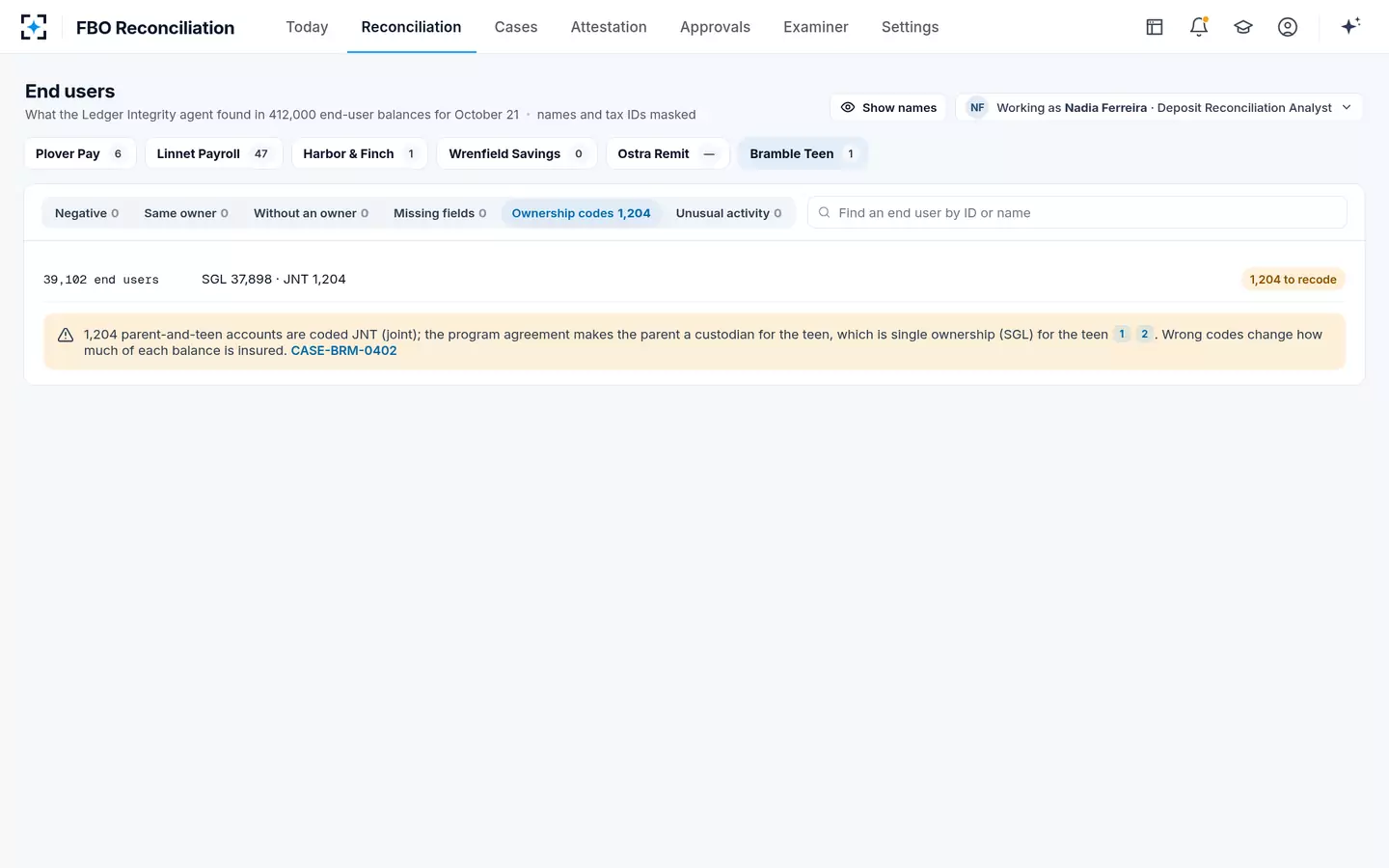
Ownership codes are where good records can still be wrong. At the sample bank, a teen-banking partner coded 1,204 parent-and-teen accounts as joint when its program agreement makes the parent a custodian for the teen. Money a custodian holds for a minor, as under the Uniform Gifts to Minors Act, is treated as an agency account and insured as the minor's own (12 CFR 330.7(b)), so each of those balances belongs in the teen's single-ownership category, not in a joint category shared with the parent. Why a reconciliation of totals never finds that kind of error is worked through separately.
FBO Reconciliation checks every end user's ownership code, not only the balances
The genuine condition: the money has to belong to the people named
The third condition is that the relationship is real: the customers own the money and the fintech does not. The FDIC starts from the bank's records, but it reserves the right to look past them. If it "has reason to believe that the insured depository institution's deposit account records misrepresent the actual ownership of deposited funds and such misrepresentation would increase deposit insurance coverage, the FDIC may consider all available evidence and pay claims for insured deposits on the basis of the actual rather than the misrepresented ownership" (12 CFR 330.5(a)(1)).
For an FBO program, that means the agreement, the flows and the records have to tell the same story. A fintech that sweeps its own operating money into the customers' account, or pays its expenses out of it, blurs the line the rule depends on. A daily reconciliation that ties every dollar in the account either to a customer or to an explained timing item is the evidence that the relationship is what the title says it is.
Are FBO accounts FDIC insured? Per owner, when the records hold
FBO accounts are FDIC insured per owner when the three conditions hold, and as a single deposit of the custodian when they do not. The proposal states the second case directly: "If the pass-through insurance requirements are not satisfied, the deposit is insured to the person named on the IDI's records and aggregated with any other deposits that person holds at the same IDI in the same ownership category. The FDIC makes determinations with respect to pass-through deposit insurance coverage at the time an IDI fails" (89 FR 80135).
One $10 million FBO account, three ways failure day can go
| Case | Who is insured | How much is insured |
|---|---|---|
| All three conditions met, codes right | Each of the partner's customers, as if they had deposited directly | Up to $250,000 per customer in each ownership category, added to that customer's other deposits at the bank in the same category |
| Conditions met, a customer's ownership code wrong | The customer, but in the wrong category | The balance is added to the wrong set of the customer's deposits; the result can be more or less coverage than intended |
| Titling or owner records fail | The fintech, as the person named on the account | Up to $250,000 in total, added to any other deposits the fintech holds at the bank in the same category |
The difference between the first and third rows is the whole value of the program to its customers. It is decided by records, and it is decided after the event. That is the reason to treat the per-owner file as something the bank proves daily rather than something it hopes a partner can produce.
Programs that spread one partner's customers across several banks add a further rule. Where custodial money is pooled and placed at more than one bank without allocating it to particular owners, each owner's insured interest at any one bank can be taken as the same fractional share the owner holds of the whole pool (12 CFR 330.5(a)(2)). A customer with $300,000 in a program that keeps 60 percent of its pool at one bank and 40 percent at another has an interest of $180,000 at the first and $120,000 at the second, each under the limit if the customer has no other single-ownership deposits there. The arithmetic works only if the per-owner balances and the split between banks are both known for the day of failure, which is one more reason a sponsor bank reconciles owners, not totals.
Failure day: what the FDIC asks for, and from whom
On failure day the FDIC works from the failed bank's records first, and turns to the custodian's records and to claim forms where the bank's records are not enough. The order of events below is our summary of the regulations and the FDIC's published claim forms.
Failure day for an FBO account, in the order the FDIC works
A person decides
The FDIC, as receiverReads the failed bank's deposit account records: the FBO account's title and balance, and any per-owner records the bank holds.
A person decides
The FDIC, on the titling conditionDecides whether the records disclose a custodial or agency relationship; if not, the account is insured to the named holder.
A person decides
The custodian or fintechSupplies the per-owner records if the bank does not hold them; a bank covered by Part 370 must already have made a good-faith effort to contract for their delivery in time for the 24-hour calculation (12 CFR 370.5).
A person decides
The FDIC, on the ownership conditionMatches each owner's interest to the account and assigns each balance to an ownership category.
A person decides
Depositors and agentsComplete FDIC declarations where information is missing, such as the Declaration of Custodian Deposit or the Declaration of Agency Account.
A person decides
The FDIC, paying claimsPays each owner up to the limit in each category, or the named holder if the conditions fail.
The FDIC's renewal notice, published on October 26, 2026, describes the purpose of those forms in one line: "In the event that the requisite information is not available in a failed IDI's records, the FDIC will utilize these forms, declarations and affidavits to request the necessary information from a depositor" (91 FR 67317). Every form is a delay for the customer. A bank that can produce a reconciled, coded per-owner file for the day it failed spares its partner's customers that wait. Why Part 370's 24-hour regime reaches few sponsor banks is explained separately.
FDIC pass-through insurance guidance in 2026: where each rule stands
The pass-through rules themselves have not changed, but several related rules have moved since 2024, and two pending proposals would affect FBO programs directly. The table gives the status of each from the Federal Register and the Unified Agenda.
The pass-through conditions are unchanged; two proposals around them are still pending
| Rule | Status | What it means for an FBO account |
|---|---|---|
| Pass-through conditions, 12 CFR 330.5 and 330.7 | In force | The three conditions above decide each owner's coverage at failure |
| Custodial-account recordkeeping, proposed 12 CFR 375 (October 2024) | Proposed; long-term action, final rule to be determined | Would require per-owner records, daily reconciliation and annual certification |
| Brokered deposits proposal (August 2024) | Withdrawn March 14, 2025 | Its changes to how deposit arrangements are classified will not proceed without a new proposal |
| Stablecoin reserves, GENIUS Act proposal (April 2026) | Proposed | Reserve deposits would be insured to the issuer as corporate deposits, not passed through to holders |
| Signs and misrepresentation rule, 12 CFR 328 | Final; digital-sign rules amended January 2026, compliance by April 1, 2027 | Non-bank partners may not imply that FDIC insurance covers their own failure, and must say pass-through coverage has conditions |
| Part 370 recordkeeping | In force | Applies only to banks with two million or more deposit accounts |
The stablecoin proposal is worth reading even for banks with no stablecoin business, because it shows the FDIC's current view of what pass-through is for. It would make deposits held as reserves for a payment stablecoin insured to the issuer under the rules for corporate deposits, "but would not be insured to payment stablecoin holders on a pass-through basis" (91 FR 18534), partly because stablecoin holders transact without money ever leaving the bank account. FBO programs are the opposite case: the customers' payments do leave the account, and the per-owner records follow them.
How FBO Reconciliation keeps the per-owner proof
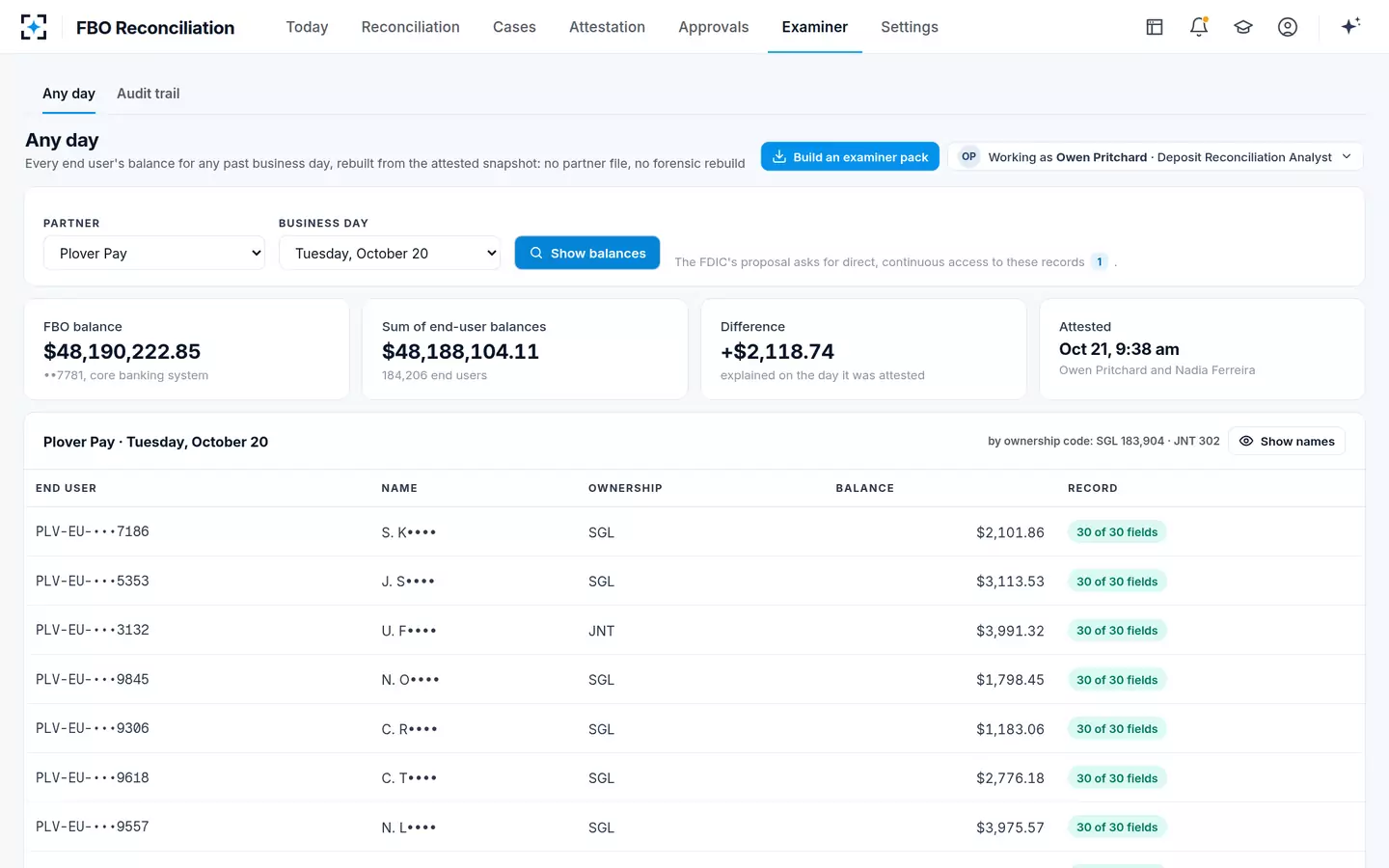
FBO Reconciliation does not decide anyone's insurance; the FDIC does that at failure. What it does is keep the evidence the ownership and genuineness conditions depend on, every business day. Each morning it ties every FBO account to the sum of its customers' balances, explains each difference with its records, checks every customer against the proposal's 30 fields and ownership codes, and has two analysts attest. The attested day is kept as a snapshot, so any past day can be rebuilt and downloaded in the format the FDIC has proposed.
FBO Reconciliation rebuilds any past day's per-owner balances from the attested snapshot
For the customer's side of the same question, what an FBO account is and whether the end customer is the bank's customer, see FBO accounts at fintechs. To see the per-owner checks on a sample of your own partners' files, start from FBO Reconciliation.
Questions people ask
What does pass-through deposit insurance mean?
The phrase is the FDIC's shorthand; the regulation itself says funds an agent, custodian or nominee deposits for their owners "shall be insured to the same extent as if deposited in the name of the principal(s)" (12 CFR 330.7(a)). FBO accounts are one use of it. Lawyers' client trust accounts, escrow accounts and the custodial accounts of mortgage servicers rest on the same idea; the section in its current form dates from 1998, long before the first fintech program.
How much FDIC pass-through insurance coverage does each customer get?
Up to the standard maximum of $250,000 per owner, per bank, in each ownership category, counted together with the owner's other deposits in that category at the same bank. A customer with $200,000 in a fintech app and $100,000 in a personal checking account at the sponsor bank, both single ownership, has $300,000 in one category and $50,000 uninsured; the app alone would not show it.
Does FBO account pass-through insurance protect customers if the fintech fails?
No. FDIC insurance is paid only when an insured bank fails. When a fintech or a middleware firm fails, what protects customers is whether the bank can still identify each owner and balance, which is why the FDIC's 2024 proposal would require direct and continuing access to the per-owner records even if the third party keeping them goes bankrupt.
Are stablecoin reserves pass-through insured?
Under the FDIC's April 2026 proposal, no: reserves would be insured to the issuer as corporate deposits, up to $250,000 in total with its other corporate deposits at that bank. The FDIC's reasoning rests on the GENIUS Act's provisions that payment stablecoins are not subject to federal deposit insurance and may not be marketed as if they were, and it asked commenters whether its reading is the best one under that Act and the Federal Deposit Insurance Act. The proposal is not final.
Can a fintech say its customers' money is FDIC insured?
Only with the conditions attached. Under the FDIC's misrepresentation rule, a non-bank that mentions deposit insurance must say clearly that it is not an insured bank and that the insurance covers only the bank's failure, and a statement about pass-through coverage must say that certain conditions have to be met for it to apply (12 CFR 328.102(b)(5)). Leaving either out counts as a material omission.