Virtual accounts in banking are account numbers or balances that live in a sub-ledger rather than as separate deposit accounts at the bank: payments addressed to them land in one real account, and software keeps track of whose money is whose. Corporate treasurers use them to sort incoming payments by customer. Fintech apps use the same structure at much larger scale: the sponsor bank holds one FBO (for benefit of) account, a custodial deposit account, and each customer's "account" in the app is a line in the partner's books. The real account is visible to the bank; the virtual ones, as a rule, are not, until someone reconciles them. Botminds' FBO Reconciliation does that every business day, tying each FBO account to the sum of its virtual balances and checking every one of them.
The examples come from a fictional sample bank as it runs through the solution: Tessaly Community Bank, six fintech partners, about 412,000 customer balances. Definitions and rules are linked where they appear.
Six deposit accounts on the bank's core, about 412,000 balances in the partners' books
Customer balances, by partner
- Plover Pay, 184,206 · 45%
- Linnet Payroll, 71,480 · 17%
- Bramble Teen, 39,102 · 9%
- Ostra Remit, 35,957 · 9%
- Harbor & Finch and Wrenfield, about 81,000 · 20%
Money held, $214 million in six FBO accounts
- Harbor & Finch, $61.2M · 29%
- Plover Pay, $48.2M · 23%
- Wrenfield Savings, $44.9M · 21%
- Linnet Payroll, $39.6M · 18%
- Ostra Remit and Bramble Teen, $20.1M · 9%
What is a virtual account in banking?
A virtual account in banking is an identifier, and usually a balance, that points to a real account without being one. Money sent to it arrives in the real account; a sub-ledger records which virtual account it belongs to. There is no single US regulatory definition. The clearest official description comes from Europe, where the European Banking Authority studied virtual IBANs in 2024 and noted that EU anti-money-laundering law will define one as "an identifier causing payments to be redirected to a payment account identified by an IBAN different from that identifier" (EBA, Report on virtual IBANs, May 2024).
The EBA's report sets out the common features it observed: "A vIBAN is an identifier that has the same format and functionality as a regular IBAN, and is linked to a payment account, referred to in this report as the ‘master account’." The master account can be held in the end user's name or in the name of the firm that hands out the virtual numbers. The second case is the European cousin of a US FBO account.
The word "virtual" is easy to misread. The money is real and sits in a real deposit account at a real bank. What is virtual is the division of that money among owners, which exists only in a set of books someone else keeps.
Virtual accounts in corporate banking and virtual account management
In corporate banking, virtual account management is a treasury tool: a company gives each of its customers, projects or business lines its own virtual account number, so that incoming payments identify themselves. The EBA describes the use plainly: "vIBANs are often used by companies to automate payment reconciliation." The company holds one physical account; the bank's system or the company's own software allocates each receipt to the right virtual account.
That corporate use and the fintech use share a structure but differ in one way that matters. In corporate banking the virtual accounts all belong to one company, so the allocation is a convenience for its accountants. In a fintech program the virtual accounts belong to thousands of different people, so the allocation is the only record of who owns what. A mistake in a treasurer's virtual accounts misfiles a receipt. A mistake in a fintech's virtual accounts can leave a customer unable to get their money.
The EBA also flagged a disagreement among European supervisors worth noticing even in the US: some national authorities take the view, in the report's words, "that a vIBAN is an identifier of a separate payment account, different from the master account." Whether a virtual account is a real account or a pointer is not settled everywhere; in the US FBO model, as far as the bank's deposit records go, it is a pointer.
What is a virtual account number?
A virtual account number is the number a customer sees in an app or gives to an employer for direct deposit, which routes money into the pooled account and identifies the customer inside it. In a US FBO program, three different numbers can be in play, and they are easy to confuse.
Three numbers behind one fintech customer's balance, and what each identifies
| Number | Where it lives | What it identifies |
|---|---|---|
| The FBO account number | The bank's core banking system | The one custodial deposit account the bank holds for the partner's customers |
| The customer's virtual account number | The partner's or program manager's books; shown in the app | One customer's share of the FBO account; payments to it land in the FBO account |
| The beneficial owner account number | A field in the FDIC's proposed 30-field file | The custodian-assigned number for each owner, listed beside the bank's account number in every row |
The FDIC's proposed file is, in effect, a standard layout for virtual accounts: one row per owner, the bank's account number and the custodian's number side by side, then the owner's name, tax ID, address, balance, accrued interest and ownership code. It turns the sub-ledger into something the bank could hand to the FDIC on the day it failed.
What is an omnibus account in banking?
An omnibus account in banking is one account that holds many owners' money together, in the name of an agent, custodian or the bank itself. FBO accounts are omnibus accounts, and brokerage sweep and prepaid card programs can use them too. The bank's core sees one depositor and one balance. Everything else, who owns what, who paid whom, is held by the party that runs the program.
The bank regulators' 2024 request for information on bank-fintech arrangements described the division of labor plainly: in many deposit programs it is the fintech that keeps the system of record for deposits and transactions, not the bank (OCC, Federal Reserve and FDIC, 89 FR 61577). The FDIC's rules handle commingled custodial money in proportion: where it is pooled without allocation, each owner's insured interest is the owner's share of the whole (12 CFR 330.5(a)(2)). Without a reliable sub-ledger, there is no way to know what that share is.
Omnibus account vs segregated account
An omnibus account pools many owners' money in one account; a segregated account holds one owner's money, or one client's, in an account of its own. The choice is a trade-off between operational simplicity and how much of the ownership record the bank itself holds.
Omnibus account vs segregated account, for a fintech program at a sponsor bank
Omnibus (FBO) account: One account and one balance per program
Segregated accounts: One account per customer, each with its own balance
Omnibus (FBO) account: The fintech or a middleware firm, in its sub-ledger
Segregated accounts: The bank, as with any deposit account
Omnibus (FBO) account: A new line in the partner's books
Segregated accounts: A new deposit account on the core
Omnibus (FBO) account: The FBO balance against every virtual balance
Segregated accounts: Each account reconciles in the core as usual
Omnibus (FBO) account: Per owner only if the pass-through conditions hold
Segregated accounts: Per owner as a direct deposit
Omnibus (FBO) account: The bank needs the partner's records to know whom to pay
Segregated accounts: The bank already knows
What is a sub-ledger, and who keeps it?
A sub-ledger is the detailed record that supports one line of a summary account: in accounting, the customer-by-customer detail behind accounts receivable; in an FBO program, the customer-by-customer detail behind one custodial deposit account. Whoever keeps it holds the only answer to the question "whose money is this?".
In US fintech programs it is usually kept by the fintech or by a middleware firm between the fintech and the bank, and occasionally by the bank itself. The FDIC's description of the Synapse arrangements makes the point that matters: the fintechs, not the banks, kept the customer-level records. That is why the FDIC's 2024 proposal would require banks either to keep the per-owner records or to have direct and continuing access to them, with a daily reconciliation either way. How the choice of who keeps the sub-ledger changes the daily breaks is worked through separately.
Custodial account vs deposit account: what the customer actually holds
A fintech customer with a virtual account holds a claim on a share of a custodial deposit account, not a deposit account of their own. In law, the depositor at the bank is the custodian; the customer is a beneficial owner. That difference is mostly invisible until something goes wrong.
The FDIC is clear about the limits of its role: "The FDIC only insures deposits of IDIs, and deposit insurance is only paid in the event of the failure of an IDI" (89 FR 80135). When the pass-through conditions are met, it looks through the custodian to the customer: "When the FDIC insures deposits on a pass-through basis, it treats end customers as depositors" (FDIC, 91 FR 18534). The EBA noticed the same gap from the European side, warning that end users who are not holders of the master account "may not have a payment account" in the legal sense, and so may not benefit from all the protections that come with one.
For the customer, then, the virtual account works like a bank account on an ordinary day and depends entirely on records on a bad one. The records the FDIC would need to treat each customer as a depositor are set out separately, and whether the end customer is also the bank's customer for other rules is covered on a sibling page.
Why every virtual balance must be reconciled to the real one, every day
Every virtual balance must be reconciled to the real account daily because customers spend their virtual balances daily. The FDIC's custodial-account proposal rests on how ordinary these accounts have become, citing its own household surveys.
Why the FDIC treats fintech virtual accounts as everyday money
46.4%
of US households used non-bank online payment services, in the FDIC's 2021 survey
6.9%
of households used prepaid cards, which generally hold funds in custodial accounts
1,000+
consumer inquiries to the FDIC about the Synapse bankruptcy since May 2024
A virtual balance that is too high can be withdrawn before anyone notices; one that is too low is a customer underpaid. A sub-ledger that is reconciled monthly can be wrong for weeks. At the sample bank, the daily tie for Plover Pay's 184,206 virtual balances found the totals $1,466.07 apart, walked the gap to zero with an ACH return batch that posted after the partner's books closed and card purchases that settle the next morning, and checked every balance inside the total.
FBO Reconciliation ties one FBO account to 184,206 virtual balances
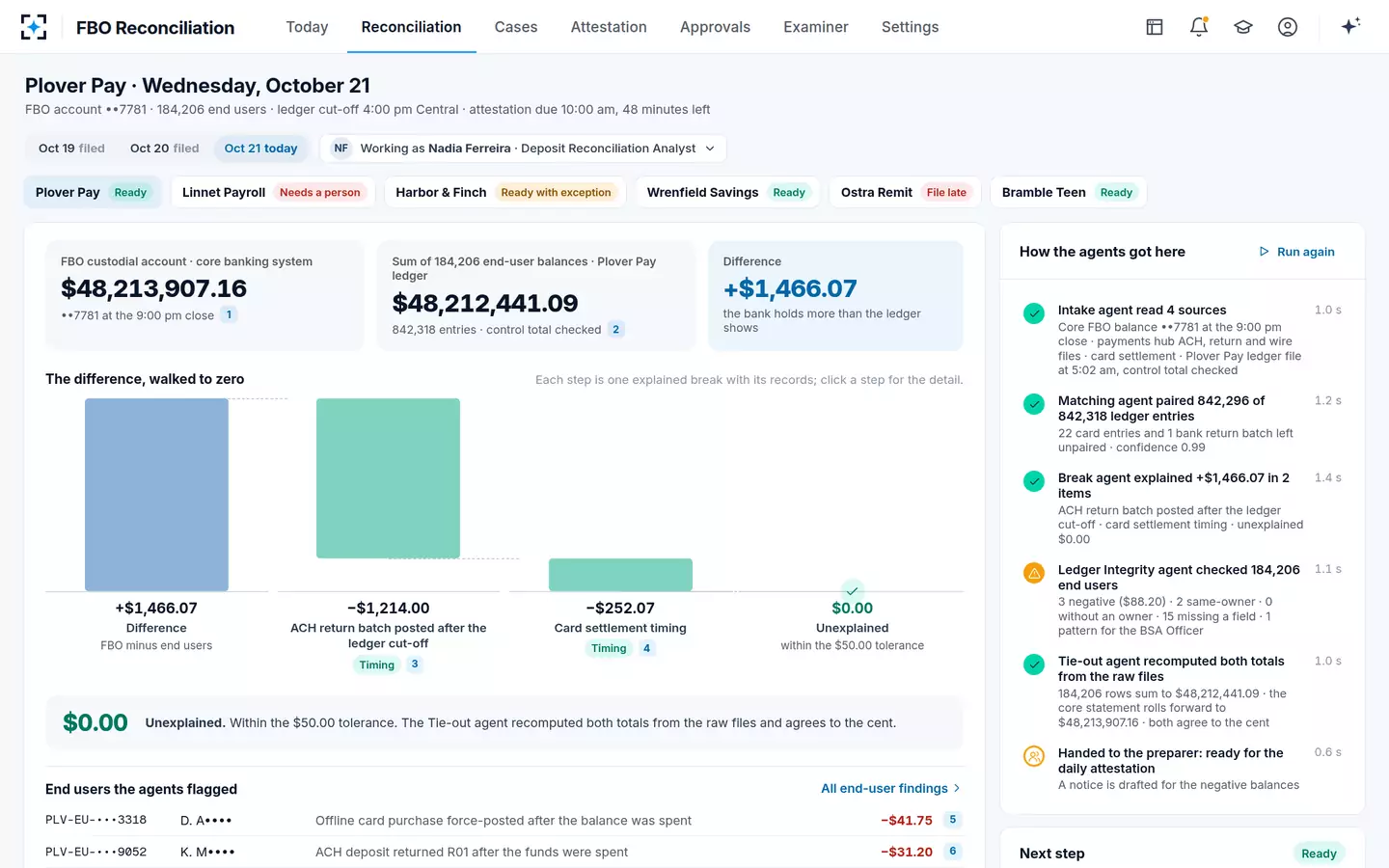
What FBO Reconciliation checks behind the virtual accounts
Behind the total, the solution checks each virtual balance for the problems a sum cannot show: negative balances, two balances for one owner, balances with no owner, missing fields from the FDIC's proposed format and ownership codes. On the sample day it found three negative balances at Plover Pay, $88.20 in all, and confirmed that the FBO account still covered every positive balance with $1,377.87 to spare.
FBO Reconciliation flags the virtual balances that need a person
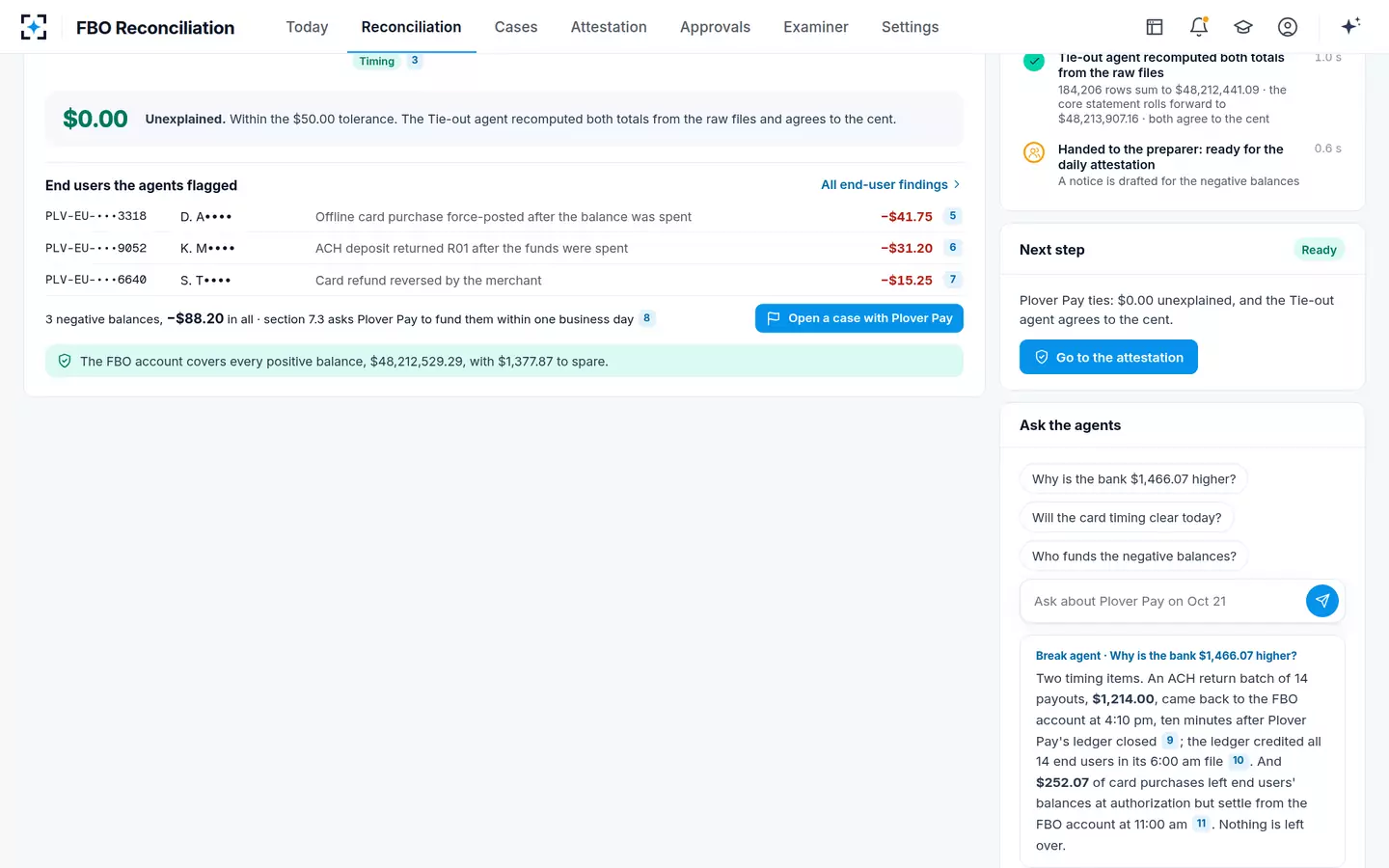
The bank does not edit the partner's books. Each finding becomes a case: a notice to the partner citing its program agreement, sent by the oversight manager, and where money must move, an entry approved by the Controller. To see the checks run on a sample of your own partners' virtual balances, start from FBO Reconciliation.
Questions people ask
Are virtual accounts real bank accounts?
Not usually. In a fintech program the virtual account is a record in the partner's books; the real deposit account is the FBO account at the bank, held for all the customers together. The money is real and at a bank, but the customer's individual account exists only as a line in a sub-ledger.
Do virtual accounts have FDIC insurance?
The money behind them can, on a pass-through basis, if the bank's records disclose the custodial relationship, each customer's interest can be traced in good records, and the relationship is genuine. Insurance pays only if the bank fails; it does not cover the failure of the fintech that keeps the virtual accounts.
Is a virtual account the same as a virtual card?
No. A virtual card is a card number for making payments, often single-use, issued against a real card account. A virtual account is a number or balance that receives and holds money inside a pooled account. A fintech customer may have both: a virtual account for the balance and a virtual card to spend it.
Who keeps the records for virtual accounts?
Whoever runs the sub-ledger: usually the fintech, sometimes a middleware or program-management firm, occasionally the bank. The FDIC's 2024 proposal, not yet final, would require the bank either to keep those records itself or to have direct and continuing access to them, in a set format, reconciled daily.
Can an omnibus account hold money for businesses as well as consumers?
Yes. The pass-through rules apply to any owner, and a business owner's share would be insured in the business category. A program can also keep business customers in segregated accounts, which removes the need for pass-through on those balances.