A daily reconciliation report is the dated statement that each account was proved against its supporting records for one business day: the two balances, every difference explained with its evidence or carried as an exception, and the names of the person who prepared it and the person who checked it. For a sponsor bank's FBO accounts, the custodial deposit accounts held for fintech partners' customers, the report has to cover every partner and, behind each total, every customer's balance, and it is due every morning. Most of the difficulty is in the hours before it is written: files arriving late or not at all, money that moved after one side closed, and partner errors that make the totals disagree. Botminds' FBO Reconciliation does that preparation overnight. This page follows one day of it.
The day is from a fictional sample bank as it runs through the solution: Tessaly Community Bank, $3.4 billion in assets, six fintech partners, 412,000 end users. The business day is Wednesday, October 21, 2026; the report for it is due at 10:00 am on Thursday, October 22. The rules and figures that are not the sample bank's are linked where they appear.
From one partner's cut-off to the filed report: eighteen hours, most of them waiting
- Cut-off to core close4:00–9:00 pm
- Overnight, files arriving9:00 pm–5:00 am
- Agents run5:00–7:40
- Draft waits, then people review and file7:40–9:21
What is a daily reconciliation report, and what does it mean for an FBO account?
A daily reconciliation report means that someone has proved the books for that day and someone else has checked the proof. For an FBO account it carries more weight than most, because it is the bank's only dated statement of what each customer was owed and whether the bank held it. If an examiner, an auditor or a bankruptcy trustee later asks about that day, the report and the records behind it are the answer.
The FDIC's 2024 custodial-account proposal, still pending, would require exactly this cadence for pooled custodial accounts: reconciliation against the beneficial-ownership records at least as of each day's close of business. It is realistic about what that means in practice, accepting that daily reconciliation will surface differences that are not errors, "with the understanding that reconciling variances due to unposted transactions and timing of transactions occurs and should be addressed based on standard banking practices, which are sufficient to manage and resolve such variances" (FDIC, Recordkeeping for Custodial Accounts, 89 FR 80135). The report's job is to show that each of those variances was in fact addressed.
What causes reconciliation breaks? Six on this day, and one missing file
On this day six items needed a cause. Four came from the usual sources: money that moved after a partner closed its books, card purchases not yet settled, a partner's own error and a wire recall that aged. One could not be explained by any record. And one sat inside a total that tied: three customers with negative balances. A seventh problem, a file that never arrived, could not be broken down at all. By size, the largest break was a partner's error; the smallest was the most urgent, because it was customers owing money they had already spent.
The day's breaks by size: the largest a partner error, the smallest the most urgent
4:10 pm: the ACH returns that missed the cut-off by ten minutes
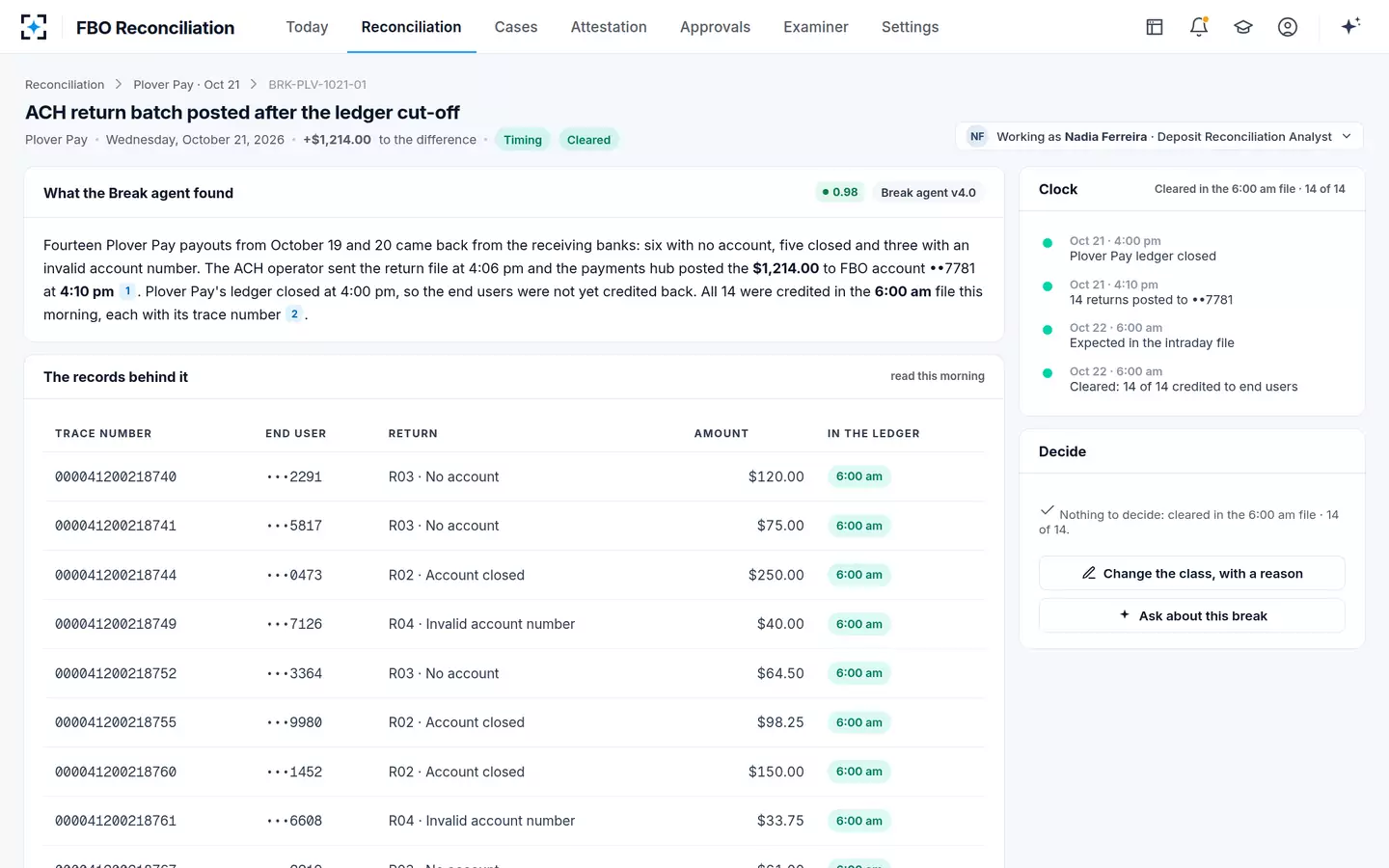
Plover Pay's books closed at 4:00 pm Central. Ten minutes later, the payments hub posted an ACH return file to the FBO account: fourteen payouts from October 19 and 20 had come back from the receiving banks, $1,214.00 in all. The money was back in the bank's account; the partner's books would not credit the customers until its next file. At the 9:00 pm close, the bank held $1,214.00 more than the partner's books said it should.
The return codes told the story. Six were R03, five R02 and three R04. In Nacha's definitions, R02 means "A previously active account has been closed by action of the customer or the RDFI"; R03 means the account number is valid but "does not correspond to the individual identified in the Entry, or the account number designated is not an existing account"; R04 means "Account number structure is not valid" (Nacha, ISO 20022 guide to return codes). Nacha groups those three as administrative returns, and in a 2025 bulletin it urged receiving banks to send them faster, noting that "Only 59% of respondents said they use Same Day ACH processing windows to send any returns" (Nacha, ACH Operations Bulletin #1-2025).
That bulletin also explains why returns land at awkward times: a receiving bank may get additional files "in later distribution windows throughout the day." For a sponsor bank, returns arriving after a partner's cut-off are a daily certainty, not an exception. The Break agent's job was to prove this batch was that and nothing else: it opened the return file, matched the fourteen trace numbers, and found all fourteen credited in Plover Pay's 6:00 am file. It called the item explained, at 0.98 confidence, and cleared.
FBO Reconciliation's explanation of the ACH return batch, with its records and its clock
The card purchases that settle tomorrow, and the promise that has to be checked
The second item on Plover Pay was $252.07 of card purchases: 22 transactions that had reduced customers' balances in the partner's books when they were authorized, but would not leave the FBO account until the card processor's settlement the next morning. Until then, the bank held that money and the partner's books did not count it. Together with the ACH returns, it walked Plover Pay's $1,466.07 difference to $0.00, within the partner's $50.00 tolerance, and the independent recompute of both totals agreed to the cent.
A timing item is a promise, and a promise has to be checked. The settlement file for those 22 purchases was due at 11:00 am, an hour after the report's deadline. The report could therefore attest the item as timing, but the solution set an expected clear time and a rule: if the purchases had not settled by noon, one hour after their expected time, the item would become an aged break with an owner. This is where a desk working by hand most easily loses track. An item labelled "card timing" that nobody checks the next day can hide a real difference for weeks, which is why a tie-out on the totals is not enough.
Linnet Payroll: a duplicate load and $310.00 nobody can explain
Not every partner tied. Linnet Payroll's books showed $10,156.12 more than its FBO account held. The Break agent found most of it in the partner's own records: payroll batch PB-7731 had been loaded twice into the partner's books, crediting customers with $9,846.12 that never arrived at the bank. That is a partner error, and the fix is the partner's.
The remaining $310.00 matched no record the agents could find, and it was above the partner's $50.00 tolerance. The agents' rule is never to call a difference explained without a record, so the item went to an analyst, a case was opened with the partner, and Linnet Payroll went into the report as an exception with a reason code. The same partner's file also held 41 balances with no owner, $1,902.55 in all, and five negative balances; a restriction on the 41 waited for the oversight manager's check.
Ostra Remit: the file that never came, and why a total is not a reconciliation
Ostra Remit's file was due at 5:00 am. At 4:48 am the transfer failed a certificate check, and nothing arrived. The case went to the oversight manager at 7:00 am and to the Controller at 9:00 am, on the bank's escalation schedule. The partner's balance service showed a provisional total of $10,355,140.22 at 11:59 pm, against the core's $10,355,780.22.
A total is not 35,957 customer balances, and the desk did not treat it as one. Ostra Remit went into the report as an exception, with a reason code and a note that an addendum would follow when the file arrived. Signing for a partner on the strength of its total would have meant attesting to balances nobody had seen. In 2024, when a middleware firm's records could not be matched to what partner banks held, the gap turned out to be $60 million to $90 million by the CFPB's account (CFPB, Synapse Financial Technologies); what the records missed in that failure is worth reading before deciding how a late file should be handled.
What is an aged reconciling item?
An aged reconciling item is a difference that was expected to clear by a certain time and did not, so it stops being a timing item and becomes a problem with an owner. The OCC's examiners ask how often someone independent of the function reviews reconciliations to ensure that "(2) stale items are being researched for disposition, and (3) old items are charged off in a timely manner" (OCC, Internal Control). On an FBO account the stakes are customers' money, so the clock is hours, not months.
On this day, Harbor & Finch carried one: a $2,400.00 wire recall that had passed its expected clear time. The rest of that partner's $20,750.00 difference was explained by records; the recall went into the report as an exception with its own reason code. In the solution every timing item gets an expected clear time when it is explained, and becomes an aged break one hour after that time if it has not cleared.
Daily reconciliation report template: what the filed report holds
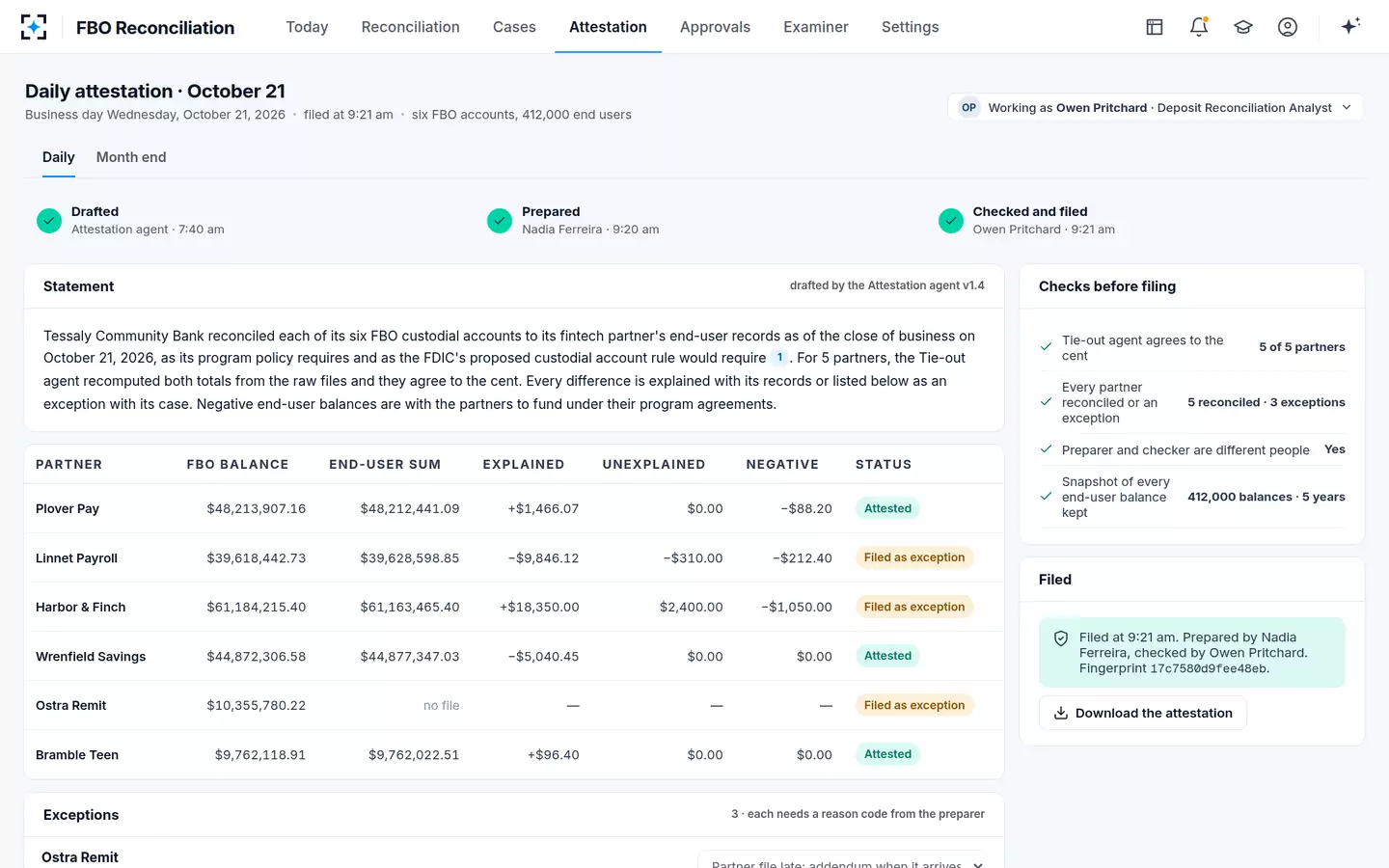
A daily reconciliation report template for FBO accounts needs one row per partner and a short statement above it. The filed report for October 21 is below, as the solution produced it; a bank building its own template could start from the same columns.
The daily reconciliation report for October 21, as filed at 9:21 am
| Partner | FBO balance | Customers' total | Explained | Unexplained | Status |
|---|---|---|---|---|---|
| Plover Pay | $48,213,907.16 | $48,212,441.09 | +$1,466.07 | $0.00 | Attested |
| Linnet Payroll | $39,618,442.73 | $39,628,598.85 | −$9,846.12 | −$310.00 | Exception |
| Harbor & Finch | $61,184,215.40 | $61,163,465.40 | +$18,350.00 | $2,400.00 | Exception |
| Wrenfield Savings | $44,872,306.58 | $44,877,347.03 | −$5,040.45 | $0.00 | Attested |
| Ostra Remit | $10,355,780.22 | No file | — | — | Exception |
| Bramble Teen | $9,762,118.91 | $9,762,022.51 | +$96.40 | $0.00 | Attested |
Above the table sits a statement that says what was done and against what standard. The sample bank's reads, in part, that it reconciled each FBO account to its partner's customer records as of the close of business, "as its program policy requires and as the FDIC's proposed custodial account rule would require". That wording is careful in the right way: the proposal is not law, and the report does not pretend it is.
FBO Reconciliation's daily attestation for October 21, filed 39 minutes before the deadline
After the report: the money that has to move
The report closes the day's proof, but some findings need money to move. Plover Pay's three negative balances, $88.20 in all, were the partner's to fund under its program agreement. At 9:14 am the analyst opened a case; the notice, drafted by the agents and citing section 7.3 of the agreement, was checked and sent by the oversight manager at 9:16 am. The partner replied at 9:18 am that it would fund all three from its reserve that day.
In FBO Reconciliation, the funding waits for the Controller
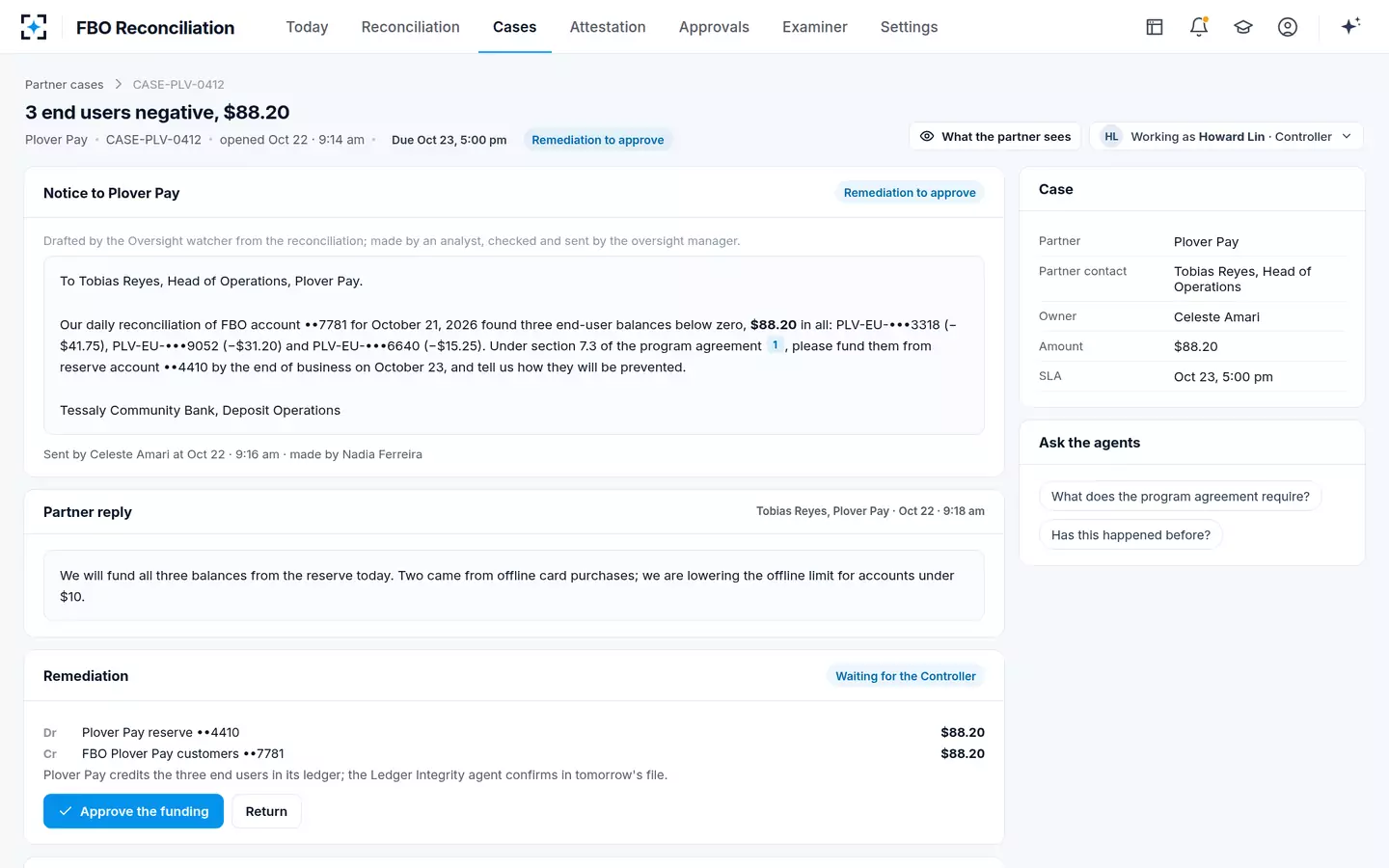
The funding entry, a debit to the partner's reserve and a credit to the FBO account, was proposed by the oversight manager and waited for the Controller, who alone approves money moving into or out of a custodial account. The next morning's reconciliation would check that the three customers had been credited in the partner's file. The seats that hand this work to each other are described in their own guide.
How long does FBO reconciliation take?
On the sample day, the agents ran for two hours and forty minutes overnight, from 5:00 to 7:40 am, across six partners. The analyst opened Plover Pay at 9:12 am, the attestation was prepared at 9:20 and filed at 9:21. One partner's day, rebuilt later for an examiner from the attested snapshot, took 2.1 seconds. Those are sample-data timings, not a measured customer result.
By hand, the same morning is a different job. Botminds' estimate for six partners is about six and a half desk hours, most of it collecting files, comparing totals and explaining differences, against a little over an hour with the solution, most of it on exceptions and the report. The design target is plain: every FBO account tied and attested by two analysts by 10:00 every business morning. To see a day like this one run on a sample of your own partners' files, start from FBO Reconciliation.
Questions people ask
What should a daily reconciliation exceptions report include?
Each item that could not be reconciled or explained, with its amount, its cause if known, its owner, the date it was raised and the date it is expected to clear, and a reason code. On FBO accounts it should also list partners whose files were late or missing, and customers with negative, duplicate or ownerless balances, even when the totals tied.
What is the daily bank reconciliation process for an FBO account?
Collect the core's balance and postings, the payments and card files and the partner's customer file; check that each file is complete; pair entries; explain every difference with its records and an expected clear time; check every customer's balance; recompute both totals independently; then one analyst prepares the report and a second checks and files it.
What is end of day reconciliation?
It is the reconciliation of balances as of the close of a business day. For FBO accounts the hard part is that the partner and the bank close at different times, so the end-of-day comparison always carries timing items that must be tracked until they clear.
What happens if a partner's file is late?
The day continues for the other partners. The late partner is escalated on a schedule, to the partner first, then the oversight manager, then the Controller, and goes into the report as an exception rather than being attested on a total. An addendum follows when the file arrives.
Who signs the daily reconciliation report?
A preparer and a different checker. At the sample bank both are reconciliation analysts, and the system will not let the preparer file the report. Agents draft the report but never sign it.