When Synapse Financial Technologies filed for Chapter 11 bankruptcy on April 22, 2024, the immediate public story was that fintech customers lost access to their money. The more precise story, and the one with the longer consequences, is that nobody could say with certainty how much money each customer was even owed. Synapse sat as a technology layer between consumer-facing fintech apps and the chartered banks that actually held the deposits; when its own records of who-owns-what stopped matching the banks' own books, the mismatch itself became the crisis: a shortfall the partner banks put at $60 to $90 million, according to the Consumer Financial Protection Bureau. It is the clearest documented argument for the discipline Botminds' Fintech Partner Oversight is built around: a bank's own, independently run test of a partner's data every week, not the partner's word for it.
This is a public case, not a Botminds customer. Everything about Synapse and Evolve below comes from the CFPB's enforcement action, the Federal Reserve's order and the agencies' own publications; the two screens near the end show fictional sample data from the solution.
What Synapse did, and why Evolve needed it
Synapse was not a bank and never held a charter. The Consumer Financial Protection Bureau describes it plainly: Synapse "provided proprietary technology and software that acted as a bridge between nonbank fintech platforms that offered banking services to consumers and traditional partnering banks". In practice, a consumer-facing fintech app would plug into Synapse's software, and Synapse would plug into one or more partner banks that actually held the funds and were chartered to do so.
Evolve Bank & Trust, a state-chartered bank in West Memphis, Arkansas, was one of those partner banks, through what its own regulators describe as its Open Banking Division: a business "that primarily involves offering deposit accounts and payment processing services to financial technology companies ('fintech partners') that, in turn, offer various financial products and services to end-user customers". Evolve needed Synapse's software layer the same way any sponsor bank needs a technology partner: to connect many small fintech apps to one set of chartered deposit accounts without building that plumbing itself.
The sub-ledger problem: whose records actually said who owned the money
A bank that holds deposits "for the benefit of" thousands of end users through one or more fintech middlemen has to rely on someone's detailed records to know which end user owns which slice of the pooled balance — the bank's own core system typically only sees the pooled total. The CFPB's allegation against Synapse goes to exactly that function: Synapse was "failing to maintain adequate records of the location of consumers' funds and failing to ensure those records matched the records maintained by its partnering banks".
The partnering banks determined that the total funds they were holding for consumers was less than the total amount of consumer funds reflected in records Synapse provided to them, reflecting a shortfall of between $60 and $90 million.
Consumer Financial Protection Bureau, enforcement action against Synapse Financial Technologies, Inc.
That gap is the whole failure in one sentence. It is not that money vanished in a single theft or a single bad trade; it is that two sets of records, which were supposed to describe the same pool of money from two different vantage points, had drifted apart, by tens of millions of dollars, before anyone outside the companies involved could see it. The regulators' own description of the structure explains why: in these arrangements, the agencies wrote in 2024, fintech companies "often play a critical role in maintaining a deposit and transaction system of record," and those records "may not be reflected in the bank's core processing system."
Two sets of books, describing the same money
The bank's own core system
One pooled account per fintech partner, held "for the benefit of" (FBO) all of that partner's end users together.
Shows the total. Does not, on its own, show any individual end user's share.
The fintech middleman's own records
A detailed sub-ledger meant to say exactly which end user owns which dollar of the pooled total.
Is the only place that detail lives — if it stops being accurate, nothing else has it.
How the collapse froze access to consumer funds
Once the discrepancy surfaced, the partnering banks could not simply pay out Synapse's numbers, because Synapse's numbers were the thing in question. The CFPB describes the result in terms of time, not drama: "Consumers did not have any access to their funds for weeks or months as the partnering banks reconciled their records with Synapse's records and then distributed funds to consumers", and, the Bureau adds, "many consumers have not received the full amount of their account balance." A freeze of this kind is not a decision any single party makes; it is what happens by default when nobody can safely certify whose money is whose.
A deposit's path, and whose records describe it at each stage
| Stage | What happens | Whose records say so |
|---|---|---|
| Deposit | An end user puts money into a fintech app built on a banking-as-a-service stack. | The fintech’s own app and, behind it, Synapse’s software layer. |
| Pooling | The money lands in one omnibus account at the partner bank, titled for the benefit of that fintech’s end users together. | The bank’s own core deposit system, at the pooled level only. |
| Attribution | Software is supposed to track which end user owns which share of the pooled total. | Synapse’s own sub-ledger, in this case — the only detailed record of individual ownership. |
| Reconciliation | The bank periodically checks that its pooled total matches the sum of the sub-ledger’s individual shares. | Whoever actually runs this check, and how often, is the control that either exists or does not. |
| Withdrawal | An end user asks for their money back. | The bank pays out against the sub-ledger’s figure — if that figure is trusted. |
What the Federal Reserve ordered Evolve to fix
On June 14, 2024, the Federal Reserve Board announced a cease-and-desist order, issued on consent jointly with the Arkansas State Bank Department and dated June 11, against Evolve Bancorp, Inc. and Evolve Bank & Trust. The order was not a response to the bankruptcy. It rests on reports of examination issued on August 11, 2023, August 30, 2023 and January 10, 2024 — all before Synapse filed — which found deficiencies in the risk management and consumer compliance of Evolve's Open Banking Division, in its anti-money-laundering program and in its sanctions (OFAC) compliance. Its requirements still go directly at the structural gap this guide describes: within 90 days, the bank had to submit a written plan, acceptable to its supervisors, that included "policies, procedures, processes, and controls to ensure that … sub-ledger responsibilities of the Bank and fintech partners are clearly defined, established, and maintained, including in the event of a material business disruption".
Two details in that clause matter beyond the Evolve case specifically. First, it names sub-ledger responsibility as something that has to be assigned in writing, in advance, not discovered by argument after a partner fails. Second, it requires that assignment to survive "a material business disruption" — in other words, a bank's plan for who owns which record has to keep working on the day its partner stops answering the phone, which is precisely the day Synapse's customers needed it to.
What is an FBO account, and why does it hide individual balances?
"FBO" stands for "for the benefit of," and it describes an account titled in a bank's name but held on behalf of someone else — in this structure, a fintech's many end users, pooled together. The three federal banking agencies' own 2024 request for information on bank-fintech arrangements describes the mechanics generally: a bank's deposit records in these arrangements may consist of accounts "often titled to reflect that they are held for the benefit of (FBO) end users" rather than one account per end user. That design is not itself a defect — it is how banking-as-a-service pooling normally works, and it is efficient precisely because the bank does not need a separate account entry for every one of a fintech's customers. The defect is treating the pooled total as sufficient oversight on its own, with no independent check that the detailed breakdown behind it still adds up.
What regulators are asking all sponsor banks to show now
Synapse accelerated a question regulators were already asking generally. The Interagency Guidance on Third-Party Relationships states the underlying standard plainly: effective oversight "includes ongoing monitoring throughout the duration of a third-party relationship, commensurate with the level of risk and complexity of the relationship", and the FDIC's community-bank guide frames the point of that monitoring as confirming "if the third party is performing as required for the duration of the contract" — not only at onboarding. For a deposit-pooling arrangement, performing as required specifically includes the fintech's record of who owns what continuing to match the bank's own pooled total, checked by the bank itself, not accepted on the partner's say-so.
What a sponsor bank's own reconciliation needs, after Synapse
- A standing, written assignment of sub-ledger responsibility
Who keeps the detailed record of individual ownership, named in writing, before a partner is live — not decided after a dispute.
- A reconciliation the bank runs itself
Comparing the pooled total on the bank’s own books against the sum of the partner’s individual records, on a fixed schedule.
- A plan that survives the partner going dark
The Federal Reserve’s Evolve order specifically required this to hold “in the event of a material business disruption.”
- Board-level visibility into the gap, if any
Not just whether a reconciliation ran, but what it found and how large any mismatch was.
Could a weekly reconciliation have caught this earlier?
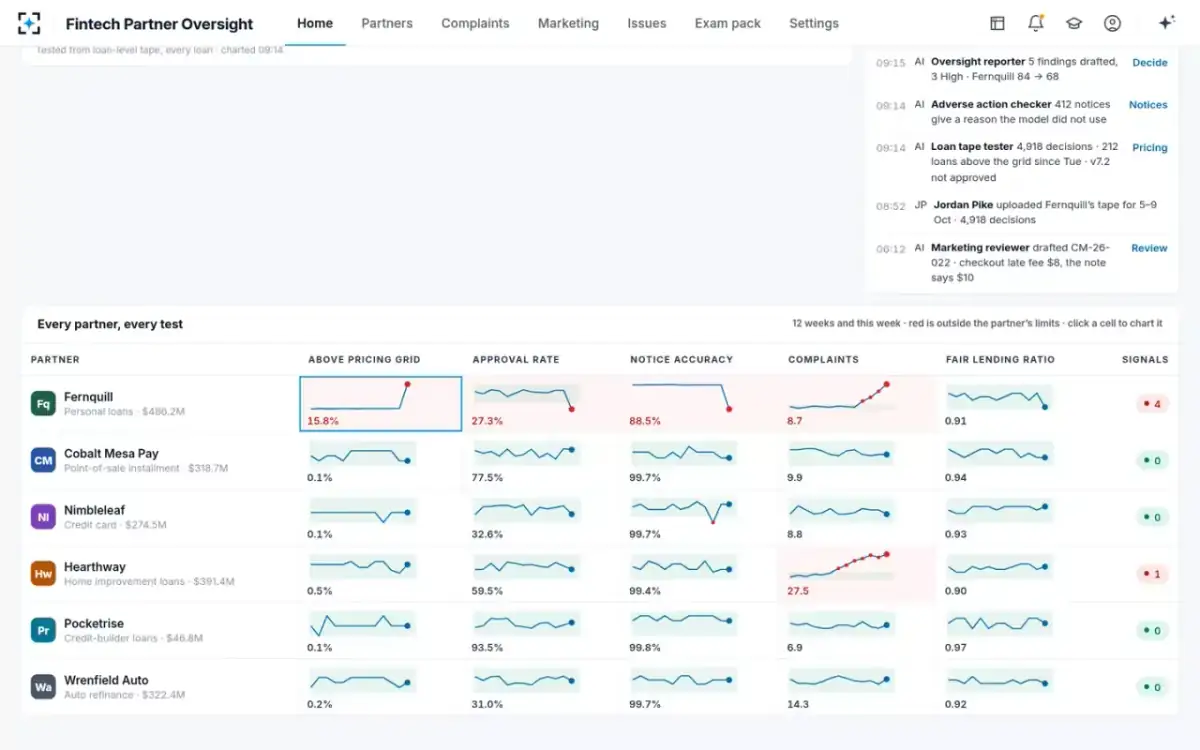
Nothing in the public record says precisely when Synapse's and its partner banks' records first began to drift, so no one can say with certainty how much earlier a given cadence of testing would have caught it. What the structure of the problem does say is that a gap measured in the tens of millions of dollars, discovered only at a bankruptcy filing, is consistent with a reconciliation that either ran infrequently, ran on data the fintech itself supplied without an independent check, or both. A sponsor bank that tests its own pooled total against a partner's sub-ledger every week, from the bank's own data, converts "we assume the two match" into "we checked, and here is this week's variance" — which is the same shift Fintech Partner Oversight makes for loan tapes: the control-chart method behind weekly testing applies as directly to a deposit reconciliation as it does to a pricing grid.
The arithmetic of cadence is still worth doing. A bank that reconciles a pooled account once a quarter looks at four data points a year; one that reconciles weekly looks at 52, and a control chart drawn on 12 weeks of history can flag a mismatch that is small but growing before it is large. That does not prove any particular cadence would have caught Synapse's gap. It does mean the bank, not the partner, holds the evidence of when a drift began.
What did the CFPB do about Synapse?
The CFPB sued Synapse inside its own bankruptcy. On August 21, 2025, the Bureau filed an adversary proceeding in the U.S. Bankruptcy Court for the Central District of California, alleging that Synapse violated the Consumer Financial Protection Act by "failing to maintain adequate records of the location of consumers' funds" and failing to ensure those records matched its partner banks' records. It filed a proposed stipulated final judgment the same day, and the court entered it on September 12, 2025.
The judgment's money term is deliberately small: a $1 civil money penalty, which, the CFPB explains, enables the Bureau to access its Civil Penalty Fund to compensate harmed consumers. It also includes injunctive relief, among it a ban on selling customer information. A bankrupt middleman cannot pay back a shortfall, which is the point for a sponsor bank: when the partner's records fail, the remedy runs through a public fund and the courts, while the bank answers to its own examiners for the deposits it held.
The same weekly, every-partner cadence, applied to six lending partners
What changed in bank-fintech arrangements after Synapse
The clearest documented change is the Evolve order itself: a named bank, a named division, and a written requirement to define and maintain sub-ledger responsibility going forward. More broadly, the same 2024 request for information that describes FBO account structures was published by the OCC, the Federal Reserve and the FDIC jointly, seeking input on exactly this category of arrangement, and Federal Reserve Governor Michelle Bowman's own statement on it acknowledged that bank-fintech relationships "can pose significant risks to banks and their customers, including retail deposit customers who reasonably expect that their deposits will be insured." Neither document claims to have solved the underlying structural question — who is independently checking the sub-ledger — but both treat it, after Synapse, as a question every sponsor bank running a pooled-deposit fintech program now has to answer for itself, in writing, before the next partner fails.
The order's reach went past deposits, too, which is worth noting for any sponsor bank assuming a Synapse-style failure is purely a payments problem. The same order required Evolve to adopt lending and credit risk policies covering its fintech partners specifically, including "standardized financial documentation required of each fintech partner," the "establishment of an exception tracking system," and "required continuous monitoring by senior management and periodic reporting to the board." That is the same shape of requirement as the sub-ledger clause: a named, partner-by-partner standard, tracked continuously, reported upward — not a once-a-year policy document that never touches an actual transaction.
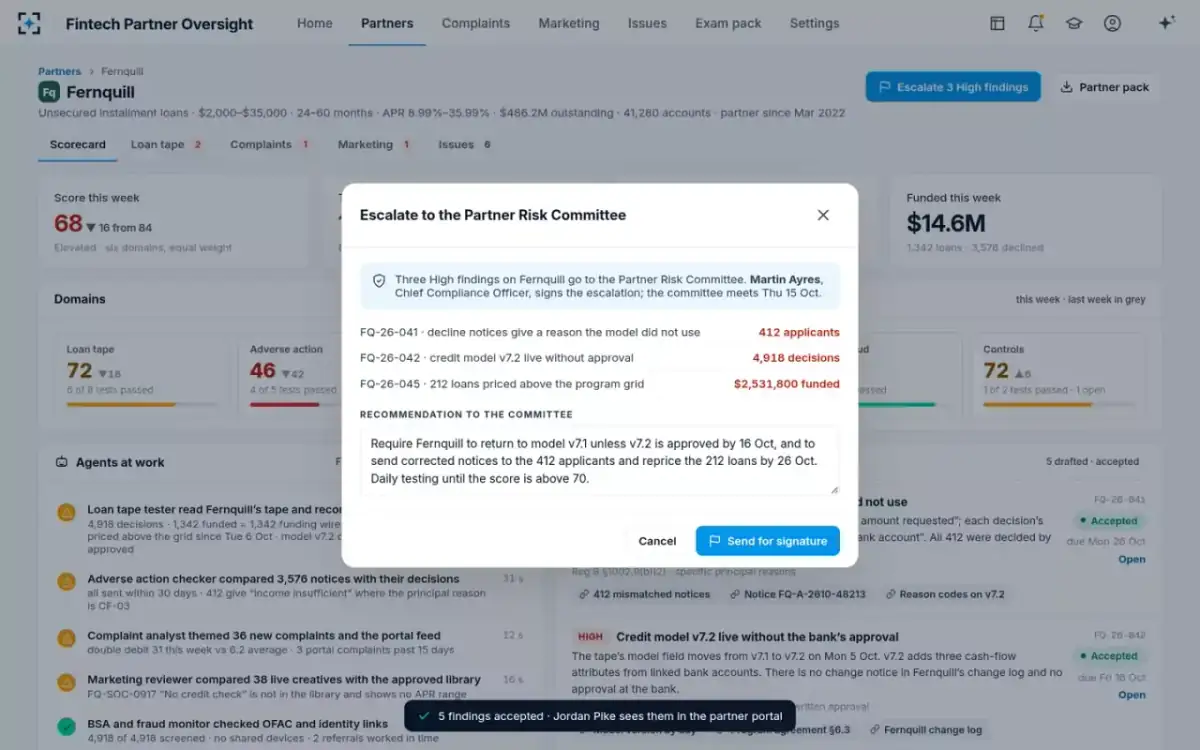
What a signed escalation looks like when a finding is caught early
Questions people ask
What happened to Synapse, the fintech company?
Synapse Financial Technologies, a software bridge between consumer fintech apps and partner banks, filed for Chapter 11 bankruptcy on April 22, 2024. Its partner banks found that Synapse's own records of consumer funds did not match the banks' records, by a shortfall the CFPB later put at $60 to $90 million, which left consumers unable to access their money for weeks or months while the records were reconciled.
What was the Evolve Bank & Trust consent order about?
On June 14, 2024, the Federal Reserve announced a consent order, issued with the Arkansas State Bank Department, against Evolve Bancorp and Evolve Bank & Trust over risk-management, anti-money-laundering and sanctions-screening deficiencies in its fintech-partnership business, found in examinations from August 2023 and January 2024. The order separately required the bank to clearly define and maintain sub-ledger responsibilities with its fintech partners going forward.
Why were Synapse's fintech customers locked out of their money?
Not because the money was necessarily gone, but because the records needed to say exactly how much each customer was owed, and which bank held it, did not agree with each other. Banks could not safely pay out against figures they could not verify, so withdrawals were paused while the banks reconciled their own records against Synapse's.
What is an FBO account?
An FBO, or "for the benefit of," account is a bank account titled in the bank's name but legally held on behalf of other people — in a banking-as-a-service arrangement, the many end users of a fintech partner, pooled into one account. The bank's own books typically show only the pooled total; a separate, detailed record is needed to say which end user owns which share.
Who is responsible when a banking-as-a-service company fails?
The chartered bank holding the deposits remains responsible to its own regulators and, ultimately, to the end users whose money it holds — a technology middleman like Synapse is not itself a regulated depository institution. Synapse itself was pursued by the CFPB under consumer financial law, while the Federal Reserve's 2024 order, based on examinations that predate the bankruptcy, was issued against Evolve, the bank.