Fintech partner oversight software is easy to demo on a vendor's own sample data and hard to trust on a bank's real partners without seeing it run on them. The safest pilot of Fintech Partner Oversight, or any tool like it, never starts on a live week at all. It starts by replaying a quarter the bank has already closed and signed off — the loan tape, the adverse action notices, the complaint log and the ad folder already sitting in a file somewhere — so the bank can compare the tool's findings against what its own quarterly review already concluded, before a single live decision depends on the answer. The screens and figures from the solution on this page are fictional sample data.
What a pilot is checking before anyone trusts a live week
100%
of a replayed quarter’s decisions tested, not a 25–60-loan sample
3–4weeks
for a realistic pilot: replay, shadow, decide
35days
notice the fictional sample bank on this page had before an exam — the scenario a pilot is meant to outrun
Why the first week of a pilot should be a quarter you already closed
How to evaluate fintech partner oversight software starts with a choice most buyers get backwards: run it live first, or replay something already finished. A live week is appealing because it feels real, but its true error count is unknown — nobody can say in advance whether the tool missed anything, because nobody already knows what was there to miss. A closed quarter the bank's own review has already signed off on has the opposite property: the real outcome is already known, so every finding the tool drafts can be checked against what the bank's analysts already concluded, loan by loan, without waiting for anything to happen.
That ordering also protects the bank from the pilot itself becoming a live risk. Nothing in a replay can affect a real partner, a real applicant or a real exam, because the quarter is already closed and the bank's own process already ran its course on it. A pilot that starts live, by contrast, is asking an unproven tool to carry real weight from day one — exactly the risk a validation built around seeded errors and replayed weeks is designed to avoid.
What data a pilot needs: the tape, notices, complaint log and ad folder
A pilot needs the same files a fintech partner already sends for a quarterly review, handed over for the pilot instead. Fintech Partner Oversight works from six categories of file, and a pilot needs at least one closed quarter of each to replay anything meaningful.
What a pilot needs, matched to what the solution already reads
- Partner loan tapes
Every decision and funded loan for the quarter being replayed, in whatever format the partner already sends: CSV, fixed-width or parquet.
- The bank’s own sub-ledger
The funding wires the tape is reconciled against, so the pilot can check funded loans actually match what the bank paid out.
- Adverse action notices
The notice each declined applicant actually received, to compare against the decision’s own reason code.
- Complaint logs and the CFPB portal history
The partner’s own log plus whatever portal complaints the bank already has on file for the quarter.
- Live marketing from that quarter, if archived
Social, search, email and landing-page captures; many banks do not archive these and the pilot can note the gap rather than invent data.
- The program agreement and credit policy
The pricing grid, change-notice clauses and the approved model register the tape is tested against — without this, there is no rule to test to.
A bank that cannot obtain some of this from a partner is not unusual, and it is not a reason to abandon a pilot. The FDIC's own guide for community banks anticipates exactly this: "if the bank cannot obtain desired due diligence information from the third party, the bank may consider alternative information, controls, or monitoring." A pilot missing the ad folder, for instance, can still replay the loan tape and notices in full and simply scope marketing review out of that run, named as a gap rather than papered over.
The pass/fail thresholds to agree before you run anything
Pass/fail criteria are the numbers that decide, in advance, what "it worked" means, and they have to be agreed first because a pilot without them turns into a demo, where any output can be waved at as impressive and any gap can be waved away as a tuning issue. Agreeing the numbers before anyone has seen a result keeps both sides honest about what "it worked" actually means.
Four thresholds worth agreeing before the pilot starts
Recall on seeded errors
≥ 95% per rule family
Measured on a seeded-error test over the replayed quarter, broken out by rule — pricing, notices, MLA, OFAC, marketing — not blended into one number.
False-positive rate
Agreed ceiling, e.g. under 15%
Share of drafted findings on the shadowed live week that a reviewer closes as not-an-issue.
Time to first finding
Within one business day
From when a seeded or real change lands on the tape to when a finding referencing it is drafted.
Coverage
100% of decisions tested
Against the replayed quarter’s full decision count, not a sample drawn from it.
None of these numbers are regulatory requirements; we found no published figure for any of them. They are a starting point a bank can tighten or loosen based on its own risk appetite and what the replayed quarter actually shows. What matters is writing them down before the pilot runs, so a result that falls short is a finding about the tool, not a negotiation about the bar.
Week by week: a realistic pilot timeline
A realistic pilot runs three to four weeks, not the single live week a vendor's sales cycle might prefer. The first two weeks replay a closed quarter in full, measuring recall and coverage against what the bank's own review already knows. The third week shadows one live week in parallel with whatever process the bank already runs, so the tool is seen on something nobody has graded yet. The fourth week is the decision itself, against the thresholds agreed at the start.
A pilot that outruns a 35-day exam notice, week by week
- Replay a closed quarterWeeks 1–2
- Shadow one live weekWeek 3
- DecideWeek 4
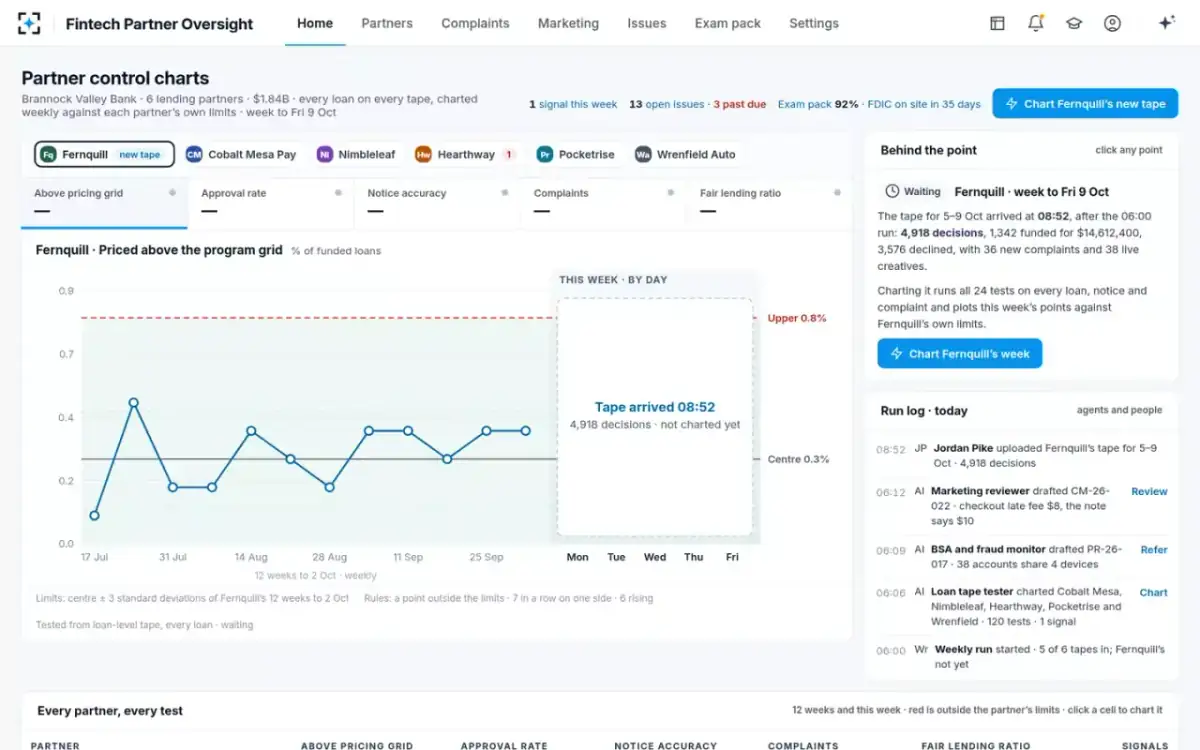
Where a pilot usually starts: a tape that has not arrived yet
What counts as a false positive in a pilot, and who adjudicates it
A false positive in a pilot is a drafted finding that a person, reviewing the evidence behind it, closes as not actually a problem — not a finding the tool merely flagged in a way someone finds annoying. The distinction matters because a tool that drafts a finding on a genuine edge case, correctly described, is working as intended even if a reviewer ultimately decides not to escalate it; that is a judgment call being made by a person, exactly as the design intends, not a false positive.
Who adjudicates it should be named before the pilot starts, and it should be someone who did not build the rule being tested — typically the oversight manager or a model-risk reviewer, not the implementation team. Every adjudication, kept and dated, becomes part of the evidence a later validation or an examiner can ask for, which is also how a false-positive rate becomes a number a bank can defend rather than an impression someone had.
How a pilot compares with your current quarterly review, side by side
Proof of concept for AI compliance monitoring is most convincing when it is run next to the thing it would replace, not instead of it. Running the replay against the same quarter the bank's own quarterly review already covered gives a side-by-side a vendor demo cannot.
The pilot's replayed quarter against the quarterly review it would replace
The quarterly review, as run: 25–60 loans sampled from the whole quarter.
The pilot’s replay, same quarter: Every decision on the quarter’s tape, tested against the same rules.
The quarterly review, as run: Whatever the sample happened to contain.
The pilot’s replay, same quarter: Every row that fails a rule, compared against what the sample already caught.
The quarterly review, as run: About thirteen staff-days, mostly collecting and sampling.
The pilot’s replay, same quarter: The replay itself runs in minutes; the days are spent reviewing what it drafted.
The quarterly review, as run: Unknown by construction — the loans not drawn are never checked.
The pilot’s replay, same quarter: Whatever lies outside the rules it was given to test, named rather than hidden.
Where the replay finds something the quarterly sample did not, that gap is the pilot's most persuasive evidence — and where the replay finds nothing the sample did not already know, that is useful too, because it tells a bank the partner's tape for that quarter was genuinely clean rather than merely under-tested.
What happens if a pilot misses a threshold?
A missed threshold is a finding, not a failure of the pilot itself — the pilot did its job either way, which is to show the tool's real performance before a live week depends on it. What happens next depends on which threshold, and why.
After the pilot: what each outcome leads to
A person decides
Model-risk and oversight leadsCompare the replayed quarter’s and shadow week’s results against the thresholds agreed before the pilot started.
A person decides
Thresholds metGo live on a weekly cadence, starting with the partners already replayed; keep the quarterly process running for one more cycle as a check.
A person decides
A threshold missedName which one, and why: a rule that was too strict for this partner, a file that was missing, or a genuine gap worth fixing before more weeks run on it.
A missed recall threshold on one rule family, such as the OFAC name-matching example a seeded test tends to surface, usually points to a threshold that needs tightening rather than a tool that cannot do the job; a missed coverage threshold, where some decisions on the tape were never tested at all, points to a data or integration gap worth fixing before any week runs live on it. Treating every miss the same way — as proof the pilot failed — throws away the specific, fixable information the pilot was built to surface.
What to ask for in writing before you commit to a partner's data
Handing over a real partner's loan tape, even a closed quarter's worth, is a decision with its own due-diligence trail, because a pilot vendor is itself a third party. The interagency guidance applies to every third-party relationship, not only lending partners: "Conducting due diligence on third parties before selecting and entering into third-party relationships is an important part of sound risk management," and "understanding potential information security implications, including access to a banking organization's systems and information, can help a banking organization decide whether or not to engage with a third party."
Before committing a partner's data to any pilot, in writing: what happens to the data once the pilot ends, who at the vendor can see it, whether it leaves the bank's own environment at all, and what the thresholds above actually mean contractually if the bank decides to proceed. Among the contract terms the same guidance suggests where non-public information is involved are provisions that "provide for the timely return or destruction of the banking organization's data, information, and other resources" — the clause a pilot agreement most often leaves out.
What the oversight team owns once a pilot becomes a go-live
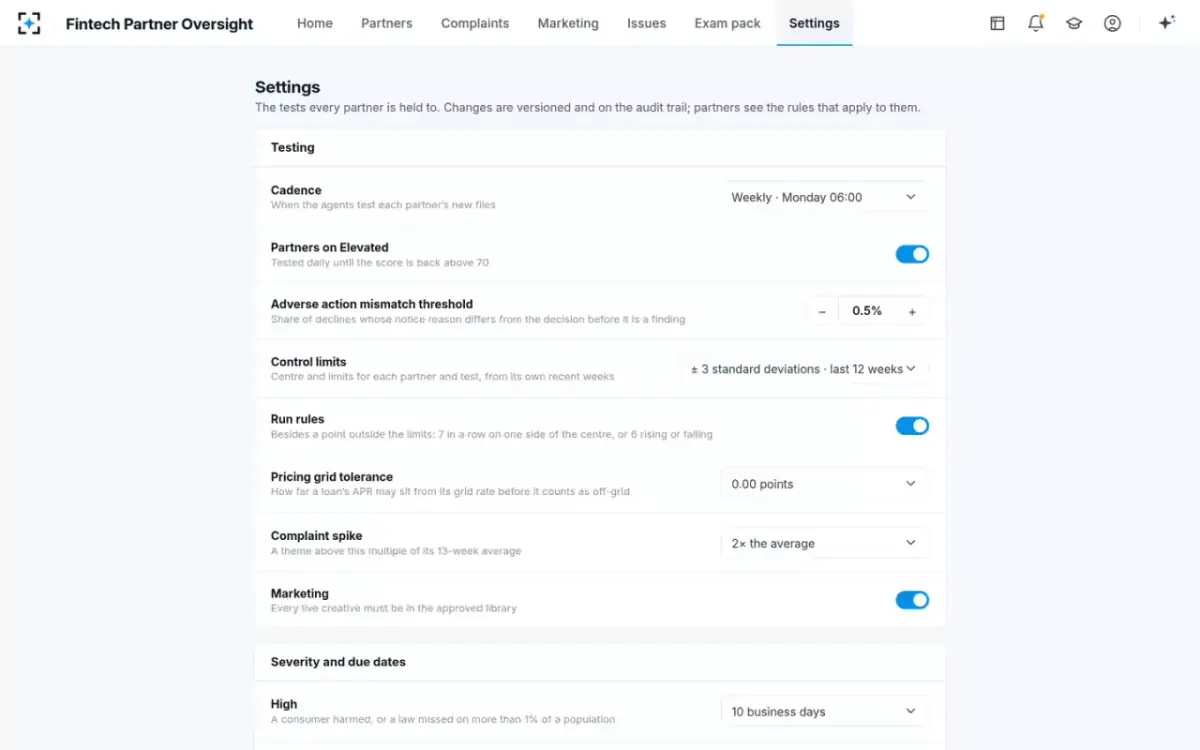
The real cost of the quarterly review a pilot is measured against is the honest baseline every threshold above should be read next to: a pilot that merely matches the quarterly sample's coverage at a lower cost is a different result from one that catches what the sample structurally could not, and the thresholds agreed up front are what tell a bank which one it actually got.
Questions people ask
How do I evaluate fintech partner oversight software before buying it?
Run a pilot that replays a quarter the bank has already closed, against pass/fail thresholds agreed in writing before the pilot starts: recall on seeded errors by rule family, a false-positive rate measured on a shadowed live week, time to first finding, and full coverage of the quarter's decisions.
What data do I need to pilot compliance monitoring software?
A closed quarter's loan tape, the bank's own sub-ledger, the adverse action notices sent on every decline, the complaint log and any CFPB portal history, archived marketing if the bank has it, and the program agreement and credit policy the tape is tested against.
How long does a fintech partner oversight software pilot take?
A realistic pilot runs three to four weeks: two replaying a closed quarter, one shadowing a live week in parallel with the bank's current process, and one deciding against the thresholds agreed at the start.
What are pass/fail thresholds for a compliance monitoring pilot?
Numbers agreed before the pilot runs, not after: typically recall on a seeded-error test by rule family, an acceptable false-positive rate, how quickly a finding is drafted after a change, and what share of decisions get tested at all. None are regulatory requirements; a bank sets its own based on its risk appetite.
How do I replay closed files through new compliance software?
Hand over one or more closed quarters' loan tapes, notices, complaint logs and program documents, agree the thresholds first, and compare what the tool finds against what the bank's own quarterly review already concluded on the same files — never against an unproven live week.