How do you validate AI for compliance monitoring before a sponsor bank's model-risk function will sign off on it? Not by asking whether it is right every time — no test proves that — but by measuring whether it finds the errors a human review would find, and how many more it finds beyond them. Botminds' Fintech Partner Oversight tests every decision on a fintech partner's weekly loan tape against the program's own rules, in place of the few dozen loans a manual quarterly review can draw from a whole quarter (we assume 25 to 60 throughout these guides). A validation lead's job is to prove that claim on the bank's own files before a single live week depends on it.
The examples on this page come from a fictional sample bank's data as it runs through the solution: Brannock Valley Bank, its fintech partner Fernquill, and the loans and findings on Fernquill's tape for 5–9 October. The regulatory and research figures are linked where they appear.
What one partner's tape looks like next to the sample a review actually draws
4,918
decisions on one partner’s weekly tape, tested against 24 rules
25–60
loans a quarterly review samples from the whole quarter, by hand
212
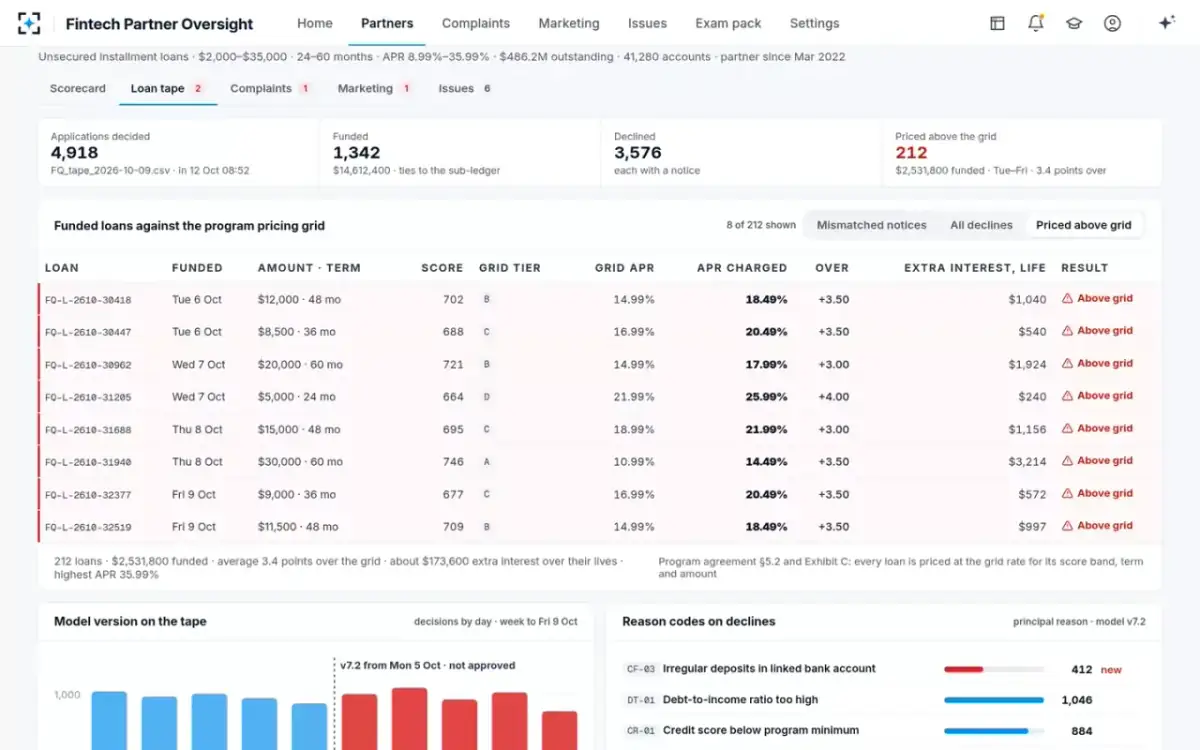
loans priced above the program grid, found only because every one was tested
What a quarterly sample of 25 to 60 loans can and cannot show
A sample proves that the loans it drew were handled correctly, or that they were not. It says very little about the loans it did not draw. A quarterly review that samples 40 loans from a partner's quarter is testing about six-hundredths of one percent of the roughly 64,000 decisions a partner like Fernquill makes in thirteen weeks, if it decides close to 4,900 applications a week. The sample is not wrong to exist — it is the most a team of two analysts can test by hand in the days a quarterly cycle allows — but it answers a narrower question than "is the partner compliant." It answers "were these particular forty loans compliant."
A 25-to-60-loan sample against a 4,918-decision tape, the same week
A quarterly sample: 25–60 loans, hand-picked or randomly drawn from roughly thirteen weeks of decisions.
Fintech Partner Oversight, full tape: All 4,918 decisions on the week’s tape: every funded loan, every decline, every notice.
A quarterly sample: A pricing error that ran for four days of one week has about a three-in-five chance of touching none of 40 loans sampled from the quarter.
Fintech Partner Oversight, full tape: Every funded loan is checked against the program grid; 212 loans priced above it are caught the week it starts.
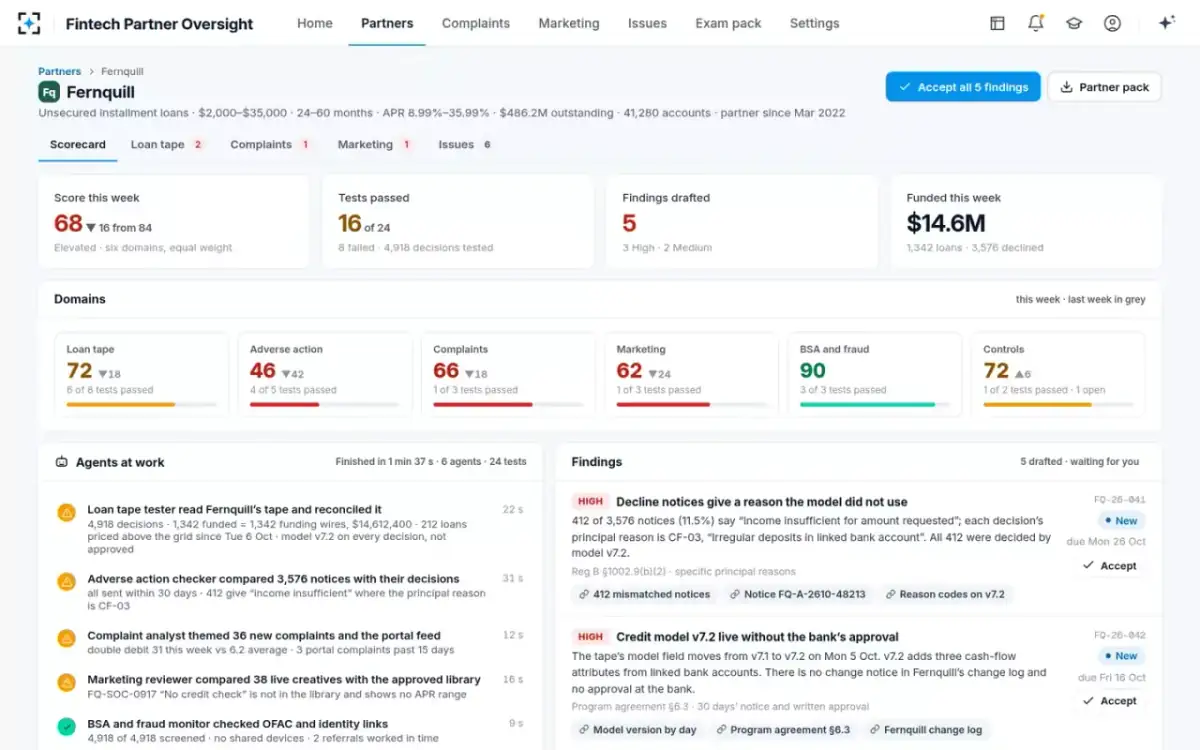
A quarterly sample: A notice-reason mismatch on 412 of one week’s 3,576 declines is 11.5% of that week but under 1% of the quarter; 40 notices sampled from the quarter have about a 70% chance of missing all of them.
Fintech Partner Oversight, full tape: All 3,576 notices are compared with the decision that produced them; the share correct is exact, not estimated.
A quarterly sample: The sampled loans were fine. More than 99.9% of the quarter’s decisions are unknown.
Fintech Partner Oversight, full tape: Every tested loan passed or failed a named rule, with the row that proves it.
The arithmetic is worth doing once. If Fernquill funds around 1,340 loans a week, a calendar quarter of thirteen weeks moves roughly 17,400 funded loans across its tape. The 212 loans priced above the grid were all funded inside one four-day window, about 1.2% of the quarter. The chance that a random 40-loan sample contains none of them is (1 − 212 ÷ 17,400) raised to the 40th power, which is about 0.61 by our arithmetic. The notices work the same way: 412 mismatches among roughly 46,500 declines in the quarter give a 40-notice sample about a 70% chance of missing every one. A review is more likely than not to miss both problems, and to report a clean quarter.
Why "accurate" means something different for a sample and a full population
Asked to validate AI for compliance monitoring, the easy question to ask is "how accurate is it," and the easy mistake is to answer it the way a sample would: against a handful of known-good and known-bad loans, the way a test bank validates a credit model against a holdout set. A tool that tests every loan on a tape does not need to generalize from a sample to a population, because it is not sampling — it already covers the population. Its accuracy question is different: for each of the rules it runs — the pricing grid, the Military Lending Act cap, the notice-reason match, the OFAC screen — does it apply the rule correctly to every row, and does it flag every row the rule actually catches?
That reframes what a validation lead is actually checking. It is not "would this tool have approved the loans I would have approved," a question a credit model answers. It is "does this tool correctly apply the rule I already wrote, to every row, every time," a question closer to auditing a calculator than judging a judgment. The two kinds of accuracy call for two different tests, and conflating them is the most common way a validation goes soft: a reviewer satisfied that the tool "looks right" on a handful of loans has not yet shown that it is right on the 4,918th.
How to build a seeded-error test from your own closed partner files
The sturdiest validation never needs a live week. It starts from a quarter the bank has already closed and signed off, where the real outcome on every loan is already known, and deliberately breaks a known number of rows in known ways before handing the file to the tool. If the tool finds every seeded error and nothing it should not, the bank has evidence it would not get from watching a live week go by, because a live week's true error count is never known in advance.
A seeded-error test, start to finish
A person decides
Model-risk leadTakes a closed quarter’s tape, already reviewed and signed off, and plants a known set of errors into copies of real rows: a pricing miss, a notice with the wrong reason code, an MLA breach, an unscreened name, an unapproved ad claim.
Agent
The oversight toolRuns its full set of tests over the seeded tape exactly as it would on a live week, with no indication which rows were altered.
A person decides
Model-risk leadChecks the tool’s findings against the seed list: every seeded error it caught is a hit; every one it missed is scored against the type of error, not averaged away.
What goes into the seed list matters more than how many rows it touches. A useful set spans every rule family the tool runs, not just the ones a reviewer expects to fail: a loan priced above the grid, a decline whose notice carries the wrong reason code, a loan whose annual percentage rate crosses the Military Lending Act's 36% cap for a covered borrower, an application that should have tripped an OFAC name match, an advertisement with a claim the file cannot support. Each seeded error should also vary in how hard it is to find — an obvious grid breach next to a one-basis-point miss — so the test measures sensitivity, not just whether the tool can spot the easy cases.
Recall by error type on one seeded test: 45 seeded, 44 found
The miss is the most valuable row in that chart, not the hits. A seeded test that finds every error it planted and stops there has proven the tool can find what it was told to look for; it has not proven where the tool's edge is. The one OFAC gap the tool missed told the validation team exactly how close a name has to be before the match fails, which is the kind of finding a live week would have surfaced only by accident, if a real sanctioned name happened to be that close.
What the NIST AI Risk Management Framework asks you to measure
A validation lead does not have to invent the shape of this exercise from nothing. The NIST AI Risk Management Framework, published in January 2023, organizes the work of managing an AI system's risk into four functions — Govern, Map, Measure and Manage — and the seeded-error test sits squarely inside Measure: the function concerned with testing, evaluating and tracking a system's behavior against its intended use, on an ongoing basis rather than once at launch.
The NIST AI RMF's four functions, mapped to evidence a loan-tape tool can produce
Govern
Who owns the tool's rules, who can change a threshold, and who signs off before a change goes live — the settings a bank can show an examiner, not a vendor's internal process.
Map
What the tool is for: testing a defined set of rules against a defined partner's tape, not a general claim about "catching compliance problems."
Measure
The seeded-error test and its recall by rule family, repeated whenever a rule or a partner's program changes, not only at go-live.
Manage
What happens when Measure finds a gap: the OFAC threshold tightened, the fix re-tested, and the date it changed kept on file.
The framework does not set a numeric bar for how high recall must be, and neither does any banking regulator we found. It asks an institution to measure, document and manage the risk on its own judgment of what the activity needs — which, for a fintech partner that decides several thousand loans a week, is a different bar than for a tool that drafts marketing copy.
What a 100% test still cannot catch
Testing every row against a rule is not the same as writing the right rule. Every loan on the tape can pass the pricing-grid test and still be priced on a model the bank never approved, if the grid itself was built around that model's outputs. In the sample scenario on this page, the 212 loans above the grid were caught because the grid's limits had not moved when the partner's pricing model changed from version 7.1 to 7.2 — the test caught a model it was not built to catch, by catching the gap the model opened between its own output and a grid that had not been re-approved. A rule that is wrong, stale or too narrow produces a 100% pass rate on every row it was never built to flag.
The same ceiling applies to anything the tape does not contain. A loan tape tester cannot see a side letter the partner never disclosed, or a verbal change to underwriting that never reached a file. Full-population testing removes sampling risk — the chance that the loans drawn happened to be the clean ones — but it does not remove scope risk, the chance that the rule set itself has a hole. The division of labor across the six agents that run these tests is written around that limit: every agent tests against a rule a person wrote and can change, and a person still owns deciding whether the rule set is complete.
How many of your own weeks should a pilot replay before you trust it?
A seeded test proves the tool can find errors it was told exist. A replay of several real, already-closed weeks proves something a seed list cannot: that the tool's findings on messy, real data match what the bank's own review already concluded, loan by loan, without anyone having planted anything. We suggest three to four weeks spanning at least one quarter boundary: enough to see a partner's ordinary variation — a slow week, a marketing push, a notice template that changed mid-quarter — without turning the exercise into a second quarterly review.
The replay and the seeded test answer different questions and both are worth running. The seeded test measures recall against a known answer key; the replay measures whether the tool's findings on unseeded, real weeks make sense to the people who already know those weeks. A tool that performs well on one and poorly on the other is telling a validation team something specific: strong seeded recall with a replay full of findings nobody recognizes points to a rule that is too strict for how this partner actually operates; weak seeded recall with a clean replay points to error types the real weeks never happened to contain.
What a false positive costs, and how to measure your own rate
Every finding a tool drafts costs someone time to review, even the ones that turn out to be nothing. A false-positive rate is not a vendor's number to quote; it is measured by running a stretch of weeks and counting how many drafted findings a reviewer closes as not-an-issue against how many it accepts or escalates. A seeded test gives one side of that rate for free — any finding not on the seed list, raised against a seeded tape, is by definition a false positive on that run — but the honest number comes from live or replayed weeks, where the tape was never altered to make a finding obviously wrong.
What a validation report should contain before sign-off
- The seeded-error test, by rule family
What was planted, what was found, and what was missed and why — not a single blended recall number.
- A replay of several real, already-closed weeks
Findings compared against what the bank’s own review already knew about those weeks.
- A measured false-positive rate
From the replay, not the seeded test alone, since a seeded tape cannot produce a false positive the same way a live one can.
- Every rule’s owner and change history
Who can move a threshold, and the date and reason for every change made during validation.
- What the tool cannot see
Named limits: undisclosed side letters, verbal underwriting changes, anything the tape itself does not carry.
- The sign-off itself
Named, dated, and tied to the evidence above — not a vendor’s demonstration.
Behind one flagged point: the 212 loans, loan by loan
Who should sign off on the validation, and what evidence they need
The sign-off belongs to whoever owns model risk at the bank, not to the team that wanted the tool approved, and the evidence it needs is the same whether the tool is bought or built: the seeded-error test by rule family, a replay of real weeks against known outcomes, a measured false-positive rate, and a named owner for every rule the tool runs. The pilot that runs this on a bank's own tapes is where that evidence is produced, before a single live week of oversight depends on the answer. None of it is a one-time exercise: a rule that changes, a partner that changes its own model, or a program amendment is a reason to run the seeded test again, which is what keeps Measure a function and not an event.
What the validation is checking against: a scorecard with its evidence attached
Questions people ask
How accurate does fintech oversight software need to be?
There is no published regulatory figure. The useful target is not a single accuracy number but recall measured by rule family on a seeded test, a false-positive rate measured on real replayed weeks, and a named process for raising either when a gap is found — exactly what the NIST AI Risk Management Framework's Measure function asks an institution to track on its own judgment.
What is sampling risk in compliance testing?
Sampling risk is the chance that the loans a review happened to draw do not represent the loans it did not draw. A quarterly sample of 25 to 60 loans from a partner deciding several thousand applications a week carries meaningful sampling risk by construction; testing every decision removes it, though it does not remove the risk that a rule itself is wrong or too narrow.
How many loans should a quarterly review sample?
No regulator sets a number. These guides assume 25 to 60 loans per quarter, our estimate of what two analysts can test by hand in the days a quarterly cycle allows. That is a practical limit on hand review, not a statistically derived figure for the risk being managed; the arithmetic above shows how easily a sample that size misses a problem confined to one week.
What is the NIST AI Risk Management Framework?
A voluntary framework published by the National Institute of Standards and Technology in January 2023, organizing the work of managing an AI system's risk into four functions: Govern, Map, Measure and Manage. A seeded-error test and a measured false-positive rate are evidence for the Measure function specifically.
Can AI miss a compliance problem a human reviewer would catch?
Yes, if the problem lies outside what the tool's rules are built to test — an undisclosed side letter or a verbal change to underwriting that never reached the tape, for instance. A seeded-error test cannot rule this out either; it can only prove the tool correctly applies the rules it was given, to every row it was given them on.
What does 100% testing actually test?
Every row on the tape against every rule the tool runs — not every possible way a partner's program could go wrong. A 100% pass rate means no row failed a given rule; it says nothing about a rule that is stale, too narrow, or missing entirely, which is why the rule set itself, not only the test rate, belongs in a validation.