AI vendor risk management — using AI to oversee the third parties a bank depends on, here its fintech lending partners — starts with a sharper question than "is the AI accurate": what, specifically, is the software never allowed to do on its own? The work is hard because a partner can decide thousands of applications a week under the bank's charter, and every one is the bank's to answer for. Botminds' Fintech Partner Oversight answers with six agents, each reading one kind of file a fintech partner sends every week — the loan tape, the adverse action notices, the complaint log, live marketing, OFAC screening, and the findings themselves — and each one is built around an explicit limit on what it may never do. No agent edits a partner's data or a decision, approves a creative, answers or closes a complaint, or files a Suspicious Activity Report. What they do instead is test, reconcile and draft, every week, so a person spends the time judging rather than collecting.
The examples on this page come from a fictional sample bank's data as it runs through the solution: Brannock Valley Bank, its fintech partner Fernquill, and the agents' run on Fernquill's tape for 5–9 October.
What six agents covered in one run
4,918
decisions tested against 24 rules on one partner’s weekly tape
1min 37s
for all six agents to test the week and draft five findings
5
findings drafted; none accepted, closed or escalated by an agent
Six agents, one file type each: what the division of labor actually is
"Can AI monitor fintech partners" is usually asked as if the answer is one piece of software doing one job. In Fintech Partner Oversight it is six: a loan tape tester, an adverse action checker, a complaint analyst, a marketing reviewer, a BSA and fraud monitor, and an oversight reporter. Each reads one file type a fintech partner already sends — the loan tape, the notices, the complaint log, the live ads, the screening results — and tests it against rules the bank wrote, not rules the software invented. None of the six reads another's file; the division is by document, the same way a human desk would split the work across analysts if it had the headcount to test every row.
Six agents, one forbidden action each
Loan tape tester
ReadsEvery funded loan and decision on the weekly tape
NeverEdit a partner’s data or a decision
Adverse action checker
ReadsEvery decline’s reason code against the notice sent
NeverDecide a reason is lawful
Complaint analyst
ReadsPartner complaint logs and the CFPB portal feed
NeverAnswer or close a complaint
Marketing reviewer
ReadsLive ads, emails, checkout and landing pages
NeverApprove a creative
BSA and fraud monitor
ReadsOFAC screening coverage, identity and device links
NeverFile a Suspicious Activity Report
Oversight reporter
ReadsEvery failed test across the week
NeverAccept, close or escalate a finding
That design answers a question a vendor's marketing rarely does: not can the AI find a problem, but which problems is each piece of it even looking for. A buyer who understands this division can ask a sharper second question of any oversight tool — what are your six agents, and what can I see that each one is forbidden from doing — rather than accepting "the AI handles compliance" as an answer.
What the loan tape tester checks, and what it never decides
The loan tape tester reads every funded loan and decision on a partner's weekly tape and reconciles funded loans to the bank's own sub-ledger before testing each one against the program's pricing grid, rate caps including the Military Lending Act's 36% MAPR, state limits, fees, score and debt-to-income cutoffs, and the model version against the bank's approved list. On the sample week, it found 212 loans priced above Fernquill's program grid, all decided under credit model v7.2, a version not on the bank's approved list.
What it never does is edit a partner's data or a decision, or decide on its own that an exception is acceptable. It reports every row that fails a test, with the loan behind it, and leaves the judgment — is this a true miss, is it material, does it need a remediation deadline — to a person. The validation that proves it finds the rows it should runs this agent's output against a known answer key before any bank should trust it on a live week.
What the adverse action checker flags, and why it never rules on lawfulness
The adverse action checker compares every decline's principal reason code against the notice the applicant actually received, and checks the 30-day timing, the number of reasons given and the credit score disclosure. Regulation B is specific about what that notice must contain: the statement of reasons "must be specific and indicate the principal reason(s) for the adverse action" (12 CFR §1002.9(b)(2)), and a notice that gives a reason the decision did not actually turn on fails that standard regardless of whether the applicant was correctly declined.
The checker's job stops at the comparison. It never decides that a mismatched reason is lawful, or that it is not — only that the code on the decision and the words on the notice disagree. On the sample week, 412 of 3,576 declines carried a notice reason that did not match the model's actual principal reason, all decided by the same unapproved model version, v7.2. Whether that is a reportable violation, and what remediation it needs, is a decision the checker hands to a person, every time.
What the BSA and fraud monitor refers, and why it never files
Can an AI agent file a Suspicious Activity Report? In this solution, no, by design. The BSA and fraud monitor checks OFAC screening coverage on every application, and looks for identity and device links across accounts that suggest one person or ring behind many applications. What it produces is a referral — the accounts, the shared devices, the screening gap — handed to the bank's BSA officer, who is the only person in the process who can decide whether a filing is warranted.
That split is not a software limitation waiting to be lifted; it follows the rule. FinCEN's regulation requires a bank to file when it "knows, suspects, or has reason to suspect" that a transaction meets one of the rule's tests, so the filing is a judgment the bank makes through its BSA officer, informed by evidence, not a mechanical output of a test passing or failing (31 CFR 1020.320). The monitor's role is to make sure the evidence — which accounts, which devices, how fast referrals are worked — is in front of the BSA officer before a pattern gets old, not to make the call itself.
What the oversight reporter drafts, and why it never accepts or closes
Every failed test, across all five other agents, becomes the oversight reporter's input. It turns each one into a finding with a severity, the rule it broke, the evidence behind it, and a proposed owner and due date, then drafts the documents a bank actually has to produce: the partner scorecard, a remediation request, the examiner pack, the board report. On the sample week it drafted five findings — three High, two Medium — in the same run that tested the tape.
Five findings drafted, none of them accepted yet
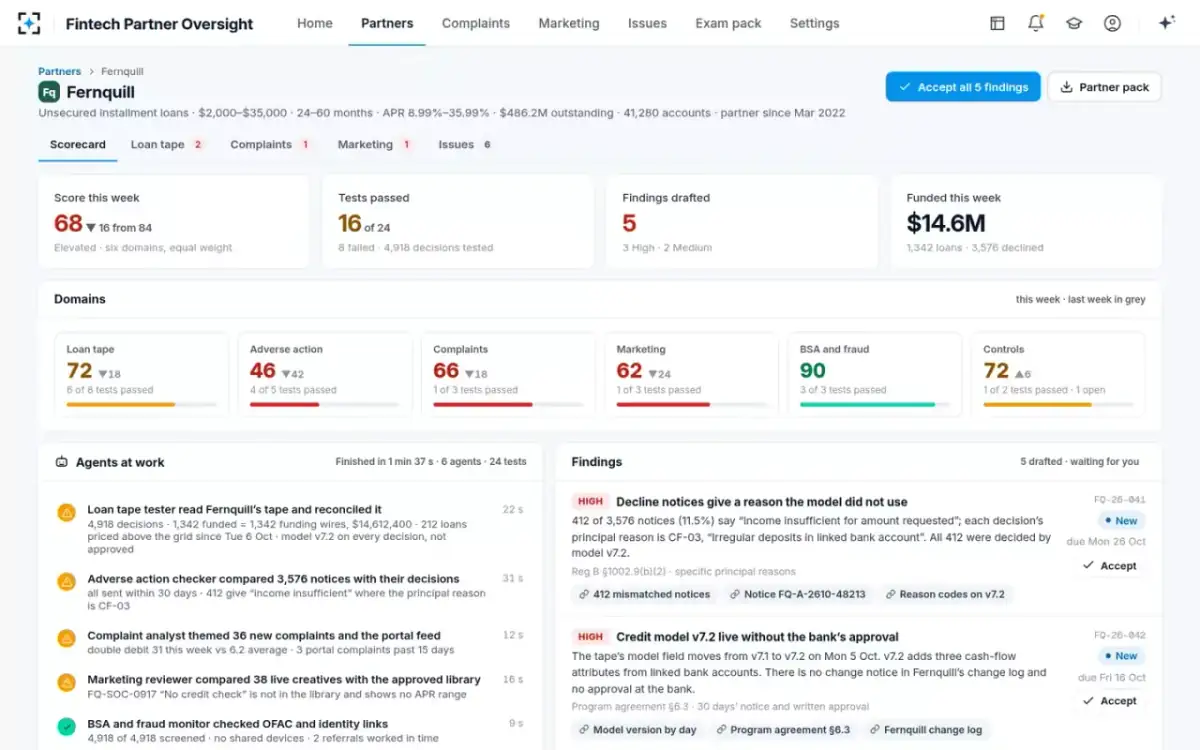
The reporter never accepts, closes or escalates what it drafts, and it never sets its own severity scale — that comes from the bank's own settings, versioned and visible to the oversight team. A drafted finding sits exactly where the checklist shows it in the screenshot above: waiting. The oversight manager's acceptance is the step that turns a draft into an actual finding on the record, and only the Chief Compliance Officer's signature sends a High finding to the Partner Risk Committee.
Why a chat assistant cannot do this job
AI agents versus a chatbot for compliance monitoring is a real distinction, not a marketing one. A chat assistant answers a question when asked and forgets the context when the conversation ends; it has no standing job to re-test 4,918 decisions every Monday at 06:00, no memory of what it found last week to compare against, and no limit baked into its design about what it may never do, because it was never built around a specific file type and a specific forbidden action. Each of the six agents in Fintech Partner Oversight runs on a schedule, against one file type, with one never, and produces the same evidence every time it runs — properties a general chat interface does not have unless something is built underneath it to enforce them.
That is also the practical answer to "can AI monitor fintech partners": only if the AI is structured around the files a partner actually sends and the specific tests a program requires. A model answering open-ended questions about a partner's compliance, without a defined loan tape tester or a defined adverse action checker behind it, is not running the tests a quarterly review runs today — it is guessing at what they might have found.
There is also a narrower, practical reason a general chat interface struggles here: consistency across thousands of rows. Asked the same question about the same loan twice, a model answering freely can phrase its reasoning differently each time, and on a borderline row that drift is exactly what a tested-rule approach is built to avoid. Each of the six agents applies the same named rule to every row the same way, which is what lets a finding be traced back to a specific test rather than to a specific answer the model happened to give that day.
What a person must do before any finding becomes an escalation
Six agents produce drafts; every step that turns a draft into an action belongs to a named person. This is maker-checker applied to AI: the agent makes the finding, and a person checks it before anything happens because of it. The oversight manager accepts or rejects each drafted finding with its evidence in front of her. A High finding — consumer harm, or a change the partner made without approval — goes to the Chief Compliance Officer, who signs the escalation before it reaches the Partner Risk Committee. Fraud and OFAC referrals go to the BSA officer, who decides on any filing alone. A remediation request only reaches the partner once a person has accepted the findings behind it.
What an agent proposes, and what the oversight manager actually decides
An agent proposes: 212 loans flagged, with score, grid tier and extra interest shown for each.
A person decides: Whether it is material, who is told, and the deadline for repricing and refunding.
An agent proposes: 412 notices flagged against the decision that produced them.
A person decides: Whether it is a reportable violation, and the remediation it requires.
An agent proposes: Accounts linked by shared devices, with the pattern described.
A person decides: Whether it meets the bar for a Suspicious Activity Report, decided by the BSA officer alone.
An agent proposes: Scored against the bank’s own rules, drafted into a finding.
A person decides: Accepted, assigned, escalated or closed — and signed, if it goes to the committee.
The right-hand column is also what an examiner eventually asks about. An exam does not stop at "the software found 212 loans" — it asks who at the bank saw that finding, what they decided, and when. A row that shows only the agent's output, with no decision recorded next to it, answers the first question and leaves the second one open; the oversight manager's acceptance, the date and the action taken are what close that gap on an examiner's own request list.
How these limits compare with a human analyst's own limits today
A human compliance analyst already works inside limits that look similar on paper: an analyst who samples a partner's loans does not unilaterally decide a mismatched notice is fine, and does not file a Suspicious Activity Report without a BSA officer's sign-off either. The interagency guidance on third-party relationships expects a bank to dedicate "sufficient staffing with the necessary expertise, authority, and accountability to perform a range of ongoing monitoring activities" — language written for people, not software, and the six agents' limits are built to sit inside that same structure rather than replace it.
What changes is not who holds the authority but how much gets tested before a person is asked to use it. A human analyst's limits are enforced by a reporting line and a policy document; an agent's limits are enforced by what it was built to do and nothing else — it has no path to closing a complaint even if someone wanted it to. The real cost of the quarterly review these agents replace is largely the hours spent collecting and sampling, which is exactly the part six agents take on, leaving the deciding to the people who already held it.
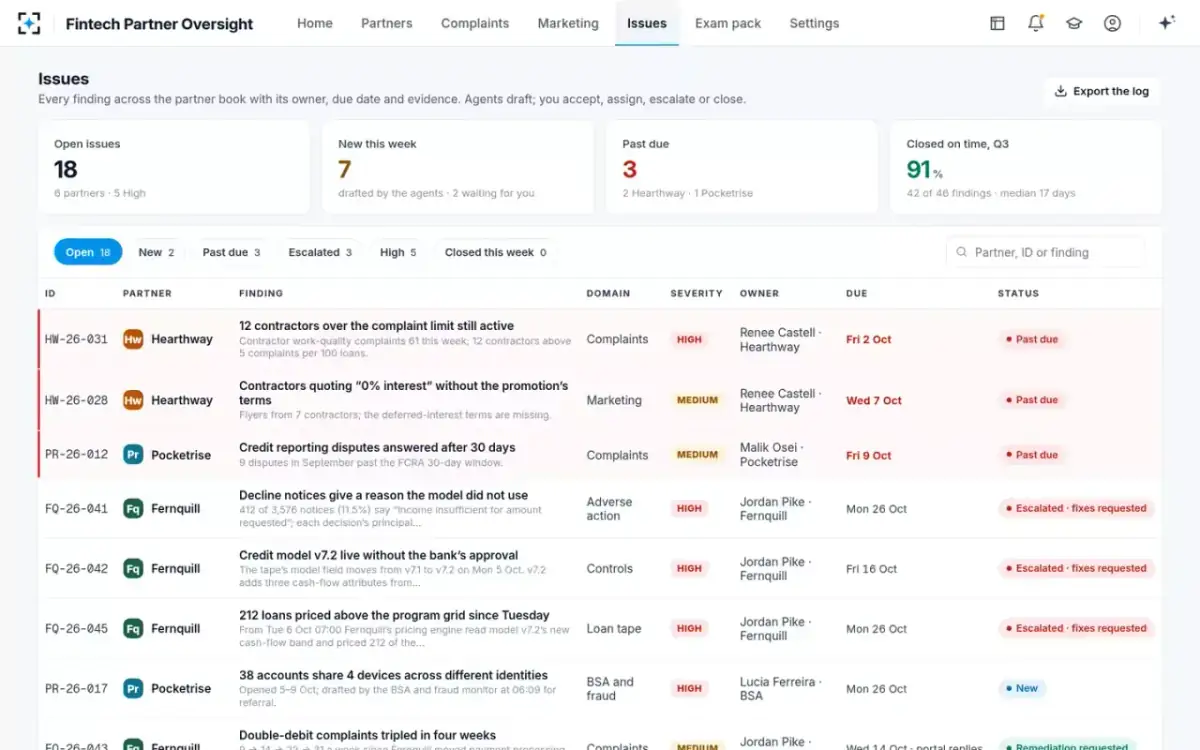
Every finding on the partner book, before anyone has acted on it
Questions people ask
Can AI monitor fintech partners on its own, with no human review?
Not in this design, and regulators would not expect it to. Six agents test every file a partner sends, but every one stops at a drafted finding; acceptance, escalation, closing and any Suspicious Activity Report filing belong to a named person at the bank.
What can AI agents not do in compliance monitoring?
In Fintech Partner Oversight, specifically: edit a partner's data or a decision, approve a marketing creative, answer or close a complaint, decide a mismatched notice reason is lawful, or file a Suspicious Activity Report. Each limit belongs to one agent and is enforced by what that agent was built to do.
Who signs off on AI compliance findings?
The partner oversight manager accepts, assigns or closes each drafted finding. A High finding on consumer harm or an unapproved partner change goes to the Chief Compliance Officer, who signs the escalation before the Partner Risk Committee sees it.
Can an AI agent file a Suspicious Activity Report?
No. The BSA and fraud monitor refers accounts, device links and screening gaps to the bank's BSA officer, who decides on any filing. The decision to file is a judgment about intent and risk that the law places with a person, not a mechanical test result.
What does "maker-checker" mean in AI compliance monitoring?
One party makes a finding or a decision; a different party checks it before it takes effect. Here, an agent makes every finding; a named person — the oversight manager, the Chief Compliance Officer, or the BSA officer, depending on what the finding is — checks and decides before anything happens because of it.