A sponsor bank is the chartered bank that actually originates a fintech's loans. Not funds them, not licenses a brand to them — originates them, under its own charter, so that every underwriting decision, adverse action notice, complaint response and advertisement the fintech produces is legally the bank's own act, reviewed by the bank's own examiners as if the bank's own staff had done the work. The fintech supplies the app, the model and the customer relationship; the bank supplies the one thing a fintech cannot get any other way — the legal standing to lend.
That structure is the reason a piece of software like Botminds' Fintech Partner Oversight exists at all: a bank that answers for a partner's loans has to be able to show, every week, that it tested them. The working example below follows Brannock Valley Bank, a fictional sponsor bank with six fintech lending partners and $1.84 billion outstanding, through one week of that testing.
What is a sponsor bank, in one paragraph?
A sponsor bank is a chartered, FDIC-insured depository institution that originates loans on behalf of a fintech company's lending program, so the fintech can offer credit without becoming a licensed lender in every state it operates in. The loan is made in the bank's name, funded with the bank's money at the moment of origination, and often sold to the fintech or an investor soon after, on terms the program agreement sets. What never transfers is responsibility: the bank's examiners hold it accountable for the underwriting, the notices, the marketing and the complaint handling of a product it may never have designed and rarely touches day to day.
A sponsor bank, defined
- Who originates the loan
- The sponsor bank, under its own charter — the fintech is not a lender of record
- Who holds the examiner relationship
- The sponsor bank; its examiners review the fintech’s underwriting, notices, complaints and ads as the bank’s own
- What the fintech brings instead
- The app, the underwriting model, the servicing experience and the customer relationship
- What the fintech cannot bring
- A charter, deposit insurance, or the legal standing to make the loan itself
Why a fintech needs a chartered bank behind every loan
Lending is a licensed activity in nearly every U.S. state, and the licenses, rate caps and disclosure rules differ state by state. A chartered bank, by contrast, can generally export the interest-rate terms of its home state nationwide. For a state-chartered, FDIC-insured bank the authority is section 27 of the Federal Deposit Insurance Act, which lets it charge interest "at the rate allowed by the laws of the State, territory, or district where the bank is located" (or a federal alternative, whichever is greater), wherever the borrower lives; national banks have the equivalent under the National Bank Act. The bank also does not need a separate consumer-lending license in each state it reaches. A fintech that partners with a bank inherits that reach without becoming a bank itself — it never holds a charter, never carries deposit insurance, and never gets the legal standing to lend directly in states where it has no license of its own.
What researchers call this category is broader than any one deal: the National Bureau of Economic Research's review of the field defines “FinTech lending – the provision of credit facilitated by technology that improves the customer-lender interaction or lenders' screening and monitoring of borrowers” (Berg, Fuster and Puri, NBER Working Paper 29421). A sponsor bank relationship is one specific legal form that definition takes: the technology sits with the fintech, the credit itself sits with the bank.
What "banking as a service" actually means for a bank's examiners
“Banking as a service” is the industry's marketing phrase for the arrangement; a bank examiner reads it differently. To an examiner, banking as a service does not describe a product category — it describes a bank that has outsourced the origination and often the servicing of a loan program to a third party, while keeping the legal and regulatory responsibility entirely in house. The FDIC's community-bank guide on third-party risk puts the underlying principle plainly: “A community bank's ongoing monitoring of the third party's performance enables bank management to determine if the third party is performing as required for the duration of the contract”. Outsourcing the work does not outsource the duty to know whether the work is being done correctly, and that duty does not expire at signing — it runs for as long as the program does.
What the bank is responsible for, and what the fintech is responsible for
In practice, the division is less a legal boundary than an operational one, and it is exactly the boundary Fintech Partner Oversight tests every week: underwriting decisions, adverse action notices, complaint handling, live marketing and Bank Secrecy Act screening are all things the bank's examiners will ask about as if the bank itself had done them, regardless of which company's name is on the app the borrower used. The fintech typically owns the day-to-day execution — building the credit model, running the app, answering support tickets — while the bank owns the standard that execution has to meet and the proof that it did.
That split is also why a sponsor bank cannot simply trust a partner's own word that its program complies. A fintech's engineers know whether their model works; they do not necessarily know whether its outputs happen to fall more harshly on one group of applicants than another, or whether a decline notice's stated reason matches the model's actual top factor. Answering those questions requires the bank's own, independent read of the partner's loan-level data — which is the entire reason the division of labor above does not collapse into "the fintech handles compliance because it built the product."
A loan's path from a fintech's app to an examiner's file
| Stage | What happens | Who answers for it |
|---|---|---|
| Application | A borrower applies through the fintech’s app or website, using the fintech’s underwriting model. | The fintech builds it; the bank’s program agreement sets the rules it must follow. |
| Decision and funding | The loan is approved or declined, and if approved, funded with the sponsor bank’s money under its own charter. | The sponsor bank, as the loan’s legal originator. |
| Notice and sale | An adverse action notice goes to declined applicants; funded loans are typically sold to the fintech or an investor shortly after. | The bank for the notice’s accuracy, even after the loan is sold. |
| Servicing, complaints, marketing | The fintech services the loan, handles support and runs live ads for the program. | The fintech executes; the bank’s examiners review the results as the bank’s own. |
| Examination | The bank’s examiners request evidence that the whole chain was tested and controlled. | The sponsor bank alone — the fintech is not the one examined. |
How a sponsor bank differs from a bank that just buys loans
Banks have bought loans originated by someone else for as long as secondary loan markets have existed, and that is not the same arrangement. The difference is which institution originates the loan and which one merely buys an interest in it afterward.
Sponsor bank vs. a bank that buys loans after origination
Sponsor bank: The bank itself, under its own charter, at the moment of funding.
Bank that buys loans: A separate lender, bank or non-bank, originates first.
Sponsor bank: Reviewed as the bank’s own underwriting, notices and marketing, wherever they were actually produced.
Bank that buys loans: Reviewed as a purchased asset: credit quality and concentration, not the originator’s underwriting process.
Sponsor bank: Continuous: the bank must keep testing the fintech’s output for the life of the program, not just at purchase.
Bank that buys loans: Concentrated at purchase and in periodic portfolio review.
Sponsor bank: A model change, a wrong notice reason or an unapproved ad — the bank’s own compliance exposure.
Bank that buys loans: Credit losses or a declining asset quality trend in the purchased book.
Does using a sponsor bank make a loan a "rent-a-bank" loan?
Sometimes, in the view of consumer advocates and some state regulators, and the dispute is specifically about rate exportation, not about the sponsor-bank structure in general. Many state small-loan laws cap interest rates well below what some fintech lending programs charge; a sponsor bank's home-state rate can lawfully exceed that cap and travel with the loan nationwide. Critics call a program that appears designed mainly to access that higher rate, with the bank retaining little of the credit risk or economics, a “rent-a-bank” scheme. The National Consumer Law Center has urged regulators to treat it as a continuation of an older practice: “Just as regulators stopped payday loan rent-a-bank schemes in the early 2000s, they must now act to stop predatory lenders from laundering their loans through banks to evade the law and facilitate destructive lending”.
Bank regulators have not adopted that framing wholesale. Federal Reserve Governor Michelle Bowman, in a July 2024 statement, stressed the other side of the argument: “While we understand that bank-fintech relationships include risks, including risks to retail customers, they present important opportunities that enable banks to remain competitive and provide enhanced services”. What both sides agree on is the test that actually matters to an examiner: not whether a bank uses a fintech partner, but whether the bank can show it tested, monitored and controlled what that partner did in its name. The Cross River Bank consent order is what happens when a bank could not.
A banking organization's board of directors has ultimate responsibility for providing oversight for third-party risk management and holding management accountable.
FDIC, OCC and Federal Reserve, Interagency Guidance on Third-Party Relationships: Risk Management, 2023
What examiners ask a sponsor bank that they never ask the fintech
Because the fintech is not the regulated entity, examiners cannot walk into its offices and ask for its records directly; they ask the sponsor bank to produce them, and the bank's inability to get a complete answer is itself a finding. The FDIC's March 2024 supervisory highlights describe exactly that finding in a 2023 case whose wording matches the Cross River Bank order: the institution "was unable to access or produce complete and accurate credit transaction records from third-party lenders, which demonstrated a critical internal control and information system deficiency." An examiner will ask a sponsor bank things like: what is your current list of active fintech partners and products; what did your last test of each partner's adverse action notices find; how many complaints did each partner receive and how were they resolved; and can you show the loan-level data behind every answer. None of those questions has a fintech-side equivalent, because the fintech is not who the exam is of.
A bank preparing for an exam of its partner programs should expect the request list to be built from exactly those questions: the list of third-party lending relationships and their volumes, the due-diligence and ongoing-monitoring file for each partner, twelve months of adverse-action testing with its exceptions, the complaint log and its analysis by partner, the marketing review records and any takedowns, and the board and committee minutes touching partner risk. A sponsor bank that can answer every line from a system of record, with the evidence attached, is in a different position at an exam than one that has to go back to each fintech partner and ask it to reconstruct the answer after the request letter arrives.
How many banks run fintech partner programs today
There is no single public count, and the regulators who would be best positioned to publish one have said they do not have a complete picture either. Governor Bowman's own statement on the agencies' 2024 joint request for information on bank-fintech arrangements acknowledged as much, noting her concern that “the agencies continue to publish piecemeal guidance and other documents based on an incomplete understanding of current bank-fintech relationships.” What is public is the enforcement record: orders such as the FDIC's against Cross River Bank in 2023 and the Federal Reserve's against Evolve Bank & Trust in 2024 name specific banks and specific partner-program failures. The absence of a clean total is itself informative: it means the honest answer to “is my bank's program typical” is not a benchmark a bank can look up, only a standard — Interagency Guidance, Reg B, Reg E, BSA — it can test itself against directly, partner by partner.
One partner, one week, at a working sponsor bank
6
fintech lending partners and $1.84B outstanding at the fictional sample bank in this guide
4,918
decisions on one partner’s tape in a single week — funded and declined loans together
100%
of those decisions tested in this guide’s working example, against the 25–60-loan sample we estimate a manual quarterly review draws
Waiting on a partner's tape, Monday morning
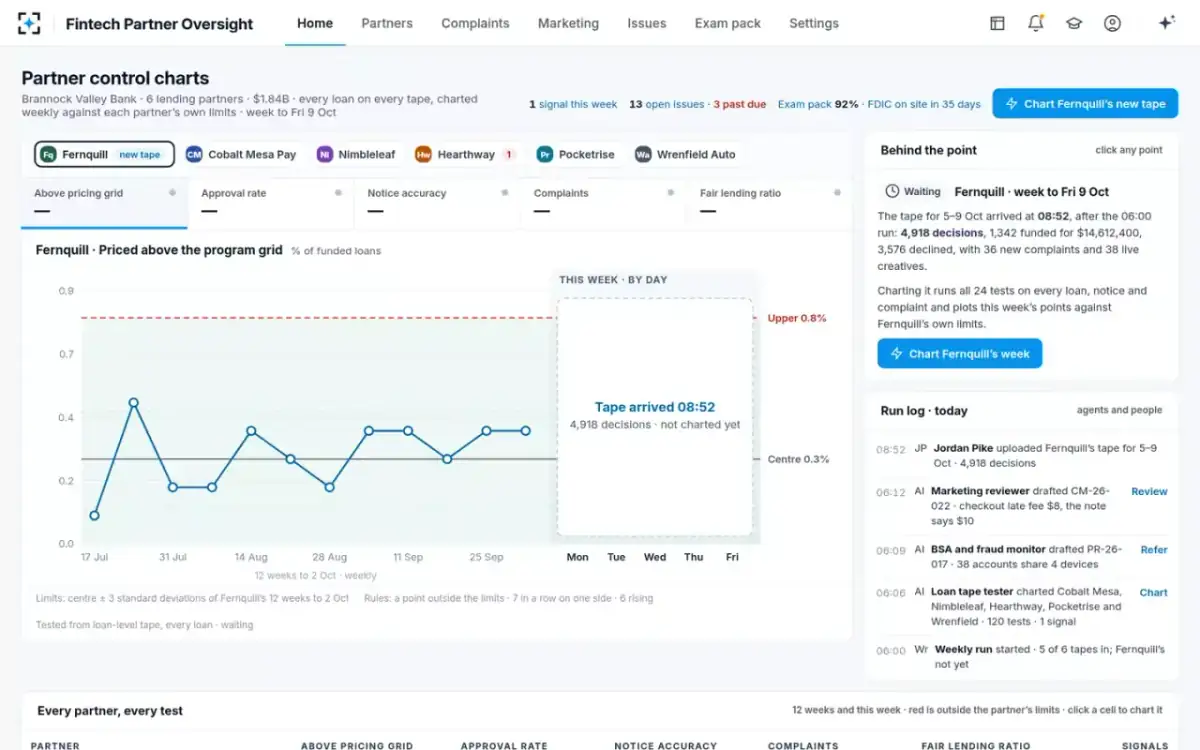
The structure behind that clock — four jobs inside one bank, plus the partner's own seat — is the subject of who actually does fintech partner oversight, seat by seat. What a control chart catches once that testing runs every week, rather than once a quarter, is covered in continuous third-party risk monitoring, explained.
Questions people ask
What is a sponsor bank in payments?
In payments specifically, a sponsor bank (sometimes called a BIN sponsor) is the bank that holds the card-network membership and bank identification number a payments fintech uses to issue cards or move money, taking on the same examiner-facing responsibility for the fintech's program that a lending sponsor bank takes on for loans.
What is banking as a service?
Banking as a service is the general model in which a chartered bank provides the licensed infrastructure — lending authority, deposit accounts, payment rails — that a technology company uses to offer financial products under its own brand, while the bank keeps the regulatory responsibility for how that infrastructure is used.
Why does a fintech need a bank partner to lend money?
Because lending is a licensed activity, state by state, and a chartered bank already has the legal standing — and in most cases the ability to apply one home-state rate nationwide — that a fintech would otherwise have to build license by license, state by state, at far greater cost and delay.
Who regulates a fintech lending app?
Directly, often no one at the federal banking-agency level, because the fintech itself is usually not a chartered, regulated depository institution. Its lending program is regulated indirectly, through the sponsor bank whose charter the loans are made under and whose examiners review the fintech's conduct as the bank's own.
Is a fintech loan a bank loan?
Legally, yes. A loan made through a sponsor bank arrangement is originated by the bank, under the bank's charter, even when every part of the borrower's experience — the app, the decision, the servicing — was built and run by the fintech.