FDIC Part 370, Recordkeeping for Timely Deposit Insurance Determination, requires banks with two million or more deposit accounts to keep the records and systems needed to calculate every depositor's insurance within 24 hours of failure. Sponsor banks often reach for it when they think about FBO accounts, the custodial deposit accounts held for fintech partners' customers, and for most of them it is the wrong rule. Few sponsor banks are that large; the FDIC's own Part 370 FAQ confirms that an omnibus account reported as one account counts once toward the threshold; and even a covered bank may keep only a placeholder for an FBO account and rely on the partner to deliver the owner data after failure. The rules that do reach a sponsor bank's FBO accounts are the pass-through conditions in 12 CFR 330.5 and the FDIC's pending custodial-account proposal. Botminds' FBO Reconciliation is built around those.
This page answers the questions sponsor banks ask about Part 370, from the regulation and the FDIC staff's own FAQ, and sets them beside the proposal that was written for their accounts. Where the solution appears, it runs on a fictional sample bank, Tessaly Community Bank, with six fintech partners.
Part 370 and the FDIC's custodial-account proposal answer different questions
Part 370 (in force since 2017): Banks with 2 million or more deposit accounts, or that opt in
Proposed Part 375 (pending since 2024): Any bank with covered custodial accounts, whatever its size
Part 370 (in force since 2017): Calculating insurance for every account within 24 hours of failure
Proposed Part 375 (pending since 2024): Accurate per-owner records for pooled custodial accounts with transactional features
Part 370 (in force since 2017): May be kept with the account holder's identifier and a pending code; owner data from the account holder after failure
Proposed Part 375 (pending since 2024): Every beneficial owner's record in a set 30-field format, held or directly accessible by the bank
Part 370 (in force since 2017): Controls to ensure every eligible account is in the output files
Proposed Part 375 (pending since 2024): Against the owner records at least as of each close of business
Part 370 (in force since 2017): Good-faith effort to contract for delivery, plus a written disclosure
Proposed Part 375 (pending since 2024): Direct, continuing access; contract terms; annual independent validation
Part 370 (in force since 2017): Annual certification by the CEO or COO, with a coverage summary report
Proposed Part 375 (pending since 2024): Annual certification by the CEO, COO or highest-ranking official, with a report
What is FDIC Part 370?
FDIC Part 370 is the regulation that makes the largest banks able to calculate deposit insurance for themselves on the day they fail. Its purpose clause says each covered institution must "implement the information technology system and recordkeeping capabilities needed to calculate the amount of deposit insurance coverage available for each deposit account in the event of its failure" (12 CFR 370.1). It took effect on April 1, 2017, with a compliance date of April 1, 2020, for banks covered at the start, and three years after becoming covered for banks that cross the threshold later.
The logic is scale. With millions of accounts, the FDIC cannot work out each depositor's coverage from the bank's records by hand fast enough to reopen the branches; the bank's own systems have to do it. That is a different problem from the one sponsor banks face, which is not the number of accounts but the fact that, for an FBO account, the records of who owns what are not at the bank.
Who is covered by FDIC Part 370? Two million accounts, and an omnibus account counts once
A bank is covered by FDIC Part 370 if its Call Reports show two million or more deposit accounts for two consecutive quarters, or if it volunteers. It can ask to be released after three consecutive quarters below two million. Most sponsor banks are far below that line.
The FDIC staff's FAQ answers the question a sponsor bank most needs answered. Asked whether a bank that "reports each omnibus account as one account according to Call Report instructions for RC-O and accordingly does not meet the two million deposit account threshold" is covered by Part 370, the answer is one word: "No." (FDIC, Part 370 FAQ, published December 7, 2018). A bank with six FBO accounts holding 412,000 customers' money, like the sample bank, would report six accounts, not 412,000.
The thresholds and clocks behind the Part 370 questions sponsor banks ask
2M
deposit accounts, for two quarters, before Part 370 applies
1
account: what one omnibus FBO account counts as, if reported that way
24
hours after failure to calculate every covered account's insurance
95%
of accounts calculable, the March 2025 FAQ's test for substantial compliance
That is why the FDIC's custodial-account proposal said Part 370 does not solve the problem. "The FDIC believes many IDIs that fall below the size thresholds for § 360.9 and 12 CFR part 370 hold custodial deposit accounts with transactional features that would complicate a deposit insurance determination," it wrote, and the new requirements would apply "regardless of the size of the IDI holding the deposits" (89 FR 80135).
FDIC Part 370 requirements: what a covered bank must be able to do in 24 hours
The FDIC Part 370 requirements are four capabilities, all of which must work within 24 hours after the FDIC is appointed receiver. They are the heart of the rule, and they show why it was built for the largest banks' own deposit systems.
The four capabilities Part 370 requires of a covered bank's systems
- Calculate deposit insurance for each account
Accurately, under the FDIC's coverage rules in Part 330, including ownership categories.
- Produce output files in the FDIC's layout
Generated and retained in the format of the regulation's Appendix B.
- Restrict access
Hold some or all of each account until the FDIC has made its determination.
- Debit the uninsured amount
Take off each account whatever the calculation shows is not insured.
Each capability assumes the bank holds the information. Where it does not, as with a custodial account whose owners are in someone else's records, Part 370 offers an alternative, and the alternative is where FBO accounts sit.
Does Part 370 apply to FBO accounts? Only as a pending file
At a covered bank, Part 370 applies to an FBO account, but lightly. Under the alternative recordkeeping rule in § 370.4(b)(1), for an account whose records disclose a pass-through relationship and for which the bank does not hold the owner data, the bank need keep only "The unique identifier of the account holder" and a "pending reason" code. The owner data is the account holder's to supply after failure.
For accounts with transactional features, § 370.5 adds a duty to try to make that work. The bank must make "A good faith effort to enter into contractual arrangements with the account holder" to deliver the information in time for the calculation to finish within 24 hours "in order for the account holder to have access to deposits on the next business day after failure," and must give the account holder a written disclosure "stating that the account holder may not have access to deposits in its deposit account before delivery of information in a format that is compatible" with the bank's system (12 CFR 370.5(a)).
The FDIC staff's FAQ explains why transactional accounts were singled out: payments in flight. "If, for example, a check is presented to the successor to the failed bank on the business day following the failure, the successor bank will not be able to honor the check unless the FDIC has completed a deposit insurance determination." For an FBO account, the equivalent is every card purchase and transfer the partner's customers make the morning after. Part 370's answer is a contract and a disclosure; the custodial-account proposal's answer is that the bank should already have the records.
FDIC 360.9 vs 370 vs the custodial proposal
Section 360.9, Part 370 and the custodial proposal are three FDIC recordkeeping regimes that are easy to confuse, and each was written for a different problem. The table sets them side by side.
Three FDIC recordkeeping regimes, and which one reaches an FBO account
| Regime | Who it reaches | What it requires | For an FBO account |
|---|---|---|---|
| 12 CFR 360.9, large-bank deposit insurance determination | Banks with at least 250,000 deposit accounts or $20 billion in assets | Provisional holds and standard data formats for a large failure | Not designed for custodial owners |
| 12 CFR part 370, timely deposit insurance determination | Banks with 2 million or more deposit accounts, or volunteers | Systems to calculate, restrict and debit within 24 hours; annual certification | Account holder identifier, a pending code, a contract effort and a disclosure |
| Proposed 12 CFR part 375, custodial accounts (pending) | Any bank with covered custodial accounts | Would require per-owner records in a set format, daily reconciliation, independent validation, annual certification | Written for it |
The proposal itself draws the line. Part 370 banks "are not necessarily required to maintain records on the beneficial owners of deposits, and 12 CFR part 370 specifically contemplates that the FDIC may need to reach out in the event of the IDI's failure to obtain these records from third parties." For custodial accounts with transactional features, the FDIC wrote, it is critical that the bank either keep those records or have continuous access to them. The proposal is still pending; the current Unified Agenda shows the final rule as "To Be Determined" (Unified Agenda, RIN 3064-AG07). What the custodial proposal would cost a sponsor bank is set out separately.
FDIC Part 370 compliance and the March 2025 FAQ: the 95 percent answer
FDIC Part 370 compliance does not have to be perfect to be certified, according to FDIC staff. The newest FAQ, published March 20, 2025, acknowledges "the difficulty of achieving and maintaining the capability to accurately calculate deposit insurance for all deposit accounts within 24 hours." A covered bank may certify if its capabilities can calculate insurance for "at least 95 percent of deposits not subject to exceptions (based on number of deposit accounts)" and it keeps a full list of the issues that stop it calculating the rest, with steps to fix them (FDIC, Part 370 FAQ).
For a large bank with FBO accounts on alternative recordkeeping, the 95 percent is counted in accounts. An omnibus account with 184,206 owners counts once. The test says a great deal about the bank's own retail book and very little about whether the owners of its custodial accounts could be paid on the next business day.
What Part 370 says about reconciliation: almost nothing
Part 370 says almost nothing about reconciliation, and FDIC staff have said so. Asked what the Part 370 Compliance Review Manual's reference to reconciliation means, the FAQ answers: "The reference in the Compliance Review Manual to reconciliation is meant only to indicate that a covered institution should have controls in place to ensure that all eligible deposit accounts are included in its Part 370 output files. For Part 370 compliance testing purposes, the FDIC will only verify that such controls are in place and will not examine or review the substance or details of such controls."
That is a completeness check on the bank's own files, not a reconciliation of a custodial account to its owners. A sponsor bank that treats its Part 370 program as covering its FBO accounts has a control that confirms the FBO account is in the output file and nothing about whether the partner's 184,206 balances add up to it. The daily tie the custodial proposal describes, and the per-owner checks behind it, are a separate piece of work.
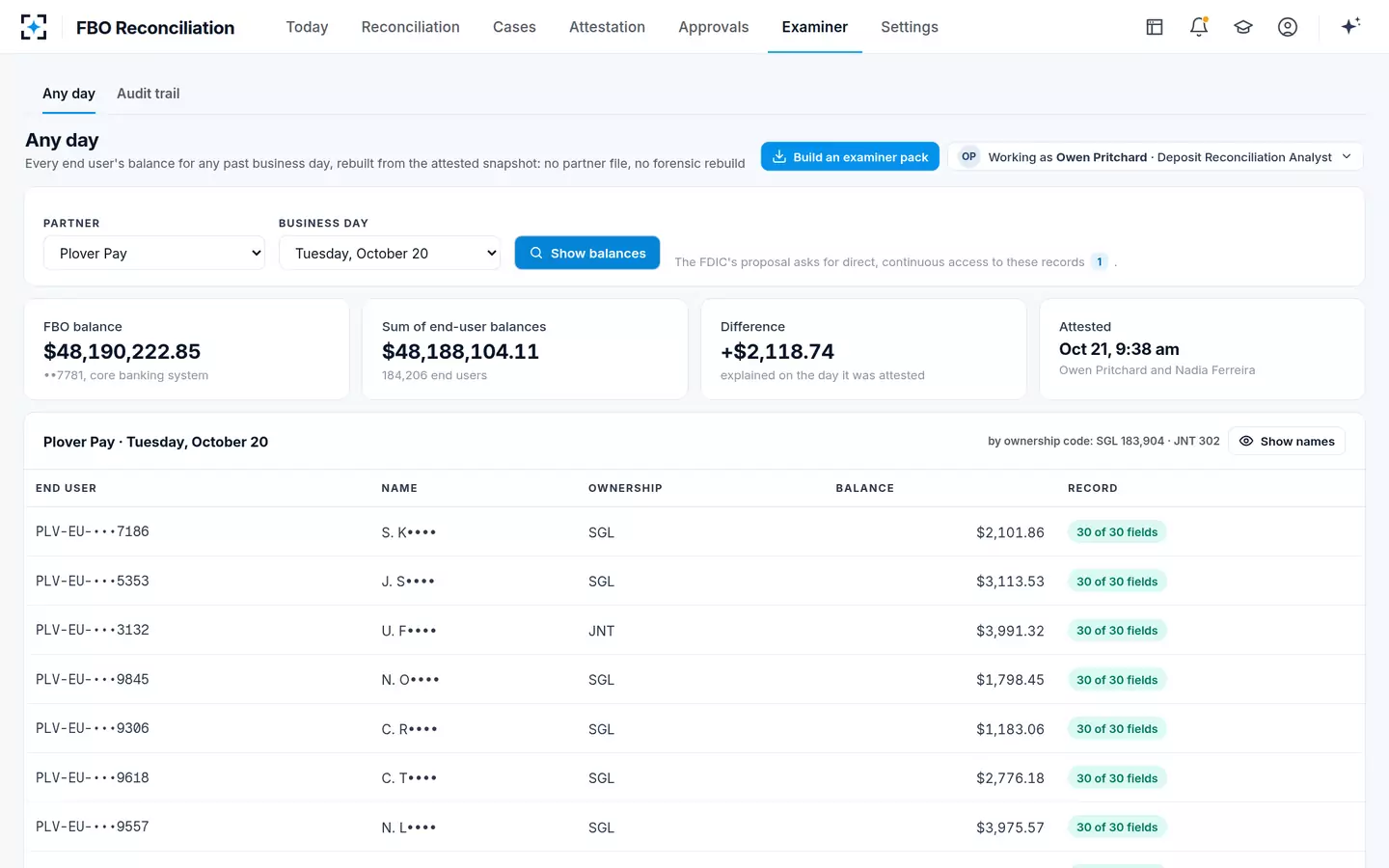
What Part 370 does not ask for: FBO Reconciliation rebuilds any past day's per-owner balances
Prepaid cards nobody registered: a Part 370 FAQ every sponsor bank should read
One Part 370 FAQ answers a pass-through question every sponsor bank should know, whether or not it is covered. It concerns prepaid cards held in a custodial account: "Where cards are not registered, and where the covered institution cannot identify the cardholder and ownership interest, the pass-through insurance requirements would not be met and the aggregate of the funds attributable to unregistered cards would be insured to the custodian up to the Standard Maximum Deposit Insurance Amount (SMDIA)."
The FAQ's example is a company that pays employees $50 bonus cards and finds that 99 percent never register them; the registered 1 percent are insured as the employees' deposits, the other 99 percent as the company's, up to $250,000 in total with its other deposits. The principle is the one in 12 CFR 330.5: coverage follows the records (12 CFR 330.5). A fintech customer whose name, tax ID or ownership code is missing from the partner's file is in the same position as an unregistered card. The pass-through conditions, and the records behind each, are set out separately.
The rules a sponsor bank actually works under
For a sponsor bank below two million accounts, the rules that govern its FBO accounts today are the pass-through conditions, its supervisor's expectations for third-party relationships and recordkeeping, any enforcement order it is under, and its own program agreements. The custodial-account proposal is the clearest statement of where the FDIC wants recordkeeping to go. The Federal Reserve's 2024 order against Evolve Bank & Trust, for example, required written controls setting out which records the bank and each fintech partner keep, and keeping that split working through a disruption (Federal Reserve Board, Evolve consent order, June 2024).
In practice that means a sponsor bank should be able to do, every business day, what Part 370 lets a large bank put off until failure: say how much of each FBO account belongs to each customer. At the sample bank the desk filed that statement for October 21 at 9:21 am, ahead of its 10:00 deadline. When a partner's file does not arrive, the desk records an exception rather than signing on a total.
FBO Reconciliation treats a missing partner file as an exception, not a pending code
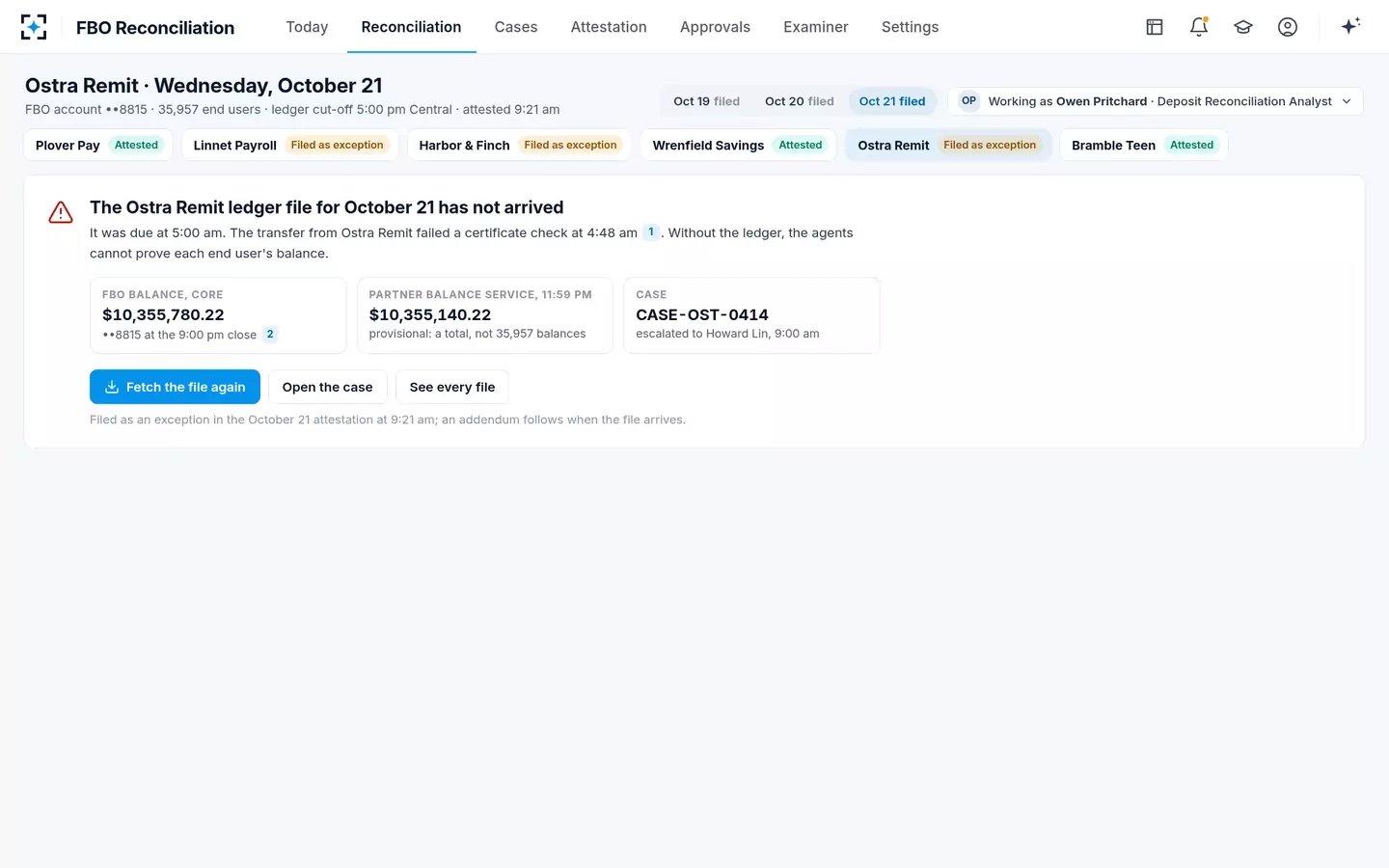
To see the per-owner checks on a sample of your own partners' files, start from FBO Reconciliation. Who on the desk prepares, checks and signs each day is described separately.
Questions people ask
What is the FDIC 370 rule?
It is 12 CFR part 370, Recordkeeping for Timely Deposit Insurance Determination. It requires banks with two million or more deposit accounts to keep the records and systems needed to calculate each depositor's insurance, restrict access and debit uninsured amounts within 24 hours after the FDIC is appointed receiver, and to certify compliance every year.
Is Part 370 the same as the FDIC custodial account rule?
No. Part 370 has been in force since April 1, 2017, for the largest banks. The custodial account rule is a separate proposal from October 2024, a new Part 375, that would cover any bank holding pooled custodial accounts with transactional features. The proposal is not final.
When did Part 370 take effect?
April 1, 2017, with a compliance date of April 1, 2020, for banks covered at the start. A bank that later has two million or more deposit accounts for two consecutive quarters has three years from becoming covered to comply.
Are the FDIC's Part 370 FAQs binding?
No. The FAQ page says the answers were prepared by FDIC staff, represent the staff's views, and "are not legally binding on covered institutions or the FDIC." They are, however, the staff's stated reading of how the rule applies.
Does Part 370 require daily reconciliation?
No. FDIC staff have said the rule's reference to reconciliation means only controls ensuring every eligible account is in the output files. Daily reconciliation against each beneficial owner's record is a requirement of the custodial-account proposal, which is still pending, and a sound practice under existing rules.