Reconciliation breaks are differences between two places that should agree, and that no documented reason explains. In regulatory reporting the same balance sits in the general ledger, the Call Report, the holding company's FR Y-9C, the Federal Reserve's FR 2900 deposits report and, at the largest firms, the FR 2052a liquidity report, and every break between them has to be resolved before a filing date that does not move. The reporting team usually finds the break, but it rarely owns the fix: that sits with whoever runs the deposit system, the loan subledger or the feed into the liquidity data mart. Botminds' Regulatory Reporting Reconciliation is built for that hand-off. Its agents run the cross-report rules every night of the close, explain the known differences, trace what is left to the accounts and the feed behind it, and draft the break for the owner with a clock attached.
No regulator's text uses the phrase "reconciliation break"; it is the practitioner's word. The nearest official definition comes from the Basel Committee, which describes reconciliation as "the process of comparing items or outcomes and explaining the differences" (BCBS 239, 2013). A break is what is left when the explaining stops. The worked examples below come from a fictional sample bank, about $92 billion in assets with one foreign branch, closing its third quarter of 2026 in the solution.
Every break runs against a filing clock that does not stop
30days
to file the Call Report after the quarter ends; 35 with more than one foreign office
40days
to file the FR Y-9C after March, June and September; 45 after December
Weekly
FR 2900: daily deposit data for a Tuesday-to-Monday week
T+10
FR 2052a for Category IV firms; Category I to III firms have two business days
What is a reconciliation break?
A reconciliation break is a difference between two reported figures that is larger than the tolerance and is not covered by any documented, legitimate reason. It is not the same as a difference. Many differences between regulatory reports are legitimate by design: the FR Y-9C consolidates the parent holding company and eliminates its deposit at the bank, the FR 2900 counts daily balances for a week rather than the quarter-end figure, and each report has its own definitions. Those are reconciling items, and they should be named and re-derived, not argued over each quarter.
The break is the remainder. In the sample bank's third quarter, total deposits read $71,482.6 million in the general ledger and on the Call Report, $71,441.4 million on the FR Y-9C, $70,961.3 million on the FR 2900 and $71,310.3 million in a parallel FR 2052a run (the bank sits just under the $100 billion line at which that report becomes mandatory). Five known items explained $600.1 million of the gaps. One line was left: $168.7 million between the FR Y-9C and the FR 2052a run, far above the rule's $5.0 million tolerance. That line is a break.
A break is also different from a failed edit. The FFIEC's validity and quality edits test the Call Report's own figures; a break is a disagreement between two places, which a single report's edits are not designed to see. The Federal Reserve runs its own version of the comparison between the FR 2900 and the Call Report and calls it "interseries editing" (Federal Reserve, FR 2900), which is the closest a regulator comes to naming the work.
Types of breaks in reconciliation between regulatory reports
Breaks between regulatory reports fall into a handful of kinds, and the kind usually names the owner before anyone has looked at an account. A mapping break belongs to whoever maintains the mapping table; a cut-off break belongs to the system that posted late; a missing attribute belongs to the system of origin. Eight of the sample bank's breaks from day 22 of its close cover most of them.
Eight breaks, eight kinds, and the owner each one names
| Break | Kind | What the trace found | Who fixes it |
|---|---|---|---|
| Total deposits: FR 2052a run $168.7M below the FR Y-9C | Mapping | A new escrow product code sent to other liabilities by a mapping row added in August | Deposit data owner |
| Repurchase agreements: FR 2052a run $97.3M below the FR Y-9C | Cut-off | Two overnight repos booked after the liquidity run's cut-off | Liquidity data owner |
| Deposits of states and political subdivisions: FR 2052a run $36.5M below the Call Report | Missing attribute | Public funds accounts at two branches carry no counterparty sector code | Deposit data owner |
| Unused commitments: FR 2052a run $54.1M below the FR Y-9C | Dropped by a feed | Expired commercial lines still open in the loan system, dropped by the liquidity feed | Liquidity data owner |
| Interest expense on time deposits: Call Report $1.7M above the general ledger | Netting | Early-withdrawal penalties netted in the general ledger, gross in the Call Report mapping | General ledger owner |
| Available-for-sale securities: FR Y-9C $8.9M below the Call Report | Pricing date | A holding company bond priced from the prior day | Investment accounting |
| Allowance for credit losses: Call Report $4.2M below the general ledger | Posting location | A qualitative overlay posted to the general ledger, not the allowance subledger | Loan subledger owner |
| Loans secured by 1–4 family residential properties: Call Report $23.4M above the general ledger | In transit | Loans moved in a servicing transfer are in the subledger but not yet in the general ledger | Loan subledger owner |
Two things in that table matter more than the kinds. First, every one of the eight is fixed somewhere other than the reporting function. Second, half of them involve the FR 2052a run, the report built furthest from the general ledger, through its own feeds and mapping tables, which is where a change in a product code or a feed can land without anyone in reporting being told.
Who resolves reconciliation breaks?
The owner of the system where the number is wrong resolves a reconciliation break; the reporting team finds it, routes it and confirms the fix. That division is not a preference. The OCC's examiner booklet on regulatory reporting says data quality "is typically dependent on the data's source, which begins when the data enter the bank" (OCC Comptroller's Handbook, Regulatory Reporting, 2021). A report-side correction leaves the source wrong, and the next run brings the break back.
The same booklet expects one person or group to prepare the reports and "another independent individual, group, or department" to review them before filing, and it lists "separation of duties, dual controls, and independent reconcilements" as the fundamental controls over regulatory reports. So a break touches at least four people: the analyst who finds and sends it, the data owner who fixes it, a reviewer who approves the closure, and a head of function who answers for the calendar. Internal audit reads all of it later.
Around one break: four people, and who waits on whom
Today
Finds the gap in a workbook, re-explains last quarter's known items, then emails a system owner with a number and no account list.
With agents
Starts from the night's run with the known items already cited, reads the trace, edits and sends the break.
Still theirs: deciding whether a break goes out, and proposing the closure
Today
Hears that "deposits are off" with no accounts, no mapping row and no due date, and puts it behind the system's own backlog.
With agents
Gets the accounts, the feed, the mapping row and a proposed fix, with a three-business-day clock.
Still theirs: the change to the source system, under its own change ticket
Today
Signs closures and top-side adjustments in the last days of the close, from the analyst's summary.
With agents
Approves each closure with the rerun in front of them; returns it with a reason code when the evidence does not hold.
Still theirs: approval as checker, never of their own work
Today
Learns a break is late when the filing date is close, or when an examiner asks.
With agents
Is escalated to two business days past the clock, with the break, its owner and its evidence.
Still theirs: reassignment and the close sign-off
Where the days go: waiting, not working
Most of a break's elapsed time is spent waiting, not working. Finding a difference takes a run; explaining the known part takes an hour with the right sources; even tracing a remainder to accounts is mechanical once both sides can be read at account level. What takes days is the gap between "someone in reporting knows" and "the person who can change the source has agreed it is theirs".
That gap has a structural cause. The reporting team's clock is the filing date. The data owner's clock is their own queue of change requests, releases and incidents, and a break that arrives as an email with a total and a question has no place in that queue. Until it carries an owner's name, a list of accounts and a due date, it is a conversation. In the manual close the solution replaces, breaks go out as emails to system owners, with no owner named and no clock written down.
In the sample, the escrow break shows how short the working time is once the waiting is removed. The nightly run finished at 02:10. The analyst asked why the reports differed in the morning, the trace ran at 09:15 and named 2,118 mortgage escrow accounts, the break went to the deposit data owner at 09:18 with a due date of Tuesday, October 27 at 17:00, and the owner fixed the mapping row at 14:40 the same day. The rerun confirmed it and the manager approved the closure at 15:05, five business days before the Call Report was due.
On day 22, most of the quarter's breaks are closed; two are past their clock
How long should a reconciliation break stay open?
No regulation sets a deadline for a reconciliation break; the filing date does, by working backwards. A break has to be fixed at the source, rerun, reviewed and approved, and the report then needs its own review and signatures, all before the due date. For the September 30, 2026 report date that is Friday, October 30 for the Call Report and Monday, November 9 for the FR Y-9C (FDIC FIL-62-2026). The Call Report instructions add that a bank should file early enough to research and clear any edit exceptions before the due date (FFIEC 031/041 General Instructions, September 2026; call report due dates 2026 quotes the rule), so the last week is not free time.
The useful rule is a clock per break that starts when the break is sent, not when it is noticed, and that is short enough to leave room behind it. The sample bank uses three business days from sending, which puts a break found on day 22 at day 27 at the latest and leaves the Call Report's last three days for review. A bank filing the FR 2052a monthly at T+10 has far less room: a break found on day eight of that cycle has two days, and the same three-day clock would not fit. The clock should be set per report and per area, and written down.
Age is also a control measure in its own right. A break open for two quarters is no longer a break; it is a known error in a filed report, and the question becomes whether it was material enough to amend.
How do you escalate a reconciliation break?
Escalate a reconciliation break on a fixed ladder that is tied to the filing calendar and runs without anyone having to remember it. The sample bank's ladder is a reminder to the owner on the due date, an alert to the regulatory reporting manager after one business day, and escalation to the head of regulatory reporting after two. The head can then reassign the break, agree more time with a reason, or accept a top-side adjustment as a documented decision.
The break queue in Regulatory Reporting Reconciliation: what differs, who owns it, how late it is
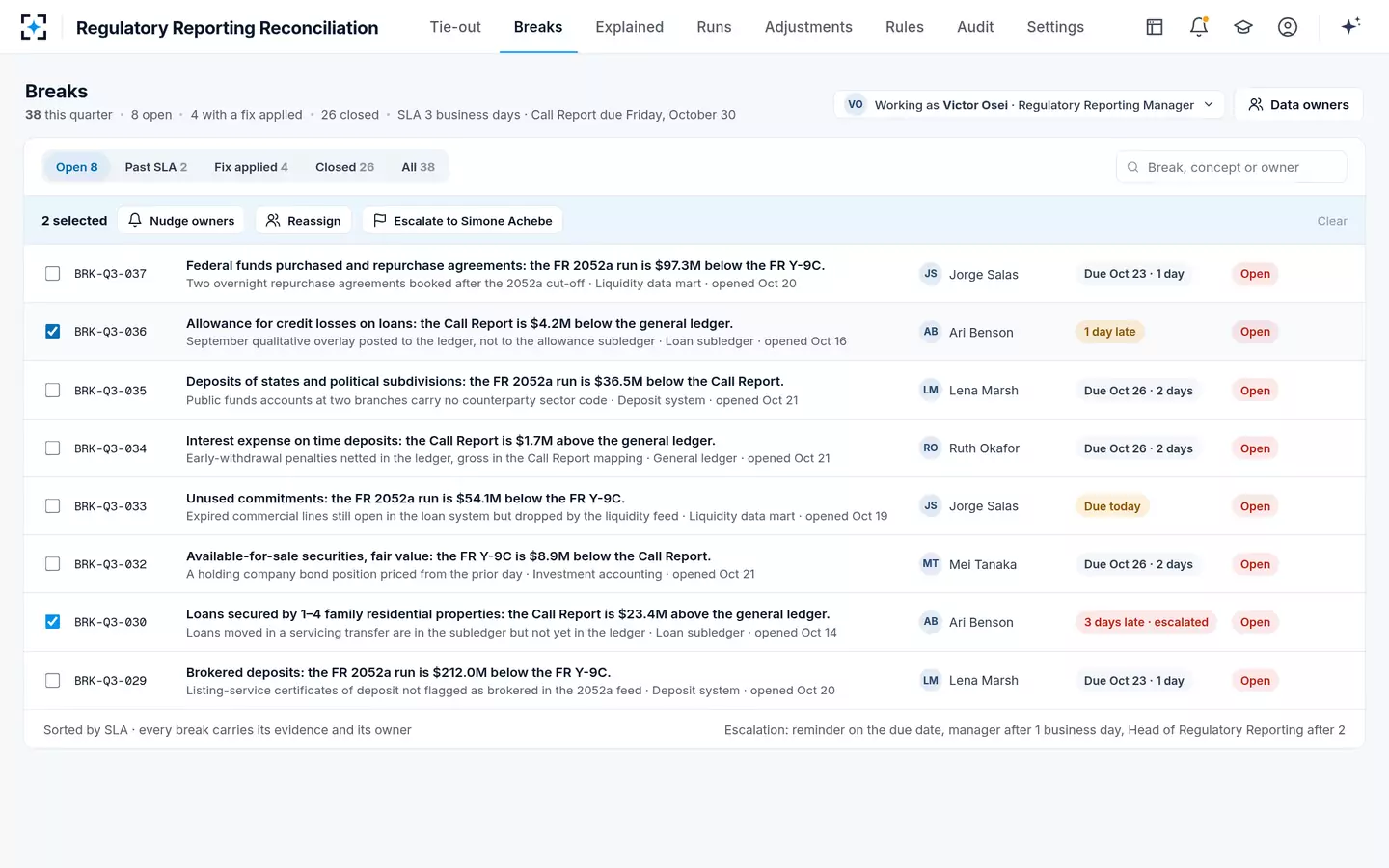
Two exits matter as much as the ladder. An owner who receives a break that is not theirs must be able to send it back with a suggested owner, or the break sits in the wrong queue until the escalation finds it. And an owner who cannot fix the source before the filing date must be able to ask for more time with a reason, so that the head of function decides, knowingly, whether the report goes out with a documented adjustment. What should never happen is a break that quietly ages because nobody was named.
What a break has to carry to reach the right owner
A break reaches the right owner and gets fixed quickly when it carries everything the owner needs to act without a meeting. An owner who receives a total and a question has to rebuild the trace before deciding whether the problem is theirs, and that rebuilding is most of the waiting. The list below is what the sample bank's breaks carry.
Seven things every break should carry before it is sent
- The concept, the rule and the tolerance
Total deposits, the rule that compares the two reports, and the $5.0 million the bank accepts as noise.
- Both figures and what is already explained
So the owner does not re-derive the eliminations, averaging and timing items the reporting team already proved.
- The accounts behind the remainder
A count, a total and a sample, grouped by product, with customer data masked.
- The feed and the mapping row
Where the number left the source and which rule moved it, with the date the rule changed.
- What changed since the last quarter that tied
In the sample, the old mapping row had sent the same escrow to deposits and the June rule tied.
- A proposed fix at the source
Point the mapping row at the right line and reload the feed, rather than adjusting the report.
- A due date and who confirms the fix
The owner's clock, and the rerun that will show whether the fix landed at the source.
A break as the deposit data owner receives it from Regulatory Reporting Reconciliation
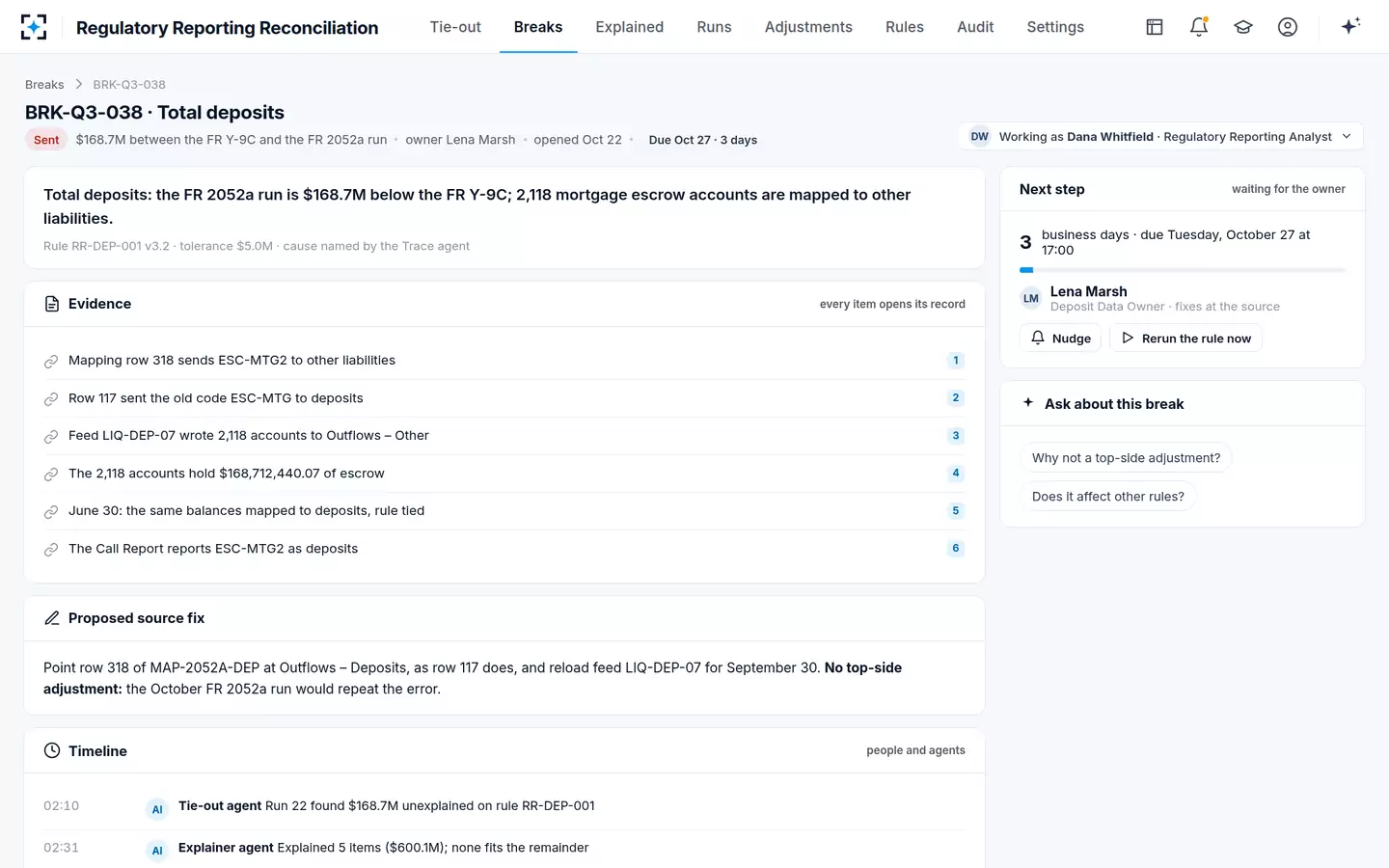
The last item on the list is the one most often missing. A break closed because the owner says it is fixed is a promise; a break closed because the next run ties at the source, with no adjustment on the concept, is evidence. The difference matters most when the fix is not a fix, and the shortcut of a top-side adjustment makes the report agree while the feed stays wrong.
When breaks pile up: the backlog an examiner found
Unresolved breaks do not stay small; they turn into inaccurate filed reports. The clearest public example is Republic First Bank, which failed in April 2024. The FDIC's Office of Inspector General quotes the 2023 examination's finding that "Internal controls over general ledger account reconcilements, intercompany transactions, and financial reporting are unsatisfactory", and that the lack of effective financial controls "resulted in apparent violations and inaccurate Consolidated Reports of Condition and Income (Call Reports)" (FDIC OIG, Material Loss Review of Republic First Bank, EVAL-25-01).
The FDIC's own comments, printed in the same report, show what the backlog looked like from inside. They quote a January 2024 supervisory letter: management was "addressing a backlog of account reconciliations that had grown while resources were prioritized to the bank's system conversion and has been charging off stale items as needed." In September 2023 the bank amended three quarters of Call Reports, and the amendments moved it to "Adequately Capitalized" for prompt corrective action purposes. FDIC officials also told the reviewers that the bank's June 2023 Call Report put $664 million of secured borrowings on the unsecured line of Schedule RC-O (what one call report error costs follows what that error cost).
The lesson for a reporting function is not that one bank was badly run. It is that a break's age is information. A queue in which items are written off because they are old, rather than fixed because they are owned, is the queue examiners describe afterwards.
The owner fixes it at the source and writes down what changed
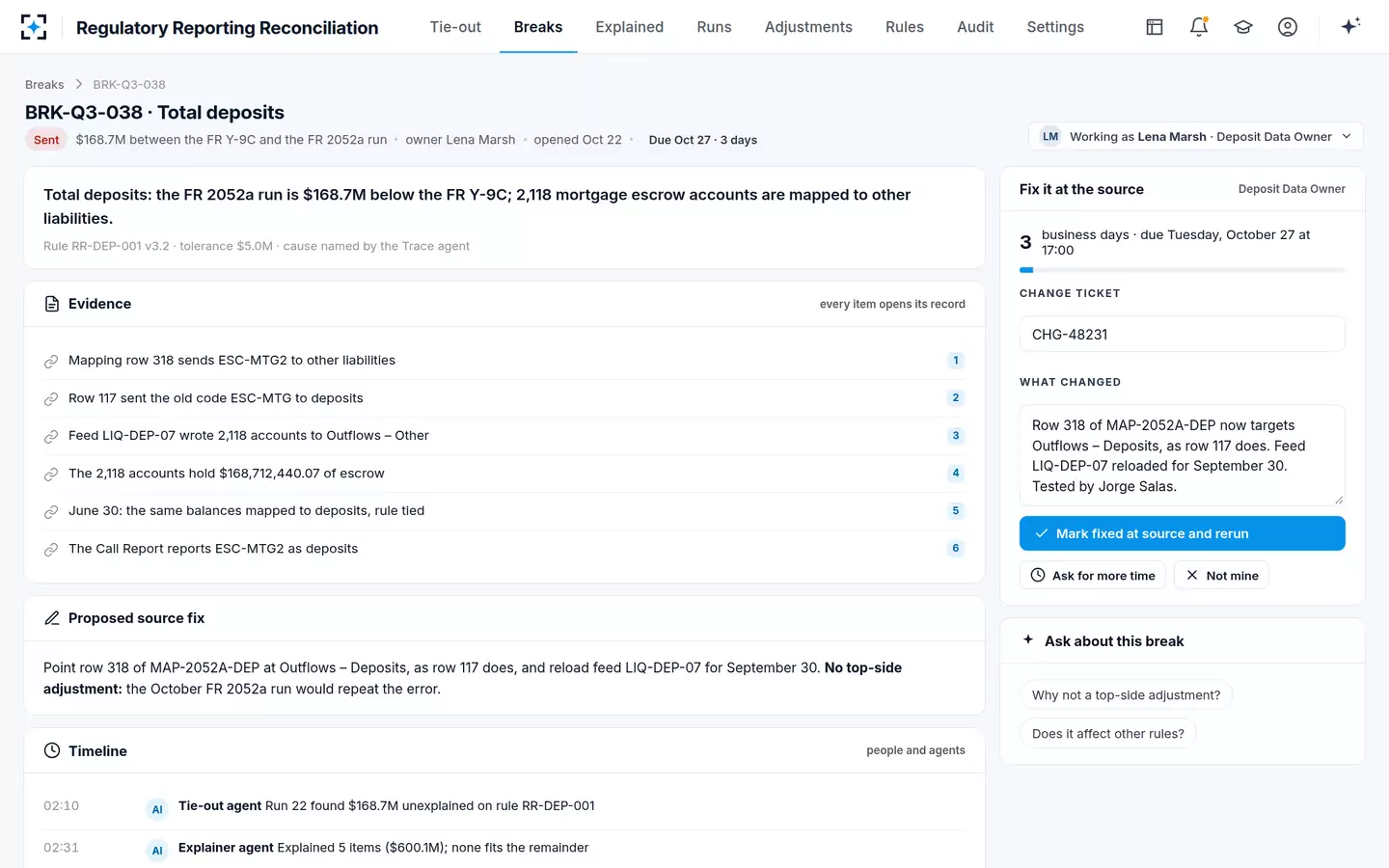
Choosing tools for this work is a separate question; which reconciliation tasks move to agents and which stay with people takes it task by task. To see the whole close on the sample bank, start from Regulatory Reporting Reconciliation.
Questions people ask
What causes breaks between regulatory reports?
Most come from the plumbing between the source systems and the reports, not from the reports themselves: a mapping table that sends a new product code to the wrong line, a feed with an earlier cut-off than the general ledger, a missing attribute such as a counterparty sector code, or a balance in transit between a subledger and the general ledger. The OCC's examiner booklet warns that automated reporting brings its own risk when nobody checks the data flowing into it.
What is the difference between a reconciliation break and a reconciling item?
A reconciling item is a difference with a documented, legitimate cause, such as a holding company elimination between the Call Report and the FR Y-9C or late adjustments that the FR 2900 did not yet include. A break is a difference no such item explains. The line between them should be drawn by evidence each quarter, not by habit: an item carried forward without being re-derived can hide a break.
Who owns a break between the Call Report and the FR Y-9C?
Whoever owns the system where the number is wrong. A break between the two reports is often in the consolidation system, which holds the eliminations and the subsidiaries the FR Y-9C adds, or in a holding company subsidiary's own books. The regulatory reporting team owns finding it and confirming the fix; the legitimate differences between the two reports should be settled first so that only the real remainder is sent.
What is a reconciliation break report?
It is the list of open and recently closed breaks for a close: each with the concept, the two reports, the amount, the owner, the due date, its age and how it was closed. In the sample bank it holds 38 breaks for the quarter. Examiners scoping a regulatory reporting review are told to look at the quality control reports management uses, and a break list with owners and dates is the most direct one.
Can a reconciliation break be closed with a top-side adjustment?
It can, if the source cannot be fixed before the filing date, but it should be a decision rather than a default: proposed with a reason, approved by someone other than the preparer, and flagged if it recurs. An adjustment that comes back the next quarter means the source was never fixed, and the Federal Reserve's own guidance warns against revising one report simply to make it agree with another.
How many reconciliation breaks are normal in a quarter?
There is no published benchmark, and a count on its own says little. The sample bank's 38 breaks across 214 cross-report rules is a design example, not a norm. More telling are the age of the open breaks, how many were closed by an adjustment rather than a source fix, and whether the same concept breaks again the next quarter.