A call report error is any figure in a bank's Consolidated Reports of Condition and Income that does not follow the instructions, from a balance on the wrong line to an amount that is simply wrong. What it costs depends almost entirely on who finds it and when. Found by the bank before filing, it is a correction and a re-run of the edits. Found by the agency's Call Report analyst after the report is accepted, it is a resubmission on someone else's clock. Found by an examiner, it can be a violation of the reporting rule, amendments going back quarters, and a matter requiring attention; and a report filed late or knowingly false draws civil money penalties by the day. Botminds' Call Report Analysis is an agentic solution built to keep errors in the first and cheapest of those places: agents run the edits on every draft, tie each swing to its source, and challenge every explanation before a person accepts it.
The penalty amounts and rules below are current as published; the sample quarter comes from the solution's fictional sample bank, Corvane National Bank.
The same error costs more each step later it is found
- 1
Found by the bank, before filing
A correction in the data, approved by a second person, and a re-run of the edits.
Hours of the window.
- 2
Found by the agency's Call Report analyst, after acceptance
A request for revised explanations, resubmitted data, or both; the agencies expect a timely response.
Days, the evidence rebuilt, and a resubmission that can arrive late.
- 3
Found by an examiner, at the next exam
Amendments for the quarters affected, a possible violation of the reporting rule, and possibly a matter requiring attention.
Quarters of restatement and a finding in the report of examination.
- 4
Found to be knowing or reckless
A Tier Three civil money penalty for each day the false report is not corrected.
Up to $2,513,215 a day, or 1% of total assets if less.
What happens if a call report is wrong?
The bank corrects it, and if it was already filed, the bank's primary supervisor decides whether it must be amended. The General Instructions let the supervisor require an amended report for significant errors in classification, meaning the line an item was reported on, and for recognition and measurement errors that are material to the bank (FFIEC 031 and 041 General Instructions). A bank can also amend on its own, and often should: an error found by internal review or an external auditor is cheaper to correct than to have found.
Beyond the amendment sit three further costs. The first is the record: Call Report data are public, and the corrected figures replace the originals, so analysts, depositors and the bank's own board see the change. The second is supervisory: an inaccurate report can be cited as a violation. The third is money, which in practice falls mostly on late filers; the penalties for false reports are large but tiered by intent.
Found before filing: the only cheap error
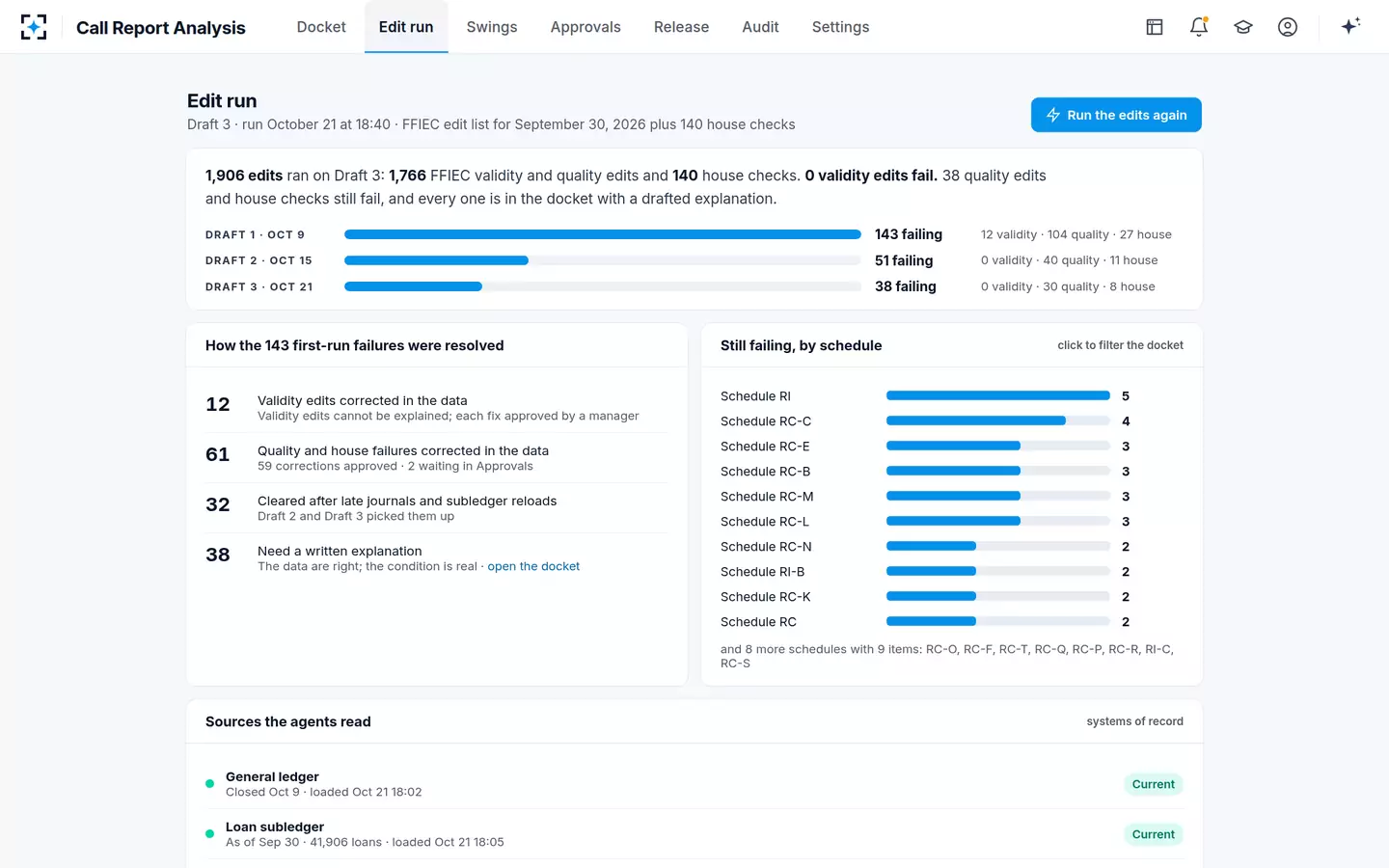
An error found while the report is still a draft costs a correction, a second person's approval and another edit run. In the sample bank's quarter, the first edit run on October 9 produced 143 failures; 12 were validity edits corrected in the data, 61 were quality and house-check failures that turned out to be real errors and were corrected, 32 cleared once late journals and subledgers were loaded, and 38 were correct figures that needed a written explanation. Every one of the 73 corrections cost the bank only time.
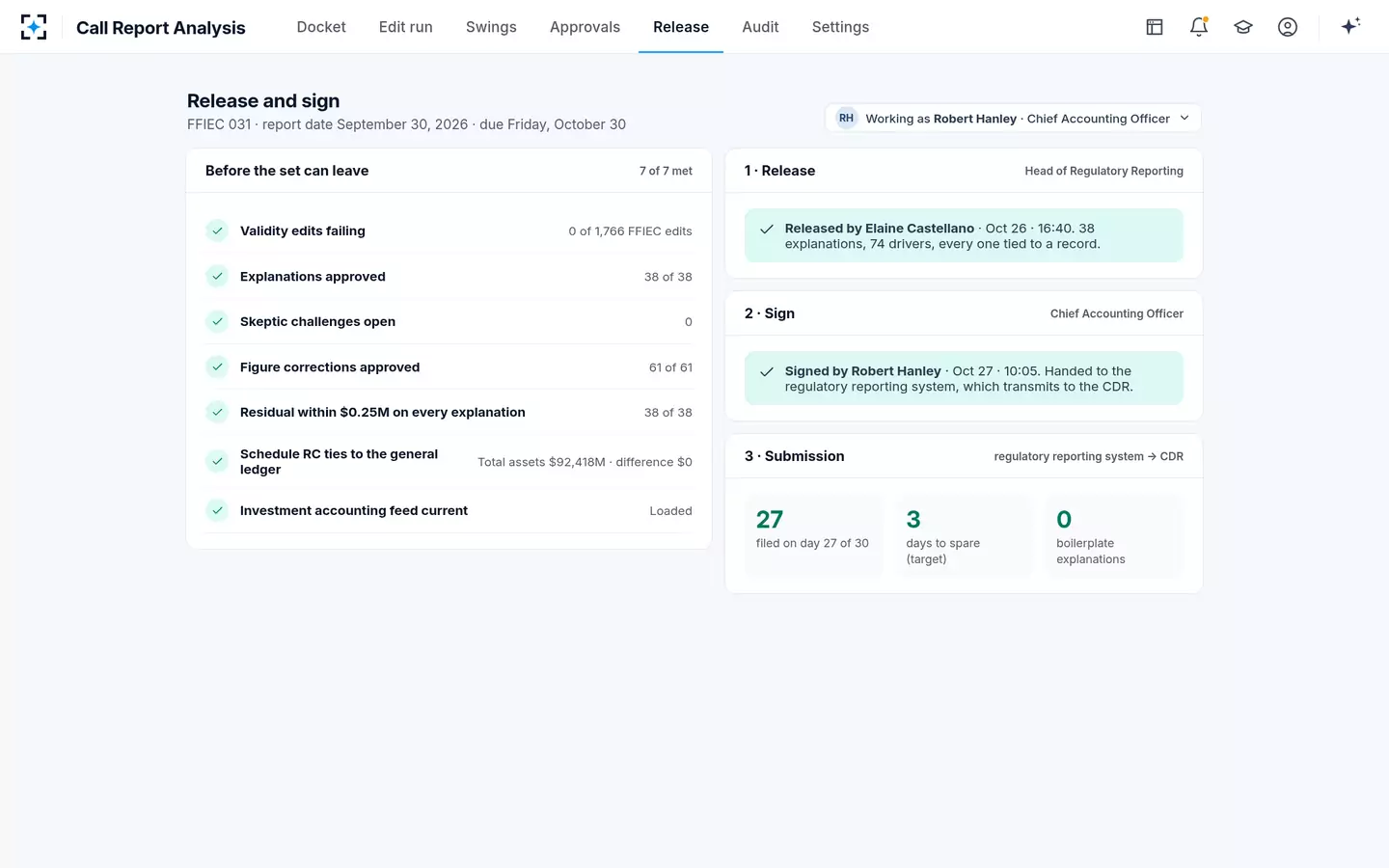
That ratio is the argument for running the edits early and often. The 61 data corrections were errors that, filed, would have been somebody else's finding. The release checks in the sample would not let the set go until all 61 had been approved by someone other than the person who proposed them.
143 failures on the first draft, 38 explanations by the third
Found by the agency's analyst: a resubmission on the agency's clock
Acceptance by the Central Data Repository is not the end of the review. Call Report analysts read the written explanations after the data are accepted, and if an explanation is inaccurate or incomplete they can require revised explanations, resubmitted data, or both. The cost is the bank's own time, spent weeks after the quarter's team has moved on, rebuilding the reasoning from whatever was kept.
There is also a timing risk inside the window. A report that the repository cannot process, or that the bank has not adequately validated, is rejected and must be corrected and resubmitted; if the resubmission arrives after the due date, the General Instructions warn that the late-filing penalties can apply. How resubmission works, and what to keep ready, is set out in FFIEC call report resubmission.
Is an inaccurate call report a violation? Found by an examiner, it can be
Yes. The FDIC's examination manual says that "Call Reports submitted with significant errors or inaccuracies, including those with errors that require an amendment per the instructions, may be considered a substantive violation of Part 304 and could warrant an MRA" (FDIC RMS Manual, section 4.5). The OCC tells its examiners to weigh the root cause and materiality of a misstatement before citing a violation or a matter requiring attention, and notes that it has separate statutory authority to assess civil money penalties for Call Report violations, with dedicated penalty matrices (OCC, Regulatory Reporting).
The rule on matters requiring attention changes on November 2, 2026. The OCC and the FDIC's final rule narrows the grounds for an MRA to practices that could reasonably be expected to materially harm the institution's financial condition, or that have, and to an actual violation of a banking or banking-related law or regulation (final rule, Federal Register, September 1, 2026). A Call Report filed inaccurately enough to be cited under the reporting rule remains in that second category. The rule asks examiners to put material financial risks ahead of concerns about policies, process and documentation; it does not take this finding off the list.
When does a bank have to amend a call report?
When the supervisor determines the error is significant or material, and in practice when the bank's own review reaches the same view. Materiality is a judgment the OCC's booklet spells out in two halves. Quantitatively, the misstatement is compared with the balance sheet, the income statement and regulatory capital. Qualitatively, "even a small misstatement may be material if it affects compliance with regulatory requirements, changes a loss into income, affects management compensation, or hides an unlawful transaction."
A misstatement is material if it is probable that the judgment of a reasonable person relying on the report would be changed or influenced if the misstatement is corrected.
OCC, Comptroller's Handbook, Regulatory Reporting
The booklet adds a point that matters most to the banks least able to absorb it: materiality tightens as condition weakens. "Small adjustments to a dwindling capital level may be material when they result in a change in a PCA category." Examiners assess each misstatement alone and all of them together, and they decide how far back to require refiling, weighing root causes and any history of refilings. In the 2023 uninsured deposit case the FDIC invited up to three years of revisions; that case shows how a consistent misreading becomes a multi-year amendment.
What is the penalty for a late call report?
A presumptive daily amount that rises after two weeks and is not waived. Under 12 CFR 308.132, an inadvertently late Call Report draws a Tier One penalty per day; the FDIC publishes presumptive amounts each January. From January 15, 2025, an institution with $25 million or more in assets faces $689 a day for days 1 to 15 and $1,379 a day from day 16; if it was late within the preceding five quarters, $1,148 and $2,296 (FDIC, 90 FR 3212). Those are the amounts in the most recent annual notice we could find in the Federal Register, so the figures below use them.
Presumptive late-filing penalties add up by the day
The amounts are small beside a bank's income, which is why the waiver rule matters more than the rate. The regulation allows a waiver of late-filing penalties only for extraordinary circumstances outside the institution's control (12 CFR 308.132(e)(1)(iv)). A late report is a matter of record, assessed per day, and does not go away with an explanation. A delinquency that is lengthy or repeated is priced case by case, and a bank that does not keep reasonable procedures in place moves out of the inadvertent tier altogether.
What is the fine for a false call report?
It depends on intent, in three tiers set by statute and adjusted for inflation. The statute's base amounts are $2,000 a day for an inadvertent error made despite procedures "reasonably adapted to avoid any inadvertent error," $20,000 a day for other false or misleading reports, and, where a bank acts "knowingly or with reckless disregard for the accuracy" of a report, "not more than $1,000,000 or 1 percent of total assets of such bank, whichever is less, per day" (12 U.S.C. 1817(a)). Each runs for every day the false information is not corrected.
Call Report civil money penalties: what the statute sets and the current maximums
| Tier | When it applies | Statute | Maximum per day from Jan 15, 2025 |
|---|---|---|---|
| One | Late or false report despite procedures reasonably adapted to avoid inadvertent error, or minimally late by inadvertence | $2,000 | $5,026 |
| Two | Late or false report in any other manner | $20,000 | $50,265 |
| Three | False or misleading report submitted knowingly or with reckless disregard for accuracy | $1,000,000 or 1% of total assets, if less | $2,513,215, or 1% of total assets if less |
The tier turns on procedures. The bank that can show reasonable procedures and an unintentional error sits in Tier One; the statute puts on the bank "the burden of proving that an error was inadvertent." That is the practical reason to keep the evidence of each review: who checked what, against which source, and when.
Republic First: one line wrong in a failing bank's numbers
The costliest Call Report errors are the ones that change a decision. Republic First Bank failed in April 2024. The FDIC Inspector General's material loss review records that in September 2023 the bank amended its Call Reports for December 31, 2022, March 31, 2023 and June 30, 2023 over a deferred tax valuation allowance, and that "These amended Call Reports caused the Bank to fall to 'Adequately Capitalized' for PCA purposes"; a $100 million Federal Home Loan Bank advance was then not renewed (FDIC OIG, EVAL-25-01).
A second error landed inside the FDIC. Its September 2023 liquidation analysis rested on the June 30, 2023 Call Report, in which, according to FDIC officials quoted in the review, the bank had misreported "$664,000,000 in secured borrowings as unsecured borrowings in Schedule RC-O." The FDIC's comments on the review say the error was corrected in a second analysis in April 2024. The June 2023 joint examination had already found internal controls over general ledger reconcilements and financial reporting "unsatisfactory," and said the weakness had led to apparent violations and inaccurate Call Reports (reconciliation breaks quotes the finding and the reconciliation backlog behind it).
What the cheapest error costs, and where Call Report Analysis moves it
Every cost on this page falls if the finding moves one step earlier, and the steps that move it are mundane: run the edits on every draft, not once at the end; tie every swing to the transactions behind it; have someone other than the preparer approve every correction; recheck what is carried forward; and keep the evidence where an examiner can follow it. None of that is new. What is new is doing all of it inside a 30-day window without the review collapsing in the last week.
Six controls that move a Call Report error to the cheap end
- Run the edits on every draft
In the sample, three runs took failures from 143 to 38 with ten days left.
- Escalate what is unresolved by a fixed day
The sample bank escalates at day 20, so late items are visible a week before the due date.
- Tie every driver to its source
An explanation whose parts do not add up to the movement is how a wrong figure gets defended.
- Approve every correction by a second person
Never the proposer. The OCC lists separation of duties among the fundamental controls.
- Recheck recurring explanations
Last quarter's reason may no longer be true; carrying it forward is how an error persists for years.
- Keep the trail for the examiner
Who did what, when, on which evidence: the record that keeps an error in Tier One, not Tier Two.
Seven release checks, then release and signature
A practical go-live for these controls, timed to the next filing window, is in regulatory reporting quality assurance. To see the sample quarter end to end, start from Call Report Analysis.
Questions people ask
Can call report late-filing penalties be waived?
Only in extraordinary circumstances outside the institution's control, under 12 CFR 308.132(e)(1)(iv). The amount can still be reduced on the factors the FDIC must weigh, such as the institution's financial resources, good faith, the gravity of the violation and its history, but a late report is presumed to be penalised.
How far back can call report amendments go?
As far as the supervisor requires. No fixed limit appears in the instructions; the OCC weighs root causes, refiling history and the effect on other public statements, and in the 2023 uninsured deposit case the FDIC invited up to three years of revisions, or more if appropriate.
Does the new MRA rule mean fewer findings for Call Report errors?
Not for errors cited as violations. From November 2, 2026 the OCC and FDIC may issue an MRA only for practices tied to material financial harm or for an actual violation of a banking law or regulation; an inaccurate report cited under the reporting rule falls in the second group. The Federal Reserve is not a party to that rule.
Can a call report error change a bank's capital category?
Yes, and that is when examiners treat small errors as material. The OCC's booklet notes that small adjustments to a dwindling capital level may be material when they change a prompt corrective action category; Republic First's amended reports did exactly that in 2023.
Is a call report penalty charged once or for every day?
For every day. Each tier in 12 U.S.C. 1817(a) runs for each day a report is late or for each day false information is not corrected, which is why a report that is corrected quickly costs far less than one that waits for the next exam.