Call report edit checks are the FFIEC's validation criteria, run against every Call Report before the agencies' Central Data Repository will accept it. There are two kinds. Validity edits catch arithmetic and factual inconsistencies and must be corrected; quality edits flag conditions that may be errors and must be either corrected or explained in writing. The explanation is where reporting teams lose time and, later, credibility: the agencies publish exactly what an acceptable explanation contains and list the comments their analysts reject, yet in the last week of the window "verified" and "same as last quarter" still get typed. Botminds' Call Report Analysis is an agentic solution for this part of the quarter: agents run the edits on each draft, split each swing into drivers tied to the general ledger and subledgers, draft the explanation to the guidelines, and challenge it, before an analyst accepts and a manager approves.
The standard below is quoted from the agencies' Guidelines for Resolving Edits, which the current General Instructions still point to; the sample explanations come from the solution's fictional sample bank.
The same quality edit, explained badly and well: three pairs
Rejected, or would be: "Consistent with prior quarter."
Rewritten to the guidelines: The agencies' own example: "The deferred taxes on RC-F and RC-G reflect net amounts from differing jurisdictions. This is consistent with FFIEC Call Instructions (page RC-F-1)."
Rejected, or would be: "Deposit campaign." (a reason with no amount, date or source)
Rewritten to the guidelines: Brokered deposits rose $700M, from $1.84B at June 30 to $2.54B at September 30, 2026, from two brokered CD issuances: $400M on July 15 and $300M on September 3.
Rejected, or would be: "Last quarter was wrong."
Rewritten to the guidelines: What the error was, how it will be resolved, and, if the amendment is not yet filed, that it is pending and when it will be transmitted.
What is a call report quality edit?
A quality edit is a test that flags a figure or relationship that looks wrong but may be right. The guidelines define it as an edit that flags "unusual conditions that may indicate a possible error or an unexpected or unanticipated relationship," and give an example: a bank that reports transaction accounts in Schedule RC-E, item 7, column A is likely also to report demand deposits in column B, so a zero in column B fires the edit.
When the edit has found an actual error, the data are corrected before submission. When the data are right, the bank explains "why the condition does not require a change," by selecting a predefined explanation where the software offers one and writing a narrative comment. Many quality edits compare the current quarter with the last, so a large legitimate movement, such as nonaccrual loans rising 64% after three loans were placed on nonaccrual, will fire one even when every figure is right.
What is the difference between validity and quality edits?
Validity edits must be fixed; quality edits must be fixed or explained. The guidelines put it in one sentence: "The Agencies require banks to correct all data that fail validity edits and to either correct or explain all conditions identified by quality edits." And for validity edits there is no way round: "No provisions exist for supplying written explanations for validity edits."
Validity and quality edits, side by side
| Validity edit | Quality edit | |
|---|---|---|
| What it flags | Mathematical discrepancies or factual inconsistencies within or between schedules | Unusual conditions that may indicate an error, or an unexpected relationship |
| Example from the guidelines | Non-interest-bearing plus interest-bearing deposits (RC, 13.a(1) + 13.a(2)) not equal to total deposits (RC, 13.a) | Transaction accounts reported in RC-E item 7, column A, but no demand deposits in column B |
| What the bank must do | Correct the data before transmission | Correct the data, or explain why the condition is not an error |
| Can it be explained? | No | Yes, with a written narrative |
| If unresolved at submission | The repository will not accept the report | The repository accepts it only with an explanation for each one |
| If stuck | Contact the assigned Call Report analyst | Contact the analyst before the deadline, not in the comment |
The practical consequence is in the General Instructions: by the due date, banks must submit a report that passes the validation criteria or that "contains explanations for any quality edits that are not passed" (FFIEC 031 and 041 General Instructions). An explanation is therefore part of the filing, not an afterthought to it, and a report missing one is not complete.
How do you write a call report edit explanation?
Explain why the condition is not an error, with the dates, the amounts and the instruction behind it, in words that stand on their own. The guidelines' core sentence: "The explanation should include dates, amounts, and reference to FFIEC Call Report Instructions or other accounting guidelines, where relevant." They then break the task into four instructions, each with a worked example.
The FFIEC guidelines' four instructions for an acceptable explanation, plus two rules
- Strive to answer the question why
Why the condition exists, why an unusual fluctuation occurred, or what triggered the edit, such as market pressures or strategic decisions.
- Explain how an event contributed to the condition
"The explanation should clearly define the connection between the cause and the condition to which the edit message refers."
- Include relevant amounts, dates and totals
For purchases or divestitures, say when in the quarter they happened.
- Review the instructions and say why the treatment is consistent
Cite the page or Glossary entry relied on, as the deferred-tax example does.
- Make it stand alone
"An analyst should be able to read and understand the narrative comment on a standalone basis."
- Never comment on the edit logic
If an edit is confusing, call the Call Report analyst before the deadline.
Length is not specified. The guidelines' own examples run from one sentence to five, and the best ones are short because the facts do the work. A useful self-test is the analyst's position: someone who has never seen the bank's general ledger, reading the comment weeks later, should be able to say what happened, when, by how much, and why the reporting follows the instructions.
Examples of acceptable call report edit explanations, from the agencies' own guide
The guidelines include worked examples, and they are the best models available because the agencies wrote them. One answers an edit that expects the annualised cost of repurchase agreements to exceed 0.5%:
The overall rate on repurchase agreements reported in RC-K 12 reflects lower rates offered to corporate customers that sweep excess demand deposits into repurchase agreements. In this year's low rate environment, these rates have typically been 0.25%.
FFIEC Guidelines for Resolving Edits, example of an explanation that answers why
Two sentences, a cause, a rate and a line reference. Another answers an edit that expects intangible assets to stay above zero when they were reported last quarter: "On 10/1/2003, Downsize Bank sold all mortgage servicing assets having a book value of $345,000 to Growth Bank. The bank is no longer servicing mortgage loans." A date, an amount, a counterparty and the consequence. Neither says the figures are correct; both show why they are.
The eighteen comments the agencies call unacceptable
The guidelines list them, in two groups. The first group is incomplete explanations, comments that "require further inquiry." The second is comments on the edit itself, which the guidelines tell preparers to avoid entirely: "Limit comments to explaining why the identified condition is consistent with the FFIEC Call Report Instructions."
Eighteen explanations the FFIEC guidelines list as unacceptable
Incomplete: twelve that need a further question
- "Verified."
- "Confirmed."
- "Amounts are correct."
- "Consistent with prior quarter."
- "Traced to system reports."
- "See above."
- "Same as last quarter."
- "Okay."
- "Figures are correct."
- "Last quarter was wrong."
- "No comment."
- "Our CPA has found nothing wrong with this report."
About the edit: six that argue with it
- "Bad edit."
- "Edit routine is wrong."
- "We disagree with this quality edit."
- "I already told you about this edit before."
- "The edit makes no sense."
- "We do not understand the edit."
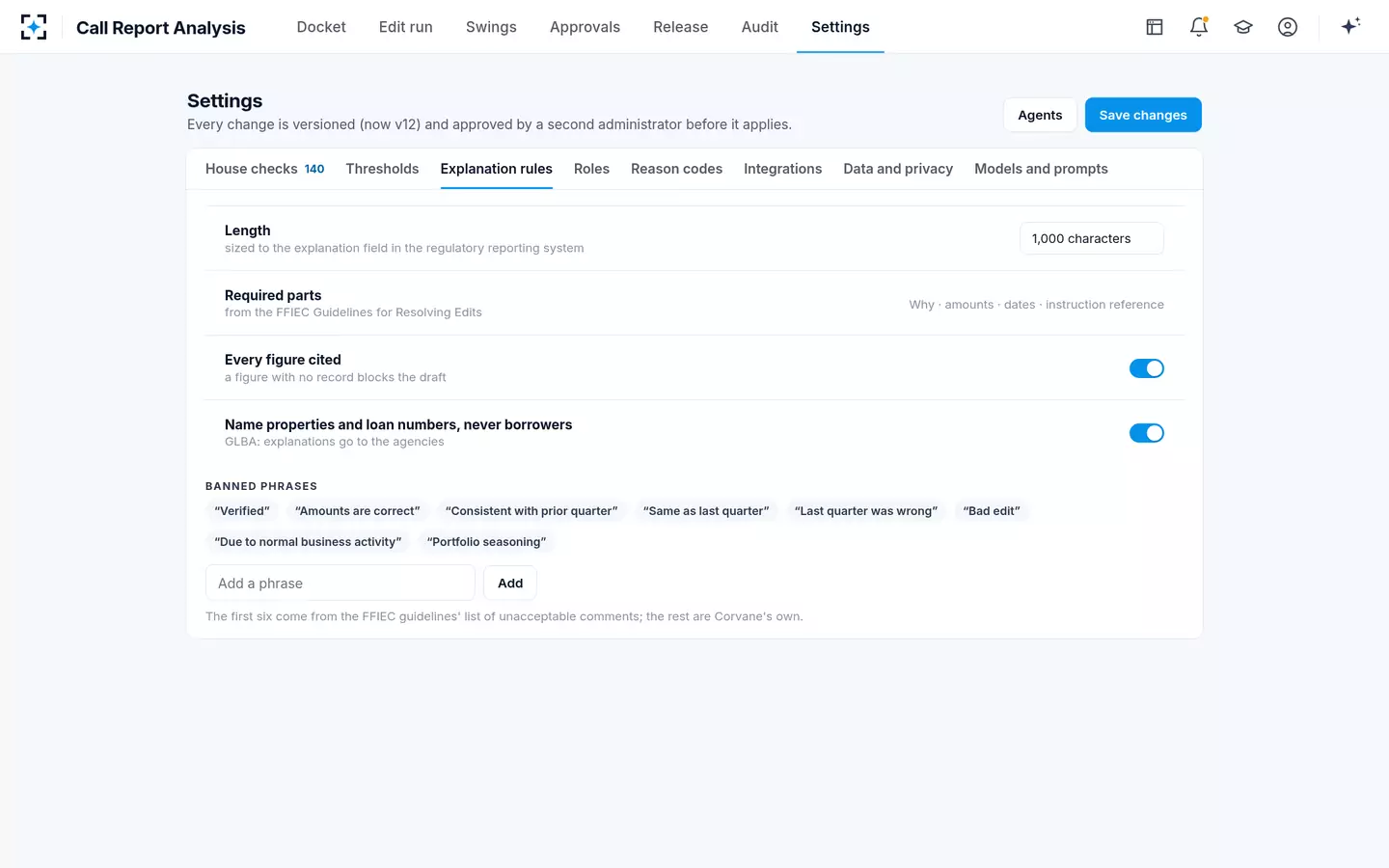
Every one of the twelve is a conclusion without its evidence. "Traced to system reports" says work was done but not what it found. "Our CPA has found nothing wrong with this report" moves the responsibility to someone the agency did not ask. Banks often add their own: the sample bank in Call Report Analysis bans "Due to normal business activity" and "Portfolio seasoning" beside six from the guidelines' list, because a phrase that fits every quarter explains none of them.
Predefined explanations are a start, not an answer
For some quality edits, the software offers predefined explanations to pick from, and picking one is not enough. "Selecting a predefined edit explanation does not eliminate the need to provide a written narrative comment," the guidelines say; a written comment "must accompany each outstanding quality edit exception and support the selected explanation." For prior-period consistency edits, the guidelines' examples of predefined choices are that reporting changed from last quarter, with or without a planned amendment, or that it did not change.
Two traps follow. Restating the predefined explanation word for word in the narrative is itself on the unacceptable list. So is writing a narrative that only makes sense next to the selected option; the narrative has to stand alone. The predefined choice tells the analyst which kind of answer is coming; the narrative is the answer.
When the edit points at last quarter: prior-period corrections
Some quality edits fire because last quarter's figure was wrong and this quarter's is right. The guidelines want the prior period fixed first where possible, earliest period first, and where it cannot be done before the deadline, an explanation that focuses on "(1) what the prior-period error is and (2) how the discrepancy will be resolved." If an amendment is still pending, preparers "should clearly state in their written explanations that a prior-period amendment is pending, and they should provide a projected timeframe." Errors that run across several quarters go to the Call Report analyst.
The guidelines also say what to leave out: "affixing blame or explaining how the error got through the internal controls." Whether the error needs an amendment at all turns on its significance and materiality, which what one call report error costs works through.
Are call report edit explanations public?
No. The data are public; the explanations are not. "Explanations to quality edits will remain confidential within the Agencies (and any applicable state bank supervisory agency)," the guidelines say, and the narrative explanations "represent confidential communications with the Agencies." The Call Report itself, apart from a short list of confidential items, is posted on the FFIEC's public data site once it is accepted (FFIEC Central Data Repository, public data).
Confidential does not mean unread. The figure that fired the edit is public, and the movement behind it is visible to anyone comparing quarters, including examiners preparing for the next exam. An explanation written now is also the bank's answer when the question comes back in that setting, which is one reason to write it as if it will be read again.
What happens if an edit explanation is rejected?
The analyst asks again, and the bank answers on the agency's timetable. The repository accepts a report once every validity edit is cleared and every failing quality edit has an explanation; the review of whether those explanations are sufficient, accurate and complete happens afterwards. If an analyst finds one wanting, the bank may be asked for revised explanations, resubmitted data, or both. FFIEC call report resubmission covers that second round in detail.
How Call Report Analysis drafts and checks each explanation
The solution writes the guidelines into its settings, so the drafting agent and the checking agent work to the same standard. The Drafter writes each explanation with the why, the amounts, the dates and the instruction reference, every figure cited to its source; the Skeptic then foots every figure, checks that dates fall in the quarter, and challenges any banned phrase or unsupported cause. Validity edits are corrected, not explained, and a correction to a reported figure needs a manager who did not propose it.
A cited explanation, ready for the analyst to accept
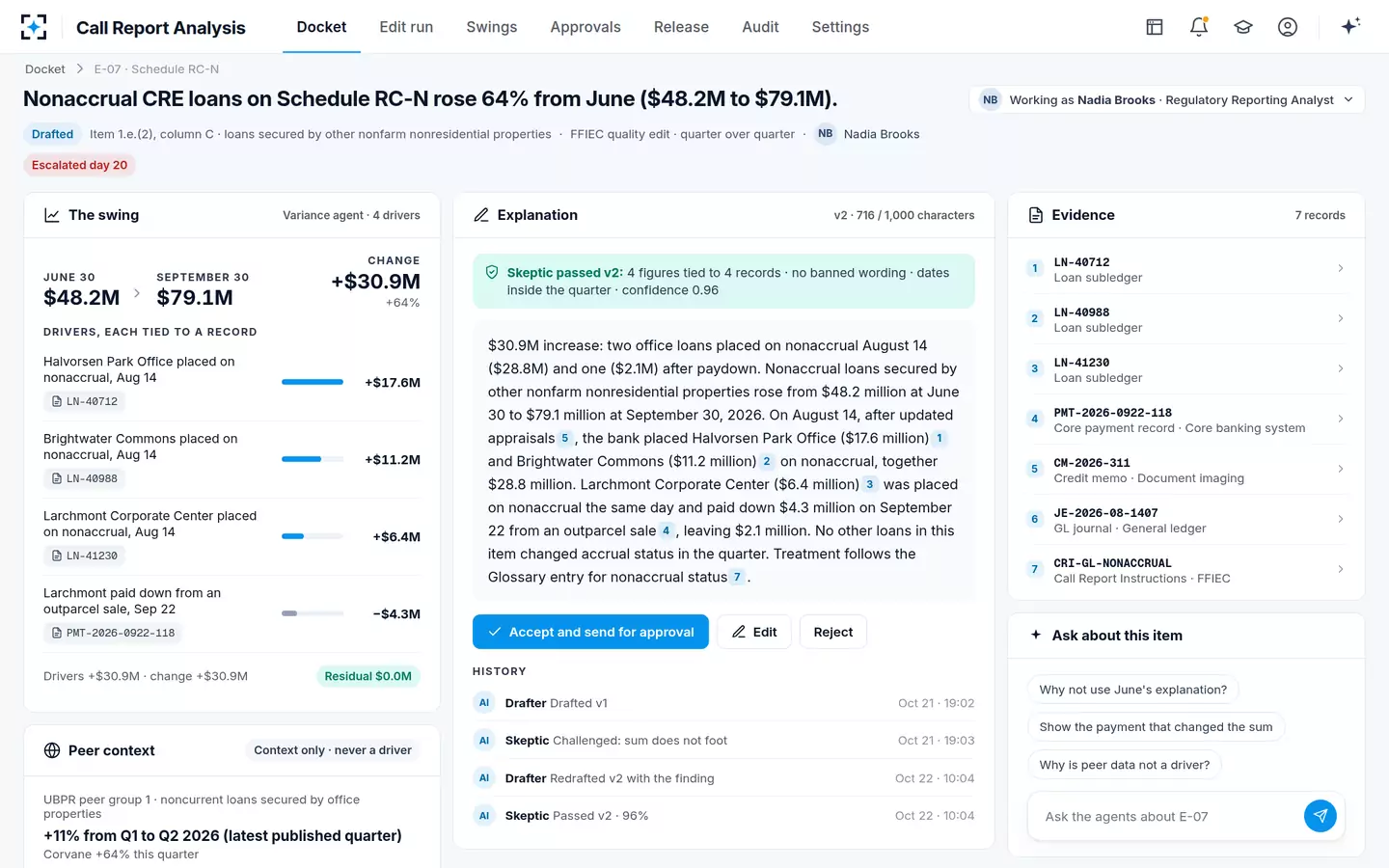
The bank's own wording rules sit in the same place as its thresholds, versioned and approved by a second administrator. In the sample they include eight banned phrases, a required set of parts, and a rule that explanations name properties and loan numbers, never borrowers, because the text goes to the agencies.
The wording rules the Drafter and the Skeptic share
To see the edits, drafts and challenges on a full quarter, start from Call Report Analysis.
Questions people ask
Where do the FFIEC edit criteria come from, and when are they published?
The FFIEC publishes the validation criteria in advance of each quarter end, and Call Report software runs them before submission. The repository rejects a report that has not been adequately validated, so a bank should run the current quarter's criteria on its final draft, not last quarter's.
How long should a call report edit explanation be?
The guidelines set no length; their own examples run from one to five sentences. Write enough to give the cause, the amounts, the dates and the instruction, and stop. A bank or its software may set a character limit; that is a local setting, not an agency rule.
Can a bank disagree with a quality edit?
Not in the explanation. "We disagree with this quality edit" is on the agencies' list of unacceptable comments. A bank that thinks an edit is wrong, or does not understand it, should call its Call Report analyst before the deadline and explain the condition in the meantime.
Do edit explanations carry over from quarter to quarter?
No. Each quarter's report needs its own explanation for each quality edit that fails, and "Same as last quarter" is on the unacceptable list. A recurring condition can have a recurring explanation, but it should be rechecked against the new quarter's figures before it is reused.
Who reviews call report edit explanations at the agencies?
Call Report analysts: at the FDIC's Data Collection and Analysis Section for national and FDIC-supervised banks, and at the Federal Reserve Banks for state member banks. They read explanations after the data are accepted and may ask for clarification later.