A regulatory reporting analyst job description usually says "prepare and review regulatory reports." On a bank's Call Report desk the work is narrower and harder than that: each quarter, the analyst owns a set of schedules, runs the FFIEC edits against each draft, fixes what is wrong, and writes an explanation for every quality edit that still fails, one an agency analyst will read after the report is accepted. The Call Report is due 30 calendar days after the quarter ends, with no other extensions, and 4,238 FDIC-insured institutions filed one for June 30, 2026. Botminds' Call Report Analysis is an agentic solution built for that desk: agents run the edits, split each swing into drivers tied to the general ledger and subledgers, and draft each explanation, while the analyst accepts, a manager approves, and the bank's signers sign.
The examples below come from the solution's fictional sample bank, Corvane National Bank, filing for September 30, 2026; its people and figures are sample data. The rules are linked where they appear.
The Call Report desk, in four numbers
4,238
FDIC-insured institutions at June 30, 2026, each filing a Call Report every quarter
30days
after the report date for the agencies to receive it; no other extensions
3directors
attest beside the CFO declaration at a national or state member bank (2 at a state nonmember bank)
12analysts
listed on the FDIC's Call Report analyst page for national and FDIC-supervised banks
What does a regulatory reporting analyst do?
A regulatory reporting analyst turns the bank's books into the figures its supervisors ask for, and then defends each figure that looks unusual. In a U.S. bank the central return is the Consolidated Reports of Condition and Income, the Call Report: a balance sheet, an income statement and dozens of supporting schedules, filed on the FFIEC 031, 041 or 051. Larger banking groups add holding-company and liquidity reports, but the Call Report is the one every insured bank files.
The analyst's quarter has three parts. The first is placing and proving: amounts reach the right schedule and line, in thousands, from a general ledger closed at the bank's own cut-off. The second is checking: the FFIEC publishes validation criteria before each quarter end, and a report must pass them or explain the quality edits it does not pass. The third, and the one that decides how the desk is judged, is explaining. When nonaccrual loans secured by other nonfarm nonresidential property rise 64% in a quarter, from $48.2 million to $79.1 million in the sample, a quality edit fires on a figure that may be entirely right, and someone has to say why, with the loans, the dates and the amounts.
That last part is where most of the late nights go. The reason a figure moved usually lives outside the reporting team, in credit, treasury or deposit operations, so the analyst is a researcher as much as an accountant: find the transactions behind the swing, prove they add up to it, and write it down in a way that stands without a phone call.
Six seats around one Call Report, from analyst to agency
A Call Report passes through at least five seats inside the bank and one outside it, and the rules name most of them. The analyst prepares; an independent reviewer checks; someone releases; the chief financial officer declares the report correct and directors attest to it; internal audit tests whether the controls worked. Outside the bank, a Call Report analyst at the agencies reads the explanations after the data are accepted.
Six seats on one Call Report, before and with Call Report Analysis
Today
Owns a set of schedules. In the last week of the window, chases credit, treasury and deposits for the reason a figure moved, pulls journals by hand and writes each explanation from an email reply.
With agents
Starts from a draft whose drivers already add up to the change, each figure opening to its journal entry or subledger line. Reads the challenge raised against it, then accepts, edits or rejects with a reason.
Still theirs: deciding whether the explanation is true, and accepting it under their own name
Today
Reviews explanations in a spreadsheet export and asks for the evidence behind each sentence, in the same days the analysts are still writing.
With agents
Approves from a queue that shows who accepted each explanation, what was challenged and what is left unexplained. Cannot approve a correction they proposed.
Still theirs: the independent review, and every correction to a reported figure
Today
Releases the set in a final crunch, when review time is shortest and the due date fixed.
With agents
Sees the window with its escalations and releases only when every release check is met.
Still theirs: the decision that the set is ready
Today
The CFO (or the officer performing that function) declares the report correct; directors attest. Neither sees who checked each explanation.
With agents
Sign with the counts, the approvers and the open items in front of them.
Still theirs: the declaration and the attestation, which no one else can give
Today
Tests the controls from email trails and spreadsheet versions.
With agents
Reads every draft, challenge, override and approval on one trail and exports it for examiners.
Still theirs: the independent test of whether the controls worked
Today
Reads the bank's explanations after the report is accepted, and calls when one does not stand on its own.
With agents
Receives explanations that state the cause, the amounts, the dates and the instruction they rest on.
Still theirs: the discretion to require revised explanations or resubmitted data
Who reviews the Call Report before it is filed?
Someone other than the preparer. The OCC's examiner booklet sets the expectation plainly: "effective policies and procedures designate an individual, group, or department with the responsibility of preparing regulatory reports, while another independent individual, group, or department would typically be designated responsible for reviewing regulatory reports for accuracy and compliance with requirements before filing" (OCC, Regulatory Reporting). The same booklet lists separation of duties, dual controls and independent reconcilements as the fundamental controls.
In practice the reviewer is the regulatory reporting manager, or at a small bank a controller or a second accountant who did not prepare the schedule. The review is only independent if the reviewer can see what the preparer relied on. A spreadsheet export of explanations shows the words, not the journal entry behind each amount, which is why reviews shrink to spot checks as the due date nears.
Maker, then checker: a different person approves every explanation
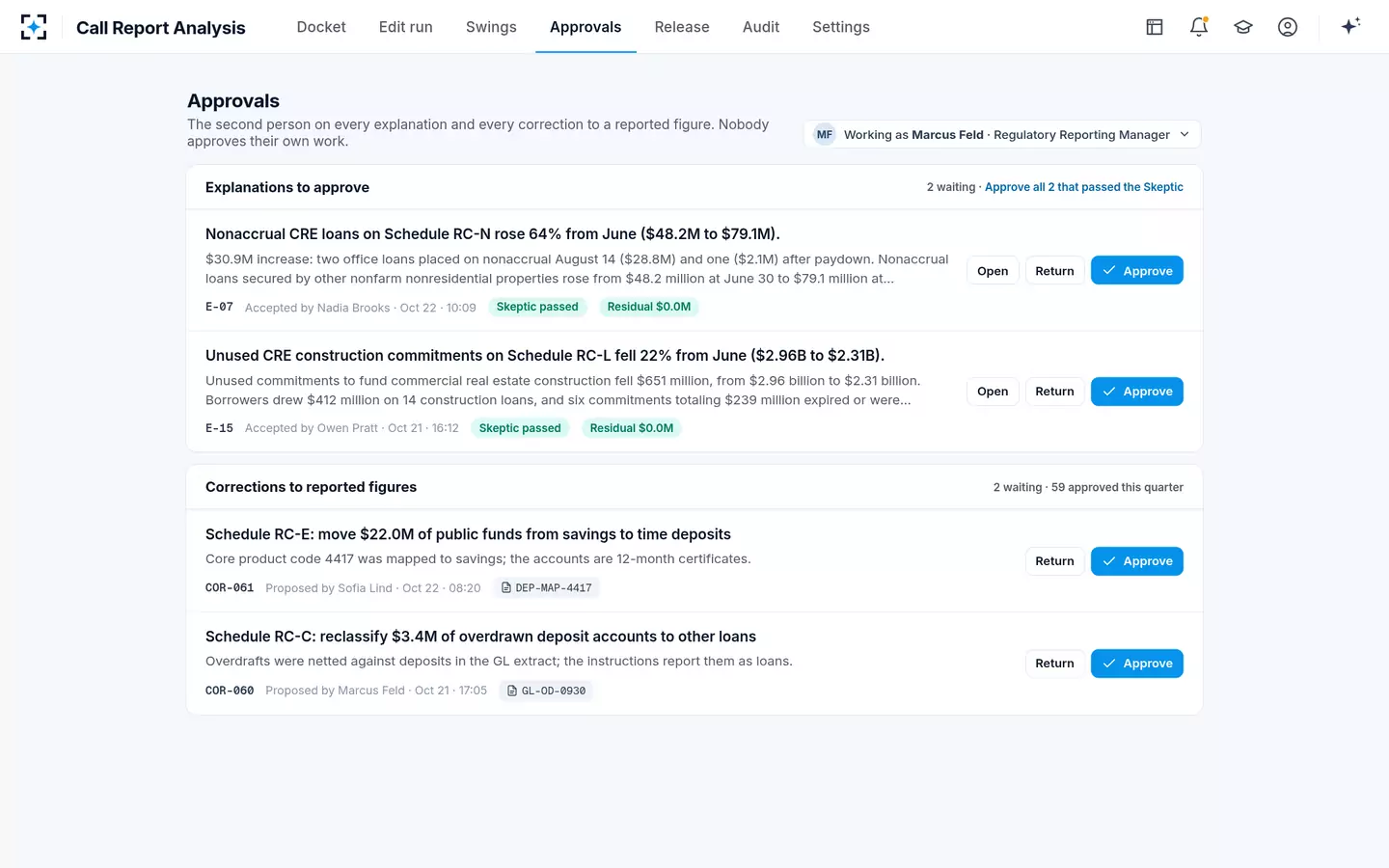
The analyst's real product is an explanation someone else accepts
An explanation is written for a reader the analyst rarely meets. For national banks and FDIC-supervised banks, that reader sits in the FDIC's Data Collection and Analysis Section; state member banks deal with their Federal Reserve Bank instead. The FDIC's contact page lists twelve Call Report analysts by name, with a section chief and two supervisory financial analysts above them, and tells banks that do not know their analyst to call the FDIC's main line (FDIC, Call Report Analysts).
That reader works after the deadline, not before it. The edit explanations are reviewed once the data are in, they stay confidential within the agencies, and an analyst who finds one inaccurate or incomplete can ask for a revised explanation or resubmitted data. What happens when an accepted report comes back is a guide of its own. For the job description, the consequence is simple: an analyst is judged on whether a stranger, months later, can read an explanation and agree with it without asking a question. How to write the quality-edit explanation analysts accept sets out the agencies' own standard.
What skills does a regulatory reporting analyst need?
The skills that matter are specific, and each one traces to a rule. A candidate who can recite debits and credits but has never read the Glossary will struggle; one who knows where the instructions depart from GAAP, and why, will not.
Eight skills the Call Report desk actually uses, and the rule behind each
- Reading the instructions as one text
The General Instructions, line-item instructions and Glossary are cross-referenced and meant to be read together; no single section gives the whole treatment of an item.
- Knowing where the instructions narrow GAAP
Nonaccrual status, collateral-dependent allowances and the separate-entity method for taxes are specific reporting guidance the instructions impose within GAAP.
- Cut-off and rounding
Close of business is the bank's own posting cut-off, applied consistently; banks under $10 billion report in thousands, and only rounding may make details differ from totals.
- Edits, and the difference between them
Validity failures are corrected; quality edits are corrected or explained. Knowing which is which saves a day of the window.
- Tracing a swing to its transactions
Splitting a movement into loans, payments and journal entries that add up to it, and seeing what is left over.
- Writing for a reader who cannot ask
Cause, amounts, dates and the instruction relied on, in a narrative that stands alone.
- Judging materiality
The instructions borrow FASB's definition: information is material if omitting or misstating it could influence users' decisions. Amendments turn on it.
- Keeping up with the quarter's changes
For September 30, 2026: no new data items, but revised capital instructions (the community bank leverage ratio fell from 9% to 8%) and a new reciprocal deposit rule.
What is a regulatory reporting manager responsible for?
The manager owns the review, the people and the process. The review is the visible part: approving each explanation and each correction to a reported figure, as the independent second person. The rest is what examiners look at when they decide whether the desk can be relied on.
The OCC lists what a bank's regulatory reporting policies generally cover, including governance, software selection, the preparation, review and filing of reports and of amended reports, reconciliation, change management for new requirements, data quality, and the standards for documentation, work papers included, and how they are kept. It is just as direct about staffing: people who prepare, review and file "should be appropriately knowledgeable and experienced," training should reflect regulatory and system changes, and duties should rotate from time to time, for succession, for depth, and to prevent or detect fraud (OCC, Regulatory Reporting).
Rotation is the line most desks honour least, because the analyst who has owned Schedule RC-N for five years is the one who knows why it moves. It is also the one an explanation trail makes cheaper: when each explanation carries its evidence, a new owner inherits the reasoning, not just last quarter's words.
Who signs the Call Report, and what the signature attests
The analyst does not sign. The General Instructions require the chief financial officer of the bank, "or the individual performing an equivalent function," to sign a declaration on the cover page attesting to the report's correctness. Directors then attest: at least three at national banks, state member banks and savings associations, at least two at state nonmember banks, in each case "other than the officer signing the chief financial officer declaration" (FFIEC 031 and 041 General Instructions).
Electronic signatures are allowed if the process proves the signer's intent, links the signature to the full report, authenticates the signer and keeps the signed report intact. One requirement shapes the desk's calendar: the bank must record the date of signing, to show that the signature came before the report was submitted. A signature collected after the file goes to the Central Data Repository is not one the instructions accept, so the signers' time has to be planned inside the 30 days, not after them.
In the sample quarter, the Head of Regulatory Reporting releases the set on day 26 and the Chief Accounting Officer signs on day 27; the directors' attestation, which the form also requires, stays with the board. The value of the explanation trail at this step is what the signer can see: how many explanations there are, who accepted and approved each, and that none is still open.
Regulatory reporting analyst interview questions that test the job
The best interview questions for this role are small cases from a real quarter. Each one below has an answer that cites a rule, which is exactly what the job requires.
Interview questions for a Call Report analyst, and what a strong answer cites
| Question | A strong answer | Rule it rests on |
|---|---|---|
| A quality edit fires on a figure you know is right. What do you submit? | An explanation of why the condition exists, with the transactions, amounts and dates and the instruction that governs it; never a bare "confirmed". | Guidelines for Resolving Edits |
| Your drivers for a swing add up to more than the change. What next? | Look for the offsetting transaction, such as a paydown or a transfer out, before writing anything; the difference is the finding. | The figures must reconcile to the reported change |
| Last quarter's figure was wrong. Do you amend? | It depends on whether the error is a significant misclassification or material in measurement, judged by whether it could influence a user's decisions; ask the Call Report analyst if unsure. | General Instructions, Amended Reports |
| You proposed a correction. Who approves it? | Someone independent of the preparer, never the proposer. | OCC booklet, policies and controls |
| An examiner asks why a line moved two quarters ago. Where is the answer? | In the workpapers and supporting documentation kept with the signed report, for three years after the report date. | General Instructions, Retention of Reports |
| What changed in the Call Report this quarter? | For September 30, 2026: no new data items; capital instructions updated for the 8% community bank leverage ratio; a reciprocal deposit interim final rule effective September 1. | FIL-62-2026 and the supplemental instructions |
A seventh question separates good candidates from very good ones: "What will the examiner look at first?" The answer is the bank's public performance data. Examiners use the Uniform Bank Performance Report to spot large movements and choose which schedules to test, which is why UBPR peer groups belong in an analyst's reading before the report goes out.
How the analyst's quarter changes with Call Report Analysis
The analyst's time moves from finding to judging. By our estimate for a team writing about 38 explanations a quarter, the hand-built version takes about 13 working days of the window; with the agents doing the edit runs, the decomposition and the first draft, it takes about 4, and the review days fall least because they are the part that should not shrink.
Where a quarter's explanation days go: finding shrinks, judging stays
| Kind of work | By hand | With Call Report Analysis |
|---|---|---|
| Asking credit, treasury and deposits why a figure moved | 3 days | 0.5 day |
| Pulling journals and subledger detail for each swing | 3 days | 0.5 day |
| Writing the explanations and making the figures foot | 3 days | 1 day |
| Re-checking last quarter's recurring explanations | 1 day | 0.25 day |
| Manager review of every explanation | 2 days | 1 day |
| Release by the Head and the signatures | 1 day | 1 day |
| Total | about 13 days | about 4 days |
In the sample quarter the agents' first edit run on October 9 left 143 failures; by the third draft on October 21, 38 needed a written explanation, every one already drafted. On day 22 of 30, 29 were ready and 9 left, with three escalated to the manager at day 20. The analyst's work on each was to read the draft, open the evidence behind any figure that looked wrong, and decide. The agents never change a reported figure, accept, approve, release or submit.
The 30-day window, with the workload by analyst
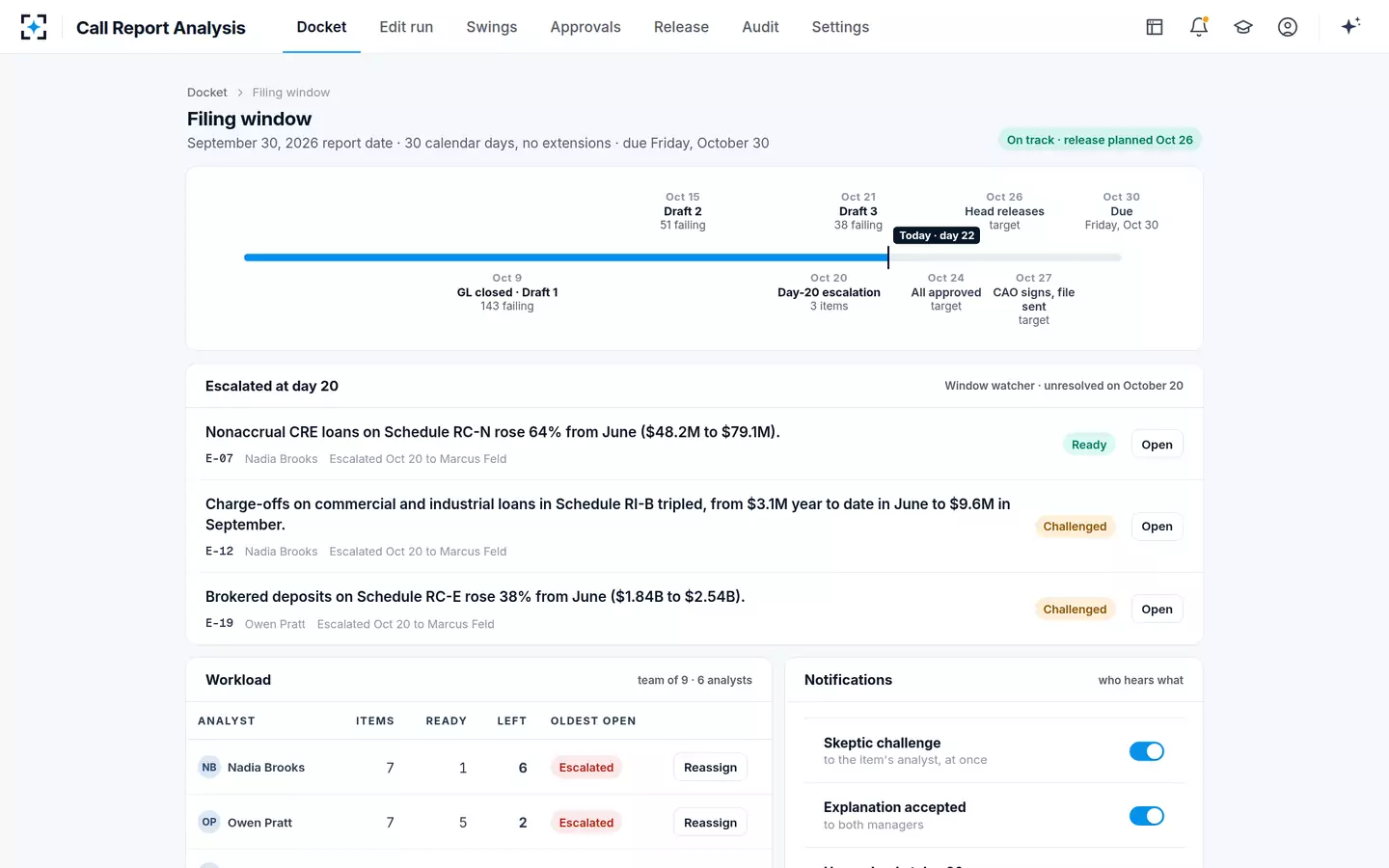
What does not change is accountability. The analyst who accepts an explanation is saying it is true; the agents make it faster to check, not unnecessary to. To see the desk with its own data, start from Call Report Analysis.
Questions people ask
What is the difference between a regulatory reporting analyst and a financial analyst?
A financial analyst reports to management or investors under GAAP; a regulatory reporting analyst reports to supervisors under their instructions. The Call Report follows GAAP for recognition and measurement, but the instructions add specific rules within it, such as the Glossary's nonaccrual rules, and decide which line each amount belongs on.
Can one person prepare and review the Call Report?
The OCC expects preparation and review to sit with different people, and calls separation of duties a fundamental control. A small bank without a second qualified person can have the pre-filing review done by a third party, which the OCC allows, as long as the reviewer is trained in the bank's reporting process.
Who is my Call Report analyst at the agencies?
National banks and FDIC-supervised banks are assigned an analyst in the FDIC's Data Collection and Analysis Section; state member banks contact their Federal Reserve Bank. A bank that does not know its FDIC analyst can call (800) 688-FDIC and be routed.
How long must Call Report workpapers be kept?
Three years after the report date, together with the signed and attested report and any amendments, unless a state requires longer. The General Instructions tie the period to the FDIC's three-year window for verifying deposit insurance assessments.
Does a regulatory reporting analyst sign the Call Report?
No. The chief financial officer, or the person performing that function, signs the declaration, and at least three directors (two at a state nonmember bank) attest. The analyst's name belongs on the workpapers and the explanations, which is where examiners look for it.
What changed for Call Report analysts in the third quarter of 2026?
No new data items, but capital instructions were updated for the community bank leverage ratio cut from 9% to 8% with a four-quarter grace period, and reciprocal deposit reporting followed an FDIC interim final rule effective September 1, 2026. A due date that falls on a weekend or holiday can now be met on the next business day, which first matters for the December 31, 2026 report: due Saturday, January 30, 2027, it may be filed on Monday, February 1.