An FFIEC call report resubmission is a revised Call Report data file, or a revised explanation, sent to the agencies' Central Data Repository after the original was filed. It happens for three reasons: an agency Call Report analyst reads the bank's quality-edit explanations after the report is accepted and finds one inaccurate or incomplete; the bank, its auditor or an examiner finds that a reported figure was wrong; or the bank's supervisor reads an instruction differently from the bank. Acceptance by the repository is therefore not the end of a quarter's review, only the end of the bank's deadline. Botminds' Call Report Analysis is an agentic solution built for the edits and explanations of the Call Report; its agents tie every explanation to its sources and keep the whole trail, so that when the analyst asks a question weeks later the answer is already written down.
The process below is quoted from the agencies' Guidelines for Resolving Edits and the September 2026 General Instructions; the screens come from the solution's fictional sample bank.
A Call Report's life after submission: accepted is not finished
- 1
Submitted
The bank transmits its file to the Central Data Repository by the due date.
Bank
- 2
Validated
Validity edits must all pass; every failing quality edit needs an explanation. Otherwise the file is rejected.
Repository
- 3
Accepted and published
Accepted data go to the public site; the UBPR usually follows within a day.
Repository
- 4
Explanations read
A Call Report analyst checks each explanation is sufficient, accurate and complete. The review runs past the due date.
Agency analyst
- 5
Closed, or reopened
No action; a question; a revised explanation; or resubmitted data, which may reach back to earlier quarters.
Analyst, then bank
What happens after a call report is submitted?
The repository validates it, accepts it, publishes it, and then a person reads the explanations. A report with any failing validity edit, or a failing quality edit without an explanation, is rejected and must be corrected and resubmitted. Once it passes, the data are accepted and posted on the FFIEC's public site; the bank's UBPR usually follows within a day of filing (FFIEC UBPR User's Guide).
The reading comes after. "After acceptance of a bank's data, Call Report analysts will review written explanations to ensure that each explanation is sufficient, accurate, and complete. Analysts may contact banks at a later date if clarifications or data resubmissions are necessary." The guidelines are explicit that this does not run on the bank's clock: "This review is an ongoing analysis that will extend beyond the submission date and will not, in and of itself, delay publication of the data" (Guidelines for Resolving Edits).
Why would the FDIC ask for a call report resubmission?
Because an explanation did not hold up, a figure was wrong, or the agency reads the instructions differently. The first is the most common route back. "The analyst will continue to have discretion in determining whether an explanation is acceptable. If explanations are inaccurate, incomplete, or otherwise unacceptable, analysts will require banks to resubmit their data, revised explanations, or both."
Three routes back to the repository, and what each one needs
| What triggered it | Who usually finds it | What the bank sends |
|---|---|---|
| An explanation is incomplete or inaccurate | The agency's Call Report analyst, after acceptance | A revised explanation; resubmitted data if the explanation reveals an error |
| A reported figure is wrong | The bank, its auditor, or an examiner | Corrected data for the affected quarters, earliest first, if the error is significant or material |
| The agency reads an instruction differently | The supervisor, often in response to the bank's question | Reports prepared on the agency's interpretation, and amended past reports if required |
The third route surprises banks most. The General Instructions say questions of interpretation go to the bank's primary federal supervisor and from there to the FFIEC's Task Force on Reports, and that where the supervisor reads an instruction differently from the bank, it can require the bank to report its way and to amend reports already filed (FFIEC 031 and 041 General Instructions; call report analyst quotes the passage). The 2023 uninsured deposit case, in which the FDIC told banks that had netted collateral to amend, is that route at industry scale; it is told in call report uninsured deposits.
How do you resubmit a call report?
Through the Central Data Repository, the same way as the original. A revised data file goes in through the bank's Call Report software, passes the same edits, and replaces the earlier submission; a revised explanation is submitted with the data it explains. Where several quarters are affected, the guidelines set the order: "When submitting prior-period data, banks should correct and resubmit the earliest data and then submitting the data for the most recent period." And when errors span more than one quarter, "banks should contact their Call Report analysts" before starting.
A revised explanation and an amended report are different jobs
Revised explanation: An analyst finds an explanation insufficient, inaccurate or incomplete
Amended report: A reported figure was wrong, or the supervisor reads the instruction differently
Revised explanation: The words; the figures stand
Amended report: The figures, for every quarter affected
Revised explanation: The same edit still fails; the new explanation must answer it
Amended report: All edits run again on the corrected file
Revised explanation: None: explanations are confidential
Amended report: Public data and the UBPR for those quarters change
Revised explanation: The drivers, dates, amounts and instruction behind the swing
Amended report: What the error was, why it happened, and the corrected workpapers
A resubmission is also a signed report. The instructions' retention rule covers the signed and attested record of any amended report as well as the original, so an amendment needs its own sign-off, not just a transmission. Plan for the signers as you would in the original window.
Is there a deadline for call report resubmission?
No fixed number of days appears in the instructions or the guidelines; the requirement is timeliness. "The FFIEC expects a timely response to resubmission requests, including requests for changes in written explanations and for changes to the quantitative values." In practice the analyst who asks will say when the answer is needed. Where an amendment is pending at the next quarter's deadline, the guidelines ask the bank to say so in its explanation and give a projected timeframe.
The OCC adds a different clock for amendments that examiners require: examiners and their supervisory office should work with management "to determine, based on the bank's specific circumstances, a reasonable corrective action date for the amended regulatory report to be filed" (OCC, Regulatory Reporting). That date then becomes a commitment the next examination checks.
Can a resubmission make a call report late?
Yes, if the original was rejected and the corrected file arrives after the due date. The General Instructions say a submission the repository cannot process, or that the bank has not adequately validated, "will be rejected and will require correction and resubmission," and that a resubmission received after the due date can bring the late-filing penalties. A report accepted on time and later revised is a different case: the original was filed on time, and the revision answers a request.
The lesson for the window is to submit early enough to absorb a rejection. The General Instructions already ask institutions to leave time before the due date to research and resolve edit exceptions. In the sample bank's plan the set is released on day 26 and signed on day 27 of 30, leaving three days for exactly this; the late-penalty schedule is set out in what one call report error costs.
Who is my call report analyst?
It depends on the bank's charter. The FDIC's page says state member banks contact their Federal Reserve District Bank, while national banks and FDIC-supervised banks contact their assigned analyst in the FDIC's Data Collection and Analysis Section; a bank that does not know its analyst can call (800) 688-FDIC (3342) (FDIC, Call Report Analysts). The guidelines encourage preparers to call the analyst before submitting when an edit is unclear, which is far cheaper than a resubmission afterwards.
The relationship is worth tending. An analyst who has seen a bank's explanations quarter after quarter learns which ones it can trust; one who has had to ask twice about the same line will ask a third time. Consistency across quarters, explanations that cite the same kinds of evidence, and quick answers when asked are the practical ways to earn the first kind of reading.
A resubmission changes the public record too
Amended data replace the original on the FFIEC's public site, and the UBPR follows. The UBPR's guide sets the schedule: the current quarter is recalculated every night, the current and four prior quarters every Friday night, and the prior twenty-one quarters once a quarter (FFIEC UBPR User's Guide). An amendment to last year's figures will therefore show in peer comparisons within days, and an analyst, investor or examiner comparing the bank's history will see the restated series.
That is one more reason to amend with an explanation ready. The figures change in public; the reasons stay with the bank and the agencies. When the question comes, at the next examination or from the board, the answer should not have to be rebuilt.
How long should call report evidence be kept, and what to keep?
The instructions require three years after the report date for the signed report, any amendments, and the workpapers and supporting documentation. That is the floor, not the useful answer. The useful answer is: keep, for each explanation, whatever would let a stranger reproduce it, for at least as long as an analyst or examiner might ask.
What to keep for each explanation until the analyst and the examiner have finished
- The edit, as it fired
The edit, the figures it compared, and the draft of the report it ran on.
- Every driver, with its source
The loan, payment, journal entry or document, with identifiers, amounts and dates.
- The residual, and why it is acceptable
The part not explained, and the limit it was within.
- The instruction relied on
The page or Glossary entry, as it read that quarter.
- Each version of the explanation
Drafts and challenges, so a later reader can see what changed and why.
- Who accepted and who approved
Two different names, with dates.
- Any question from the agency, and the answer
With the date the answer went and what was resubmitted.
How Call Report Analysis keeps the answer ready for the second read
It writes the trail while the work is done, not after. Every explanation in the solution is built from cited sources, challenged, accepted by an analyst and approved by a different manager, and each of those steps lands on one audit trail with its time and its evidence. When the agency asks about an item, the trail filtered to that item is the answer, and one export assembles the item's versions, challenges, approvals and sources for the analyst, an examiner or internal audit.
One item's history, from escalation to approval, in seven lines
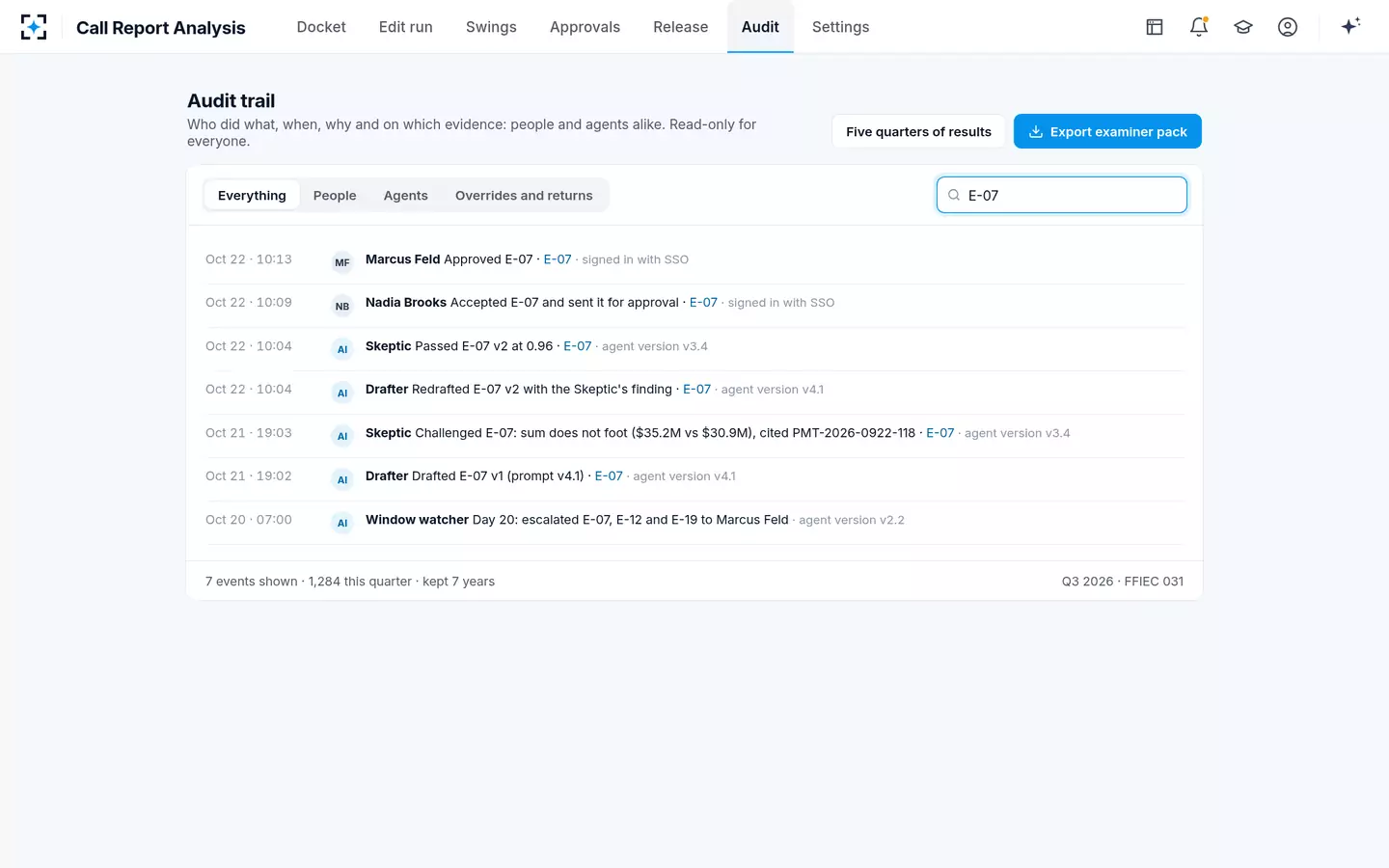
The citation is the other half. Every figure in an explanation opens to its source, the payment entry, the subledger line or the credit memo, with the passage the citation points to highlighted, and opening it is itself logged. An analyst's question about the $30.9 million rise in the sample bank's nonaccrual loans is answered by the record of a $4.3 million principal payment on September 22, not by someone's recollection of a phone call.
Two names on every explanation: who accepted it and who approved it
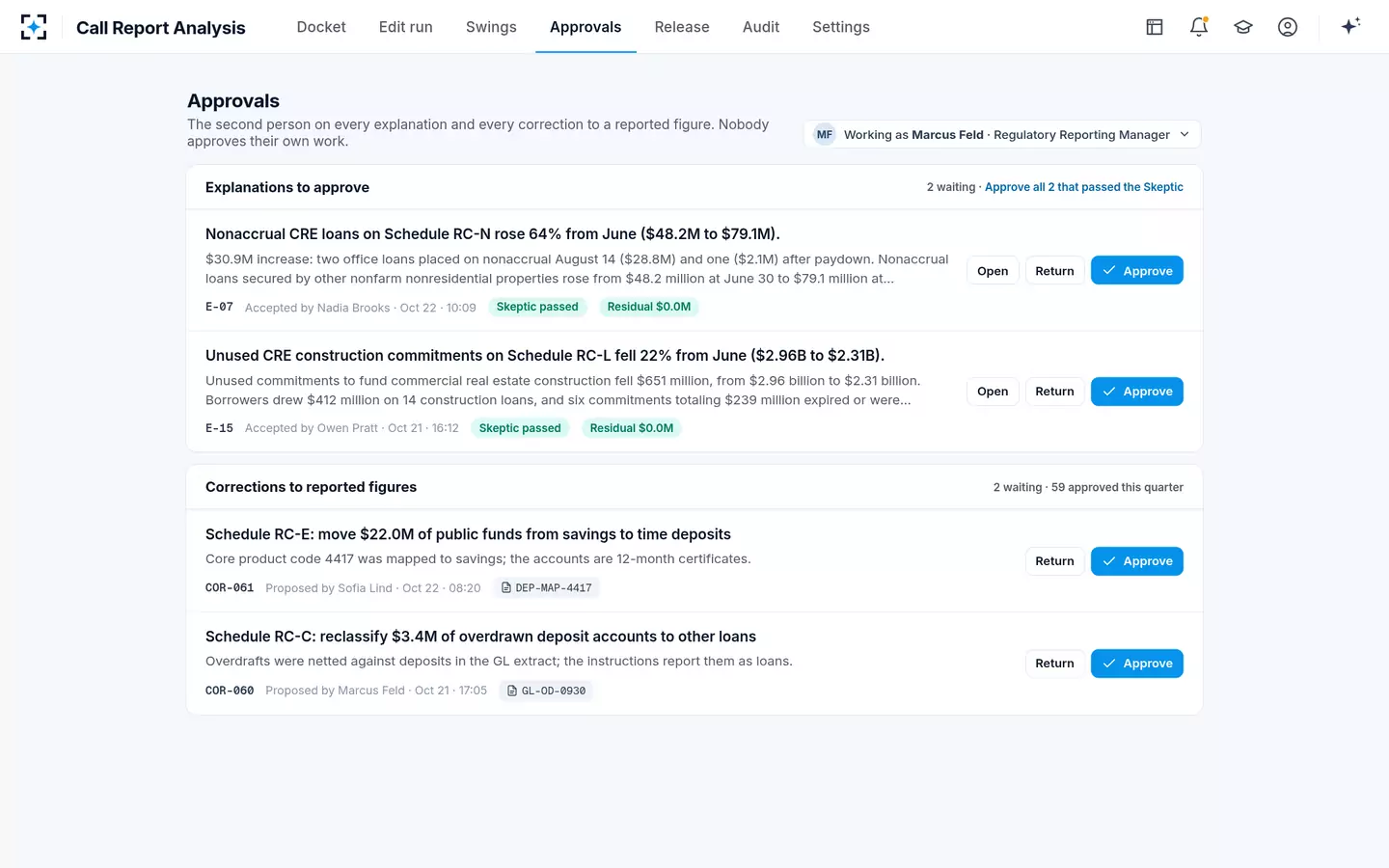
To see the trail and the export on a full quarter, start from Call Report Analysis.
Questions people ask
Does a resubmission request mean the bank did something wrong?
Not necessarily. A request for a revised explanation means the analyst could not confirm the condition from what was written; the figure may be right. A request for resubmitted data means a figure is wrong, and whether that is a violation depends on its significance, which examiners judge separately.
Can a bank resubmit a Call Report on its own initiative?
Yes. A bank that finds an error itself, or whose external auditor recommends an adjustment, can amend without being asked, and the OCC expects management to amend reports for the periods in which a material misstatement occurred. Calling the Call Report analyst first is sensible when several quarters are involved.
Does a resubmission need new signatures?
The instructions require a signed and attested record of the completed report, including any amended reports, kept with the workpapers. Treat an amendment as a report: the CFO's declaration and the directors' attestation should cover it.
How far back can the agencies ask for resubmitted data?
No fixed limit appears in the instructions. Examiners decide which reports and how far back based on the error's nature, root cause and the bank's refiling history; in the 2023 uninsured deposit case the FDIC invited up to three years of revisions, or more if appropriate.
Do edit explanations need resubmitting when the data are amended?
Yes, wherever an amended file still fails quality edits. The corrected data run through the same edits, and any that still fail need explanations that fit the corrected figures, not the original ones.