A call report analyst, in the agencies' usage, is the staff member assigned to review a bank's Consolidated Reports of Condition and Income and to answer its specific reporting questions: for national banks and FDIC-supervised banks, an analyst in the FDIC's Data Collection and Analysis Section; for state member banks, staff at their Federal Reserve District Bank. The title also describes a job inside banks, the person who prepares and explains the Call Report. Both meet at the same moment: when the FFIEC 031, 041 or 051 instructions do not settle where an amount goes, the agencies' own documents tell the preparer to ask a person. That is hard to do well in a 30-day filing window, because the question has to be specific enough to answer and the answer has to be kept where the next preparer will find it. Botminds' Call Report Instructions Search exists for that gap: its agents answer from the instruction books with citations, and package only the questions the books do not decide for the bank's Policy Lead, who decides whether to ask the agency.
Five people answer Call Report questions, and each settles a different kind
Today
Gets the bank's instruction questions by phone or email, often in the last days before the due date, with little context.
With agents
Gets fewer questions, each with the passages already read and the bank's own position stated.
Still theirs: Reads explanations after acceptance; can ask for revised data or an amendment.
Today
Fields user accounts, passwords and other system issues, including multifactor sign-in.
With agents
Unchanged: it is not a source of instruction answers.
Still theirs: 9:00 a.m. to 8:00 p.m. Eastern, Monday to Friday.
Today
Answers the same placement questions by email for every finance team, most in the last week of the window.
With agents
Rules once on a packaged question with a reason code; decides when to ask the agency.
Still theirs: Every ruling, and the call to send a question out.
Today
Searches PDFs or copies last quarter, and does not know whom to ask.
With agents
Asks in plain words and gets the line with three cited layers, or a routed question with a clock.
Still theirs: The figure on the line, and saving the answer to the working papers.
What is a call report analyst?
At the agencies, a call report analyst is the person a bank is assigned for Call Report assistance. The FDIC's contact page is explicit about the routing: state member banks "should contact their Federal Reserve District Bank," while national and FDIC-supervised banks contact "their assigned analyst" in the FDIC's Data Collection and Analysis Section, and a bank that does not know its analyst can reach one through the FDIC's main number (FDIC, Call Report Analysts). National banks are on the FDIC's list even though the OCC supervises them; the General Instructions group them the same way for filing, naming the FDIC "for national banks, FDIC-supervised banks, and savings associations" and the Federal Reserve District Bank "for state member banks" (General Instructions, page 10).
The FDIC's page for new filers puts the analyst's role in one line: "For specific reporting questions, institutions should contact their assigned Call Report Analyst" (FDIC, Important Information for New Call Report Filers). The same page adds that amendments "may also be requested by your Call Report Analyst to resolve edit exceptions or by examiners as part of examination activities." So the analyst is both the bank's help line before filing and a reviewer after it.
Inside banks the same words describe a different seat: the regulatory reporting analyst who owns schedules, runs the edits and writes the explanations. That role, with its duties and the review chain around it, is set out in the regulatory reporting analyst job description from Call Report Analysis. This guide is about the agency side and the questions that travel between the two.
Who is my FDIC call report analyst, and who do state member banks ask?
It depends on the charter, not on the form. A national bank or an FDIC-supervised state nonmember bank has an assigned analyst in the FDIC's Data Collection and Analysis Section; a state member bank goes to its Federal Reserve District Bank; a holding company's FR Y-9C questions go to its district Reserve Bank as well. The quarterly letter adds a broader instruction for policy questions: the September 2026 Supplemental Instructions close their section on a new accounting standard with "Should a financial institution have specific reporting questions, please contact your primary Federal regulator" (Supplemental Instructions, September 30, 2026).
Who to ask, by the kind of Call Report question
| Kind of question | Who answers it | What it rests on |
|---|---|---|
| Where an amount goes on a schedule (national or FDIC-supervised bank) | Assigned analyst, FDIC Data Collection and Analysis Section | FDIC Call Report Analysts page |
| Where an amount goes on a schedule (state member bank) | Federal Reserve District Bank | FDIC Call Report Analysts page |
| A validity or quality edit, before submitting | The bank's Call Report analyst | Guidelines for Resolving Edits |
| How a new rule or accounting standard applies | The primary federal regulator | Supplemental Instructions, September 2026 |
| User accounts, passwords, multifactor sign-in, file processing | CDR Help Desk | Supplemental Instructions; FIL-1-2026 |
| FR Y-9C submission and reporting questions | District Reserve Bank | FR Y-9C General Instructions |
| A formal interpretation of an instruction | Primary federal supervisor, referred to the FFIEC Task Force on Reports | General Instructions, page 8 |
| What the bank itself will do where the books are silent | The bank: policy lead, approved by the reporting manager | FFIEC 031/041 General Instructions |
What does the CDR help desk handle, and what does it not?
The CDR Help Desk handles the Central Data Repository, the system that receives and validates the report, not the instructions. The supplemental instructions describe its job as assistance "with user accounts, passwords, and other CDR system-related issues," available from 9:00 a.m. to 8:00 p.m. Eastern Time, Monday through Friday, at (888) CDR-3111 or cdr.help@cdr.ffiec.gov; it is also where a bank can ask which vendors sell Call Report preparation software (Supplemental Instructions, September 2026; call report software vendors sets out the three lists).
System questions can still stop a filing. The fourth-quarter 2025 letter warned that multifactor authentication was fully in place in the CDR and that "Users who do not register for MFA will be unable to submit their December 31, 2025, Call Reports" (FIL-1-2026). That is a help desk matter. Whether leases to a county belong in item 8 or item 10 of Schedule RC-C is not, and sending it there costs a day the bank does not have.
The window a question to the analyst has to fit inside
30days
after the report date for the CDR to receive the Call Report; 35 for a bank with more than one foreign office
Oct 30
due date for the September 30, 2026 report; November 4 for certain banks with foreign offices
4,238
FDIC-insured institutions at June 30, 2026, each filing a Call Report
9–8ET
CDR Help Desk hours, weekdays: systems, not instructions
When should I contact my call report analyst?
Before submitting, and early enough to act on the answer. The agencies' edit guidelines say that preparers with questions about validity or quality edits "are encouraged to contact their Call Report analyst before submitting their Call Report data" (Guidelines for Resolving Edits), and the General Instructions require a completed report, edits resolved and explanations written, by a due date that allows "No other extensions" (General Instructions, page 10a). A question asked on day 28 leaves no time to change a mapping, re-run the edits and get a second review.
The better trigger is the kind of question, not the calendar. Three kinds belong with the analyst: a classification the instructions and Glossary leave genuinely open; a new rule whose reporting the agencies have described only in outline, as with custodial deposits for September 30, 2026; and an edit the bank believes is firing on a correct figure. Two kinds do not: a question the instruction page answers in a sentence, which the bank should find itself, and a question about the bank's own policy choice, which the bank has to make and document whatever the analyst says.
Can a call report analyst answer instruction questions?
Yes, and the instructions invite it, but the answer does not replace the bank's responsibility for the figure. The General Instructions make each bank responsible for reporting "fully and accurately" each quarter, a responsibility that stays with the bank whoever helped it (General Instructions, page 10). An analyst's reply is evidence the bank used to reach its position; it is not a published instruction, it does not bind another bank, and it does not survive a revised instruction page.
Formal interpretations take a longer road. The General Instructions send "Questions and requests for interpretations" to the bank's primary federal supervisor and say what happens next:
Such inquiries will be referred for resolution to the Task Force on Reports of the Federal Financial Institutions Examination Council (FFIEC). Regardless of whether a bank requests an interpretation of a matter appearing in these instructions, when a bank's primary federal bank supervisory agency's interpretation of the instructions differs from the bank's interpretation, the supervisory agency may require the bank to prepare its Call Report in accordance with the agency's interpretation and to amend previously submitted reports.
FFIEC 031 and 041 General Instructions, page 8 (6-22)
The second sentence is the one to remember. A bank that never asked is not protected by not asking, and a bank that asked informally and got a quick reply has not obtained an interpretation of the Task Force. For events that neither the Call Report instructions nor authoritative U.S. GAAP cover in principle, the same instructions encourage banks to discuss the transaction with their supervisor first, and the agency's view still prevails if it differs.
That has a practical consequence for how the reply is kept. A one-line email saying "item 10.b" is of little use eighteen months later, when an examiner asks why the bank reports that way and the person who asked has moved on. The reply is worth keeping with the question as sent, the passages both sides read, the report date, the analyst's name and the date, and the bank's resulting position, approved like any other policy. The OCC's examination booklet expects a bank's regulatory reporting policies to set documentation standards, work papers and their upkeep included (Comptroller's Handbook, Regulatory Reporting; accounting research software and the Call Report memo quotes the list).
A question an analyst can answer in one reply
- Name the form, the report date and the schedule
FFIEC 031, 041 or 051; September 30, 2026; Schedule RC-C, Part I. Page numbers differ between the books.
- State the facts that decide it
Borrower or lessee type, collateral at origination, purpose, maturity: the facts the instruction tests, not the product name.
- Quote the passages already read
With page and revision date, such as RC-C-20a (12-24), so the analyst sees where the doubt is.
- Say what the bank proposes, and why
A line and the sentence it rests on. An open question invites an open answer.
- Give amounts and quarters
How much, and what was filed on the line last quarter, so any change of placement is visible.
- Ask one question
Two placements in one email tend to get one answer.
Who decides when a question goes to the agency?
Someone inside the bank should, deliberately, and only after the bank's own sources have been read. Most placement questions are answered by a sentence in the schedule instructions, the Glossary or the current supplemental instructions; a smaller share are answered by the bank's approved position memos; the rest are genuinely open. Sending everything to the analyst wastes the analyst's time and the bank's, and sending nothing leaves preparers guessing. A policy lead who sees every open question, with the passages already gathered, can tell the three groups apart.
One Call Report question, from the preparer to the agency and back
A person decides
Preparer asksTypes the question in plain words, with the form and the quarter.
Agent
Answer agentFinds the instruction, Glossary and supplemental passages that decide it.
Never: answers without a citation.
Agent
Change and Precedent agentsCheck page revision dates against the bank's memo, and what was filed on the line.
Never: edits a memo.
Agent
Routing agentPackages what the sources do not settle for the Policy Lead, with a clock.
Never: rules on a question.
A person decides
Policy Lead rules, or asks the agencyRules with a reason code; where the books are silent, takes the packaged question to the analyst.
A person decides
Manager approvesApproves the resulting memo version; the maker cannot approve it.
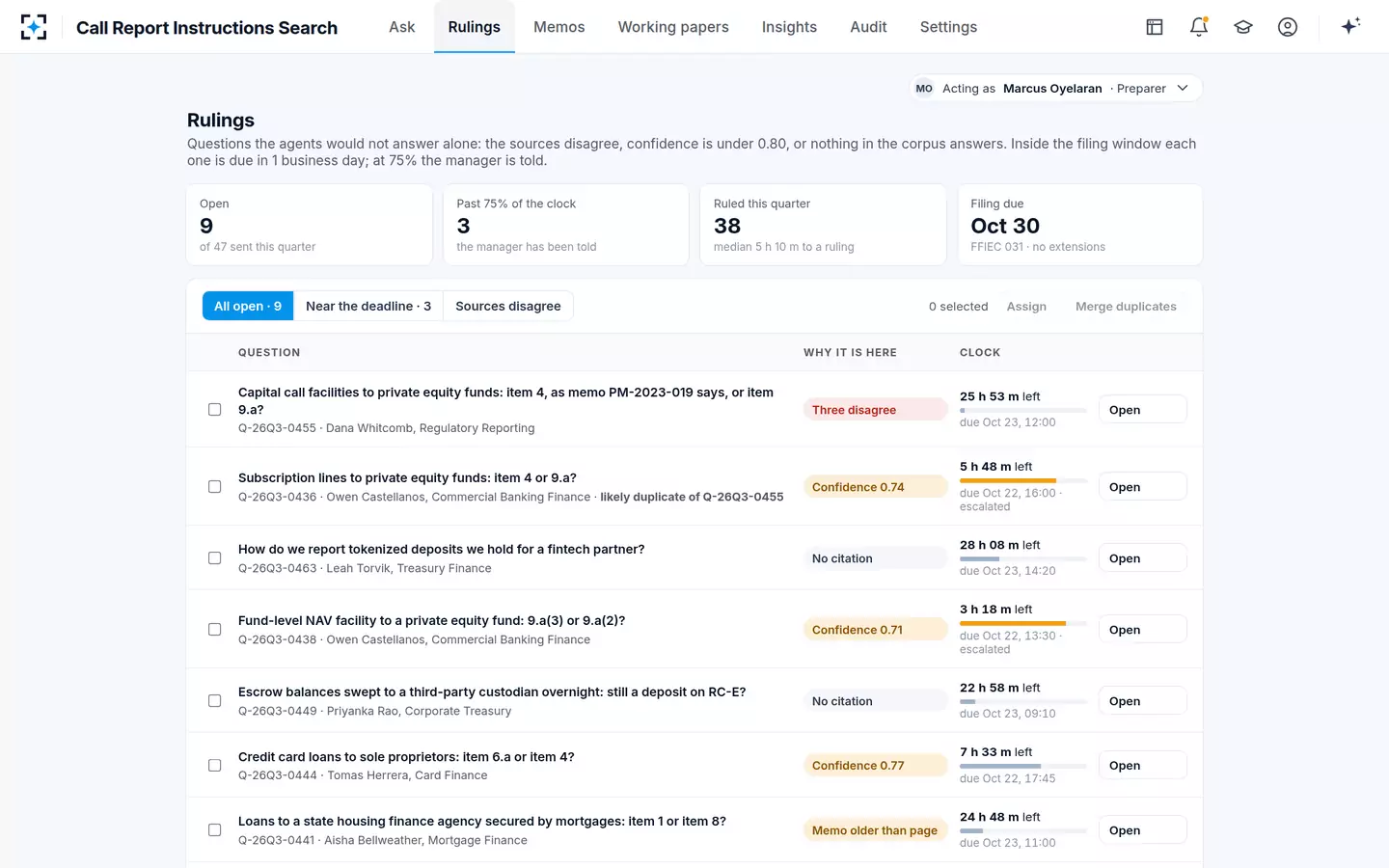
Call Report Instructions Search builds that triage into the answer. On sample data about a fictional $92 billion bank in the last week of its third-quarter 2026 window, the Policy Lead's queue holds nine open questions, each with the reason it came: the three sources disagree, the answer scored under the 0.80 confidence threshold, or nothing in the instructions and memos answers it. One of the reason codes she can rule with is "Ask the agencies before ruling," and the screen carries a button to send the question out. That button is hers; the agents do not use it.
The Policy Lead's queue: only questions the books did not settle
How should a bank document an answer from its call report analyst?
As a ruling with a source, not as an email in someone's inbox. The file that holds up has five parts: the question as asked, with its facts and amounts; the instruction passages read, with their page revision dates; the analyst's reply, with name and date; the bank's position, written as a memo version and approved by someone other than its author; and the report date from which the bank applied it. The General Instructions ask banks to keep the signed report, its workpapers and the support behind them for three years from the report date (General Instructions; the call report checklist quotes the rule), and many banks keep policy decisions longer.
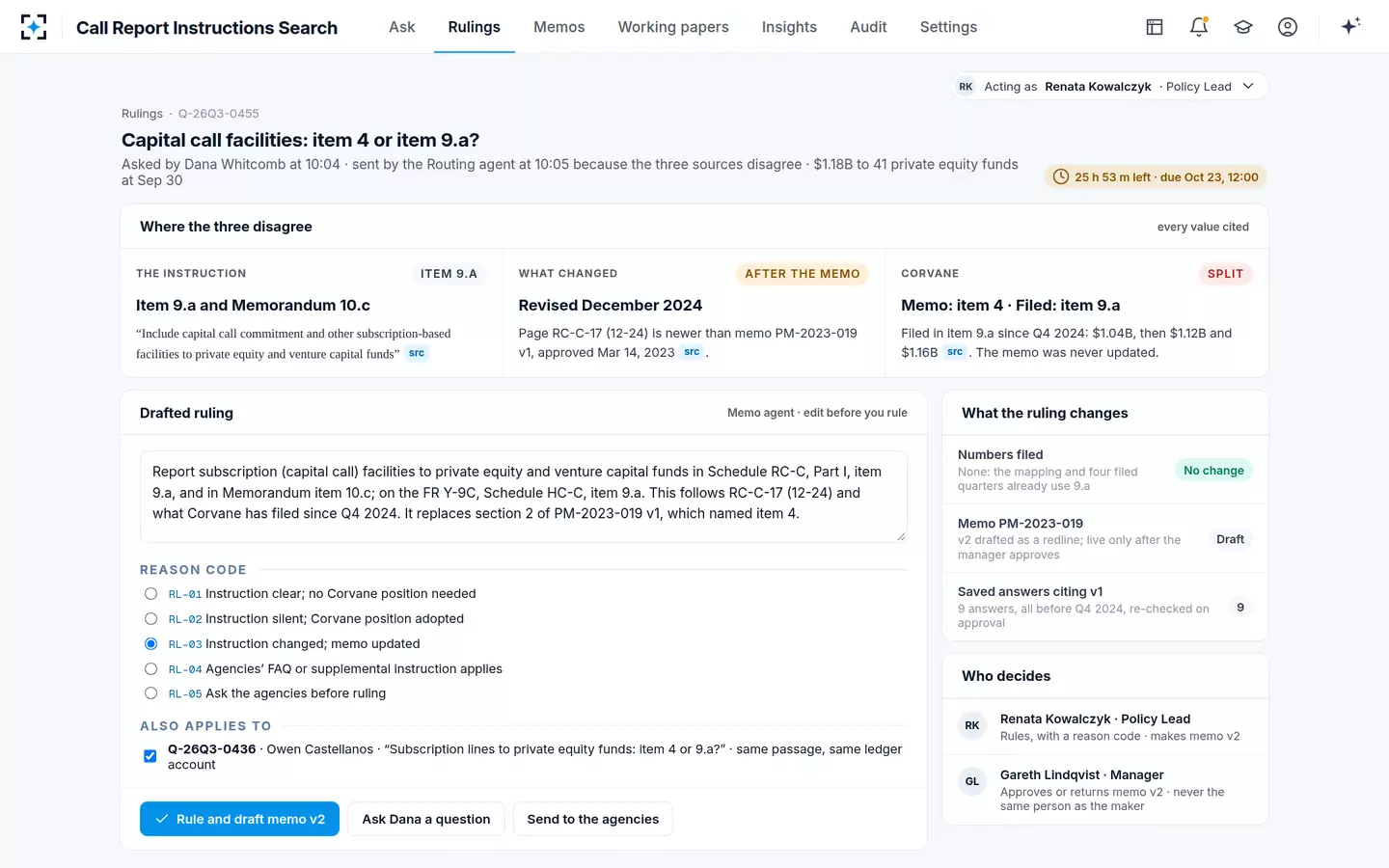
In Call Report Instructions Search the ruling screen is where that comes together. The three sources sit side by side, the Memo agent drafts the ruling text for the Policy Lead to edit, she picks a reason code, and the drafted ruling names the FR Y-9C line as well when the holding company files one. The ruling becomes a redline of the position memo, and only the Regulatory Reporting Manager can approve it.
A ruling with its sources, its reason code and the duplicate it also answers
What happens if the analyst disagrees with the bank later?
The analyst can ask for clarification, revised explanations or resubmitted data, and an examiner can require an amendment. The edit guidelines say analysts may come back to a bank later for a clarification or resubmitted data (Guidelines for Resolving Edits; quoted in FFIEC call report resubmission), and the General Instructions let the primary federal supervisor require an amended report when an item sits on the wrong line and the error is significant (General Instructions, page 10a). What follows from an accepted report coming back is covered in the guide to Call Report edit checks from Call Report Analysis.
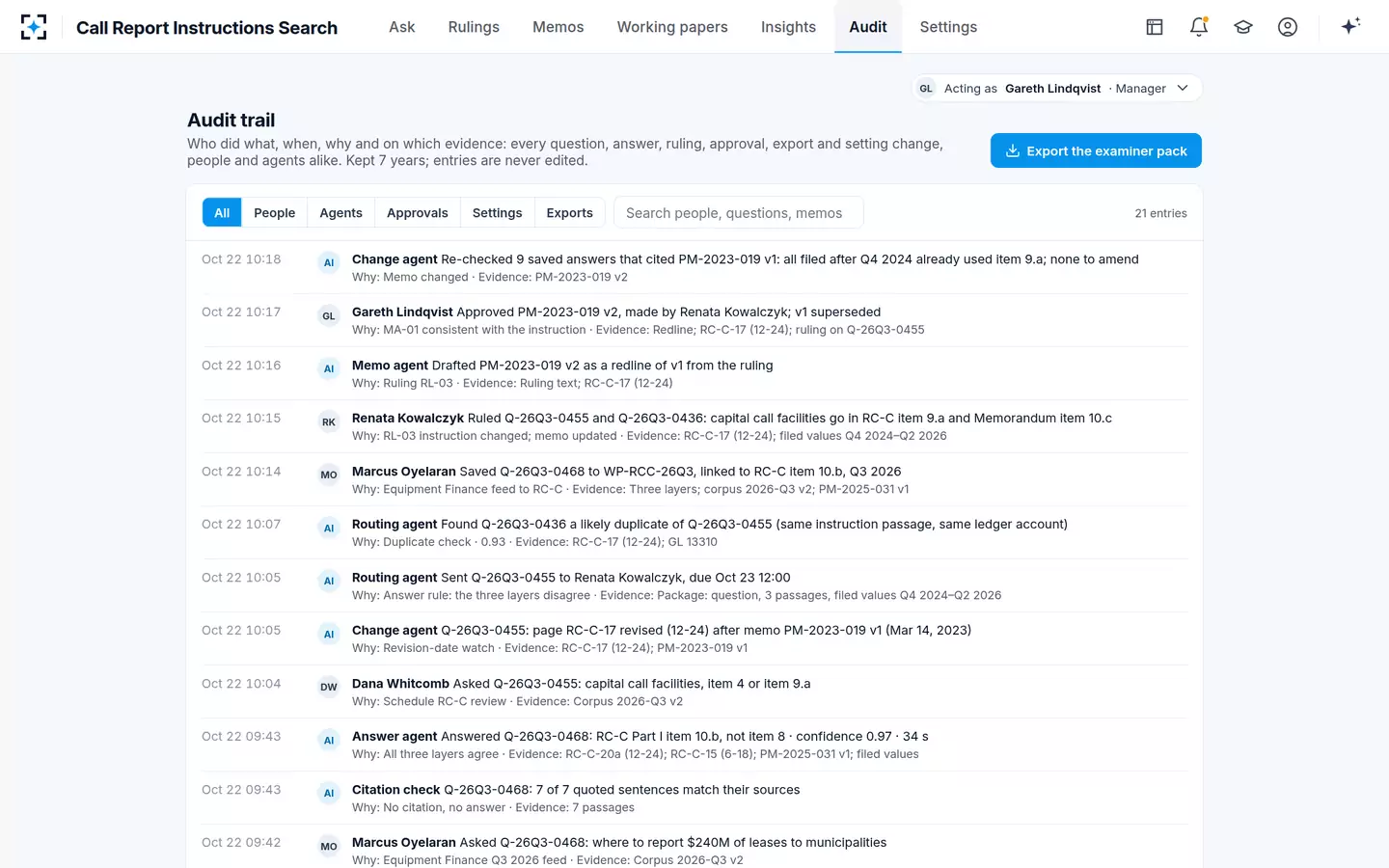
A bank that kept the question, the passages and the reply is in a far better position in that conversation than one that kept a recollection. It can show that it read the right page in force on the report date, asked before filing and applied the answer consistently. It can also find every other answer that rested on the same passage when the analyst's view or the instruction page changes, which is the job of the revision-date check described in the guide to Call Report instruction updates.
What the preparer was told, from which page, on which day
What does a call report analyst do at a bank?
At a bank, the call report analyst is the preparer and explainer of the report: places amounts on the schedules, runs the FFIEC edits, writes explanations for quality edits that still fail, and fields the business lines' questions about where their balances go. The last part is the one this solution changes. Finance teams in lending, treasury and deposits ask the reporting team where their products go, and the reporting team either answers from memory, searches the PDFs or forwards the question. A cited answer in under a minute is a design target for Call Report Instructions Search, measured in the live solution, not a promise about any bank's queue.
On the solution's sample data, 468 questions came in during the first three weeks of the quarter, 90% were answered with all three layers cited, and 47 went to the Policy Lead. Those 47 are the ones worth an analyst's time, inside the bank and, sometimes, at the agency. Which questions an agent should route rather than answer sets out the rule that decides them.
Questions people ask
How do I find out who my FDIC call report analyst is?
The FDIC's Call Report Analysts page lists the analysts for national and FDIC-supervised banks with their telephone numbers. A bank that does not know its assigned analyst can call the FDIC's main line, (800) 688-FDIC, and ask for one.
Is the call report analyst at the OCC for a national bank?
For day-to-day Call Report assistance, no: the FDIC's page tells national banks, along with FDIC-supervised banks, to contact their assigned analyst in the FDIC's Data Collection and Analysis Section. A formal request to interpret the instructions goes to the bank's primary federal supervisor, the OCC for a national bank, which refers it to the FFIEC's Task Force on Reports.
Can the CDR help desk tell me where to report an item?
No. The supplemental instructions describe the CDR Help Desk as assistance with user accounts, passwords and other system issues, weekdays 9:00 a.m. to 8:00 p.m. Eastern. Placement questions go to the Call Report analyst or the primary federal regulator.
Does an analyst's answer bind the bank in future quarters?
It is guidance for the bank's position, not a published instruction, and the bank remains responsible for the figure each quarter. If an instruction page is later revised, the position resting on the earlier reply should be checked again against the new text.
Who answers FR Y-9C questions?
The holding company's district Reserve Bank. The FR Y-9C General Instructions send questions and requests for interpretation to the Reserve Bank for the district where the holding company submits the report (FR Y-9C instructions quotes the rule), which is due 40 days after the quarter end, 45 for December.