The Call Report Glossary is the definitions section of the FFIEC instruction books: 137 pages in the FFIEC 031 and 041 book as of September 2026, and 128 in the separate FFIEC 051 book, arranged alphabetically from "Acceptances" onward (Glossary, FFIEC 031 and 041, September 2026). The schedule instructions say what goes on each line; the Glossary defines the words those instructions use, such as what counts as a loan, when a loan is secured by real estate, what a deposit is for reporting purposes, and when an asset must go on nonaccrual. A large share of the questions preparers ask turn on one Glossary sentence that sits in a different file from the schedule they are filling in, on a page with its own revision date. Botminds' Call Report Instructions Search searches the Glossary with the schedule instructions and the quarter's supplemental instructions, and quotes the deciding Glossary passage with its page and date beside the schedule text.
The Call Report Glossary's pages, by the year each was last revised
What is the call report glossary?
It is the part of the Call Report instructions that holds definitions and accounting guidance used across schedules, as distinct from the line-by-line schedule instructions and the General Instructions on who files, when and how. Its entries range from one-line cross-references, such as "Time Deposits: See 'Deposits,'" to multi-page treatments of subjects such as deposits, leases, nonaccrual status and transfers of financial assets. By our count of the September 2026 edition, it has roughly 160 headwords, about 70 of which are cross-references to another entry.
The definitions in this Glossary apply to the Consolidated Reports of Condition and Income and are not necessarily applicable for other regulatory or legal purposes. Similarly, the accounting discussions in this Glossary are those relevant to the preparation of these reports and are not intended to constitute a comprehensive presentation on bank accounting.
Glossary, FFIEC 031 and 041 Call Report instructions, opening paragraph
That opening paragraph is the most important sentence in the Glossary for anyone answering questions. A definition that works for the Call Report may not work for a regulation that uses the same word, and the reverse. A preparer who answers a reporting question from a lending policy definition, or a lawyer's reading of a statute, can be right in that context and wrong on the report.
Is a glossary definition the same as the legal definition?
Not necessarily, and the Glossary says so in the places where it matters most. Its entry for Deposits begins with the statutory and regulatory definitions, in section 3(l) of the Federal Deposit Insurance Act and in Regulation D, notes that the two "differ in certain respects," and adds: "for purposes of these reports, the reporting standards for deposits specified in these instructions do not strictly follow the precise legal definitions in these two sources" (Glossary, Deposits). The Brokered Deposits entry, by contrast, quotes the FDIC's regulation directly, because the Call Report figure is meant to match the regulatory one.
Overdrafts show how a Glossary definition can override intuition. "Any overdraft, whether planned or unplanned, is an extension of credit and is to be treated and reported as a 'loan' rather than being treated as a negative deposit balance," and planned overdrafts are classified in Schedule RC-C "by type of loan according to the nature of the overdrawn depositor" (Glossary, Overdraft). An overdrawn county account is therefore a loan to a political subdivision, not a smaller deposit.
How does the glossary differ from the schedule instructions?
The schedule instructions place amounts on lines; the Glossary supplies the tests the placement depends on, and it can change the line. The entry for Loan Secured by Real Estate is the clearest case. A loan is secured by real estate if, at origination, the lien is central to the credit and the collateral value, after senior liens, is more than half the loan's principal at origination; such a loan is reported in Schedule RC-C, item 1, whatever category the bank's own records give it and whatever its purpose, with one named exception: "a loan to a state or political subdivision in the U.S." (Glossary, Loan Secured by Real Estate). A county's mortgage loan on its operations center therefore stays in item 8 with other obligations of political subdivisions. How the same definition drives loan codes, with the full test quoted, is covered in Call Report Preparation's guide to Call Report codes for loans.
The General Instructions also give some Glossary entries a special status. They describe certain reporting guidance that the agencies adopted within the range of U.S. GAAP for supervisory purposes, and name as current examples the nonaccrual rules in the Glossary entry for "Nonaccrual Status," the allowance for collateral-dependent loans, the separate-entity method for income taxes of bank subsidiaries, and property dividends (General Instructions). For those subjects the Glossary, not general accounting practice, decides the Call Report answer.
Glossary entries that decide common Call Report questions
| Question preparers ask | Glossary entry | What decides it |
|---|---|---|
| Is this extension of credit a loan? | Loan | Generally credit "resulting from direct negotiations between a lender and a borrower," originated or purchased |
| Does this loan go in item 1 because there is real estate behind it? | Loan Secured by Real Estate | Collateral value over 50 percent of principal at origination, lien central to the credit; not for loans to states or political subdivisions |
| Is an overdraft a negative deposit? | Overdraft | No: always a loan, classified by the type of depositor |
| When must interest stop accruing? | Nonaccrual Status | Cash basis, full payment not expected, or 90 days in default unless well secured and in process of collection |
| Is this balance a deposit for the report? | Deposits | Reporting standards that "do not strictly follow" the FDI Act and Regulation D definitions |
| Are these deposits brokered? | Brokered Deposits | The FDIC's definition, its exceptions, and the reciprocal deposit cap |
What does the call report glossary say about nonaccrual?
That an asset goes on nonaccrual in three situations, with defined exceptions. The general rule: banks "shall not accrue interest, amortize deferred net loan fees or costs, or accrete discount on any asset (1) which is maintained on a cash basis because of deterioration in the financial condition of the borrower, (2) for which payment in full of principal or interest is not expected, or (3) upon which principal or interest has been in default for a period of 90 days or more unless the asset is both well secured and in the process of collection" (Glossary, Nonaccrual Status, page A-92 (3-24)).
The details are where questions come from. "Well secured" means collateral with a realizable value sufficient to discharge the debt including accrued interest, or the guarantee of a financially responsible party; "in the process of collection" means legal action, or in appropriate circumstances other collection efforts reasonably expected to bring repayment or restoration to current status soon. The 90-day test runs on contractual terms, so an asset that reaches 90 days between report dates goes on nonaccrual "as of the date it becomes 90 days past due." Stricter state rules take precedence, and some consumer loans are excepted.
Nonaccrual in two rulebooks: the Call Report Glossary and the NCUA's 5300 FAQ
Call Report Glossary (banks): A multi-page Glossary entry inside the instruction book
NCUA 5300 Call Report FAQ (credit unions): A one-line answer in a published list of questions and answers
Call Report Glossary (banks): 90 days in default, unless both well secured and in the process of collection
NCUA 5300 Call Report FAQ (credit unions): 90 days past due
Call Report Glossary (banks): Payment in full not expected, or kept on a cash basis because the borrower's condition deteriorated
NCUA 5300 Call Report FAQ (credit unions): Doubt about full collection of principal and interest
Call Report Glossary (banks): Defined terms, consumer-loan exceptions, state rules that are stricter take precedence
NCUA 5300 Call Report FAQ (credit unions): Further detail in the 5300 instructions
Is there an FAQ for the Call Report?
Not among the materials the agencies publish each quarter for banks. The FDIC's current-quarter page lists the forms, the instruction books for each form, the Instructions Updates, the quarter's Financial Institution Letter and the Supplemental Instructions in clean and redline versions (FDIC, current quarter Call Report materials). For "specific reporting questions," the FDIC tells institutions to contact their assigned Call Report analyst (FDIC, New Call Report Filers), and formal requests to interpret the instructions go to the bank's primary federal supervisor (General Instructions, page 8).
In practice the Glossary and the supplemental instructions do much of the work an FAQ would. The Glossary answers the definitional questions that recur every quarter; the supplemental instructions answer the questions a new rule raises, such as how to report custodial deposits for September 30, 2026. Credit unions have a different arrangement: the NCUA publishes a 5300 Call Report FAQ page, which carried 78 questions and answers when counted on October 26, 2026 (NCUA, 5300 Call Report FAQs). The person to ask when neither book settles a bank's question is the subject of the guide to your Call Report analyst.
The Call Report Glossary in four numbers
137
pages in the FFIEC 031 and 041 Glossary, September 2026; 128 in the FFIEC 051 Glossary
~160
headwords, about 70 of them cross-references to another entry (our count)
5
Glossary pages replaced in September 2026, two in December 2025
2
replacements of page A-20a, the Brokered Deposits page: December 2025 and September 2026
Where is the FFIEC call report glossary?
On the FDIC's instruction page for each book, as its own PDF, and on the FFIEC's reporting forms page. On October 27, 2026 the FDIC's FFIEC 031 and 041 page listed the "Glossary (As of September 2026)" beside the General Instructions and the schedule files (FDIC, FFIEC 031 and 041 instructions); the FFIEC 051 has its own Glossary file (FFIEC 051 Glossary). The two use different page numbers for the same entry: the Brokered Deposits page replaced in December 2025 was A-20a in one book and A-14a in the other. The FR Y-9C instructions carry a Glossary of their own, inside the Federal Reserve's single book.
When was the call report glossary last updated?
In September 2026, when five pages of the FFIEC 031 and 041 Glossary were replaced: A-20a, A-78, A-102, A-118a and A-119 (Instructions Update, September 2026). Those pages carry, among others, the continuation of the Brokered Deposits entry, the start of Lease Accounting, Purchased Credit-Deteriorated Assets, Trade Date and Settlement Date Accounting, and Trading Account. In December 2025, pages A-11 and A-20a were replaced (Instructions Update, December 2025). The chart above shows how uneven the book is: most pages were last revised in 2020, 2021 or 2024.
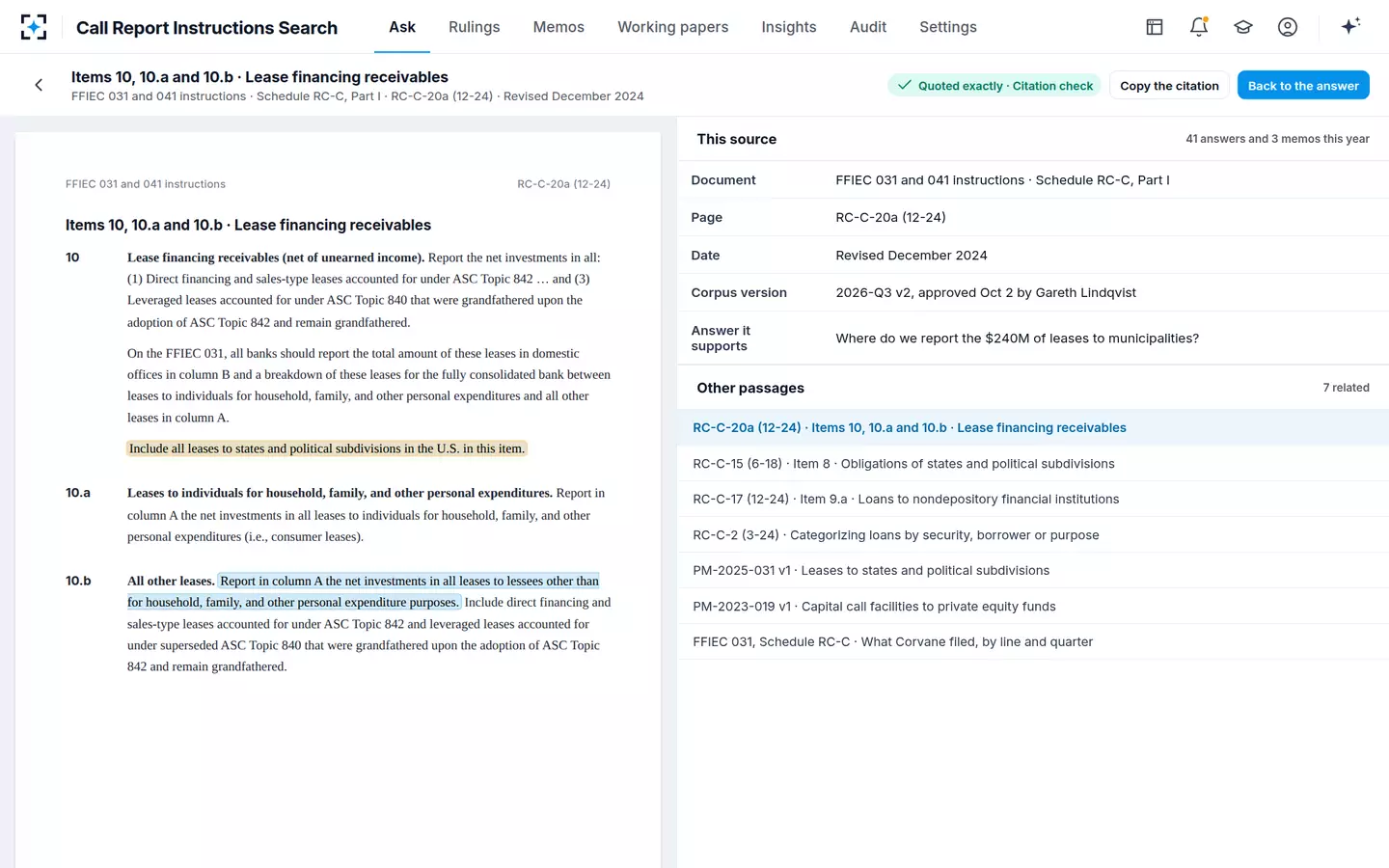
A replaced page does not always mean a changed definition, because a page is reissued whole and the change may sit in a neighbouring entry. That is why the useful check compares the cited passage itself. In Call Report Instructions Search the instruction page behind every citation opens with its page number, revision date and corpus version, and the Change agent compares the passage a memo or saved answer relies on with the current text, quarter by quarter.
The page behind a citation: exact text, page number and revision date
When the Glossary has no entry for it
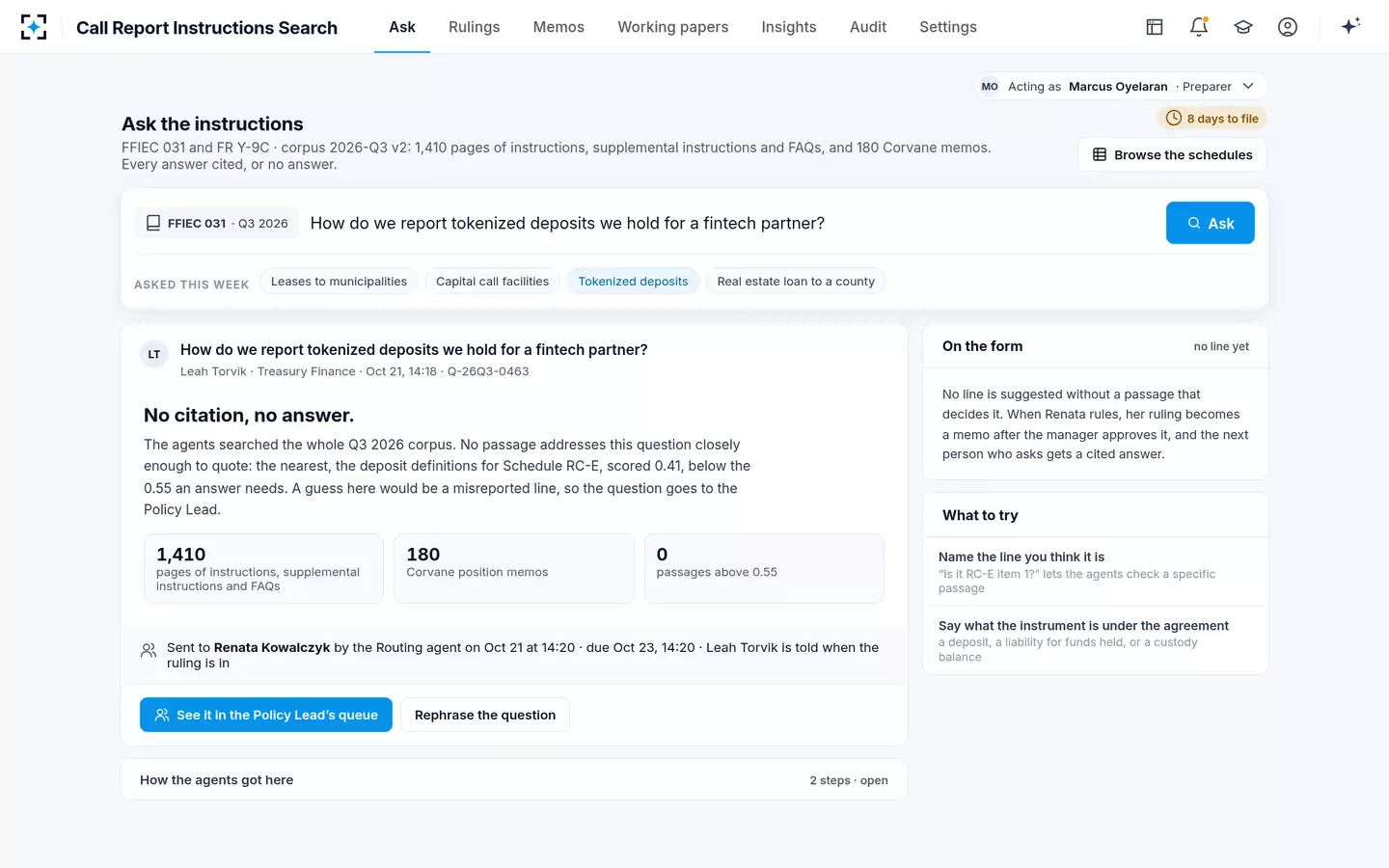
New instruments arrive before definitions do. On the solution's sample data, a treasury preparer asks how to report tokenized deposits held for a fintech partner. The nearest passages are the deposit definitions used for Schedule RC-E, and they score 0.41 against the 0.55 a passage needs before the agents will rely on it, so the answer is "No citation, no answer," with what was searched, and the question goes to the Policy Lead. Stretching a definition written for other instruments to cover a new one is exactly the judgment the instructions leave to the bank and, when it is unclear, to the supervisor.
No Glossary entry decides it, so no line is suggested
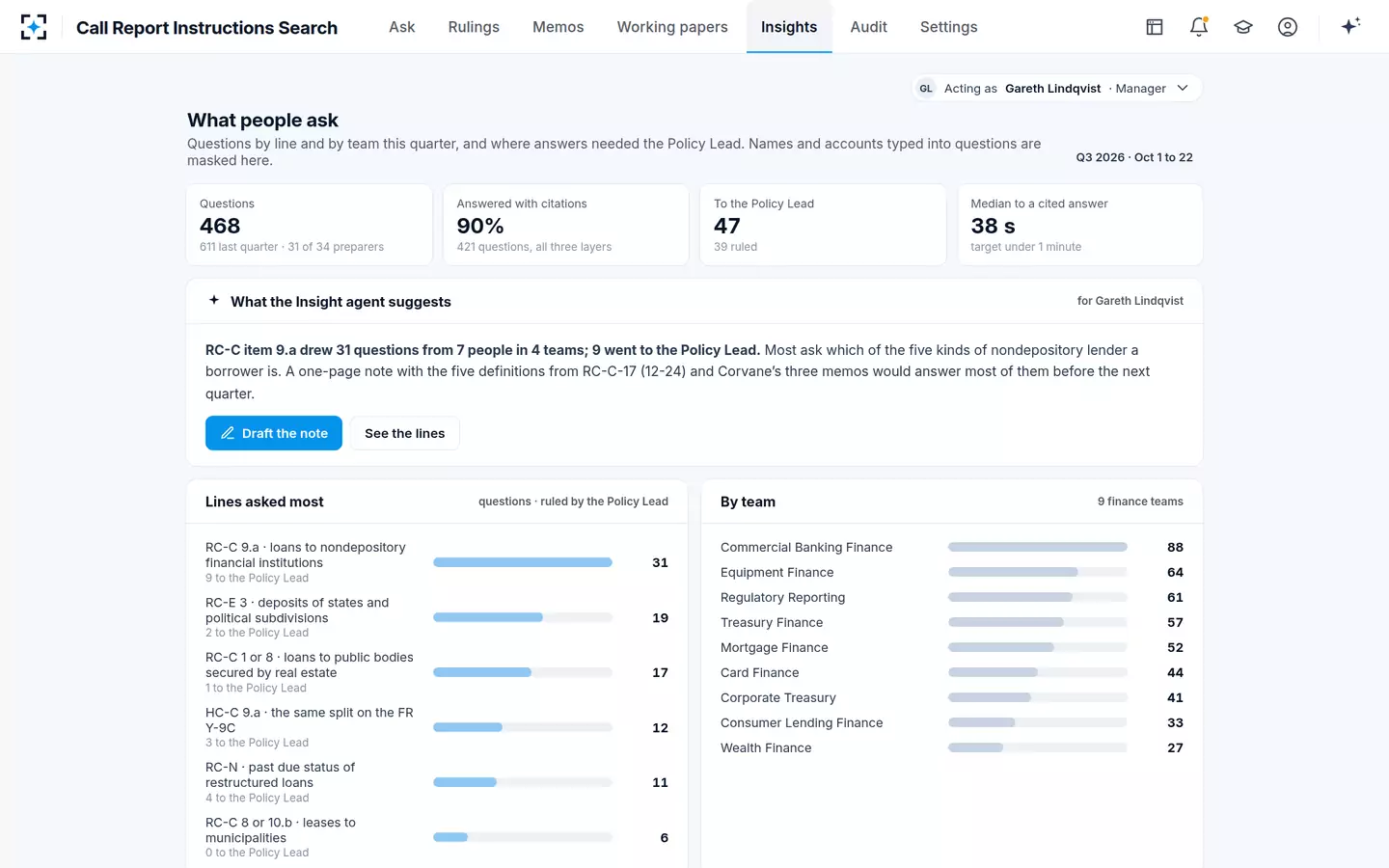
The questions that do have an entry are the ones a team should never have to research twice. On the sample data, the lines that drew the most questions in a quarter included deposits of states and political subdivisions and loans to public bodies secured by real estate, both settled by Glossary definitions, and the Insight agent drafts a one-page training note from the most-asked lines for the manager to approve.
Which definitions people keep asking about
Questions people ask
Is the call report glossary the same for the 041 and the 051?
The definitions largely match, but they are separate files with different page numbers: 137 pages for the FFIEC 031 and 041 and 128 for the FFIEC 051 in September 2026. Cite the book as well as the page.
What is a loan for call report purposes?
The Glossary says a loan is generally an extension of credit resulting from direct negotiations between a lender and a borrower, whether the bank originated it or purchased all or part of it. Loans can take the form of promissory notes, overdrafts, acceptances and similar written or oral obligations.
Does a state rule on nonaccrual override the Call Report Glossary?
Only if it is stricter. The Nonaccrual Status entry says any state statute, regulation or rule that imposes more stringent standards for nonaccrual of interest takes precedence over the Glossary's rule.
Is a mortgage loan to a county reported as real estate?
No. The Glossary's definition of a loan secured by real estate excludes loans to states and political subdivisions in the U.S., so on the FFIEC 031 and 041 such a loan is reported with other obligations of political subdivisions in Schedule RC-C, item 8.
Does the call report glossary cover accounting standards?
Yes, for what the reports need: entries such as Lease Accounting, Allowances for Credit Losses and Business Combinations explain how to apply U.S. GAAP in the Call Report, but the Glossary says its accounting discussions are not a comprehensive presentation on bank accounting.