Call report codes for loans are the line numbers of Schedule RC-C, Part I that a bank assigns to each loan: 1.a.(1) for 1–4 family construction, 1.c.(2)(a) for closed-end first liens on 1–4 family homes, 1.e.(1) and 1.e.(2) for owner-occupied and other nonfarm nonresidential real estate, 4 for commercial and industrial loans, 6.c for automobile loans, 9.a for loans to nondepository financial institutions, and so on. Many banks store the code on the loan in the core system as a "call code". It matters because the code is decided by facts about the loan, its collateral at origination, its purpose, its borrower and the property's use, and the instructions say plainly that how the bank files the loan internally does not decide it. Botminds' Call Report Preparation reads those facts from the core banking system and the loan subledger, proposes the line for every account with the governing paragraph beside it, and leaves every new or changed placement to a person.
This guide is for loan accounting, regulatory reporting and the loan operations teams who set the fields at boarding. The rules quoted are from the FFIEC 031 and 041 instructions; the bank and loans in the examples are fictional sample data from running the solution.
Schedule RC-C loan codes, and the field on the loan that decides each
| Code (FFIEC 041) | What goes there | The deciding field | Set when | Error to watch for |
|---|---|---|---|---|
| 1.a.(1), 1.a.(2) | Construction, land development and other land loans secured by real estate | Real estate collateral test; purpose of construction or development; 1–4 family or other | Origination | Moving a construction loan out of 1.a too early |
| 1.b | Secured by farmland | Collateral type: land used or usable for agriculture | Origination | Farm loans with farmland collateral reported in item 3 |
| 1.c.(1), 1.c.(2)(a), (b) | Secured by 1–4 family residential: open-end lines; closed-end first and junior liens | Collateral type, lien position, open- or closed-end | Origination | Coding a home-secured business loan by purpose before running the collateral test |
| 1.d | Secured by multifamily (5 or more) residential | Collateral type: dwelling units | Origination | Mixed-use buildings coded by borrower, not property |
| 1.e.(1), 1.e.(2) | Secured by owner-occupied, or other, nonfarm nonresidential properties | Source of repayment: the owner’s operations, or third-party rent | Origination; not reviewed after | Recoding later when the tenant mix changes |
| 2 | Loans to depository institutions and acceptances of other banks | Borrower type | Origination | Loans to bank holding companies, which belong in 9.a |
| 3 | Agricultural production and other loans to farmers | Purpose: agricultural production; not secured by real estate | Origination | A farmer’s non-farm business loan, which is C&I |
| 4 | Commercial and industrial loans | Purpose; and not a loan secured by real estate | Origination | Real-estate-secured business loans left in 4 |
| 6.a to 6.d | Consumer: credit cards, other revolving, automobile, other | Borrower is an individual; personal purpose; product | Origination | Business credit cards, which are C&I |
| 9.a | Loans to nondepository financial institutions | Borrower type: REIT, mortgage company, finance or insurance company, SBIC | Origination | A loan to a REIT or mortgage lender coded as real estate because mortgages are pledged to the bank |
What are call report codes for loans?
They are the item numbers of Schedule RC-C, Part I, Loans and Lease Financing Receivables, used as codes. The schedule asks for loans by category, and on the FFIEC 041 "all institutions should report in items 1.a.(1) through 1.e.(2) of column B a nine-category breakdown of loans secured by real estate" (Schedule RC-C instructions), followed by loans to depository institutions, agricultural loans, commercial and industrial loans, consumer loans, loans to states and political subdivisions, loans to nondepository financial institutions, other loans and leases. The total of every category, less unearned income, is item 12, which must equal the loans on the balance sheet.
A code on the loan record is a convenience; the line is a conclusion. The convenience is real: a bank with thousands of loans cannot decide each one's line every quarter, so it decides once, at boarding, and reports by summing codes. The risk is that the code was set from the wrong field, or by the wrong person, and every quarter's report repeats the error until someone samples the loan.
How are loans classified on the call report?
By asking four questions in order, and stopping at the first that answers. The order is the instructions' own: real estate collateral comes first and overrides purpose; within real estate the property type decides; outside it, the borrower and the purpose decide.
The order the instructions apply to a loan
- 1. Is it a loan to a state or political subdivision in the U.S.?
Then item 8, even if secured by real estate.
- 2. Is it a loan secured by real estate?
Collateral value at origination above 50 percent of the principal, and the lien central to the credit. If yes, item 1, whatever the purpose.
- 3. If secured by real estate, what is the property?
Construction or land; farmland; 1–4 family (open-end, closed-end first or junior lien); multifamily; nonfarm nonresidential, owner-occupied or other.
- 4. If not, who is the borrower and what is the purpose?
Depository institutions; agricultural production; commercial and industrial; consumer; nondepository financial institutions; other loans; leases.
What is a loan secured by real estate on the call report?
A loan whose real estate collateral was worth more than half its principal at origination and was central to the credit. The Glossary sets the test, and then says what does not matter, which is the part loan accounting most needs to read.
“To be considered wholly or substantially secured by a lien or liens on real property, the estimated value of the real estate collateral at origination (after deducting any more senior liens held by others) must be greater than 50 percent of the principal amount of the loan at origination.”
FFIEC 031 and 041 Glossary, Loan Secured by Real Estate (September 2026)
A loan that meets the test is reported in item 1 "regardless of whether the loan is secured by a first or a junior lien; ... regardless of whether the loan was originated by the reporting bank or purchased from others and, if originated by the reporting bank, regardless of the department within the bank or bank subsidiary that made the loan; ... regardless of how the loan is categorized in the bank's records; ... and regardless of the purpose of the financing" (Glossary). The commercial lending department's portfolio code, the loan's product type in the core system and the general ledger account it books to are all, by that sentence, irrelevant.
The one exception is narrow. A lien taken "solely through an abundance of caution", where the terms are no more favourable than without it, does not make the loan real estate secured. A loan partly secured by real estate worth 50 percent or less of the principal is reported by purpose instead.
The Glossary's own example: one $700,000 dental office loan, two codes
Building $400,000, equipment $350,000: A $700,000 loan to a dental group to construct and equip its office, secured by the building and the equipment.
Building $340,000, equipment $410,000: The same loan, the same purpose, the same borrower.
Building $400,000, equipment $350,000: $400,000, more than 50 percent of $700,000.
Building $340,000, equipment $410,000: $340,000, less than 50 percent of $700,000.
Building $400,000, equipment $350,000: Item 1.a.(2), other construction loans and all land development and other land loans.
Building $340,000, equipment $410,000: Item 4, commercial and industrial loans.
Building $400,000, equipment $350,000: The appraised value of the building at origination.
Building $340,000, equipment $410,000: The same field, with a different number.
The example settles which field matters: not the loan amount, not the purpose, not the borrower, but the estimated value of the real estate collateral at origination, net of senior liens. A bank whose core system does not store that value at origination cannot prove the code on any mixed-collateral loan, and the code cannot be fixed later by reappraising the property.
Is a commercial loan secured by real estate a C&I loan on the call report?
No. The Schedule RC-C instructions exclude from commercial and industrial loans "Loans that meet the definition of a 'loan secured by real estate,' even if for commercial and industrial purposes" (Schedule RC-C, item 4). A working capital line secured by a first lien on the borrower's warehouse belongs in item 1 if the real estate test is met, and the instructions say the same about agricultural loans, loans to depository institutions and consumer loans.
This is the most consequential rule for loan codes because it moves loans between the real estate and the commercial lines, which feed different ratios and concentration measures. It is also the easiest to get wrong at boarding, because the person boarding a commercial loan thinks of it as commercial. The test can also point the other way. The second example in the same Glossary entry is a $25,000 line and a $125,000 term loan for working capital, cross-collateralized by equipment and a third lien on the owner's residence. The two loans are tested together; the house is worth $140,000 but carries $126,000 of other lenders' liens, so the bank's $14,000 of equity against $150,000 of loans makes them commercial and industrial loans, not real estate loans. The test runs on the bank's own equity in the property.
What is call report code 1e2?
Item 1.e.(2) is loans secured by other nonfarm nonresidential properties: commercial real estate whose repayment depends mainly on rent from unaffiliated third parties or on the sale, refinancing or permanent financing of the property. Item 1.e.(1) is its owner-occupied twin, where repayment comes mainly from the operations of the owner or an affiliate. The split is a 50 percent test on the source of repayment, made once when the bank acquires the loan and not revisited afterwards.
For codes the practical consequences are two. The deciding field is not collateral type, which is the same for both lines, but a judgment about the source of repayment recorded at origination, usually as a purpose or occupancy code. And because the determination is not reviewed later, a later change in tenants does not move the loan, so a recoding exercise that "cleans up" 1.e codes against today's rent rolls can introduce errors rather than fix them. How the test works property type by property type, with hotels, nursing homes and self-storage, is set out in the guide to the non-owner-occupied CRE 50 percent test from CRE Concentration Stress Testing.
Where do call report loan codes come from?
From fields that loan operations sets when the loan is boarded: collateral type and value, lien position, open- or closed-end structure, purpose, occupancy or repayment source, and borrower type. The general ledger account the loan books to is usually one level coarser than the code, which is why the loan schedules cannot be prepared from the trial balance alone.
The sample bank shows how far the fields can carry a placement. Its new account 1427-310 holds 31 purchased commercial real estate participations. The core banking system carries collateral code 22, the bank's code for owner-occupied nonfarm nonresidential property, on all 31; purpose code OO on 29; and the credit file holds an occupancy certification for the other two. The loan subledger shows no third-party rental income on any of them. Those fields, not the account name, are what put the account on item 1.e.(1). Purchased participations follow the same rule as loans the bank originates: the instructions tell a bank to report them in Schedule RC-C "in the loan category appropriate to the underlying loan."
The loan codes as Schedule RC-C reads them, in Call Report Preparation
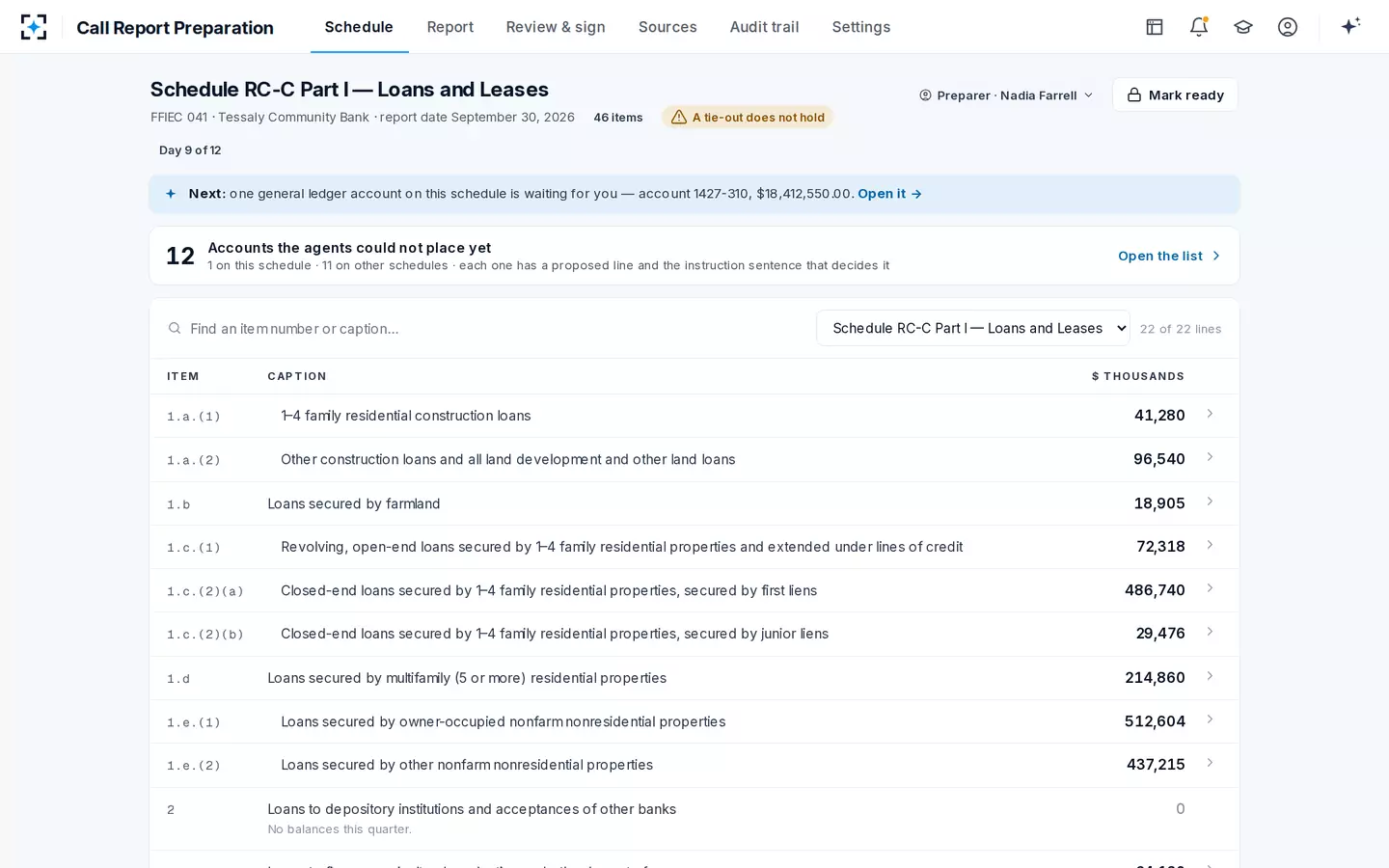
Where the sample bank's loans sit by Call Report code
Three quarters of the sample bank's loans are real estate secured, which is why the real estate test at the top of the order carries so much weight. A code error at that first question moves money between the largest line on the schedule and the commercial or consumer lines, and between the concentration measures that read them.
Who assigns call report codes, and when should they be checked?
Whoever boards the loan sets the fields; the reporting team inherits the result. That division is sensible, because the boarding team has the documents, but it means the reporting team needs a way to check fields it did not set. The OCC's examination procedures describe the check an examiner will run: "If the bank used an automated system to assist with the preparation of the regulatory report, select a sample of coded items to verify the items are coded accurately" (OCC Comptroller's Handbook, Regulatory Reporting). A bank can run the same sample first.
Three moments deserve a check. At boarding, for any loan with mixed collateral, the collateral value at origination should be recorded with the code. When a new product or program starts, the first loans should be traced from code to line before the program grows. And when a loan is modified or refinanced, the instructions sometimes require a fresh look: a construction loan written as construction-permanent "should be reported in this item until construction is completed or principal amortization payments begin, whichever comes first," while other construction loans stay in item 1.a after completion "unless and until" the loan is refinanced into a new permanent loan, the bank takes the collateral, or the loan is charged off (Schedule RC-C, item 1.a).
Two exclusions at the borrower question catch banks that code by collateral or by department. Loans to holding companies of depository institutions are not loans to depository institutions; the instructions send them to item 9.a. So are loans to real estate investment trusts, mortgage companies, finance companies, insurance companies and Small Business Investment Companies. How item 9.a is defined and why it is drawing attention is covered in loans to nondepository financial institutions from Credit Concentration Risk Monitoring.
How Call Report Preparation reads the codes
It treats the code as evidence, not as the answer. For every loan account, the Mapping agent reads the collateral, purpose and occupancy codes on the underlying loans in the core banking system and the attributes in the loan subledger, compares them with where the same account or program sat last quarter, and proposes the line. The Instruction agent attaches the paragraph that decides it, quoted with its schedule and item. When the fields disagree, as when 2 of 31 loans lack a purpose code, the agent says which loans and what else in the file speaks to them. A new or changed account always waits for a person, and a schedule cannot be signed while its total disagrees with the balance sheet.
Loan codes as evidence for a placement
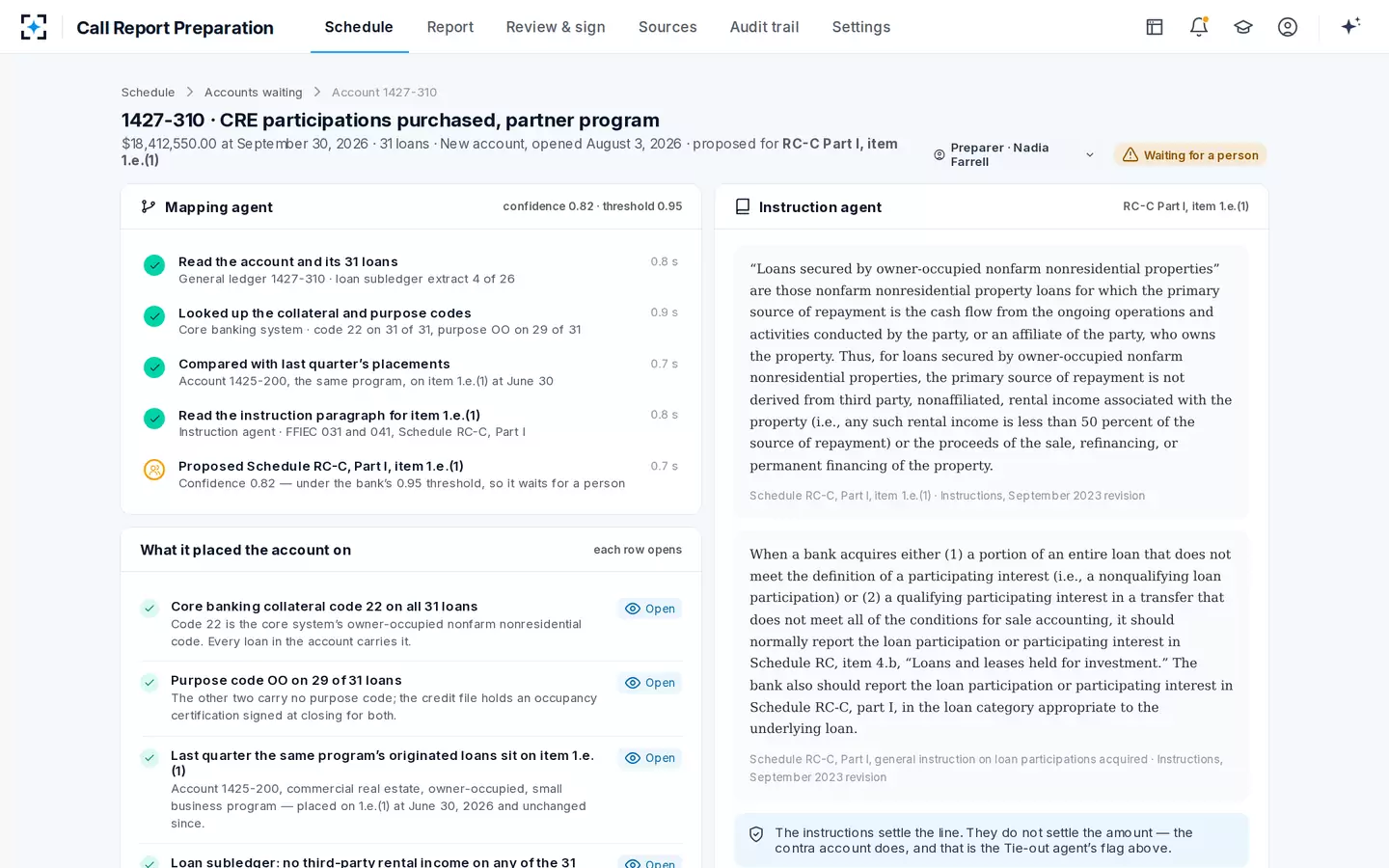
The codes also feed the checks after placement. Past due and nonaccrual amounts by loan line in Schedule RC-N, and modified loans in the Schedule RC-C memoranda, must stay within the line they relate to, so a code error usually breaks a limit before an examiner finds it. Call report mapping, inside the agent follows the same account through the rest of its placement, and the call report checklist that starts with this quarter's new accounts turns the boarding checks above into a quarterly review.
Questions people ask
Is there an official list of call report loan codes?
The official list is Schedule RC-C, Part I itself, with its item numbers, and the instructions for each item. Codes stored in core systems are each bank's own shorthand for those items, and their names and numbering vary by system.
Are loans secured by a borrower's home always 1–4 family loans on the call report?
If the home is the real estate collateral and its value at origination, after senior liens, is more than 50 percent of the principal, the loan is reported as secured by 1–4 family residential property, whatever its purpose. If the home is worth 50 percent or less of the principal, or the lien was taken only out of an abundance of caution, the loan is reported by purpose.
Do call report loan codes change when a loan is refinanced?
A refinancing that creates a new loan is a new origination, so the tests are applied afresh. Owner-occupied status, by contrast, is decided when the bank acquires the loan and need not be reviewed afterwards. Construction loans have their own rules for when they leave item 1.a.
How are purchased loans and participations coded?
The same way as loans the bank originates. The Glossary's real estate test applies regardless of whether the loan was purchased, and participations that stay on the balance sheet are reported in Schedule RC-C in the category appropriate to the underlying loan.
Are FFIEC 051 loan codes different from FFIEC 041 codes?
The categories are largely the same, but the FFIEC 051 asks for less detail in places and moves some loan memoranda to semiannual reporting. A bank changing form should map its codes to the new form's items rather than assume the numbering carries over.