Non-owner-occupied CRE is commercial real estate lending repaid from the property itself: a loan secured by nonfarm nonresidential property where 50% or more of the source of repayment comes from third-party, nonaffiliated rental income, or from the sale, refinancing or permanent financing of the property. Owner-occupied CRE is the opposite case, a building repaid from the cash flow of the business that occupies it. The line between them decides which loans enter the 300% CRE concentration ratio examiners screen every bank on, and a misclassified loan moves that ratio as surely as a bad quarter. Botminds' CRE Concentration & Stress Testing reads each loan's classification from the month-end tape, tests the ratios and the stress scenarios on it, and sends any loan whose owner-occupied status looks doubtful to the credit file rather than changing it.
The non-owner-occupied line carries most of a bank's CRE ratio
$1.94T
nonfarm nonresidential loans at FDIC-insured institutions, June 30, 2026, owner-occupied and not
50%
the share of repayment from third-party rent that makes a loan non-owner-occupied
1.e.(2)
the call report line the total CRE ratio uses; 1.e.(1), owner-occupied, is left out
What is non-owner-occupied CRE?
It is the part of a bank's commercial property lending whose repayment depends on the real estate market. The call report instructions define the line exactly: "Loans secured by other nonfarm nonresidential properties" are those "where the primary source of repayment is derived from rental income associated with the property (i.e., loans for which 50 percent or more of the source of repayment comes from third party, nonaffiliated, rental income) or the proceeds of the sale, refinancing, or permanent financing of the property" (FFIEC 031 and 041 instructions, RC-C item 1.e.(2)).
The 2006 interagency guidance uses the same test to draw its scope. It covers nonfarm nonresidential loans "where the primary source of repayment is derived from rental income associated with the property" and excludes those "where the primary source of repayment is the cash flow from the ongoing operations and activities conducted by the party, or affiliate of the party, who owns the property" (71 FR 74580). In the guidance's language, the first group has "risk profiles sensitive to the condition of the general CRE market (for example, market demand, changes in capitalization rates, vacancy rates, or rents)."
Multifamily loans (item 1.d) and construction and land loans (item 1.a) count as CRE whoever occupies them. The owner-occupied question arises only on item 1.e, nonfarm nonresidential property: offices, retail, industrial, hotels, medical buildings and the rest.
Owner occupied vs non owner occupied CRE: the test in one table
The test is about where the money to repay comes from, not who signs the note or whose name is on the deed. An operating company that owns its plant through an affiliate is still owner-occupied; an investor who leases the same plant to an unrelated operator is not.
Owner-occupied or not: what the call report instructions look at
Owner-occupied, item 1.e.(1): Cash flow from the ongoing operations of the owner or its affiliate
Non-owner-occupied, item 1.e.(2): Third-party, nonaffiliated rent, or sale, refinancing or permanent financing proceeds
Owner-occupied, item 1.e.(1): Less than 50% of the source of repayment
Non-owner-occupied, item 1.e.(2): 50% or more of the source of repayment
Owner-occupied, item 1.e.(1): A manufacturer's plant, a dentist's office, a church owned by its congregation
Non-owner-occupied, item 1.e.(2): A multi-tenant office, a shopping centre, a hotel, self storage
Owner-occupied, item 1.e.(1): No
Non-owner-occupied, item 1.e.(2): Yes
Owner-occupied, item 1.e.(1): The business's cash flow and the guarantor
Non-owner-occupied, item 1.e.(2): The rent roll, the leases and the property's value
Is a hotel owner-occupied or non-owner-occupied CRE?
A hotel is non-owner-occupied for call report purposes. The instructions list hotels, motels, dormitories, nursing homes, assisted-living facilities and mini-storage among the properties to report in item 1.e.(2). That surprises some lenders, because a hotel's revenue comes from operating the business, not from leases. The instructions give no reason, but the logic is visible in how such loans fail: a hotel's value and its ability to refinance move with room rates and occupancy across its market, as an office tower's move with rents, not with the fortunes of one operating company.
Nursing homes and assisted-living facilities have an exception. They may go in item 1.e.(1) when "50 percent or more of the source of repayment for the loan comes from the cash flow from the ongoing operations and activities, such as medical or maintenance services, conducted by the party, or an affiliate of the party, who owns the property." The other edge cases run the other way: hospitals, golf courses, recreational facilities, car washes and churches are owner-occupied unless an investor owns the property and leases it to an unrelated operator or congregation.
Edge cases the call report instructions settle
| Property | Default line | When it moves |
|---|---|---|
| Hotel, motel | 1.e.(2) non-owner-occupied | Listed in 1.e.(2); no exception given |
| Mini-storage warehouse | 1.e.(2) non-owner-occupied | Listed in 1.e.(2) |
| Nursing home, assisted living | 1.e.(2) non-owner-occupied | To 1.e.(1) when 50% or more of repayment is from the owner's own medical or maintenance services |
| Hospital, golf course, car wash, recreational facility | 1.e.(1) owner-occupied | To 1.e.(2) when an investor leases it to an unrelated operator |
| Church | 1.e.(1) owner-occupied | To 1.e.(2) when an investor leases it to the congregation |
| Multi-tenant building partly used by the borrower | Depends on the split | Non-owner-occupied once third-party rent is 50% or more of repayment |
The classification is made once, at origination
The determination is fixed when the loan is made or bought. The instructions say whether a property "is considered 'owner-occupied' should be made upon acquisition (origination or purchase) of the loan. Once a bank determines whether a loan should be reported as 'owner-occupied' or not, this determination need not be reviewed thereafter" (RC-C item 1.e).
Once a bank determines whether a loan should be reported as "owner-occupied" or not, this determination need not be reviewed thereafter.
FFIEC call report instructions, schedule RC-C, item 1.e
That rule keeps the call report stable, and it also means the label can drift from the risk. A family business that sells its operating company and keeps the building, now leased to the buyer, still reports as owner-occupied if that was the answer at origination. Its repayment now depends on a tenant. For the call report, nothing has to change; for concentration risk management, the bank should know. The guidance asks banks to "identify potential concentrations by stratifying the CRE portfolio into segments that have common risk characteristics," and a book of former owner-occupied loans now repaid by rent is one such segment.
How misclassification moves the CRE concentration ratio
Every dollar moved between items 1.e.(1) and 1.e.(2) moves the total CRE ratio by that dollar divided by capital. On a bank with $400M of tier 1 capital plus the allowance, $40M of loans reclassified moves the ratio by 10 points. That is more than many stress scenarios move it.
Moving loans between owner-occupied and non-owner-occupied, on one illustrative bank
The direction of the pressure is not neutral. A loan officer has no reason to prefer the non-owner-occupied label, which brings a loan into the concentration ratio and its limits. Examiners know this: the OCC told EH National Bank in a 2025 consent order that its concentration programme must cover "the Bank's concentration in commercial real estate, including non-owners occupied and multifamily loans, which were identified in the most recent examination" (OCC AA-WE-2025-20). A bank that cannot show how each 1.e loan was classified invites the examiner to reclassify a sample.
The full calculation, including the denominator and the growth leg, is worked through in how to calculate the CRE concentration ratio.
Why non-owner-occupied CRE is riskier, in the regulators' own models
Because its repayment depends on rents, vacancies and capitalization rates, it moves with the property market rather than with one business. The Federal Reserve's own supervisory stress test models the two groups apart: its commercial real estate loss model covers "non-owner-occupied multifamily or non-farm, non-residential properties (referred to as 'income-producing' loans), and construction and land development," while loans secured by owner-occupied nonfarm nonresidential property are projected by the corporate model (Federal Reserve, Credit Risk Models, 2026).
The drivers the Fed's model uses are the property's: loan-to-value, property type, loan size and the proximity of maturity. It applies a fourfold increase to the default probability of income-producing loans that approach maturity with debt service coverage below 1.2. None of those inputs says much about an owner-occupied loan, whose risk is the borrower's business; all of them are what a non-owner-occupied stress test has to read from the rent roll and the appraisal.
Owner-occupied CRE still belongs in the stress test
Leaving owner-occupied loans out of the concentration ratio does not take them out of the bank's risk. They are still secured by commercial property, and when a borrower's business fails, the bank's recovery depends on what the building will fetch, often in the same market and the same downturn as its non-owner-occupied loans. The 2006 guidance's own warning applies: concentrations of loans "similarly affected by cyclical changes in the CRE market can expose an institution to an unacceptable level of risk."
The stress is different in kind. A non-owner-occupied loan is stressed through its rent roll: rents, vacancy, capitalization rate, refinance rate. An owner-occupied loan is stressed through the borrower: its revenue and margins in a downturn, then the collateral value if the business cannot pay. The Federal Reserve's supervisory test reflects that split by sending owner-occupied loans to its corporate model rather than its CRE model.
A bank with a large owner-occupied book, common at community banks that lend to local businesses, should therefore show it beside the CRE ratio, not inside it: its size against capital, its concentration by property type and market, and how much of it has quietly become rent-dependent since origination. The ratio stays clean; the board still sees the property exposure.
What the 50% test means for the loan tape
It means each nonfarm nonresidential loan needs a reason on file, not just a code. A practical classification record answers four questions: who owns the property, who occupies it, what share of repayment comes from third-party rent at origination, and what changed since. The checklist below is the one we would use to audit a book before relying on its ratio.
Auditing the owner-occupied flag on a CRE loan tape
- Every 1.e loan carries the evidence for its flag
Occupancy and the share of repayment from third-party rent at origination, from the rent roll or the borrower's statements.
- Affiliates are traced
A property held by an affiliate of the operating company is owner-occupied; an unrelated tenant is not.
- Hotels and self storage sit in 1.e.(2)
They are listed there by the instructions, whoever runs them.
- Nursing homes and assisted living are tested at 50%
Owner-occupied only when the owner's own services carry at least half of repayment.
- Owner-occupied loans now repaid by rent are listed
The call report label stands, but the concentration report should show them as a segment.
- Reclassifications are dated and approved
A changed flag alters the 36-month growth comparison as well as today's ratio.
How the solution handles the flag
In CRE Concentration & Stress Testing, the loan tape reader classifies every loan by property type, market and call report line. It is not allowed to change a loan's owner-occupied status: where the tape and the documents disagree, it flags the loan for the credit file and the credit officer decides. Each loan is counted once, and the classification is what the concentration ratios and every stress scenario run on.
CRE Concentration & Stress Testing: each loan's type and market, as the ratios count it
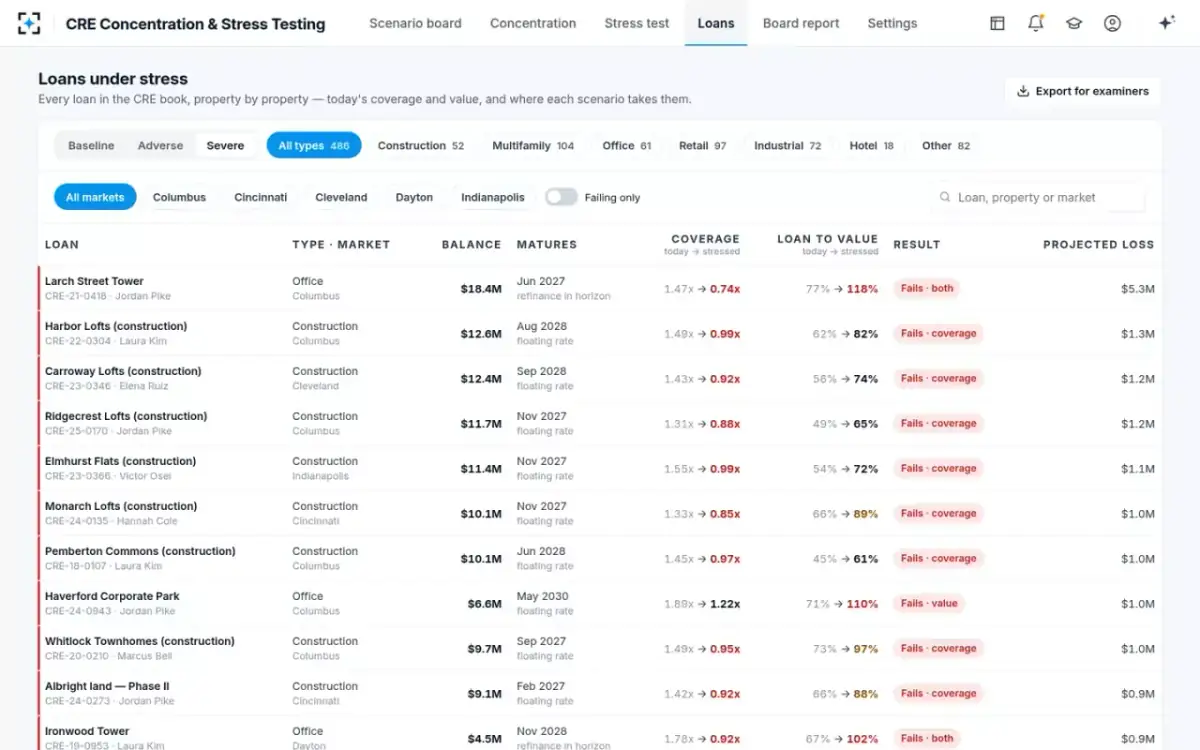
Because the stress test runs on the same tape, the classification also decides which loans are re-stressed from their own rent roll. A non-owner-occupied office loan is shocked on its rents, occupancy and value; the loan-level stress test shows that walk for one office tower.
Questions people ask
Is multifamily non-owner-occupied CRE?
Multifamily loans are in the CRE concentration ratio whatever the occupancy, because the guidance's total CRE uses all of call report item 1.d. The owner-occupied test applies only to nonfarm nonresidential loans in item 1.e. The OCC's 2025 order against EH National Bank names "non-owners occupied and multifamily loans" side by side for that reason.
What is the NAICS code for non-owner-occupied CRE?
There is no NAICS code that decides the classification. NAICS describes the borrower's industry, while the call report test looks at the source of repayment: 50% or more from third-party rent, or from sale or refinancing, makes a loan non-owner-occupied. A real estate lessor's NAICS code is a hint, not the answer.
Can a loan move from owner-occupied to non-owner-occupied later?
For the call report it need not: the determination is made at origination or purchase and "need not be reviewed thereafter." For risk management, a loan whose repayment has come to depend on rent belongs in the concentration analysis, so many banks track those loans as a separate segment.
Are owner-occupied CRE loans in the 100% construction ratio?
Yes, while they are under construction. The construction ratio uses all of call report item 1.a and Memorandum item 3, and item 1.a has no owner-occupied split. Once the building is finished and the loan converts, an owner-occupied loan moves to item 1.e.(1) and leaves both ratios.
Why is non-owner-occupied CRE riskier than owner-occupied?
Its repayment depends on the property market: rents, vacancies, capitalization rates and refinancing conditions. The Federal Reserve's stress test models income-producing CRE separately for that reason, using loan-to-value, property type, size and proximity to maturity, and quadruples default probability for those loans near maturity with debt service coverage below 1.2.