A concentration risk report is the document that tells a bank's board where its credit risk is concentrated, against capital and against the limits the board set, and what would happen to that concentration under stress. For commercial real estate it has six parts: a summary, concentrations against limits, a stratified view of the book with its trend, stress results, the loans behind the losses, and the assumptions and data quality behind every number. The 2006 interagency guidance asks banks to "report all concentrations to management and the board of directors on a periodic basis," and recent OCC agreements now specify monthly monitoring against board limits. Most banks assemble it by hand once a quarter or once a year. Botminds' CRE Concentration & Stress Testing drafts it every month from the loan tape and the property files, for the portfolio manager to edit, the chief risk officer to review and the chief credit officer to sign.
How concentration reports have fallen short
74%
of FDIC exam reports sampled lacked a complete written analysis or conclusions on parts of a bank's concentration risk management
26%
that did include a complete analysis and specific conclusions for each category
Monthly
monitoring of concentration reports against board limits, required in a 2025 OCC agreement
What is a concentration risk report?
It is the board's standing view of concentration risk: a report that identifies the bank's concentrations of credit, measures each against capital and against board-approved limits, shows how they are changing and what drives them, and connects them to stress results and to action. The 2006 guidance describes the information behind it as "meaningful information on CRE portfolio characteristics that is relevant to the institution's lending strategy, underwriting standards, and risk tolerances," and asks that management reporting "be timely and in a format that clearly indicates changes in the portfolio's risk profile, including risk-rating migrations" (71 FR 74580).
For the board, the test of the report is simple: can a director tell, from the report alone, whether the bank is inside its limits, how close it is, which loans would take it over, and what management proposes? The OCC's CRE examination procedures ask examiners to "assess the adequacy of management and board reports regarding CRE," considering "the adequacy, timeliness, and distribution of reports" and whether they address growth, asset quality, concentrations and trends (OCC, Commercial Real Estate Lending).
What should a CRE concentration report include?
Six pages cover what the guidance, the examination procedures and recent enforcement orders ask for. The layout below is ours; each page answers one question a director should be able to ask.
A six-page CRE concentration risk report, page by page
Page 1
Summary
Where the bank stands against each limit, what changed since the last report, and the actions proposed. One page.
Page 2
Concentration against limits
Total CRE, construction and 36-month growth against the supervisory screens and the board's limits; sub-limits by property type and market; headroom in dollars; the same with approved, unfunded loans added.
Page 3
Stratification and trend
The book by property type, market, maturity, rate type, risk rating, debt service coverage and loan to value bands, with the change over four quarters.
Page 4
Stress results
Losses, capital and concentrations after losses under each board scenario, and any scenario a director asked for.
Page 5
What drives the loss
The loans, property types and markets behind the severe-case result, each named.
Page 6
Assumptions and data quality
Every scenario assumption with its approval date; stale operating statements and old appraisals listed; policy exceptions and their trend.
The 2025 OCC agreement with Patriot Bank lists the reporting elements almost word for word: "management information systems that ensure timely and accurate reporting of concentrations to management and the Board, including concentration reports that stratify the loan portfolio by type, industry, locality, and other meaningful measures; portfolio credit quality metrics and performance metrics; market analyses for the Bank's significant loan portfolios, asset classes, and geographic markets; and procedures for monitoring concentration reports monthly based upon total committed amounts relative to Board-approved limits" (OCC AA-NE-2025-05).
Note the last clause: total committed amounts. A report on funded balances alone understates a bank with a construction pipeline, because approved draws raise the balance without any new approval. Page two should carry both.
How to stratify a CRE portfolio for the board
Stratify by the characteristics that would make many loans go wrong together. The 2006 guidance lists them: "property type, geographic market, tenant concentrations, tenant industries, developer concentrations, and risk rating," and, as other useful cuts, loan structure, loan purpose, loan-to-value limits, debt service coverage, policy exceptions on newly underwritten loans and affiliated loans. It also warns against the opposite error: the portfolio "should not be divided into multiple segments simply to avoid the appearance of concentration risk."
Stratifications for a CRE board report, and what each reveals
| Cut | Why the board needs it | Typical sub-limit or flag |
|---|---|---|
| Property type | Office, hotel, retail, multifamily and industrial move on different drivers | Sub-limit as a share of capital per type |
| Market | A local downturn hits every property type in it at once | Sub-limit per metropolitan market; out-of-area flag |
| Maturity and rate type | Fixed-rate loans maturing inside two years meet today's rates | Share of book refinancing in the horizon |
| Debt service coverage band | Loans near 1.0x fail first under an income or rate shock | Balance below 1.25x and below 1.0x |
| Loan to value band | Loans near 100% fail first under a value shock | Balance above 80% and above 100% |
| Construction and pipeline | Funded and unfunded construction moves the 100% screen | Construction on committed amounts against its limit |
| Tenant and developer | One large tenant or sponsor across several loans is one risk | Exposure to the largest tenants and developers |
| Policy exceptions | Rising exceptions signal relaxed underwriting | Count and trend by type and officer |
Which KPIs should a board track for CRE concentration?
Track a short list that ties concentration to capital, trend and stress. Ten measures cover it; most boards need fewer on page one and the rest behind them.
Ten measures for a CRE concentration report
| Measure | How it is calculated | What it warns of |
|---|---|---|
| Total CRE ratio | CRE loans ÷ (tier 1 capital + allowance on loans) | The 300% screen and the board's limit |
| Construction ratio | Construction and land loans ÷ the same capital | The 100% screen; the riskiest segment |
| 36-month CRE growth | Today's CRE ÷ CRE twelve quarters ago − 1 | The 50% growth leg; growth outrunning controls |
| Headroom in dollars | Limit × capital − exposure, per limit | How much more the bank can lend before a limit |
| Ratios with the pipeline | The same ratios on committed amounts | Limits that approved loans will cross |
| Share maturing in the horizon | Balance refinancing or repricing in two years ÷ CRE | Refinance risk at today's rates |
| Loans below 1.0x stressed | Count and balance under each scenario | Where losses will come from |
| Severe-case loss and capital after | Sum of loan losses; capital less losses | Whether capital holds |
| Ratios after losses | CRE after charge-offs ÷ capital after losses | Limits a downturn would push over |
| Stale inputs | Loans on operating statements older than the bank's threshold | How much of the result rests on old income |
Two of these deserve a word. Headroom in dollars turns a percentage into the decision the board actually makes: how much more office lending is possible before the sub-limit. And ratios after losses are the measure most reports leave out; how to calculate the CRE concentration ratio shows the arithmetic, including why the ratio rises under stress even as the book shrinks.
How often to report concentrations to the board
Quarterly at least, monthly where the bank is near its limits or under an agreement. The 2006 guidance says only "periodic." The OCC's recent agreements are specific: monthly monitoring of concentration reports "based upon total committed amounts relative to Board-approved limits," and "annual re-evaluation and approval of concentration limits by the Board." For a bank near the 300% screen, the FDIC's data say it has company: 1,374 banks, about 31% of all banks, were CRE-concentrated at year-end 2024 on the FDIC's measure (FDIC 2025 Risk Review).
The case for monthly is practical rather than regulatory. The construction ratio moves with draws, maturities arrive monthly, and markets move between quarters. The study by OCC and Federal Reserve staff of the 2007–2011 failures found that banks over the construction screen alone accounted for about 80% of the insurance fund's losses in that period (Friend, Glenos and Nichols, 2013), which is the segment a quarterly report sees latest.
What producing the report costs, by hand and monthly
By hand, most of the cost is collection, not analysis. We estimate a CRE stress test and board report on a book of about 500 loans at around six working weeks by spreadsheet: twelve days gathering rent rolls and operating statements, three on the loan tape and capital, two on ratios, eight stressing the scenarios and five writing the report. That is why most banks produce the full report once a year and a ratio table in between.
One concentration and stress report: where the working days go
The comparison is an estimate, and the honest version of it says where the remaining time goes: reviewing assumptions, deciding actions and signing. Those do not shrink, and should not. What shrinks is reading files and rebuilding formulas, which is why the same report can be produced monthly.
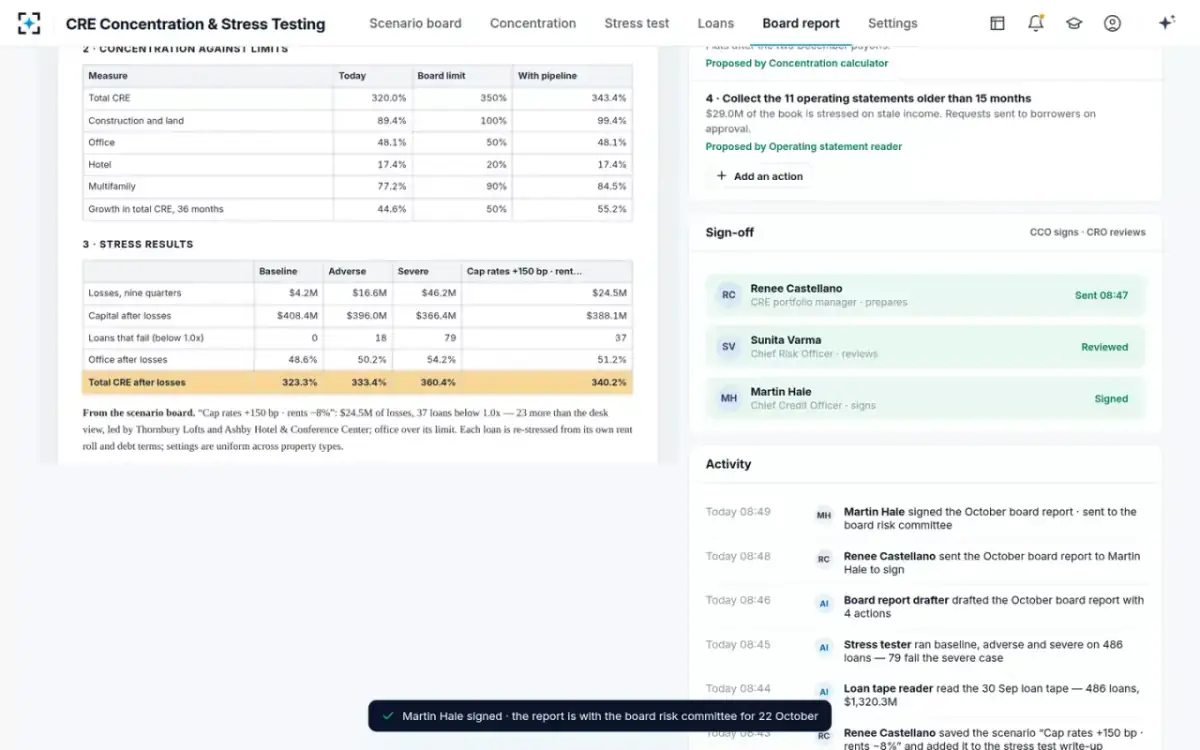
CRE Concentration & Stress Testing: the October report, prepared, reviewed and signed
Concentration risk report template: the checks before it goes to the board
Whatever produces it, the report should pass a short list of checks before a director reads it. Each answers a point the 2006 guidance, the OCC's examination procedures or the 2025 orders raise.
Before the concentration report goes out
- Benchmarks and board limits are labelled apart
The 100% and 300% screens are supervisory indicators; the board's limits are its own.
- The denominator is stated
Tier 1 capital plus the allowance on loans, from the latest call report.
- Committed amounts appear beside funded balances
Approved construction draws are exposure the board has already accepted.
- Every stressed loss traces to loans
A director can ask which loans, and get names.
- Assumptions carry their approval date
Scenarios and limits are the board's; the report says which version.
- Stale inputs are counted, not hidden
Loans stressed on old statements or appraisals are listed with their balance.
- Actions are proposals, with owners
The committee decides; the report says who proposed what and why.
- Someone signed it
Prepared, reviewed and signed by named people, with dates.
What to look for in software that drafts the report
Look for a draft that a portfolio manager can defend line by line, not a dashboard. The useful questions are where each number comes from, who can change the limits and scenarios, and whether the software proposes or decides.
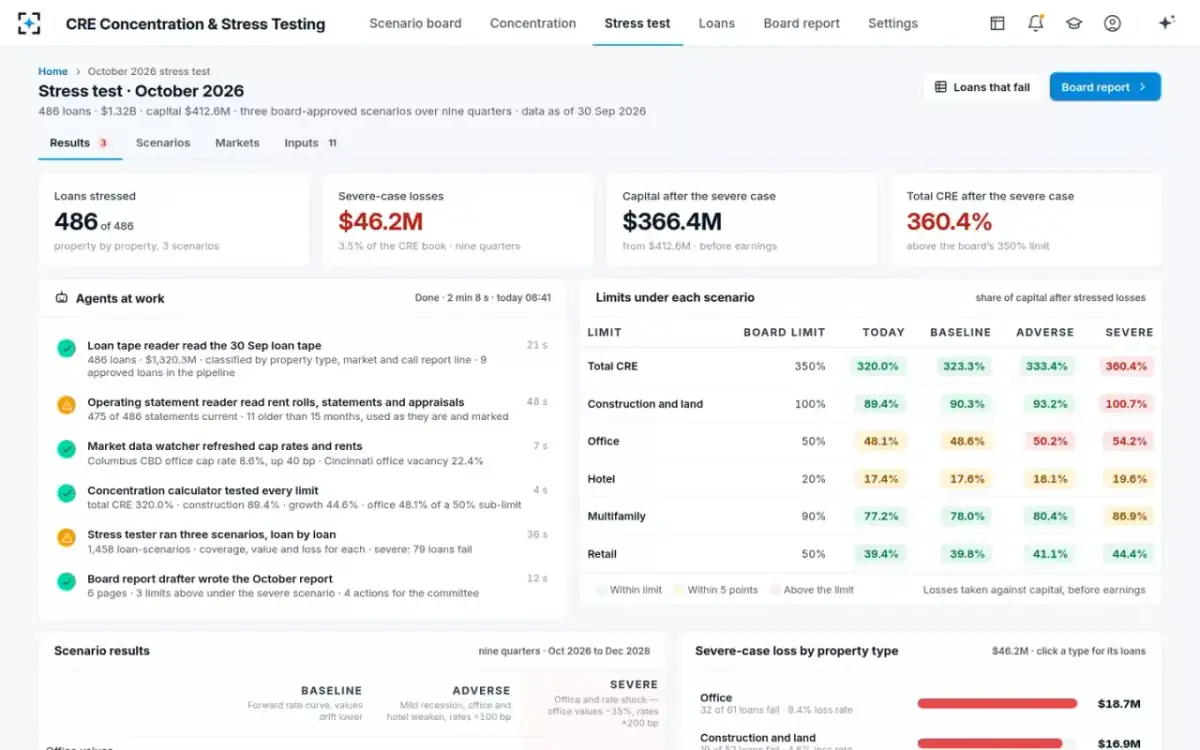
In CRE Concentration & Stress Testing, a board report drafter writes the report from the month's run: summary, concentration against limits with and without the pipeline, stress results with any scenario the portfolio manager saved, the loans that drive the loss and every assumption. It proposes actions and never decides them, and it never sends a report the chief credit officer has not signed. The limits are settings only the board's approval changes. What the solution does not do is replace the bank's call report, its allowance calculation or its other portfolio reports; it reads the first and sits beside the rest.
CRE Concentration & Stress Testing: the monthly run that feeds the report
The board's side of the same report, what it approves and what it is expected to ask, is in board risk committee responsibilities for CRE.
Questions people ask
Is there a concentration risk report template?
Regulators publish none. The closest official outline is in OCC enforcement orders, which list the contents of a concentration programme's reporting: stratification by type, industry and locality, credit quality and performance metrics, market analyses, and monthly monitoring against board limits on committed amounts. The six-page layout on this page follows that list.
What is the difference between a concentration limit and a supervisory threshold?
A threshold, such as 300% of capital for total CRE, is a screen the agencies use to decide where to look more closely; the 2006 guidance says it does not limit lending. A concentration limit is the board's own ceiling, set from its strategy, capital and stress results, and the report should show both, labelled apart.
Should a concentration report include unfunded commitments?
Yes, beside funded balances. The FDIC's count of concentrated banks excludes unfunded commitments, but the OCC's 2025 agreements ask for monitoring "based upon total committed amounts relative to Board-approved limits," because approved construction draws will raise the ratios without a new decision.
Who prepares the concentration risk report?
Usually the CRE portfolio manager or credit risk team prepares it, the chief risk officer reviews it and the chief credit officer signs it before it goes to the board risk committee. Whoever prepares it, the board's limits and scenarios should be ones the board approved, and the report should say which version.
How long should a concentration risk report be?
Long enough to answer whether the bank is inside its limits, how close it is, what stress would do and which loans drive it; six pages is enough for most community banks, with detail in appendices. A one-page ratio table answers only the first of those questions.