Loan level stress testing estimates what a scenario does to each loan from that loan's own numbers: its net operating income, its interest rate and the date it matures or reprices, its amortisation and its latest appraised value. Each loan gets a stressed debt service coverage ratio, a stressed loan-to-value and, where it fails, a projected loss; the portfolio result is the sum. The OCC calls this transaction stress testing, and a "bottom up" portfolio test when the results are aggregated. It is harder than applying one loss rate to a pool, because it needs every property's financials, but it is the only version that can say which loans break and why. Botminds' CRE Concentration & Stress Testing runs it every month across the CRE book; this page traces one loan through it.
The loan is from the solution's fictional sample bank, Ashgrove Community Bank of Columbus, Ohio, and its October 2026 run: 486 CRE loans worth $1,320.3M, stressed under three board-approved scenarios over nine quarters to December 2028. Research and regulatory figures are linked where they appear.
Why the loan, not the pool, is where CRE stress shows
44%
of office loans in negative equity after the 2022 rate rise and the shift to hybrid work
64%
of office loans that may face cash flow and refinancing problems
4×
the default probability the Fed's stress model applies to income-producing loans near maturity with coverage below 1.2
What is loan level stress testing?
It is stress testing done one credit at a time. The OCC's community bank guidance defines it: "Transaction stress testing is a method that estimates potential losses at the loan level by assessing the impact of changing economic conditions on a borrower's ability to service debt" (OCC Bulletin 2012-33, appendix A). For income property the borrower's ability to service debt is the property's: rent less expenses, against the payment the loan will require.
The same bulletin names the CRE version directly. For commercial mortgages, "management may link commercial mortgages to debt service coverage and loan-to-value ratios to project potential loss under possible adverse circumstances." That sentence is the whole method in miniature: a scenario moves income and value, coverage and loan-to-value follow, and a loss is projected where they break.
Bottom-up vs top-down stress testing: what each one can tell you
A top-down test applies a stressed loss rate to a pool; a bottom-up test adds up loan-level results. Both are acceptable to the OCC, which describes them side by side, and both can produce a credible loss estimate. They answer different questions.
Two ways to stress the same CRE book
Top-down: a loss rate on each pool: Balances by call report category and a stressed loss rate for each
Bottom-up: every loan from its own numbers: Each loan's NOI, rate, maturity, amortisation and appraised value
Top-down: a loss rate on each pool: A loss for each pool
Bottom-up: every loan from its own numbers: A coverage ratio, loan-to-value and loss for each loan, and their sum
Top-down: a loss rate on each pool: Applied to the whole pool, or not at all
Bottom-up: every loan from its own numbers: Applied only to loans that mature or reprice inside the horizon
Top-down: a loss rate on each pool: No
Bottom-up: every loan from its own numbers: Yes, with the reason: income, rate or value
Top-down: a loss rate on each pool: Low: the call report and a loss history
Bottom-up: every loan from its own numbers: High: a current rent roll and operating statement for every property
Top-down: a loss rate on each pool: A first screen, and a check on the bottom-up total
Bottom-up: every loan from its own numbers: Board actions, early refinance conversations, appraisal orders
The difference that matters most is the rate shock. Most CRE loans at community banks are fixed for a term and then refinance or reprice. A higher market rate only hurts a loan when it meets that date. A pool-level test cannot see dates, so it either shocks every loan, which overstates the near-term damage, or none, which misses the refinance problem the OCC flagged in spring 2026: "A substantial volume of CRE loans originated in a lower-interest environment will mature in the next several years and will need to be refinanced at prevailing rates" (OCC Semiannual Risk Perspective, Spring 2026).
How do you stress test a CRE loan? One office tower, step by step
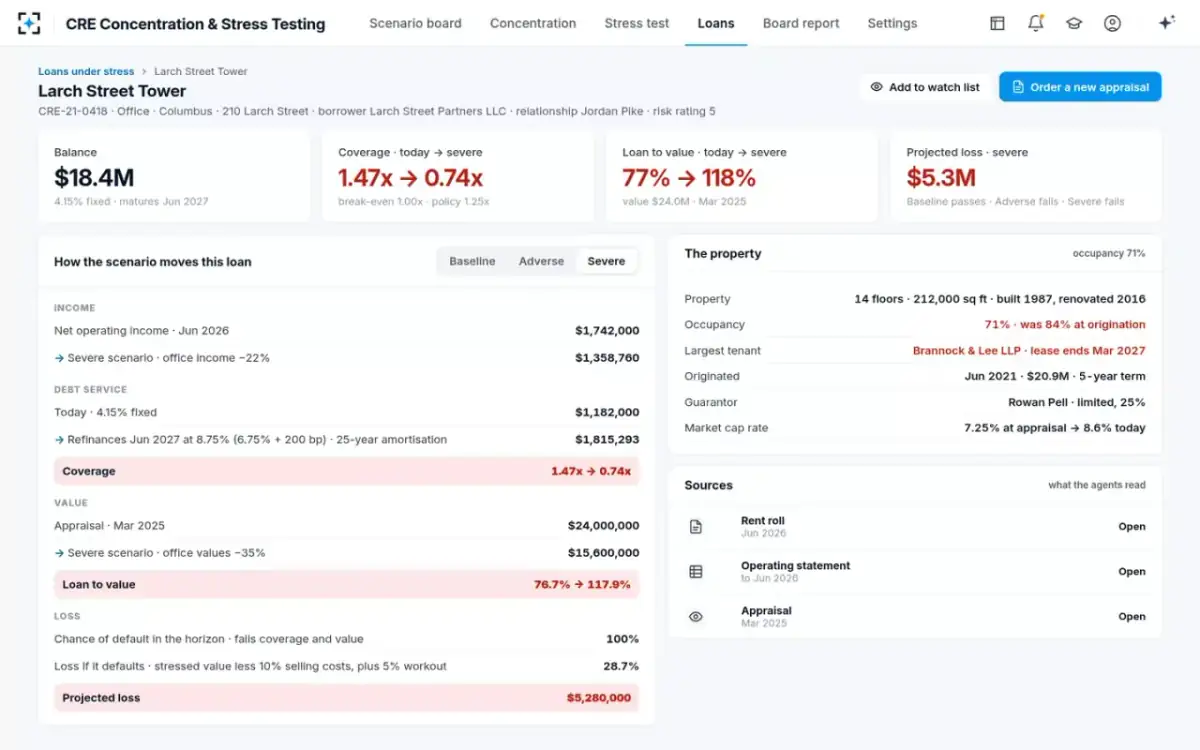
Start with the loan's facts, apply the scenario to income, to the rate at refinance and to value, and then decide whether it fails and what it would lose. Larch Street Tower is an $18.4M loan on a 14-floor Columbus office building, 71% occupied, fixed at 4.15% and maturing in June 2027, inside the nine-quarter horizon. The bank's severe scenario takes office income down 22%, office values down 35%, and adds 200 basis points to today's 6.75% refinance rate.
Larch Street Tower under the severe scenario, line by line
| Step | Today | Severe scenario | Rule applied |
|---|---|---|---|
| Net operating income | $1,742,000 | $1,358,760 | Office income −22%, from the latest operating statement |
| Annual debt service | $1,182,000 at 4.15% | $1,815,293 at 8.75% | Matures June 2027, so refinances at 6.75% + 200 bp on 25-year amortisation |
| Debt service coverage | 1.47x | Below 0.75x | NOI ÷ debt service; fails below 1.0x |
| Value | $24.0M, appraisal March 2025 | $15.6M | Office values −35% from the latest appraisal |
| Loan to value | 76.7% | 117.9% | $18.4M ÷ value; fails above 100% |
| Loss if it defaults | 28.7% of balance | Stressed value less 10% selling costs, plus 5% workout costs | |
| Projected loss | $5,280,000 | Fails both tests, so default is assumed in the horizon |
Two things break this loan at once, and they come from different documents. The income shock comes from the operating statement and lands on a building already down from 84% occupancy at origination to 71%, whose largest tenant's lease ends in March 2027, three months before maturity. The rate shock comes from the note: debt service rises 54% when a 4.15% coupon meets an 8.75% refinance. Either alone takes coverage down; together they take it from 1.47x to under 0.75x. A pool-level office loss rate would have produced a number for this loan's share of the book. It could not have said that the refinance date and the tenant's lease expiry are three months apart.
CRE Concentration & Stress Testing: one loan's walk through income, debt service, value and loss
What shocks to use in a CRE stress test
Use shocks by property type, applied to the variables a property's value and cash flow depend on: rents or income, vacancy, capitalization rates or values, and the interest rate at refinance or reprice. The OCC's bulletin lists stress factors by property type in its appendix C, from decreases in rents and sales prices to absorption rates, and expects a base case and at least one adverse scenario built from national and local economic data.
The sample bank's board-approved library shows what that looks like in practice. Its severe case takes office values down 35% and office income down 22%, hotel values down 30% and income down 20%, multifamily values down 15% and income down 6%, and construction and land values down 25% and income down 10%, with 200 basis points on rates at refinance or reprice. The office figure is not arbitrary: the board raised it from 30% in April after local office sales cleared well below their 2019 prices.
Research gives the order of magnitude. Gupta, Mittal and Van Nieuwerburgh estimated a 45% decline in New York office values in 2020 and 39% in the longer run (American Economic Review, 2026). A severe office shock of 35% is inside that range; a 10% shock applied to all CRE alike is not a severe office scenario at all.
How do cap rate changes affect value?
Value is income divided by the capitalization rate, so a wider cap rate lowers value even when income holds. A property with $1,000,000 of NOI is worth $13.8M at a 7.25% cap rate and $11.6M at 8.6%, a fall of about 16% with no change in rent. Add an income decline and the two compound.
That is why a CRE stress test should move cap rates and income separately rather than apply a single value haircut. The OCC's CRE booklet makes the same point about underwriting: "capitalization rates, interest rates, and DSCRs should be stress-tested to determine whether a property will likely remain viable during a period of economic stress" (OCC, Commercial Real Estate Lending). Larch Street's own market cap rate moved from 7.25% at its 2025 appraisal to 8.6% in the October market data, which is what the illustration above uses.
Rolling 486 loans up into one portfolio result
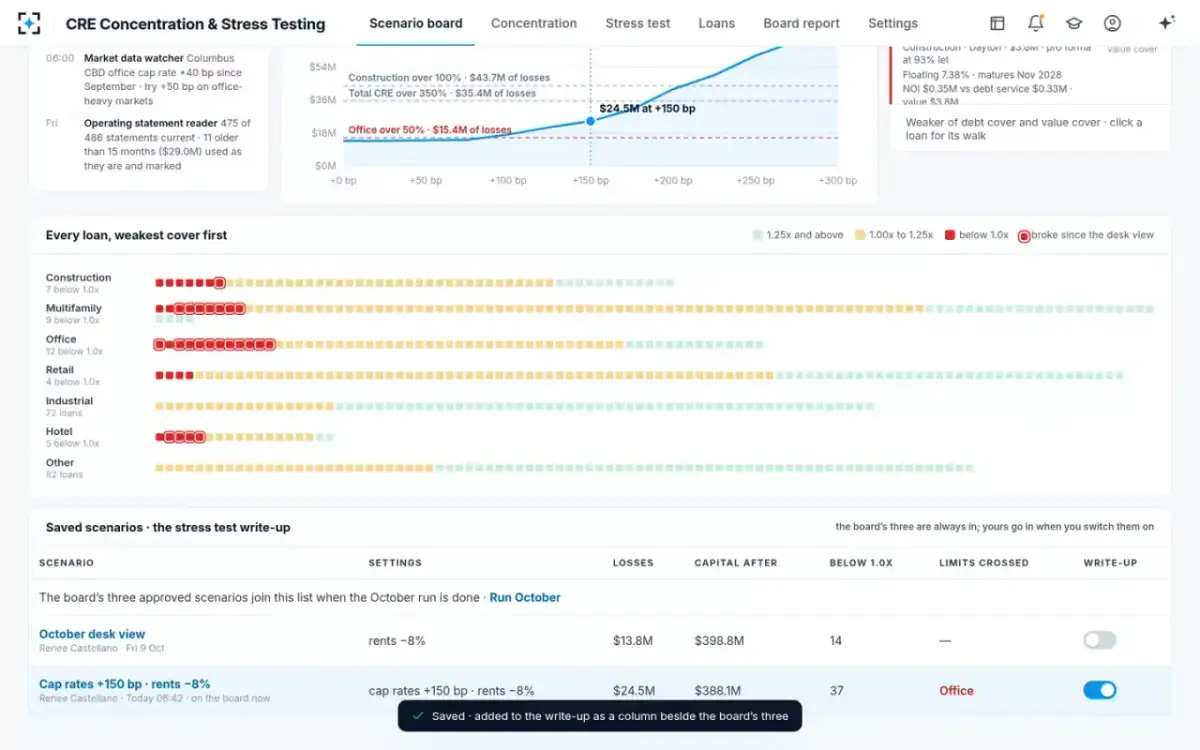
The portfolio result is the sum of the loan results, so it can be cut any way the loans can. In the October run, the severe scenario failed 79 loans worth $301.7M and projected $46.2M of losses over nine quarters, 3.5% of the CRE book. Office and construction carried most of it.
Where the severe-case loss comes from, by property type
A bottom-up rollup also explains itself. The same run under the adverse scenario failed 18 loans and projected $16.6M. The difference between adverse and severe is not a single multiplier; it is 61 more loans crossing 1.0x coverage or 100% loan-to-value, each of which can be opened to see which of its three shocks did it. In the severe list, floating-rate construction loans fail on coverage while the office loans near the top of the list that refinance inside the horizon, Larch Street among them, fail on both. Two thirds of the book, $866.8M, matures or reprices before December 2028, which is where the rate shock does its work.
CRE Concentration & Stress Testing: every loan in the book as a square, weakest cover first
Loan level stress testing: which loans the rate shock reaches
The rate shock reaches only loans that refinance or reprice inside the horizon, and that is where loan-level results most often surprise. A fixed-rate loan maturing in 2031 keeps its coupon through a nine-quarter test whatever the market does. A floating-rate construction loan feels the shock in the first quarter.
When the rate shock reaches three kinds of loan in a nine-quarter test
- Coupon 4.15%3 qtrs at its coupon
- Refinanced at 8.75%6 qtrs at the shocked rate
- Reprices with the market9 qtrs at the shocked rate
- Coupon unchanged9 qtrs at its coupon
The Federal Reserve's own model shows why the maturity date deserves this weight. It notes that "most CRE loans on income-producing properties are not fully amortizing and often have a significant balloon payment due at maturity," that lenders "generally require a minimum DSCR between 1.2 and 1.5," and it raises the default probability of loans approaching maturity with coverage below 1.2 by a factor of four (Federal Reserve, Credit Risk Models). A loan-level test that knows each maturity is applying the same idea to a community bank's book.
What loan level results change for the bank
They turn a loss estimate into a list of actions. At the sample bank, the October board report proposed a new appraisal for Larch Street Tower, whose 2025 value fails both stressed scenarios, and an early refinance conversation with its borrower while the tenant's renewal is still open. Neither action could come from a pool loss rate.
The cost is data. A bottom-up test needs a current rent roll and operating statement for every income property; at the sample bank, 11 of 486 statements were more than 15 months old, covering $29.0M of loans, and the run used them as they were and marked them rather than estimating income. How a bank gets from a spreadsheet test to this, on its own book, is the subject of portfolio stress testing in Excel and a loan-level pilot; how a loan-level engine sits under model risk guidance is in bank stress testing software under SR 26-2.
Questions people ask
What is the difference between transaction and portfolio stress testing?
Transaction stress testing estimates one loan's loss from its own ability to service debt under a scenario. Portfolio stress testing measures the effect on the whole book, either by adding up transaction results ("bottom up") or by applying stress loss rates to pools ("top down"), as the OCC describes in Bulletin 2012-33.
Do regulators require loan level stress testing?
No. The OCC says "a bottom-up, loan-by-loan analysis may help identify particular concerns," and accepts simpler methods for most community banks. A bank with CRE concentrations is expected to stress test at the portfolio level; whether it builds that from loans or pools is its choice, scaled to its risk.
How is loss given default estimated in a CRE stress test?
Commonly as the shortfall of the stressed collateral value, after selling costs, against the balance, plus workout costs. The sample bank uses 10% selling and 5% workout costs, which gives Larch Street Tower a 28.7% loss given default on an $18.4M balance.
What horizon should a loan level stress test use?
At least two years. The OCC explains that "losses generally emerge over a two-year period following the downturn," and that after the 2007–2009 recession charge-off rates took "nine or 10 quarters" to return to normal. The sample bank uses nine quarters.
Can a loan pass on coverage and still fail the stress test?
Yes, on value. A loan with strong income can still have a stressed loan-to-value above 100%, which means a sale or refinance would not repay it. The sample bank's results distinguish loans that fail on coverage, on value, or on both, because each points to a different action.