The OCC stress testing tool for income-producing commercial real estate loan portfolios no longer exists. The OCC's own page for Bulletin 2012-33 now opens with a one-line notice: "The stress test tool for income-producing CRE loan portfolios was terminated in 2021 and is no longer on the OCC's BankNet website." No replacement tool was announced. What remains is the guidance the tool served: banks with CRE concentrations are still expected to stress test, at least annually, over at least two years, by a method that fits their risk. A bank that relied on the tool has three ways forward: the OCC's own spreadsheet example, a loan-level test built in-house, or software. Botminds' CRE Concentration & Stress Testing is one of the third kind; this guide is honest about where it fits and where a simpler answer will do.
The tool went; the expectation stayed
2021
the year the OCC terminated its stress test tool for income-producing CRE portfolios
2012-33
the OCC bulletin, still current, that asks community banks to stress test at least annually
311%
median CRE concentration at banks of $1 billion to $10 billion at year-end 2025, the banks the tool was for
Does the OCC have a stress testing tool?
Not for CRE, not since 2021. When Bulletin 2012-33 was issued in October 2012, it announced that "The OCC's new stress test tool for income-producing CRE loan portfolios is available on the OCC's BankNet website along with other tools banks may use to stress test other types of loans." BankNet is the OCC's website for the banks it supervises; the tool lived there, not on the OCC's public pages.
The bulletin's text was never rewritten to remove the sentence; the notice was added above it. That is why people still search for "OCC stress testing tool" and land on a bulletin that seems to offer one. The OCC's public material does not describe the tool's formulas, and we do not reconstruct them here. What the bulletin does describe, in its own words, is the method a CRE loan stress test should follow, and that is what can be rebuilt.
Why was the OCC stress testing tool discontinued?
The OCC has not published a reason. The notice states the fact and the year and nothing else. What can be said is that the guidance never depended on the tool: Bulletin 2012-33 leaves the method to the bank and says "Effective methods can range from a single spreadsheet analysis to a more sophisticated model." The tool was one option the agency offered; its end removed the option, not the obligation.
Nor did the tool's output ever stand in for the bank's own judgement. Examiners grade the quality of a bank's stress testing, and what it changed, whatever produced it. A bank that switched off the tool's output in 2021 and filed nothing in its place has a gap in its concentration risk management, not a gap in a reporting form.
What OCC stress testing guidance still asks
Four things, all still in force. The 2006 interagency guidance expects a bank with CRE concentrations to stress test its portfolio, or run sensitivity analysis, and to measure the effect on asset quality, earnings and capital (71 FR 74580). Bulletin 2012-33 asks for a test at least annually, a horizon of at least two years, and a base case with at least one adverse scenario. And it asks that the results feed the bank's risk management, strategic and capital planning. The full rulebook, including what examiners grade, is in CRE stress testing guidance from the OCC, FDIC and Fed.
Rebuilding the method in the open: the CRE loan stress test the bulletin describes
The bulletin's method for commercial mortgages is one sentence long: tie each loan to its debt service coverage and loan-to-value, and project the loss when adverse conditions move them. Spelled out, that is six steps, each of which a bank can perform and an examiner can re-perform.
A CRE loan stress test, step by step, as the OCC's guidance describes it
Agent
Segment the bookEvery income-producing loan by property type and market, with its balance, rate, maturity and amortisation.
Agent
Read each property's income and valueLatest net operating income from the operating statement and rent roll; latest appraised value and its date.
A person decides
Approve the scenariosShocks to income, vacancy, capitalization rates or values and refinance rates, by property type, for a base case and at least one adverse case.
Agent
Re-run coverage and loan-to-valueStressed NOI over debt service, at the shocked rate where the loan refinances or reprices in the horizon; balance over stressed value.
Agent
Project the lossFor loans that fail, the shortfall of stressed value less selling costs, plus workout costs, against the balance.
A person decides
Read it against capital and decideLosses against earnings and capital; concentrations after losses; actions on limits, growth, appraisals and capital.
Steps four and five are where a hand-built version usually simplifies too far. A test that applies the rate shock to every loan, rather than to loans that refinance or reprice inside the horizon, overstates losses on long fixed-rate loans and understates the problem with loans maturing next year. The Federal Reserve's own CRE model puts maturity at the centre, quadrupling the default probability it projects for income-producing loans that approach maturity with coverage below 1.2 (Federal Reserve, Credit Risk Models).
The stress factors the OCC listed by property type
Bulletin 2012-33 includes, in appendix C, a table of factors to stress by property type, from land development through leased office, industrial and retail. Four factors apply to every property type in the table; the rest apply to some.
Possible real estate stress testing factors, from OCC Bulletin 2012-33, appendix C
| Factor | Direction | Applies to |
|---|---|---|
| Collateral values | Decrease | Every property type listed |
| Interest rates | Increase | Every property type listed |
| Capitalization rates | Increase | Every property type listed |
| Utility and energy costs | Increase | Every property type listed |
| Rents | Decrease | Leased and rental property types |
| Vacancy rates, tenant concessions | Increase | Leased property types |
| Sales prices, absorption and sell-out rates | Decrease | Development, construction and condominium projects |
| Material and labour costs | Increase | Projects under development or construction |
| Maintenance and marketing costs | Increase | Most property types listed |
The table is a better starting point than most templates, because it forces the question every CRE stress test should answer: what actually moves this property's cash flow and value? For a leased office building it is rent, vacancy, concessions and the capitalization rate. For a condominium project it is sale prices and the pace of sales. A test that applies one value haircut to both has skipped the analysis the table asks for.
Free CRE stress test template, or software: the three options compared
There are three practical replacements. The OCC's own appendix B example is a pool-level loss-rate spreadsheet; a loan-level spreadsheet follows the six steps above; software runs the loan-level method on the bank's data. Each is acceptable to the guidance; they differ in what they can tell the board and what they cost to keep current.
Replacing the OCC tool: three ways to test a CRE book
Spreadsheet: Low; the OCC's example is free and in the bulletin
Loan-level software: A subscription and a set-up on the bank's loan tape and policy
Spreadsheet: Call report balances and loss rates; a loan-level build needs every property's NOI and value
Loan-level software: The loan tape, rent rolls, operating statements, appraisals, call report capital and market data
Spreadsheet: Loss-rate version: no. Loan-level build: yes, if it is kept current
Loan-level software: Yes, with each loan's walk and the documents behind it
Spreadsheet: Usually once a year; every rerun is manual
Loan-level software: Monthly, and again on a market move above a set threshold
Spreadsheet: Simple arithmetic is outside the 2026 definition of a model
Loan-level software: The bank decides; the agents that read documents and draft fall outside the 2026 guidance's scope
Spreadsheet: Key-person risk; formulas drift; hard to trace a number to a loan
Loan-level software: Not a CECL allowance model, not an enterprise interest-rate or liquidity test, and only as good as the property financials it reads
For a bank below the screens, with a seasoned multifamily book and little construction, the appendix B spreadsheet may be all the guidance needs; the 2006 text itself expects well-margined, seasoned multifamily loans to need far lighter testing than construction. The case for a loan-level method grows with construction, office and hotel exposure, with maturities inside the horizon, and with a board that asks what-if questions between annual tests. How the two compare on the same book is worked through in portfolio stress testing in Excel, and a loan-level pilot.
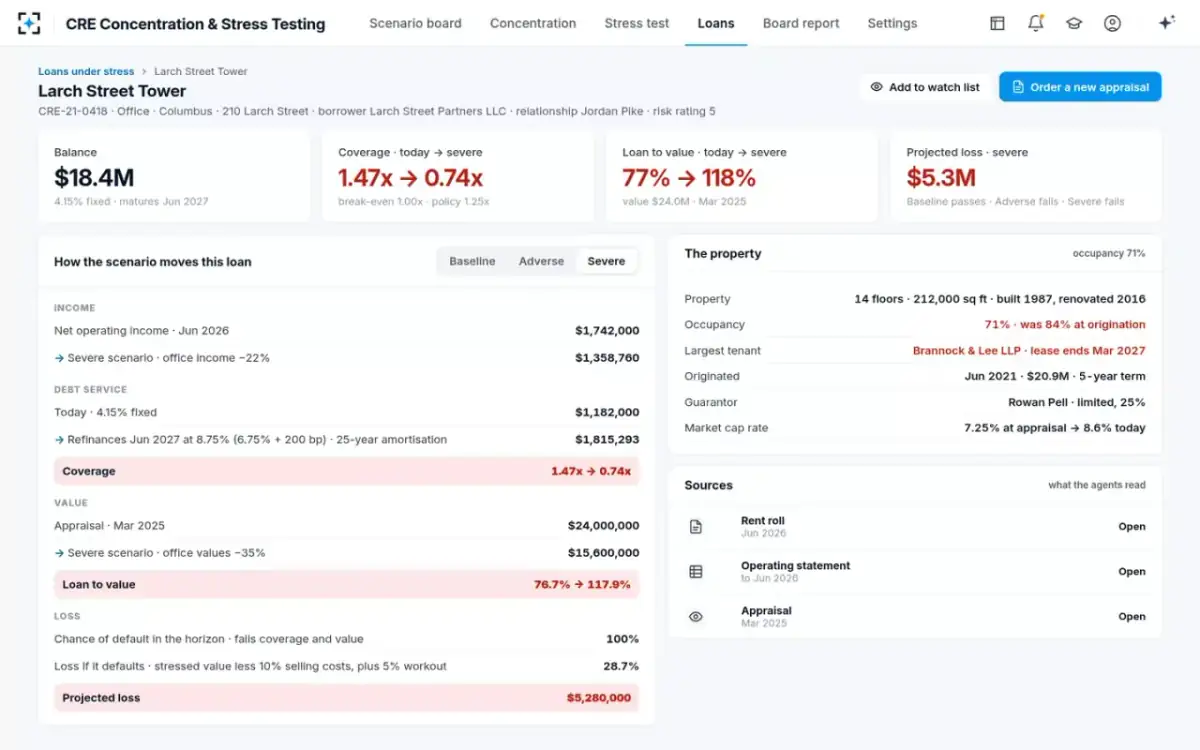
CRE Concentration & Stress Testing: a loan's walk under each scenario replaces the tool's output
What to look for in a replacement for the OCC stress testing tool
Look for a method an examiner can re-perform and a board can question. The checklist below applies whether the replacement is a spreadsheet the bank builds or software it buys.
Ten questions for any CRE stress test, built or bought
- Does it stress each property type on its own drivers?
Rents and capitalization rates for leased property; sale prices and absorption for projects, as in appendix C.
- Does the rate shock reach only loans that refinance or reprice in the horizon?
Otherwise fixed-rate loans are over-stressed and maturing ones under-stressed.
- Is the horizon at least two years?
Bulletin 2012-33 asks for at least a two-year projection.
- Are the scenarios the board's, versioned and dated?
A vendor default scenario is not the bank's risk appetite.
- Can every result be traced to a loan and a document?
Income to the operating statement, value to the appraisal, terms to the note.
- Are stale inputs shown, not hidden?
An old operating statement should be marked, not silently used or quietly estimated.
- Does it restate concentrations after losses?
On tier 1 capital plus the allowance, against both the screens and the board's limits.
- Can it answer a director's what-if the same day?
A question asked at the meeting should not wait for next year's test.
- Who signs, and is that on the record?
The results go to the board through named people, with dates.
- How does it sit under the bank's model risk policy?
Decide whether it is a model, and how it is checked, before the first board report.
Where CRE Concentration & Stress Testing fits, and where it does not
It fits a bank whose CRE book is large enough, or concentrated enough, that the board needs to know which loans break and why, and wants that every month rather than once a year. Six agents read the month-end loan tape, the rent rolls, operating statements and appraisals, and the bank's market data; they re-stress every loan under the board's scenarios, test every limit after the losses and draft the report. People approve the scenarios and limits, propose the actions and sign. In the solution's fictional sample run, 486 loans under three scenarios took 2 minutes 8 seconds; we estimate the same test by spreadsheet at about six weeks.
It does not fit everything the OCC tool's absence leaves open. It stresses the CRE book, not consumer, agricultural or commercial and industrial loans; it does not compute the CECL allowance or an enterprise-wide interest rate and liquidity test; and it reads the bank's own market data rather than supplying a scenario of its own. A bank that needs only a first annual screen should start with the OCC's appendix B and graduate when the questions outgrow it.
Questions people ask
Is there a free CRE stress test template?
Yes: appendix B of OCC Bulletin 2012-33 sets out a basic portfolio-level stress test in three sections, estimated loan losses by call report category, the effect on earnings over two years, and the effect on tier 1 capital and the leverage ratio. It is a pool-level loss-rate method; it does not stress individual loans.
Did the OCC replace its CRE stress test tool?
No replacement has been announced. The OCC's notice says only that the tool "was terminated in 2021 and is no longer on the OCC's BankNet website." The bulletin that described the tool, and the expectation to stress test, remain in force.
What are OCC stress test scenarios for community banks?
The OCC does not publish scenarios for community banks. Bulletin 2012-33 asks each bank to build its own: a base case and at least one adverse case drawn from national and local economic data, with assumptions that may differ by geography and collateral type.
Does the OCC require a specific stress testing method?
No. The bulletin leaves the method to the bank and says a stress test needs neither sophisticated analysis nor outside consultants. What it requires is that the method fit the bank's risk and that the results reach its planning.
Can state-chartered banks use OCC stress testing guidance?
Bulletin 2012-33 is addressed to national banks and federal savings associations, but the 2006 CRE concentration guidance it builds on was issued jointly with the Federal Reserve and FDIC. For a state bank, the OCC bulletin's method is a useful reference rather than an obligation; its examiner will apply the 2006 guidance, which expects stress testing from banks with CRE concentrations but gives no worked example of its own.