CRE stress testing guidance for US banks rests on two documents. The 2006 interagency guidance on concentrations in commercial real estate lending, issued by the OCC, Federal Reserve and FDIC, says a bank with CRE concentrations "should perform portfolio-level stress tests or sensitivity analysis to quantify the impact of changing economic conditions on asset quality, earnings, and capital." OCC Bulletin 2012-33 adds the cadence and horizon for banks of $10 billion or less: some form of stress testing "on at least an annual basis," over "at least a two-year projection." Neither prescribes a method, and examiners grade the quality of whatever the bank does. Botminds' CRE Concentration & Stress Testing runs the test monthly, loan by loan, on the bank's own board-approved scenarios; this guide is about what the rules ask, not the product.
The CRE stress testing expectation in three numbers
1×a year
at least: the OCC's minimum cadence for loan portfolio stress testing at community banks
2years
at least: the projection horizon the OCC expects a stress scenario to cover
4kinds
of stress test the OCC describes: transaction, portfolio, enterprise and reverse
What is the CRE stress testing guidance, and who issued it?
The core text is the interagency guidance "Concentrations in Commercial Real Estate Lending, Sound Risk Management Practices," published December 12, 2006 by the OCC (Bulletin 2006-46), the Federal Reserve (SR 07-1) and the FDIC (FIL-104-2006) (71 FR 74580). It applies to all three agencies' banks and is still in force: the OCC's "Concentrations of Credit" booklet, version 3.0 of September 2026, still refers readers to Bulletin 2006-46 for CRE (OCC Comptroller's Handbook).
The guidance lists portfolio stress testing and sensitivity analysis as one of seven elements of CRE risk management, alongside board and management oversight, portfolio management, management information systems, market analysis, underwriting standards and credit risk review. It scales the expectation to the book: stress testing "should be consistent with the size, complexity, and risk characteristics of its CRE loan portfolio," and "well-margined and seasoned performing loans on multifamily housing normally would require significantly less robust stress testing than most acquisition, development, and construction loans."
It also sets the floor low on method. "Portfolio stress testing and sensitivity analysis may not necessarily require the use of a sophisticated portfolio model," it says; stress testing "may be as simple as analyzing the potential effect of stressed loss rates on the CRE portfolio, capital, and earnings." The analysis "should focus on the more vulnerable segments" of the portfolio.
The rulebook, in the order it was written
Six documents shape what an examiner expects of a CRE stress test today. Each added one piece; none replaced the 2006 guidance.
CRE stress testing guidance from 2006 to 2026
| Year | Document | What it added |
|---|---|---|
| 2006 | Interagency CRE concentration guidance (OCC 2006-46, SR 07-1, FIL-104-2006) | Stress testing expected of banks with CRE concentrations; the 100% and 300% screens; board-approved limits |
| 2012 | OCC Bulletin 2012-33, Community Bank Stress Testing | At least annual; at least a two-year horizon; four kinds of test; a simple spreadsheet method is acceptable |
| 2015 | Interagency statement on prudent CRE risk management (OCC 2015-51) | Reminder after rising concentrations and easing standards; exams to focus on concentration guidance |
| 2020 | Joint statement on credit concentration ratios (OCC 2020-29) | Ratios computed on tier 1 capital plus the allowance from March 31, 2020 |
| 2021 | OCC stress test tool for income-producing CRE | Terminated; no longer on BankNet |
| 2026 | Revised model risk guidance (OCC 2026-13, SR 26-2) | Sets which stress engines count as models; generative and agentic AI out of scope |
The 2015 statement is the one most often forgotten. The agencies observed "substantial growth in many markets, increased competitive pressures, rising concentrations, and an easing of underwriting standards," and reminded banks that examinations would "focus on institutions' adherence to guidance pertaining to the management of concentration risk" (OCC Bulletin 2015-51). The 2020 statement changed the arithmetic of the screens but not the stress testing expectation; how to calculate the CRE concentration ratio covers it.
OCC Bulletin 2012-33: how often, how far ahead, and how simple
Bulletin 2012-33 is the OCC's community bank stress testing guidance, and it answers the practical questions. It applies to banks with $10 billion or less in assets and sets three expectations (OCC Bulletin 2012-33).
Cadence: "some form of stress testing or sensitivity analysis of loan portfolios on at least an annual basis." Horizon: "at least a two-year projection," because losses tend to emerge over two years after a downturn. Method: "The OCC does not endorse a particular stress testing method for community banks," and "Stress tests do not need to involve sophisticated analysis or third-party consultative support."
The bulletin is also specific about what an effective test contains, whatever its method: "asking plausible 'what if' questions about key vulnerabilities; making a reasonable determination of how much impact the stress event or factor might have on earnings and capital; and incorporating the resulting analysis into the bank's overall risk management process, asset/liability strategies, and strategic and capital planning processes." The third element is the one examiners find missing most often. A test that is run and filed has done the first two.
Per OCC Bulletin 2006-46 … banks that exceed certain CRE concentration thresholds are expected to use more robust stress testing practices to effectively manage the concentrations and maintain adequate capital.
OCC Bulletin 2012-33
What are the four types of stress testing?
The OCC names four: transaction, portfolio, enterprise and reverse. They differ in what is stressed and in which direction the question runs.
The four kinds of stress test in OCC Bulletin 2012-33, appendix A
| Kind | What it does | What it answers for a CRE book |
|---|---|---|
| Transaction | Estimates losses at the loan level from the effect of changing conditions on a borrower's ability to service debt | Which loans break, and why: income, rate at refinance or value |
| Portfolio | "Bottom up" adds up transaction results; "top down" applies stress loss rates to pools with common risk characteristics | What the scenario costs the CRE book, and how the concentration ratios move |
| Enterprise | Combines credit, interest rate and liquidity effects under one scenario, with consistent assumptions | Whether capital and funding hold when CRE losses arrive with a rate move |
| Reverse | Starts from an outcome, such as losses that breach regulatory capital ratios, and works back to the events that would cause it | How bad office values or construction losses would have to get to break the bank |
Most community banks run a portfolio test and stop there. The reverse test is the one boards find most useful once they have seen it, because it turns a scenario nobody believes into a threshold everybody can watch: if office values would have to fall 55% to take the bank below its capital target, the board knows how far today's market is from that line. The loan-level version of the transaction test is worked through on one office loan in loan level stress testing.
FDIC CRE stress testing: the same guidance, and a finding about exams
The FDIC co-issued the 2006 guidance, so its CRE stress testing expectation is the same text. What the FDIC record adds is evidence about how it is examined. Its Office of Inspector General reviewed concentration supervision in 2018 and found that examiners often struggled to judge the stress tests banks gave them.
"Some examiners also noted that they did not realize what 'good' concentration stress tests or concentration strategic contingency plans were until they reviewed one at an institution," the report says (FDIC OIG, EVAL-18-004). The same review put the cost of badly managed concentrations from 2007 to 2013 at 492 failed institutions and $74.6 billion of losses to the Deposit Insurance Fund. For a bank, the practical lesson is that the burden of showing the test is good sits with the bank: assumptions written down, results traced to loans, and a visible link from results to decisions.
Federal Reserve expectations for CRE-concentrated banks in 2026
The Federal Reserve applies the same 2006 guidance through SR 07-1 and says where it is looking now. Its June 2026 supervision report says supervisors "continue to monitor CBOs and RBOs that are concentrated in CRE lending, particularly the office and multifamily sectors," and are "reviewing CBO and RBO underwriting practices, classifications, and credit loss reserve methodologies and levels" (Federal Reserve Supervision and Regulation Report, June 2026). CBOs and RBOs are community and regional banking organizations.
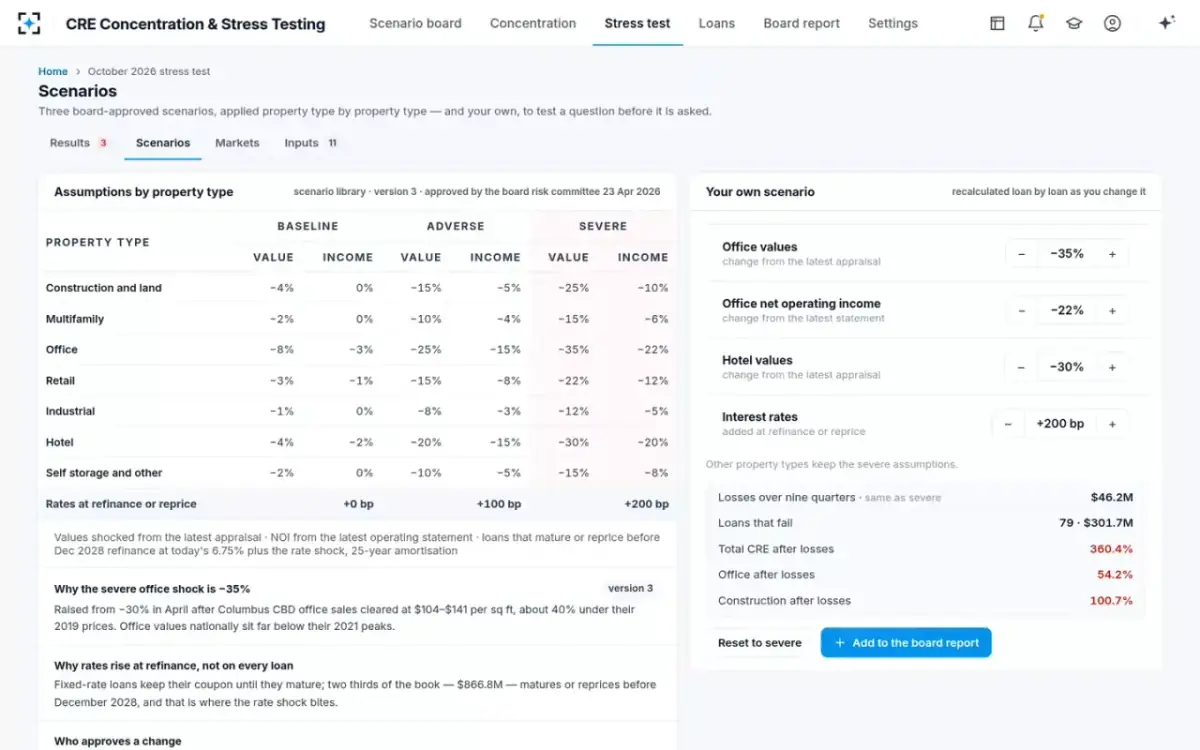
That focus tells a bank what its scenarios should stress. A severe case that shocks office and multifamily values and income, and the rate at which maturing loans refinance, is aimed where the examiner is aimed. The sample bank in the solution, a fictional community bank in Ohio, uses board-approved assumptions by property type: in its severe case, office values down 35% and income down 22%, multifamily values down 15% and income down 6%, and 200 basis points added to rates at refinance or reprice.
CRE Concentration & Stress Testing: the board's scenario assumptions, by property type
What examiners grade in a CRE stress test
Examiners grade the quality of the test and what it changed, not whether a file exists. The OCC's CRE examination procedures say it plainly: "Evaluate the quality and results of portfolio stress testing," under the objective of determining "whether the bank has systems in place to provide accurate and timely assessments of the risks associated with its CRE lending function" (OCC, Commercial Real Estate Lending, examination procedures). The next procedure asks whether management and board reports address growth, asset quality, concentrations and trends.
What a CRE stress test needs to stand up in an exam
- A base case and at least one adverse scenario
OCC 2012-33 asks for both, built from macro and local data.
- Assumptions written down, with the reason for each
Value and income shocks by property type, rates at refinance, horizon, loss severity.
- A horizon of two years or more
Long enough for losses to emerge and for maturing loans to meet the rate shock.
- Results stated for earnings and capital
Losses alone do not answer the question; capital and the concentration ratios after losses do.
- The most vulnerable segments tested hardest
Construction, office and hotel before seasoned multifamily, as the 2006 guidance suggests.
- A visible link to decisions
Limits, sub-limits, underwriting, capital plans and the contingency plan reviewed against the results.
- Board review on the record
Who saw the results, when, and what they decided.
When a CRE stress test shows a problem: the actions the guidance lists
The guidance expects action, and Bulletin 2012-33 lists the options. If a stress test "reveals critical vulnerabilities, management and the board should take steps to mitigate those risks through such means as modifying loan growth, revising the risk tolerance strategy, adjusting the portfolio mix and underwriting criteria, altering concentration limits or other policies and procedures, and strengthening capital." The 2006 guidance adds a contingency plan for reducing concentrations if the CRE market turns, and names loan participations, whole loan sales and securitizations as tools.
From a stress result to a board decision
Agent
Run the scenariosEvery loan stressed on the board's assumptions; losses, capital and ratios after losses computed.
Agent
Find what drives the lossThe loans, property types and markets behind the result, each traced to its documents.
Agent
Draft the report and actionsProposed actions, such as a new appraisal, an early refinance talk or pacing construction funding.
Never: decides an action or changes a limit
A person decides
Portfolio manager and CROReview the assumptions and results, add or remove actions.
A person decides
Chief Credit Officer and board committeeSign the report; the committee decides on limits, growth and capital.
That division matters for a second reason. The revised model risk guidance of April 2026 sets out which stress engines count as models and leaves generative and agentic AI outside its scope (OCC Bulletin 2026-13), so a bank needs its own answer for how agent-drafted reports are checked; bank stress testing software under SR 26-2 takes that question up.
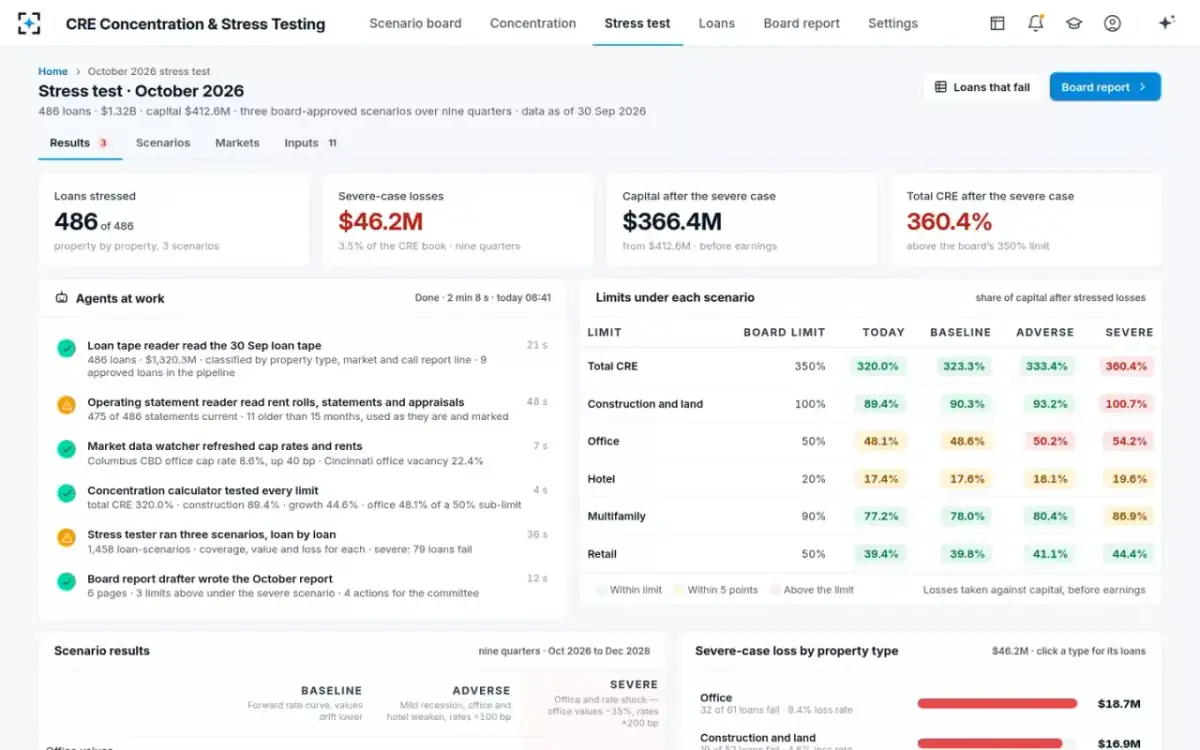
CRE Concentration & Stress Testing: one month's stress test, run and checked
Questions people ask
How often must banks stress test CRE?
The OCC expects community banks to stress test loan portfolios "on at least an annual basis," under Bulletin 2012-33. The 2006 interagency guidance sets no frequency but expects banks with CRE concentrations to stress test. Banks near their limits, or whose markets are moving, often run it quarterly or more.
Is OCC Bulletin 2012-33 still in effect?
Yes. The bulletin remains on the OCC's site as current guidance. The only change is a banner noting that the OCC ended its stress test tool for income-producing CRE loans in 2021 and removed it from BankNet; what replaced the OCC stress testing tool covers that gap.
Do banks above $10 billion follow different stress testing guidance?
Bulletin 2012-33 is written for banks of $10 billion or less and says larger institutions have separate stress testing standards. The 2006 CRE concentration guidance applies regardless of size, so a larger bank with CRE concentrations is still expected to stress test its CRE book.
What stress scenarios do regulators expect for CRE?
No regulator publishes a required CRE scenario for community banks. The OCC asks for "a projected base case and at least one or more adverse scenario(s) based on macro and local economic data," and lists property-type stress factors such as falling rents, sale prices and absorption. Scenarios should hit the bank's most vulnerable segments hardest.
Does the CRE stress testing guidance apply to credit unions?
The 2006 guidance and Bulletin 2012-33 were issued by the OCC, Federal Reserve and FDIC for the banks they supervise. Credit unions are supervised by the NCUA under its own commercial lending rules, so the bank texts are a reference point for them rather than a direct obligation.