Call report preparation software takes a bank's general ledger and subledgers to finished Call Report schedules: it places every account on a line, re-foots the schedules, runs the agencies' edits and prepares the data file that the bank's filing system sends to the FFIEC's Central Data Repository. The way to test it before buying is to re-prepare the quarter you last filed, from the same trial balance and extracts, and compare every reported line with what you submitted. Every difference then falls into one of four causes, mapping, instruction, source data or rounding, and a product earns its place by how many it explains rather than how many it produces. Botminds' Call Report Preparation is built to be tested this way: its agents place, cite, re-foot, check and explain on your own general ledger and your last filing, while your preparer, reviewer and controller decide.
This guide is for the people who will buy and run the software: the controller who owns the decision, the regulatory reporting manager who will live with it, and the project lead who has to make a pilot mean something. The examples come from the solution's fictional sample bank, a $3.4 billion state nonmember bank filing the FFIEC 041; your own pilot should use your own quarter.
A ten-business-day pilot of call report preparation software on last quarter's filing
- Criteria and filesDays 1–2
- New-account questionsDays 3–4
- Classify differencesDays 5–7
- Try the reviewDays 8–9
- DecideDay 10
- Load and proveDays 1–2
- Place, cite, editDays 3–4
- Explain each lineDays 5–7
- Review and trailDays 8–10
What is call report preparation software?
It is software that turns the bank's own accounting data into the Call Report's schedules, and it comes in two layers that are often sold together. The lower layer produces a submission file in the format the CDR accepts, runs the agencies' validity and quality edits, prints the form and the cover page, and either submits the file or hands it to someone who does. The upper layer is preparation proper: getting from thousands of general ledger accounts and loan-level records to the right lines, with the arithmetic proven.
The FDIC tells new filers that "Most institutions utilize Call Report software to prepare and submit the Call Report to the CDR" (FDIC, Important Information for New Call Report Filers). The agencies' streamlining Request for Information of December 2025 notes that preparation is still "not a fully automated process" at some institutions, which is the upper layer. Call Report Preparation is an upper-layer product: it prepares, proves and explains, and passes the signed data file to the bank's own regulatory reporting system to submit.
Does call report software file to the CDR?
Submission software does; preparation software may not, and the difference matters for a pilot. The General Instructions set two routes: a bank can "use computer software to prepare and edit its report data and then electronically submit the data directly" to the CDR, or complete a paper report and arrange with a software vendor or another party to convert it and submit the file. Either way the software has to meet the CDR's technical specifications, and vendors whose software has passed that test are named in each quarter's Financial Institution Letter, while a bank may instead build its own and test it with the CDR directly (call report software vendors quotes the passage; FFIEC 031 and 041 General Instructions).
After submission the CDR answers quickly. The FDIC describes it: the institution "will promptly receive an e-mail notification indicating that the Call Report has been submitted and will then receive an e-mail notification indicating that the report has been accepted or rejected. Edit checks are automatically run against the data to verify its validity and quality." A pilot does not touch that step, because the quarter it re-prepares has already been accepted. What a pilot can test is everything before it.
Who is responsible if call report software is wrong?
The bank, always. The agencies wrote this into the General Instructions in terms that leave no room for a vendor contract to shift it:
“Each bank is responsible for ensuring that the data reported each quarter reflects fully and accurately the data item reporting requirements for that report date, including any changes that may be made from time to time. This responsibility cannot be transferred or delegated to software vendors, servicers, or others outside the reporting bank.”
FFIEC 031 and 041 General Instructions, Submission of the Reports
That sentence is the reason a pilot has to be run by the bank's own preparers on the bank's own data. A vendor demonstration on a vendor's sample bank shows what the software can do; it cannot show whether the software will get your quarter right, and your quarter is the only one you are responsible for. It is also why the quarter's instruction changes belong in the pilot: "including any changes that may be made from time to time" means the software has to keep up with the Supplemental Instructions, and so does your test of it.
How do you test call report software before buying?
Re-prepare a quarter you have already filed and compare. Give the software the same trial balance, the same subledger extracts and the same instruction set as the filed quarter, without the filed answers, and let it prepare every schedule. Then lay its figures beside yours, line by line, and give every difference a cause before anyone argues about which number is right.
Four causes of a difference between the pilot and the filed report
| Cause | What it looks like | Who settles it | What it tells you |
|---|---|---|---|
| Mapping | An account on a different line: a participation on 1.e.(2) instead of 1.e.(1) | Your preparer, with the paragraph | Whether the software reads your accounts as your team does, and which of you was right |
| Instruction | A line applied under the quarter’s Supplemental Instructions, or an older reading of them | Your reviewer, against the instruction text | Whether the software keeps up with quarterly changes |
| Source data | A different balance from an extract that did not foot, or a field missing on some loans | Your systems owner | Whether your data are ready, whatever you buy |
| Rounding | A difference of a thousand on a total built from rounded components | Nobody: the instructions allow it | Whether the software rounds the way the instructions permit |
Two outcomes are likely and both are useful. Most lines will match, which proves the plumbing. A few will not, and in some of those the software will be right and the filed report wrong. Plan for that before the pilot starts: a significant classification error found in a filed report may require an amended report. The General Instructions say the primary federal regulator "may require the filing of an amended Call Report if reports as previously submitted contain significant errors ... in how the reporting bank classified or categorized items in the reports, i.e., on what line of the report an item has been reported." A pilot that finds one has paid for itself, but the bank needs to know who decides what happens next.
What data does call report software need?
More than a trial balance. The general ledger decides most lines, but the loan schedules turn on fields that live on the loan, and the deposit and securities schedules on fields that live in their own systems. The pilot is the cheapest moment to find out which fields your systems can provide.
What to hand over for a pilot on one filed quarter
- General ledger trial balance and account master
At the report date’s close of business, with account descriptions and open and close dates.
- Core banking loan and deposit balances
With collateral, purpose and occupancy codes on loans, and depositor types on deposits.
- Loan subledger
Participations bought and sold, past due and nonaccrual, modifications, servicing.
- Investment accounting
Positions with amortized cost and fair value, and how each security is classified.
- Fixed asset subledger
Premises, equipment and right-of-use assets.
- The instruction set for that report date
The instruction book and that quarter’s Supplemental Instructions.
- Last quarter’s placements and the filed report
The prior quarter for carry-forward, and the filed quarter held back until the comparison.
Borrower-level data raise a fair question about what leaves the bank in a pilot. In Call Report Preparation, borrower names and tax identifiers are redacted in exported evidence by default, and retention is a setting; ask the same of any product you test.
Pass and fail: set the criteria before the run
Criteria written after the results are a sales conversation. Fix them on day one, in writing, with the controller's name on them. These are the ones we would use; adjust the numbers to your own report.
Pass and fail criteria to fix before the pilot starts
- Every difference has a cause
Zero lines left unexplained by day 7; a line with no cause fails, whoever is right.
- Every new account caught
Every account opened, renamed or reclassified in the quarter appears in front of a person, none silently placed.
- Every stated tie holds
Each equality and limit the instructions write into the line items holds, or the software says which does not and by how much.
- The paragraph, not a paraphrase
For any line your reviewer picks, the governing instruction text is quoted with its schedule and item.
- Overrides are counted
How many of the software’s proposals your preparer changed, and why, is reported without being asked for.
- The review is shorter
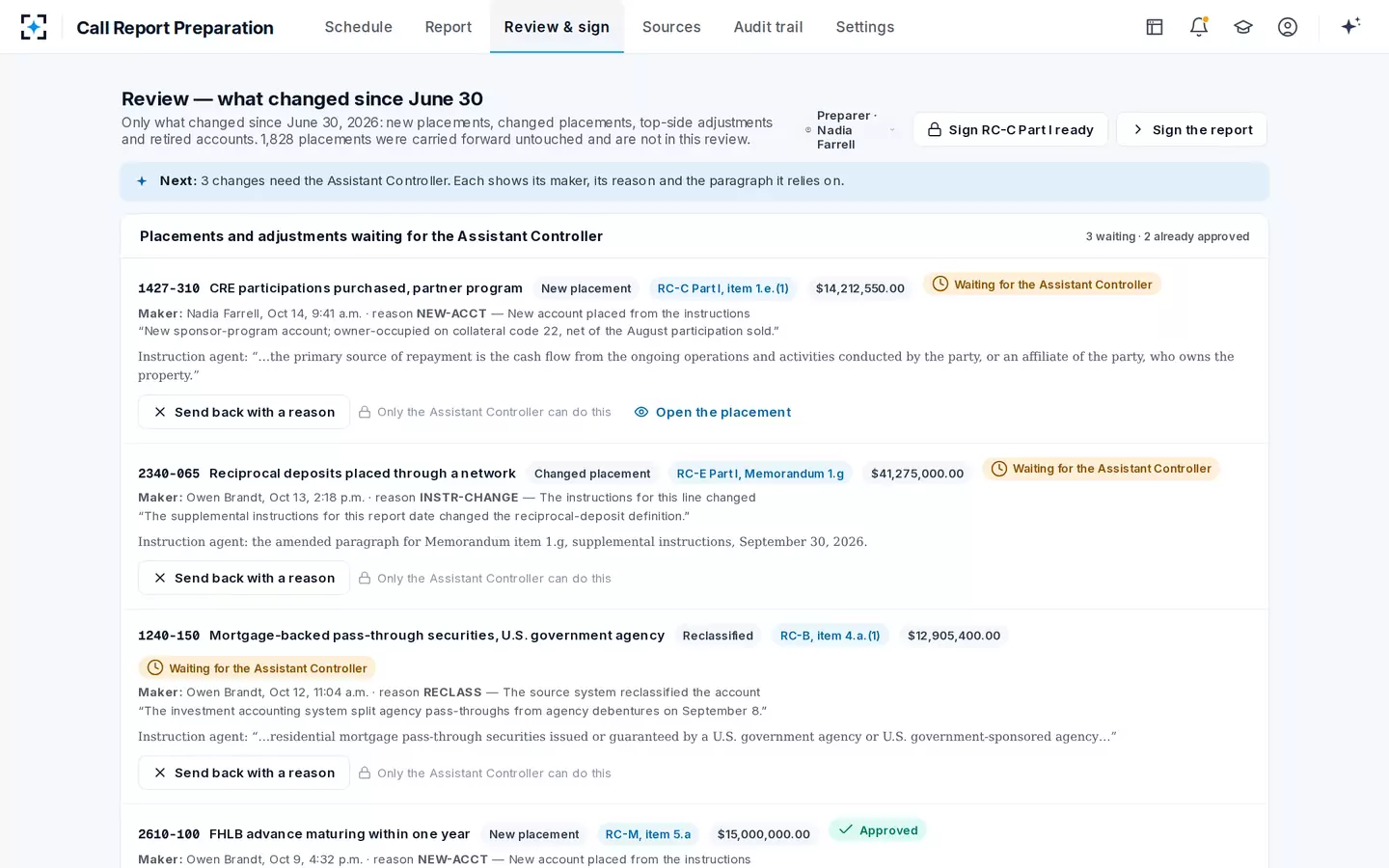
Your reviewer reads only what changed since the previous report date, with maker, reason and paragraph for each.
- An examiner could follow it
For a sampled line, the trail from the figure to the accounts, the people and the paragraph exports as one file.
The fourth criterion is worth its own test. Research on language models and financial statements has found that verification is harder than it looks: one 2026 benchmark built from SEC XBRL filings found that most of the complete model runs it tested, nine of fourteen, flagged errors on almost every clean statement (FinVerBench, arXiv preprint, not peer reviewed; generative AI in financial reporting quotes the finding). A tool that flags everything is as unhelpful as one that flags nothing. Ask the software to explain lines that match as well as lines that do not, and count how often it invents a problem.
What a reviewer reads after Call Report Preparation runs
Can we run new call report software in parallel?
Yes, and after a back-test it is the natural second step: one live quarter in which the existing process files and the new one shadows it. Only one report can be signed and submitted, so decide in advance which one that is and keep the other inside the bank. The value of a parallel quarter over a back-test is that it tests what a back-test cannot: the new software against a quarter whose answers nobody yet knows, under the real calendar.
Two tests, two questions
Back-test on last quarter: Does the software reach the figures we filed, and can it explain every difference?
Parallel run on the current quarter: Can it prepare a quarter nobody has finished yet, inside the window?
Back-test on last quarter: Any time; ten business days
Parallel run on the current quarter: One live quarter, from report date to due date
Back-test on last quarter: Nothing; the quarter is already accepted
Parallel run on the current quarter: One report only, from whichever process the bank chose in advance
Back-test on last quarter: Finding an error in the filed report, and having to decide about an amendment
Parallel run on the current quarter: Doubling the team’s work in the busiest weeks
Back-test on last quarter: Whether to go further
Parallel run on the current quarter: Whether to switch
How long does it take to implement call report software?
The pilot takes ten business days; going live takes as long as connecting the bank's sources takes, which is mostly the bank's data, not the software. The variables are the number of source systems and extracts, how many loan-level fields exist and are populated, and how much of the current mapping is written down. A bank with 26 extracts and a mapping held in a workbook can expect the first live quarter to spend more time on placements than later ones, because every account the software sees for the first time is a decision.
The OCC's handbook sets the expectation for what has to be ready by then: policies that set standards for choosing and using reporting software, and training that keeps up with every reporting or system change the bank goes through (OCC Comptroller's Handbook, Regulatory Reporting; the training paragraph is quoted in call report training for a new preparer). A change of software is a system change in that sense, so the procedures and the training should change in the same quarter.
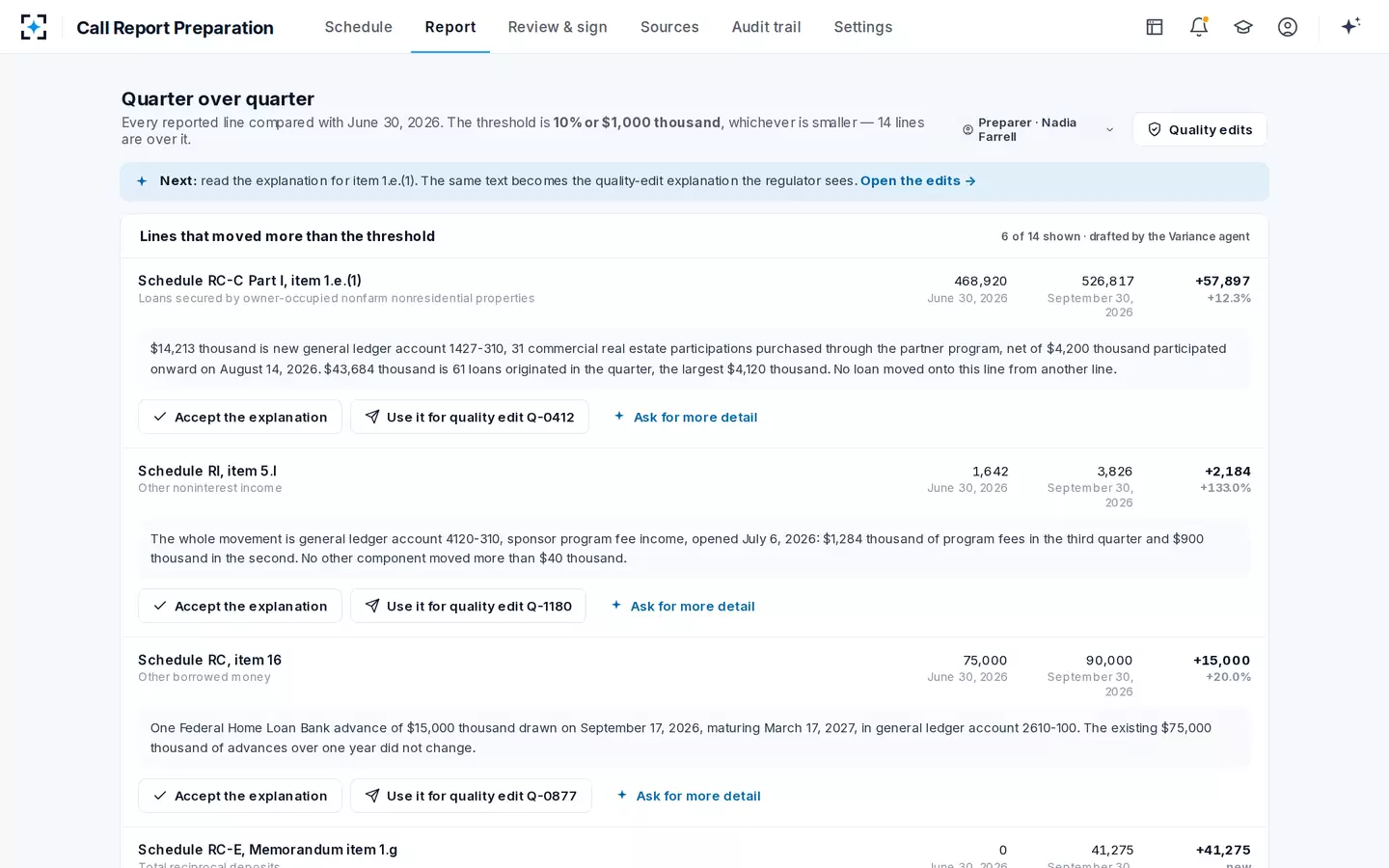
Every moved line explained from its accounts
Where Call Report Preparation fits in a pilot, and where it does not
It fits the upper layer: preparing the FFIEC 041, 051 or 031 from your general ledger and subledgers, with every placement cited, every schedule re-footed after every change and every moved line explained. In a back-test it shows, for each line, the accounts behind the figure and the paragraph behind the line, which is what the four-cause classification needs. It holds a schedule out of ready while a tie-out fails, keeps the preparer and the reviewer as different people, and assembles no file before every schedule is signed.
It does not submit to the CDR; your existing regulatory reporting system does, so the submission side of your current setup stays in place. It does not decide new placements, and it will not change a figure to make a tie-out hold. If your pilot needs the submission layer replaced as well, that is a different purchase, and the questions to ask of any vendor in it are in call report software vendors: 12 questions before you sign. What the pilot's results are worth in hours is worked through in regulatory reporting automation, priced from the Call Report's own hours.
Questions people ask
Which quarter should we use for the back-test?
The most recent one with the most change: new products, a merger, an instruction change, or the December report with its annual items. A quiet quarter proves the plumbing; a busy one proves the judgment. The September 2026 quarter, with its reciprocal and custodial deposit changes in the Supplemental Instructions, is a good test of instruction handling.
Should internal audit be involved in a call report software pilot?
As an observer, yes. The OCC notes that some banks have an audit that tests the accuracy of the automated mapping software feeding regulatory reports, and the pilot is where that test's baseline comes from. Audit should agree the pass and fail criteria before the run, not after.
What if the pilot finds an error in the report we filed?
Treat it as you would any error found after filing: decide whether it is significant enough to amend under the General Instructions, which allow a regulator to require an amendment for significant classification errors and material recognition or measurement errors. Amended reports go through the CDR in the same way as originals.
Can call report preparation software handle the FFIEC 051 and 031?
Ask to see the form you file, not the one in the demonstration. In Call Report Preparation the form is a setting with the FFIEC 041, 051 and 031 as choices, and the instruction set follows the form and the report date. A bank eligible for the FFIEC 051 may file the FFIEC 041 instead.
How many people does a call report software pilot need?
Three, part time: the preparer who filed the quarter, a reviewer who can settle instruction questions, and someone from systems who can produce the extracts. The controller signs off the criteria at the start and the decision at the end.