The FFIEC 051 vs 041 choice comes down to three tests and one option. A bank with only domestic offices files the FFIEC 041 if it has less than $100 billion in total assets; it may file the shorter FFIEC 051 instead if it has less than $5 billion, measured each June 30, and is neither an advanced approaches institution, nor subject to Category III capital standards, nor a large or highly complex institution for deposit insurance assessments. An eligible bank may still choose the FFIEC 041, and its regulator may require it. The difference is worth about 20 hours a quarter on the agencies' own estimate, and a different set of schedules every quarter. Botminds' Call Report Preparation handles either form: the form is a setting, and the instruction set, the schedules and the agents' placements follow it.
This guide is for CFOs and controllers at banks near the $5 billion line, and for preparers who need to know what changes when the form does. Counts of filers come from the FDIC's public data for June 30, 2026; examples of the solution use its fictional sample bank, which is eligible for the FFIEC 051 and files the FFIEC 041.
FFIEC 041 vs 051, schedule by schedule
FFIEC 041: Every quarter
FFIEC 051: Every quarter; many RI-E components only in December
FFIEC 041: Quarterly, from $1 billion
FFIEC 051: June and December only, from $1 billion
FFIEC 041: Every quarter
FFIEC 051: Every quarter, with some memoranda semiannual
FFIEC 041: Reported
FFIEC 051: June and December only
FFIEC 041: Every quarter, with components
FFIEC 051: Totals quarterly; components June and December
FFIEC 041: Every quarter
FFIEC 051: Items 1 to 25 June and December only
FFIEC 041: From $300 million in total assets
FFIEC 051: Not on the form
FFIEC 041: If the bank has the activity
FFIEC 051: Not on the form; Schedule SU asks a smaller set of questions
FFIEC 041: Quarterly or annually by size
FFIEC 051: Quarterly, semiannually or annually by size
FFIEC 041: Not on the form
FFIEC 051: Every quarter, as applicable
What is the difference between FFIEC 031, 041 and 051?
They are three versions of the same Consolidated Reports of Condition and Income, with decreasing detail. The FFIEC 031 is for banks with any foreign office, and for domestic banks with $100 billion or more in total assets or that are advanced approaches institutions. The FFIEC 041 is for banks with domestic offices only and less than $100 billion. The FFIEC 051 is for eligible domestic banks under $5 billion. The General Instructions put the order plainly: the FFIEC 031 has "more detail" than the FFIEC 041, and the FFIEC 051 "has the least amount of detail of the three reports."
Three Call Report forms at a glance
| FFIEC 031 | FFIEC 041 | FFIEC 051 | |
|---|---|---|---|
| Who files | Any foreign office; or $100 billion or more; or advanced approaches | Domestic offices only, under $100 billion | Eligible domestic banks under $5 billion |
| Agencies’ average hours a quarter | 86.25 | 55.56 | 34.99 |
| Balance sheet schedules | RC and RC-A through RC-V | RC and RC-A through RC-V, except RC-H and RC-I | RC and RC-B through RC-T, plus SU |
| First and third quarters | Full report | Full report | Reduced: many items only in June and December |
| Filers at June 30, 2026 | 80 | 934 | 3,282 |
Who can file the FFIEC 051?
A bank with domestic offices only and less than $5 billion in total assets, unless it falls into one of the excluded groups. The General Instructions set the test in one paragraph:
“Institutions with domestic offices only and total assets less than $5 billion, excluding (1) those that are advanced approaches institutions or are subject to Category III capital standards for regulatory capital purposes and (2) those that are large or highly complex institutions for deposit insurance assessment purposes, are eligible to file the FFIEC 051 Call Report.”
FFIEC 051 General Instructions, Eligibility to File the FFIEC 051
Eligibility is permission, not obligation: "An institution eligible to file the FFIEC 051 report may choose instead to file the FFIEC 041 report." A domestic office, for this test, excludes more than a foreign branch: an international banking facility, a majority-owned Edge or Agreement subsidiary, or a branch or consolidated subsidiary in Puerto Rico or a U.S. territory, for a bank headquartered in the states, all count as foreign offices and put the bank on the FFIEC 031.
What is the asset threshold for the FFIEC 051, and when is it measured?
Less than $5 billion in total assets, measured on the June 30 Call Report and applied from the following March. The instructions add that a bank is "expected to file the same report form, either the FFIEC 051 or the FFIEC 041, for each quarterly report date in a given year." A bank that crosses $5 billion in September files the FFIEC 051 for the rest of the year if it was eligible at the previous June 30; one that is above $5 billion at June 30 moves to the FFIEC 041 the next March.
The FDIC's public data show the rule at work. For June 30, 2026, six banks with $5 billion or more in total assets filed the FFIEC 051, and each had reported less than $5 billion at June 30, 2025, the date that set its form for 2026. In the other direction, 711 of the 934 FFIEC 041 filers reported less than $5 billion in total assets, so most FFIEC 041 filers are small enough by size alone to be considered for the short form. Some of them are excluded on other grounds, some have been told by their regulator to file the longer form, and some have chosen it; the public data do not say which.
Which Call Report banks filed for June 30, 2026
Which schedules are not on the FFIEC 051?
Six schedules that the FFIEC 041 carries are absent: RC-A, cash and balances due from depository institutions, which the FFIEC 041 requires from $300 million in total assets; and RC-D, RC-P, RC-Q, RC-S and RC-V, which cover trading, 1–4 family mortgage banking, fair value measurement, servicing and securitization, and variable interest entities. In their place the FFIEC 051 has Schedule SU, Supplemental Information, which the instructions describe as collecting "additional information in the FFIEC 051 on certain complex or specialized activities in which an institution may engage."
The schedules that remain are lighter too. On the FFIEC 051, the risk-weighting detail of Schedule RC-R, Part II, items 1 through 25, the small business and small farm loans of Schedule RC-C, Part II, and the components of other assets, other liabilities and off-balance-sheet items are reported only in June and December, and the components of other noninterest income and expense only in December. Those semiannual and annual items are what makes the first and third quarters short.
What is reduced reporting in the first and third quarters?
It is a statutory requirement, delivered through the FFIEC 051. The law (12 U.S.C. 1817(a)(12)) requires the agencies to allow "a reduced reporting requirement for a covered depository institution when the institution makes the first and third report of condition for a year," and the agencies' December 2025 Request for Information records that they "introduced the FFIEC 051 in March 2017" and in September 2019 "implemented certain reduced reporting for the first and third quarters of the year for respondents with total assets of less than $5 billion" (Federal Register, December 1, 2025). The OCC's booklet summarises the effect: "Compared with the FFIEC 031 and FFIEC 041, the FFIEC 051 has reduced reporting overall and particularly in the first and third quarters of the calendar year" (OCC Comptroller's Handbook, Regulatory Reporting).
What the short form is worth, on the agencies' averages
20.57hours
a quarter less for the FFIEC 051 than the FFIEC 041
55.56 minus 34.99
82hours
a year at the average filer
our arithmetic: 20.57 × 4
6
balance sheet schedules not on the FFIEC 051
RC-A, RC-D, RC-P, RC-Q, RC-S, RC-V
Can a regulator require a bank to file the 041?
Yes, and the instructions say on what grounds. For an otherwise eligible institution, the primary federal regulator, jointly with the state chartering authority where there is one, "may require the institution to file the FFIEC 041 instead based on supervisory needs." The factors named are whether the bank "is significantly engaged in one or more complex, specialized, or other higher risk activities, such as those for which limited information is reported in the FFIEC 051 compared to the FFIEC 041 (trading; derivatives; mortgage banking; fair value option usage; servicing, securitization, and asset sales; and variable interest entities)."
The same paragraph sets expectations: "The agencies anticipate making such determinations only in a limited number of cases." The list is the schedule matrix in reverse. A small bank with a large mortgage banking operation or a derivatives book is the case the FFIEC 051's missing schedules would hide, and the case a regulator is most likely to want reported in full.
When does a bank have to switch from 051 to 041?
In four situations, two on a calendar and two at once. The calendar cases follow the June 30 measurement; the immediate ones follow a change in what the bank is.
When an FFIEC 051 filer moves to another form
| Trigger | New form | From |
|---|---|---|
| Total assets of $5 billion or more at June 30 | FFIEC 041 | The March report of the following year |
| Regulator requires the longer form for supervisory needs | FFIEC 041 | As the regulator directs |
| Becomes a Category III institution, or a large or highly complex institution for deposit insurance assessments | FFIEC 041 | The first quarterly report date after the change |
| Becomes an advanced approaches institution, or establishes or acquires a foreign office | FFIEC 031 | The first quarterly report date after the change |
| A merger or acquisition | Depends on the resulting institution | The first quarterly report date after the transaction |
A switch is a mapping project, not a form change. Every general ledger account and loan code that fed an FFIEC 051 line needs a home on the FFIEC 041, and the six schedules the bank did not report before need sources: a bank that crosses $300 million at the same time also starts Schedule RC-A. The quarter before a switch is the time to map them, which is the subject of call report mapping, inside the agent; the hours the bigger form adds are priced in regulatory reporting automation, priced from the Call Report's own hours.
Will the FFIEC 051 be expanded above $5 billion?
The agencies have asked, and not yet proposed. Their December 2025 Request for Information said they "are interested in whether to expand the usage of the FFIEC 051 to larger institutions and how to further streamline the information collected by the FFIEC 051," noted that they "are not prohibited ... from expanding the availability of a short form Call Report to larger institutions," and asked directly: "Should the agencies set a higher size threshold for the availability of the short form Call Report in the first and third quarters of the calendar year? If so, what should the total asset size be?" They also asked why "eligible institutions have or have not chosen to use this option."
In July 2026 the agencies said they were reviewing the comments and, together with the 2027 statutory review of Call Report data, planned "to publish proposed revisions to Call Report forms and instructions for comment, as appropriate" (FIL-33-2026). By late October 2026 no proposal had been published. A bank between $5 billion and whatever threshold might follow should plan on the FFIEC 041 until a rule says otherwise.
How Call Report Preparation handles either form
The form is a setting with three choices, the FFIEC 041, the FFIEC 051 and the FFIEC 031, and the instruction set the agents quote follows the form and the report date, including that quarter's Supplemental Instructions. The solution's fictional sample bank, a $3.4 billion state nonmember bank, is eligible for the FFIEC 051 and files the FFIEC 041, which the settings screen notes in a line: a bank eligible for the FFIEC 051 may file the FFIEC 041 instead.
The form is a setting in Call Report Preparation
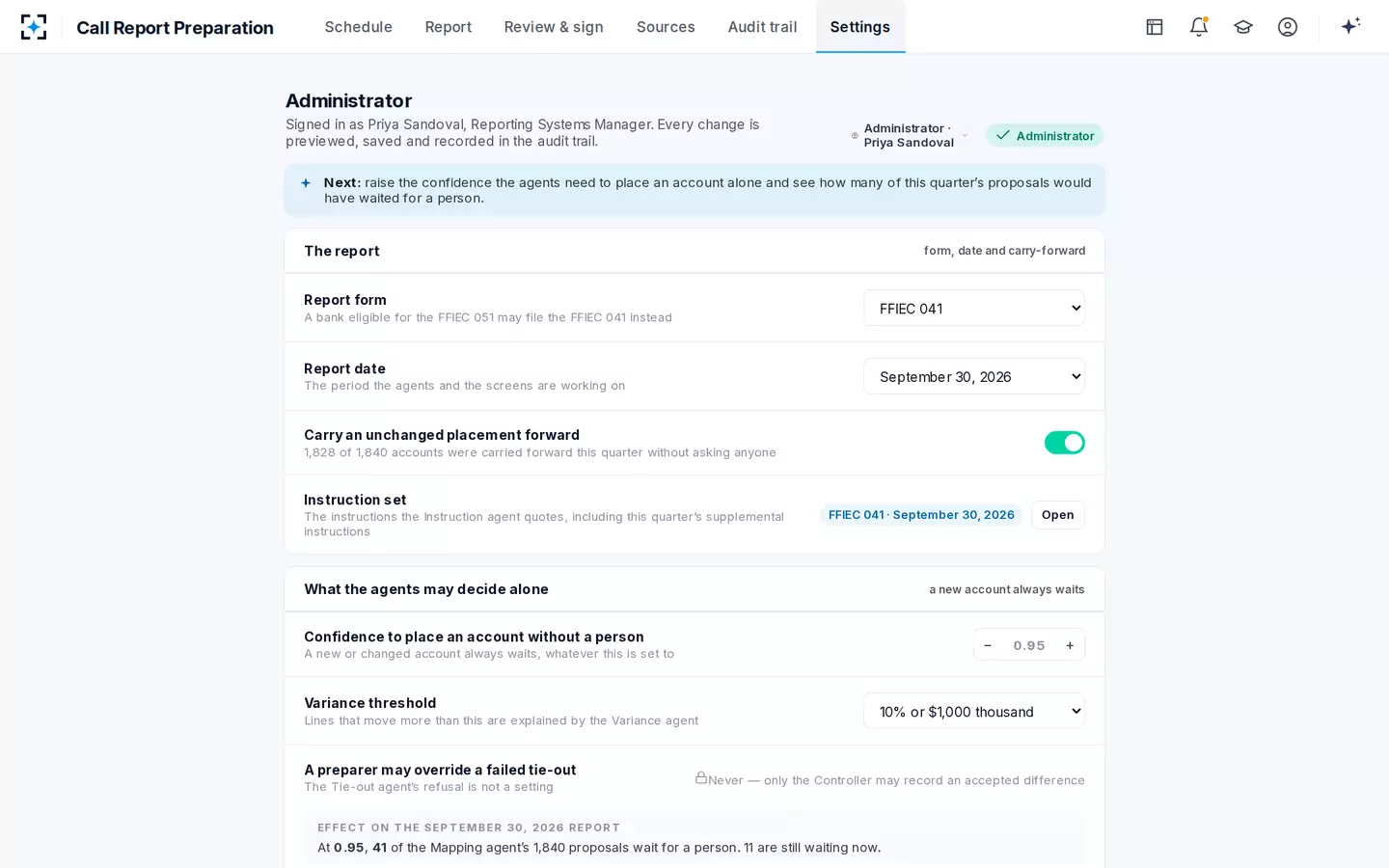
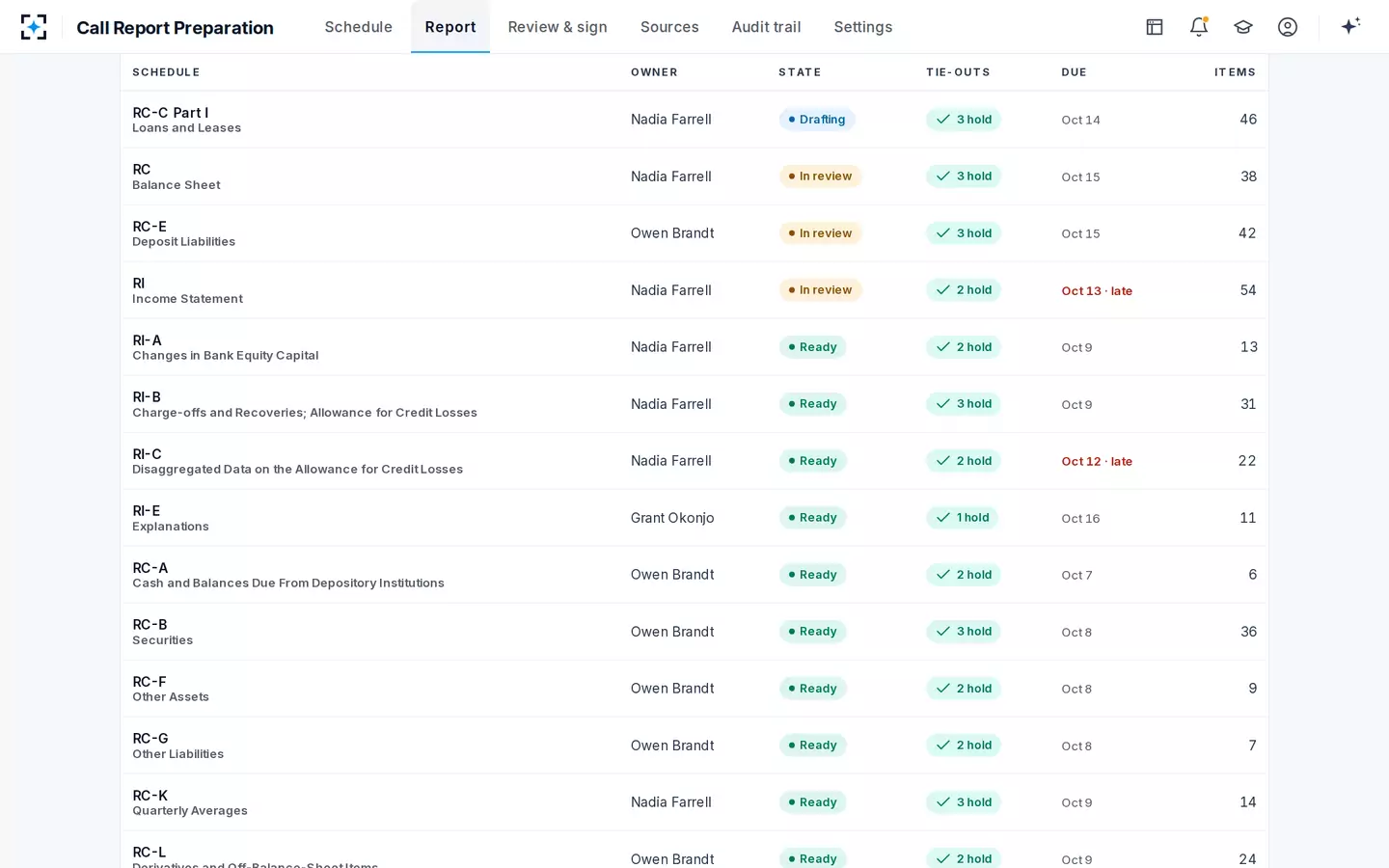
Semiannual and annual items follow the report date. In the sample bank's September report, three schedules are not required that quarter and the report screen says why, so a preparer is not left to wonder whether a blank schedule is an omission. A bank moving from the FFIEC 051 to the FFIEC 041 can run the new form on its last FFIEC 051 quarter first and see which accounts need new placements before the March report it counts for; testing on last quarter's filing describes that kind of run.
The schedules the form requires this quarter
Questions people ask
Is the FFIEC 051 the same as the "short form" Call Report?
Yes. The agencies use "short form Call Report" for the reduced first- and third-quarter reporting the law requires for eligible institutions under $5 billion, and they implemented it through the FFIEC 051, introduced in March 2017 with reduced quarterly reporting added in September 2019.
Do FFIEC 051 filers use different instructions?
Yes. The FFIEC 051 has its own instruction book, with its own General Instructions, line item instructions and Glossary, posted separately by the FDIC and the FFIEC. Much of the text is shared with the FFIEC 031 and 041 book, but item numbers and reporting frequencies differ.
Can a bank switch from the 041 back to the 051?
If it is eligible on the June 30 measurement and its regulator has not required the FFIEC 041, it may file the FFIEC 051 from the following March. The instructions expect the same form for every quarter of a given year, so the switch happens at the start of a year.
Does the FFIEC 051 have fewer edits?
It has fewer items, so there is less for the edits to test. The obligation is the same: validity edits must pass and quality edits must be fixed or explained before the report is complete.
Which banks file the FFIEC 031?
Banks with any foreign office, including an international banking facility or an Edge or Agreement subsidiary, and domestic banks with $100 billion or more in total assets or that are advanced approaches institutions. Eighty institutions filed it for June 30, 2026, more than a quarter of them with less than $5 billion in assets.