Call report preparation is the quarterly work of turning a bank's general ledger and subledgers into the schedules of the Consolidated Reports of Condition and Income, proving that they add up and agree with each other, resolving the agencies' edits, and having the report signed before the FFIEC's Central Data Repository receives it. It is hard because every reported figure is a chain of decisions made by different people on different days, and the report is only as good as the weakest link nobody wrote down. Botminds' Call Report Preparation keeps that chain on one screen: agents pull, place, cite, re-foot, check and explain, and the preparer, the Assistant Controller and the Controller decide and sign. The fastest way to understand the whole process is to follow one figure through it.
The figure here is Schedule RC-C, Part I, item 1.e.(1), loans secured by owner-occupied nonfarm nonresidential properties, at the solution's fictional sample bank: a $3.4 billion state nonmember bank filing the FFIEC 041 for September 30, 2026. The bank, its people and every balance are invented; the rules at each hop are the agencies' own.
One Call Report figure, eight hops from the general ledger to the signature
A person decides
1 · Cut-offThe bank’s close of business on September 30 fixes what is in the general ledger; quarter adjustments are posted as of that cut-off.
Agent
2 · ProofGeneral ledger agent proves the trial balance and 26 subledger extracts foot to their control accounts.
Never: edits a balance
Agent
3 · PlacementMapping agent places three carried-forward accounts and proposes one new one on item 1.e.(1).
Never: places a new account without a person
Agent
4 · RoundingTie-out agent sums dollars and cents and reports whole thousands.
Agent
5 · Tie-outItem 12 must equal Schedule RC items 4.a plus 4.b; past due and modified amounts cannot exceed the line.
Never: changes a figure to make a relationship hold
Agent
6 · EditsEdit-check agent runs validity and quality edits and drafts explanations.
Never: files anything
Agent
7 · ComparisonVariance agent explains the move from June 30 in accounts and loans.
A person decides
8 · SignatureAssistant Controller signs the schedule ready; the CFO signs the declaration and two directors attest.
How is a call report prepared, step by step?
In eight steps, each of which an examiner can test separately. Close the books at a defined cut-off; prove the trial balance and the subledgers; place every account on a line; round; make the schedules agree with each other; run and resolve the edits; compare every line with the prior report; and sign before submission. The order matters less than the evidence: at each step there is a rule in the instructions and a question an examiner can ask, and a well-prepared report is one where the answer to each question is already on file.
The OCC's examination procedures make that the test. Examiners are told to "select a sample of regulatory report schedules and work papers for testing" and to "Review the work papers supporting each line item and the supplementary schedules to test the accuracy of reported items" (OCC Comptroller's Handbook, Regulatory Reporting). A figure is accurate, in the sense that matters at an examination, when each hop behind it can be shown.
What is close of business for the call report?
It is the cut-off the bank itself sets for posting the day's work to the general ledger, applied consistently. The General Instructions define it: "The term 'close of business' refers to the time established by the reporting bank as the cut-off time for receipt of work for posting transactions to its general ledger accounts for that day. The time designated as the close of business should be reasonable and applied consistently. The posting of a transaction to the general ledger means that both debit and credit entries are recorded as of the same date."
The report date's cut-off does not end the quarter's postings. Entries made afterwards that belong to the quarter, such as accrual adjustments and items moved out of suspense, "should be reported in the Call Report as if they had actually been posted to the general ledger at or before the cut-off time on the report date" (General Instructions, Close of Business). For item 1.e.(1) at the sample bank that means the three owner-occupied accounts at their September 30 balances, plus a new account opened in August that nobody had yet mapped.
Hops 2 and 3: proof, then placement
Before any account is placed, the trial balance has to foot and every extract has to agree with the account that controls it. In the sample quarter the general ledger agent proved the trial balance on October 1 and loaded 26 subledger extracts, refusing any extract that did not foot to its control account and saying by how much. A placement built on an extract that does not foot is a right answer to the wrong number.
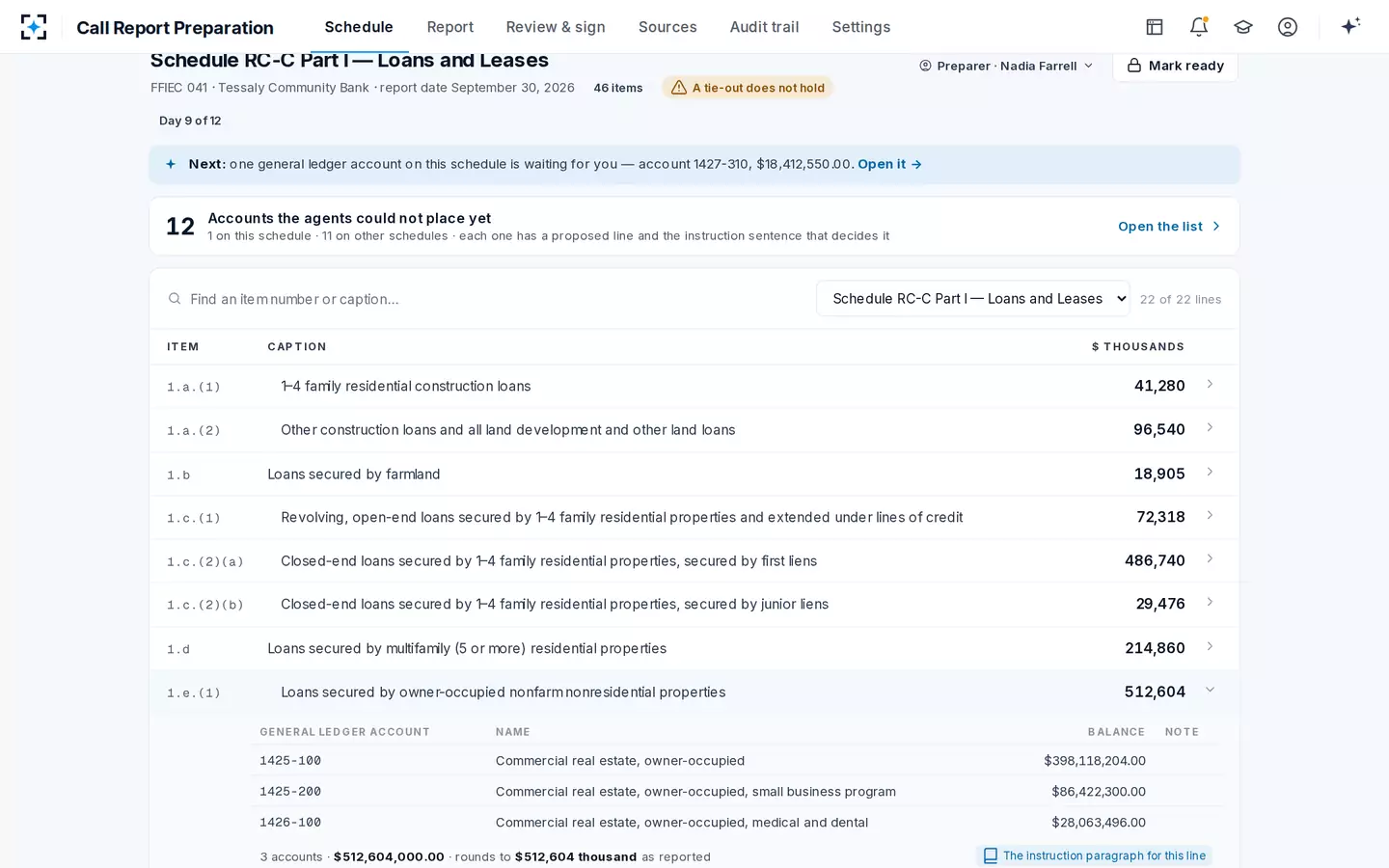
Placement then sends each account to its line. Three accounts were already on item 1.e.(1) at June 30 and carry forward unchanged: commercial real estate, owner-occupied, at $398,118,204.00; the small business program at $86,422,300.00; and medical and dental at $28,063,496.00. The fourth, account 1427-310, CRE participations purchased through a partner program, is new, and waits for a person. How the agent proposed it, and why the line took a net amount, is the subject of call report mapping, inside the agent.
The general ledger under one Call Report figure
How are call report amounts rounded?
To the nearest thousand dollars for a bank with less than $10 billion in total assets, with amounts under $500 reported as zero. A bank with $10 billion or more may round to the nearest million instead. The General Instructions add the rule that makes rounding a control rather than a convenience: "Rounding may result in details not adding to their stated totals. The only permissible differences between totals and the sums of their components are those attributable to the mechanics of rounding."
Item 1.e.(1) at each hop, in the units each hop works in
| Hop | Amount | What changed it |
|---|---|---|
| Three carried-forward accounts | $512,604,000.00 | September 30 balances of 1425-100, 1425-200 and 1426-100 |
| Rounded and reported | 512,604 (thousands) | The bank is under $10 billion, so whole thousands |
| New account placed, net of its contra account | +14,213 (thousands) | $18,412,550.00 less $4,200,000.00 participated onward = $14,212,550.00 |
| Item 1.e.(1) as filed | 526,817 (thousands) | After the preparer accepts and the Assistant Controller approves |
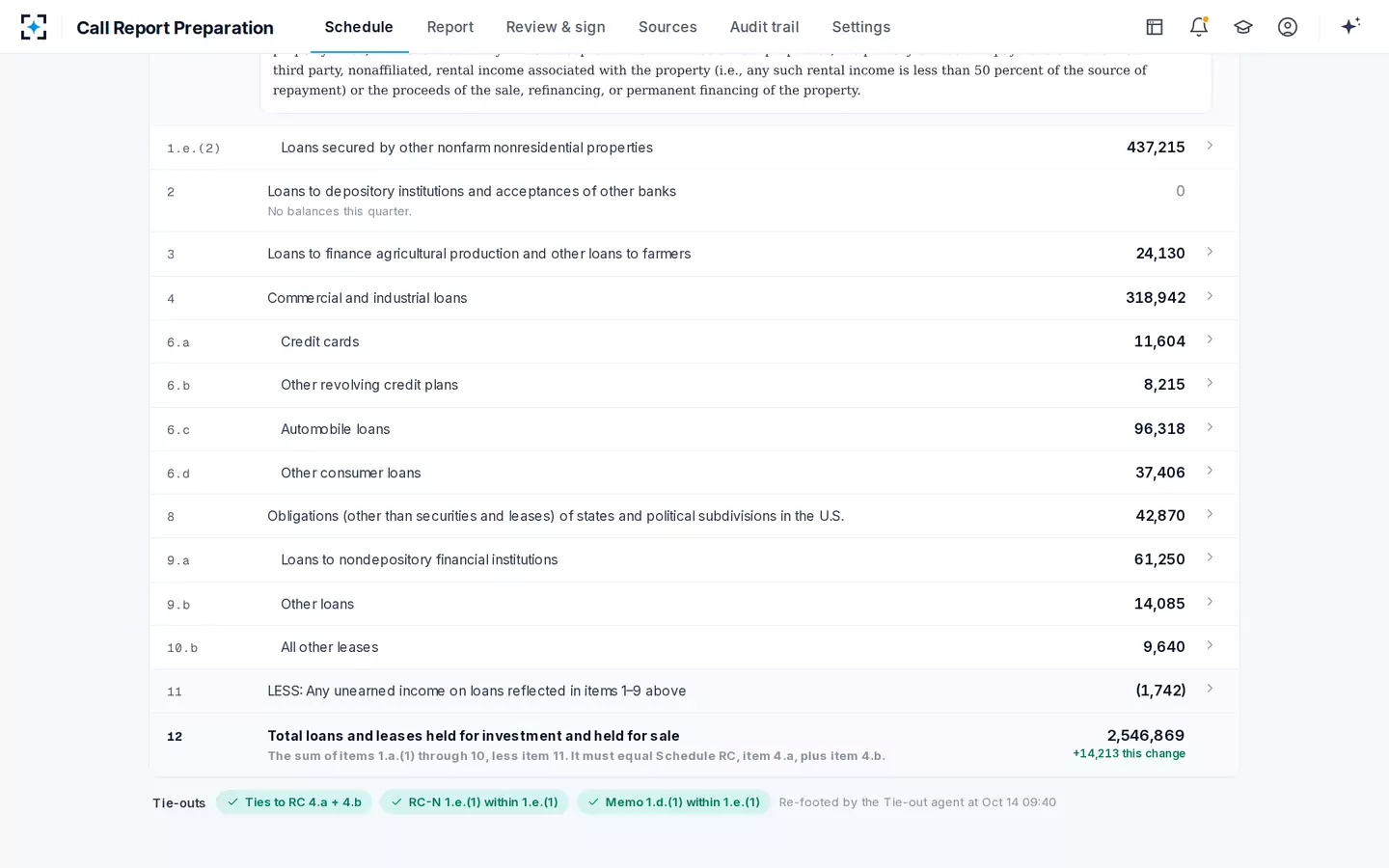
| Item 12, total loans and leases | 2,546,869 (thousands) | Must equal Schedule RC item 4.a (6,415) plus item 4.b (2,540,454) |
| Change from June 30 | +57,897 (+12.3%) | 14,213 from the new account; 43,684 from 61 loans originated in the quarter |
Rounding produces small differences that are legitimate, and the rule is strict about which ones. Each item is rounded on its own, so the rounded lines of a schedule need not add exactly to its rounded total; the gap a reviewer may accept is the one the arithmetic of rounding can explain, and nothing else. A gap on a line that is not a total, or one larger than the number of rounded components could produce, is a placement or posting problem dressed as rounding. Two items are exempt from the arithmetic altogether: total assets in Schedule RC, item 12, and total liabilities and equity capital in item 29 "must be equal" and "must be derived".
What is a call report tie-out?
A tie-out is a check that a figure on one schedule equals, or does not exceed, a related figure elsewhere in the report. The instructions write many of them into the line items themselves. For item 12 of Schedule RC-C, Part I, the total of loans and leases, the amount "must equal Schedule RC, item 4.a" plus item 4.b on the FFIEC 041 (Schedule RC-C instructions). Others are limits that follow from the definitions: past due and nonaccrual amounts on a loan line cannot exceed the line itself.
The General Instructions make the habit general: "All addition and subtraction should be double-checked before reports are submitted. Totals and subtotals in supporting materials should be cross-checked to corresponding items elsewhere in the reports." In the sample quarter, item 12 was $14,213 thousand short of Schedule RC items 4.a plus 4.b until the new account was placed. The difference was exactly the account still waiting, which is how most tie-out breaks look when they are caught early: not an error in arithmetic, but a placement not yet made.
Re-footed the moment a placement is accepted
Some ties run between reports and between schedules prepared by different teams. The allowance roll-forward in Schedule RI-B, for example, has to end at the allowance on the balance sheet, and its calendar-year-to-date basis catches out quarterly management bridges; CECL Allowance Management's guide to the allowance for credit losses rollforward works through that tie.
Hops 6 and 7: the edits, and the line-by-line comparison
The edits are the agencies' own checks, published ahead of each quarter: validity edits that must pass and quality edits that must be fixed or explained before the report counts as complete. In the sample quarter the Edit-check agent ran 1,874 validity edits with none failing and 212 quality edits with three still standing, each with an explanation drafted from the accounts behind it and held until a named person approved it. Those counts are the sample bank's, not a published total.
The comparison with the previous report is older than the edits and broader. The General Instructions ask for it outright:
“Before a report is submitted, all amounts should be compared with the corresponding amounts in the previous report. If there are any unusual changes from the previous report, a brief explanation of the changes should be attached to the submitted reports.”
FFIEC 031 and 041 General Instructions, Verification
For item 1.e.(1) the comparison is a sentence anyone can check: up $57,897 thousand, or 12.3 percent, of which $14,213 thousand is the new partner-program account and $43,684 thousand is 61 loans originated in the quarter, the largest $4,120 thousand; no loan moved onto the line from another line. That last clause is the one a reviewer most needs, because a reclassification between loan lines is invisible in the total and visible only in the detail.
Who signs the call report?
The chief financial officer, or the person performing that function, signs a declaration, and directors attest: at least three at a national bank, a state member bank or a savings association, at least two at a state nonmember bank, in each case other than the officer who signs the declaration. The CFO's declaration attests "to the correctness of the Consolidated Reports of Condition and Income that the bank has filed with the appropriate supervisory agency" (General Instructions, Signatures).
Electronic signatures are allowed if they meet five principles, and one of them sets the order of work: "The bank must include the date of signing as part of the signature process to validate that the electronic signature occurred prior to Call Report submission." A report signed after it was sent does not meet that principle, whatever the signature looks like.
Sign, declare, attest, release in Call Report Preparation
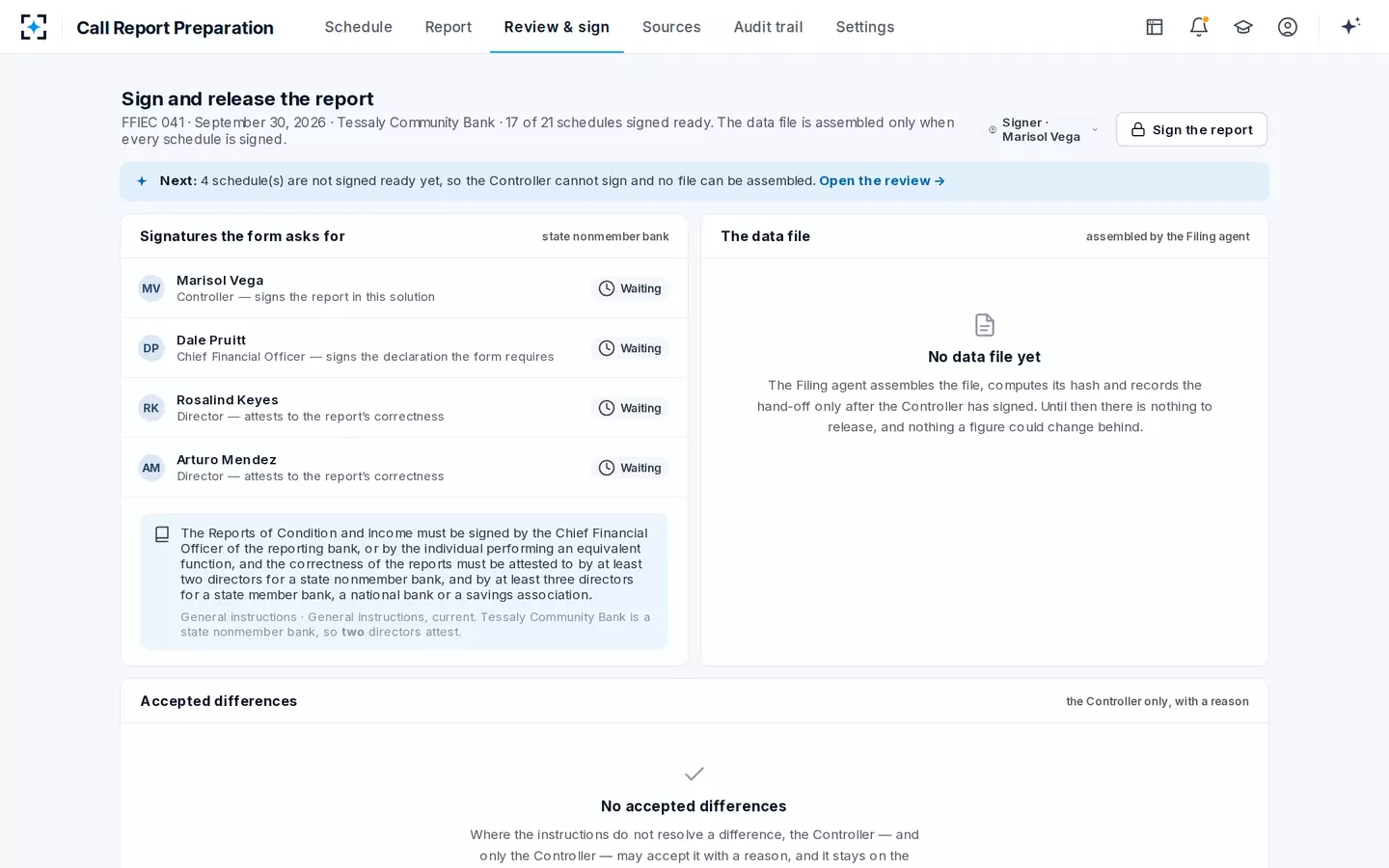
Inside the bank there are usually more signatures than the form asks for. In Call Report Preparation the Assistant Controller signs each schedule ready, the Controller signs the report, and no data file is assembled until every schedule is signed. Those are controls the bank chooses; the form's own requirement is the CFO's declaration and the directors' attestation.
How long must call report workpapers be kept?
Three years after the report date, unless state law requires longer. The General Instructions ask a bank to keep the signed and attested report, any amendments, and the workpapers and support behind them for three years from the report date, or longer where a state requires it (the rule is quoted in the call report checklist). The three years match the period the Federal Deposit Insurance Act sets for records that verify a deposit insurance assessment.
“Preparation of appropriate work papers provides not only a logical tie between report data and the bank’s financial records but also facilitates accurate reporting and verification. Work papers should allow for a proper audit trail.”
OCC Comptroller's Handbook, Regulatory Reporting, Work Papers
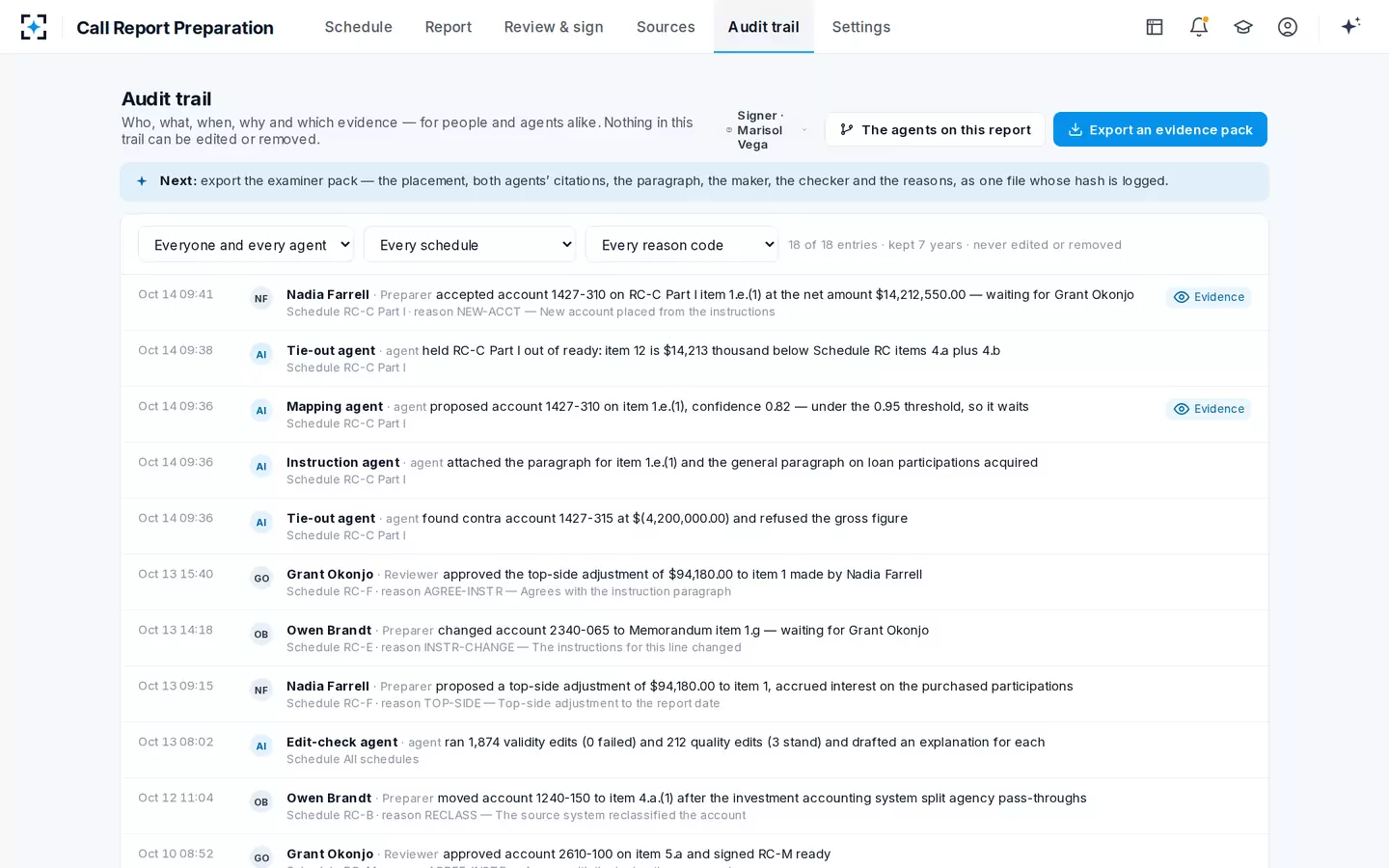
A logical tie is exactly what the eight hops produce when each is written down. For item 1.e.(1), the trail holds the cut-off, the extract that fed it, the four accounts and their balances, the placement of the new one with its maker, checker, reason code and paragraph, the rounding, the tie to Schedule RC, the comparison with June and the signatures, each with its time.
The trail behind one figure, people and agents alike
What happens to the figure after it is filed?
It becomes public, and it becomes the starting point for the next examination. The General Instructions say publicly available data are posted on the CDR's public site "as soon as the data have been submitted, placed in an accepted status, and prepared for publication." The agencies describe Call Reports as, for many institutions, "the source of the most current statistical data available for identifying areas of focus for on-site and off-site examinations" (Federal Register, December 1, 2025).
And it can come back. The FDIC's examination manual treats a Call Report filed with significant errors, including errors that require an amendment under the instructions, as a possible substantive violation of Part 304 that can warrant a matter requiring attention (FDIC RMS Manual, Section 4.5). That is the practical case for keeping every hop: when an examiner samples item 1.e.(1) next year, the answer is already in the file.
What an examiner can ask to see for one figure, hop by hop
- Cut-off
The bank’s defined close of business and the post-closing entries booked to the quarter.
- Proof
The trial balance and each extract footed to its control account.
- Placement
Every account on the line, with the paragraph and the person who decided any new one.
- Rounding
Differences between totals and components explained by rounding alone.
- Tie-out
The equalities and limits the instructions state, each shown holding.
- Edits
Validity edits passed; each quality edit fixed or explained, with the approver.
- Comparison
The move from the previous report, explained in accounts and loans.
- Signature
CFO declaration and directors’ attestation, dated before submission.
The eight hops fit inside the 30-day window only if they start early; call report due dates 2026 sets out the calendar, and the checklist that starts with the accounts opened this quarter turns the same hops into a review.
Questions people ask
What documentation supports a call report?
The workpapers that tie each reported item to the general ledger and subledgers, the reconciliations and tie-outs, the edit results and explanations, the comparison with the prior report, and the signed cover page attached to a copy of the report. The General Instructions name overdraft reports, trust department records and records of other material adjustments to deposits as examples of supporting documentation.
Can the call report be signed electronically?
Yes, if the process shows the signer's intent, links the signature to the full report, authenticates the signer, protects the signed report from loss or change, and records the date of signing before submission. The signed report must be kept as long as a paper one would be.
Does the call report have to agree with the bank's audited financial statements?
For recognition and measurement the Call Report follows U.S. GAAP, but it is an institution-level report prepared on a separate entity basis, with some specific regulatory instructions, such as the nonaccrual rules. Differences in scope and presentation are normal; differences in measurement need an explanation that cites the instruction.
Who reviews call report figures inside the bank?
The OCC expects one person, group or department to prepare and another independent one to review before filing. In practice that is a preparer and a reviewer such as an assistant controller, with the CFO signing the declaration and internal audit testing the process periodically.
What is the hardest step in call report preparation?
Placement, in most quarters: deciding the line for accounts that are new, renamed or reclassified, and for loans whose line depends on collateral, purpose or occupancy rather than the account they sit in. The arithmetic steps are mechanical once placement is right.