Call report mapping is the set of decisions that sends each general ledger account, or each part of one, to a schedule and a numbered line of the Call Report: account 1425-100 to Schedule RC-C, Part I, item 1.e.(1); a deposit account to Schedule RC-E; a fee account to Schedule RI, item 5.l. Most banks keep it in a workbook or in the mapping table of their reporting software, and most quarters most of it carries forward unchanged. It is hard because the general ledger was never built for the Call Report: the line often depends on fields that live on the loan or the deposit, not on the account, and the paragraph that decides it sits in an instruction book that the agencies revise every quarter. Botminds' Call Report Preparation gives the work to a Mapping agent that proposes a schedule and a numbered line for every account, with its evidence and the governing paragraph beside it, while a person decides every account that is new or changed.
This guide is for preparers, assistant controllers and the finance-systems owners who maintain the mapping. It sets out what supervisors expect of a mapping, then follows one new account through the agent. The account, the bank and every figure in the walk-through are fictional sample data from running the solution.
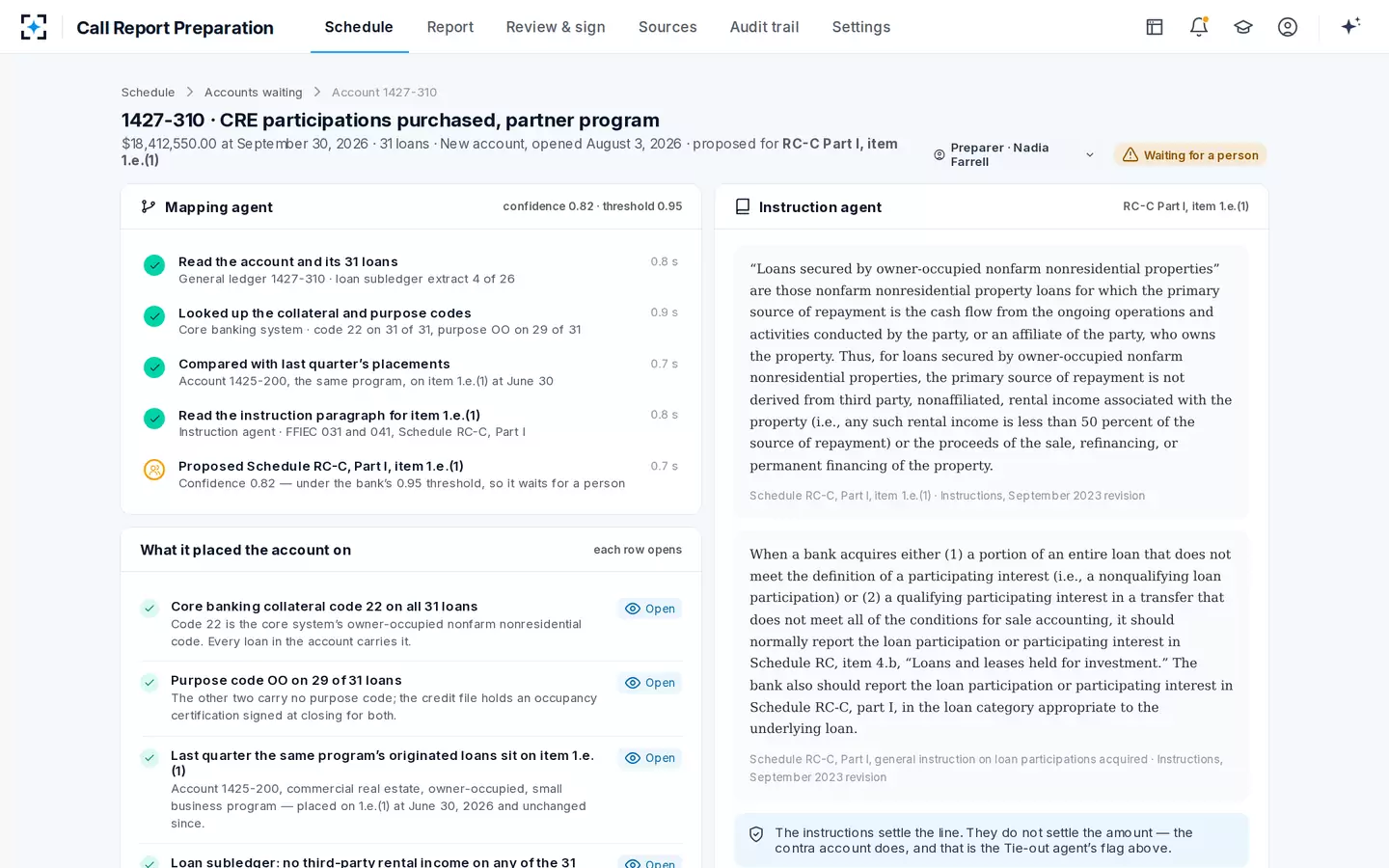
One placement card from the Mapping agent: the evidence, the line and the reason it waits
- General ledger account
- 1427-310 · CRE participations purchased, partner program
- Balance at September 30, 2026
- $18,412,550.00 across 31 loans
- Why it is in front of a person
- New account, opened August 3, 2026
- Collateral code, core banking system
- 22, owner-occupied nonfarm nonresidential, on 31 of 31 loans
- Purpose code
- OO on 29 of 31; occupancy certification in the credit file for the other 2
- Last quarter’s placement of the same program
- Account 1425-200 on item 1.e.(1) at June 30, 2026
- Contra account found
- 1427-315, ($4,200,000.00): 3 loans participated onward on August 14, 2026
- Proposed line
- Schedule RC-C, Part I, item 1.e.(1), at the net $14,212,550.00
- Paragraphs attached
- RC-C item 1.e.(1); RC-C general instruction on loan participations acquired
- Confidence and threshold
- 0.82 against the bank’s 0.95: it waits for a person
What is call report mapping?
Call report mapping is the rule set that turns a trial balance into Call Report line items. Each row of a mapping says which account, or which slice of an account, feeds which item, and the sum of the rows for an item is the reported amount, rounded to thousands for a bank under $10 billion. The OCC's examiners use the word themselves: "Banks may use an automated system or mapping software to prepare, review, and file regulatory reports" (OCC Comptroller's Handbook, Regulatory Reporting).
A mapping is many-to-one in the easy cases. Three commercial real estate accounts can all feed item 1.e.(1). It becomes one-to-many where a single account holds loans that the instructions split: a commercial real estate account can hold loans that belong on item 1.e.(1) and loans that belong on item 1.e.(2), and only a field on each loan says which. That is why mapping at the account level alone is not enough for the loan schedules, and why call report codes for loans need a guide of their own.
A mapping is also a reading of the instructions, and the instructions are not written to be read one paragraph at a time. The General Instructions warn that "the General Instructions, the line item instructions, and the Glossary (all of which are extensively cross-referenced) must be used jointly. A single section does not necessarily give the complete instructions for completing all the items of the reports" (FFIEC 031 and 041 General Instructions). A mapping row with no reference to the paragraph behind it is a conclusion with its reasoning thrown away.
How do you map general ledger accounts to the call report?
Start from four kinds of evidence and one rule. The evidence is the account's own description, the attributes of what sits in it (collateral, purpose and occupancy codes on loans; depositor type on deposits), the subledger detail behind the balance, and where the same account or the same product sat at the last report date. The rule is the instruction paragraph for the candidate line, read with the Glossary entry it points to.
In practice a mapping review runs in three passes. The first carries forward every account that has not changed: same number, same description, same attributes, same line. The second deals with everything that has changed since the last report date, which in most quarters is a short list: new accounts, renamed accounts, accounts whose contents were reclassified, accounts closed. The third tests that the result adds up, schedule by schedule and across schedules, because a mapping error usually shows first as a tie-out that does not hold.
The middle pass is where the work and the risk are. The agencies' December 2025 Request for Information records that "some institutions indicated that Call Report preparation is not a fully automated process where data flows directly from core data processing systems to the Call Report software and into the individual Call Report items," and asks which items need heavy manual adjustment to turn the bank's own core and general ledger data into the form the report requires (Federal Register, December 1, 2025; the full question is quoted in regulatory reporting automation). Converting internal data into the form required is mapping by another name.
Do examiners review call report mapping?
Yes, and by name. The OCC's booklet on regulatory reporting treats mapping software as a source of operational risk, lists "mapping of items" among the procedures examiners check, and tells them to test coded items directly.
“Given that a bank may use an automated system or mapping software to prepare, review, and file regulatory reports, sound practices generally include setting appropriate controls, verifying that items are properly coded, and making adjustments, as needed. Examiners should consider whether automated systems are updated as new accounts are added to the general ledger, when software is updated, and to reflect accounting and regulatory changes.”
OCC Comptroller's Handbook, Regulatory Reporting (Version 1.0)
What the OCC's examiners ask about a call report mapping
| Where in the handbook | What it asks | What a bank should be able to show |
|---|---|---|
| Risks | Risk rises when systems are "not appropriately programmed", when "items are not correctly coded", or when a system is not updated for accounting or regulatory changes | A list of what changed in the mapping this quarter and why |
| Procedures | Whether the bank’s procedures address "Mapping of items", alongside separation of duties, dual controls and independent reconcilements | A written mapping procedure, with who may change a row |
| Examination procedures | Where an automated system helped prepare the report, the examiner samples coded items to check that each was coded accurately | For any sampled account, the line, the paragraph and the evidence |
| Audit | "some banks have an audit that tests the accuracy of the automated mapping software used to feed the regulatory reporting data" | A periodic test of the mapping, not only of the figures |
| Internal control questionnaire | For banks using automated mapping, whether the person verifying the data differs from the person who files | Maker and checker on every mapping change |
Read together, those passages describe a mapping as a control with three properties: it is kept current with new accounts and new instructions, each coded item can be verified against its basis, and the person who changes it is not the person who approves it. A workbook can meet all three. It usually meets the first two only in the head of the person who maintains it.
Inside the Mapping agent: five steps on one new account
The Mapping agent in Call Report Preparation does what an experienced preparer does with a new account, in the same order, and writes each step down. Take one account in the solution's fictional sample bank, a $3.4 billion state nonmember bank filing the FFIEC 041 for September 30, 2026: account 1427-310, commercial real estate participations purchased through a partner program, opened on August 3, 2026, holding $18,412,550.00 across 31 loans.
Who does what when a new account reaches the Call Report
Agent
General ledger agentProves the trial balance and the 26 subledger extracts, and flags 1427-310 as opened since June 30.
Never: edits a balance
Agent
Mapping agentReads the account and its 31 loans, looks up the collateral and purpose codes, compares last quarter’s placements, and proposes RC-C Part I item 1.e.(1).
Never: places a new or changed account without a person
Agent
Instruction agentAttaches the item 1.e.(1) paragraph and the RC-C general instruction on loan participations acquired, with schedule and item.
Never: paraphrases a rule as if the paraphrase were the rule
Agent
Tie-out agentFinds contra account 1427-315 and holds the line to the net balance; shows that item 12 is off by exactly this account.
Never: places a gross figure where a contra account exists
A person decides
Preparer (maker)Accepts, moves or sends back the placement with a reason code and a note.
A person decides
Assistant Controller (checker)Approves the new placement before the schedule can be signed ready.
The agent's evidence is concrete. The core banking system carries collateral code 22, owner-occupied nonfarm nonresidential, on all 31 loans. Purpose code OO is on 29 of them, and the credit file holds a signed occupancy certification for the other two. The same program's originated loans already sit on item 1.e.(1) at June 30 in account 1425-200. And the loan subledger shows no third-party rental income on any of the 31. On that basis the agent proposes item 1.e.(1), with a confidence of 0.82.
Call report mapping with its evidence, in Call Report Preparation
What happens when a new GL account is opened?
In Call Report Preparation it always waits for a person, whatever the agent's confidence. The rule is a setting the bank cannot loosen for new or changed accounts: the confidence setting applies only to accounts that are neither new nor changed. Account 1427-310 would have waited at any setting.
The reason is the handbook's own sentence. "Updated as new accounts are added to the general ledger" is the point at which a mapping fails silently: a new account that nobody maps either drops out of the report or lands in a catch-all line, and the totals still foot because the trial balance does. The OCC's internal control questionnaire then asks the follow-up a bank must be able to answer: whether "the person responsible for verifying the accuracy of the regulatory reporting data" is different from "the person who files the regulatory report."
One quarter of call report mapping in the sample bank
1,840
general ledger accounts in the trial balance
1,828
carried forward from June 30 with nothing changed
12
left for a person: 8 new, 2 redescribed, 1 reclassified, 1 changed at the report date
3
changes waiting for the Assistant Controller when the review screen was captured, 2 more already approved
Can call report mapping be automated?
The carrying forward and the proving can, and should. The judgment about a new line cannot be handed over: the General Instructions make each bank responsible for the accuracy of every item it reports and say that responsibility cannot be delegated to software vendors or anyone else outside the bank (General Instructions, Submission of the Reports).
Research on language models points the same way. A 2025 benchmark of financial tagging, an academic preprint that has not been peer reviewed, found that "while models generalize well in extraction, they struggle significantly with fine grained concept linking" (FinTagging, arXiv 2505.20650). Reading a number off a page is the easy half; linking it to the right concept in a taxonomy is the hard half, and a Call Report line is a concept in a taxonomy. That is the case for an agent that shows its evidence and the paragraph, and leaves the link to a person when the account is new.
The same mapping, kept two ways
A mapping workbook: Found when a tie-out fails or a reviewer notices; mapped by whoever maintains the workbook.
The Mapping agent: Found on day one by the general ledger agent; proposed with evidence; decided by a named preparer and approved by the Assistant Controller.
A mapping workbook: In the maintainer’s memory, or a comment cell.
The Mapping agent: The evidence rows and the quoted paragraph, kept with the placement.
A mapping workbook: Someone reads the Supplemental Instructions and edits affected rows.
The Mapping agent: The changed paragraph is attached to every placement that relies on it, and the change waits for review.
A mapping workbook: Rebuilt from the workbook and email.
The Mapping agent: The placement, its evidence, its maker and checker, exported as one pack.
A mapping workbook: Prove who changed what, and when.
The Mapping agent: Decide a new line on its own, or change a figure to make a tie-out hold.
The instructions settle the line; the contra account settles the amount
Account 1427-310 shows why a mapping is not only about lines. Three of its 31 loans were participated onward to another bank under an agreement dated August 14, 2026, and the bank booked them in contra account 1427-315 at $4,200,000.00. The instructions decide where a purchased participation is reported: when a bank acquires a nonqualifying participation or a participating interest that fails sale accounting, it "should normally report the loan participation or participating interest in Schedule RC, item 4.b," and also in Schedule RC-C, Part I, under the loan category that fits the underlying loan (RC-C instructions; call report codes for loans covers participations). They do not decide the amount. The contra account does.
The contra account the line has to net
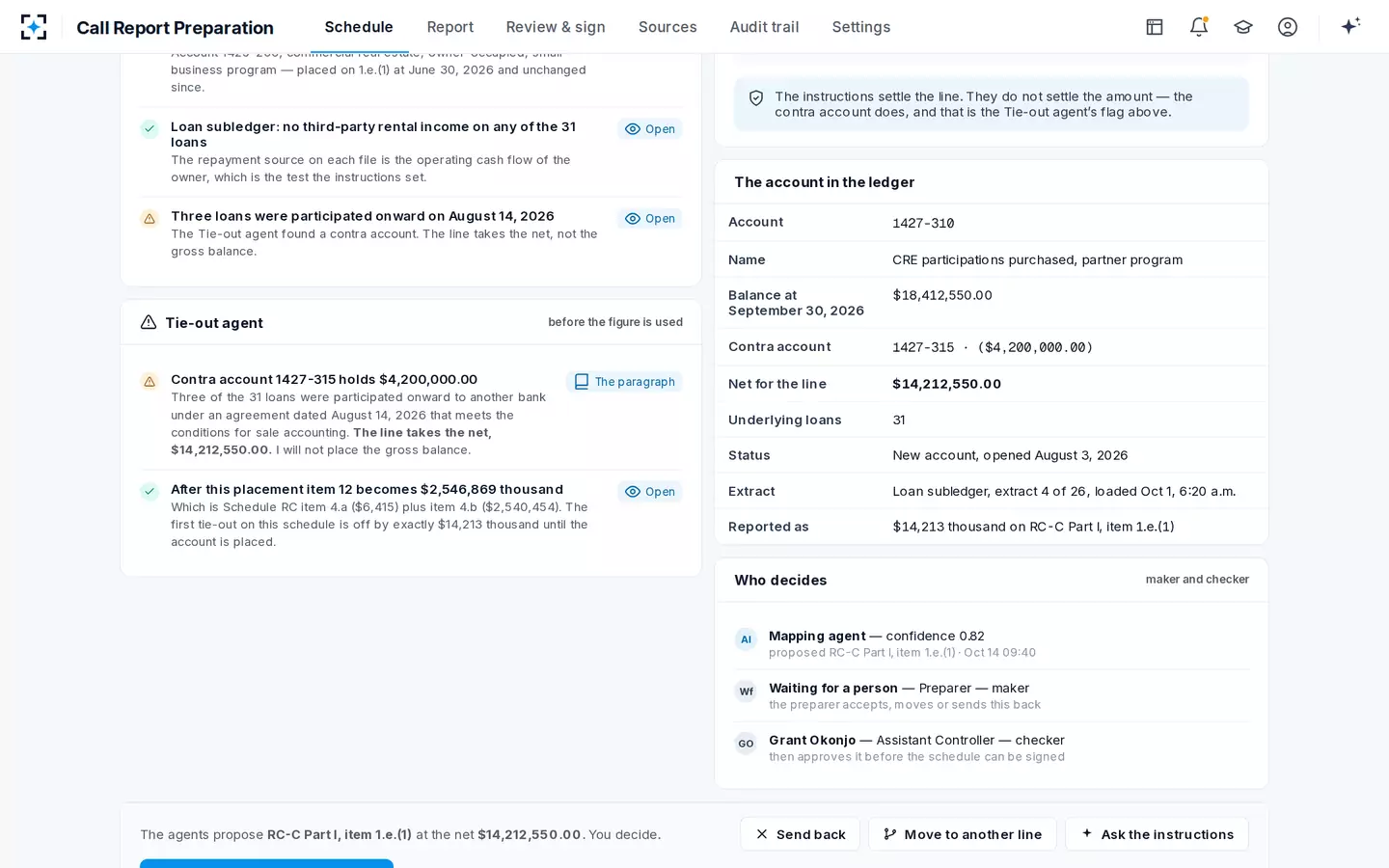
This is the most common way a correct mapping still produces a wrong figure: the right account on the right line at the gross amount. The Tie-out agent will not place a gross balance where a contra account exists, and it shows the cross-schedule consequence of the placement before anyone accepts it. Here, Schedule RC-C, Part I, item 12 must equal Schedule RC items 4.a plus 4.b; it is $14,213 thousand short until the account is placed, and equal after.
Who approves call report mapping changes, and how often should mapping be reviewed?
A person other than the one who made the change, every time a row is added, moved or retired. In Call Report Preparation the preparer is the maker and a named Assistant Controller is the checker for every new, changed or retired placement, each with a reason code from a fixed list. The 1,828 carried-forward placements are not in the review at all, so the reviewer reads three changes, not 1,840 rows.
On frequency, the handbook names three triggers rather than a calendar: new accounts, software updates, and accounting or regulatory changes. That means a quarterly review of the changes, a review of every row an instruction change touches, and a periodic full test, which the handbook notes some banks give to internal audit. The September 2026 quarter shows why the second trigger matters: after the 21st Century ROAD to Housing Act, the Supplemental Instructions told banks to report reciprocal deposits in Schedule RC-E, Memorandum items 1.b through 1.d and Schedule RC-O, item 9 under updated instructions (Supplemental Instructions, September 2026). Any account mapped to those items needed its reasoning checked against the new text that quarter. A practical review list built from the quarter's changes is in a call report checklist that starts with the accounts opened this quarter.
Questions people ask
What is a call report mapping template?
A spreadsheet with one row per general ledger account and columns for the schedule, item number and column it feeds, often with a sign convention and a notes column. It works as long as accounts do not split by loan-level attributes and the person who maintains it is available. The weakness is the missing column: the paragraph and the evidence that justify each row.
Is call report mapping software a model that needs model validation?
Deterministic mapping rules are not. The agencies' April 2026 model risk guidance leaves out of its definition of a model any rule-based process or software that rests on no statistical, economic or financial theory (SR 26-2; the exclusion is quoted in customer risk rating model). The same guidance leaves generative and agentic AI out of its scope while saying a bank's governance should still decide the controls. That is a reason to keep a person deciding every new placement.
Does the mapping change when the call report instructions change?
Sometimes the rows stay the same and only the reasoning changes; sometimes accounts move. Each quarter's Supplemental Instructions mark substantive changes with a vertical line in the margin, and the affected items are the rows to re-read. A mapping that records which paragraph each row relies on can find them in minutes.
Who should own call report mapping, finance systems or regulatory reporting?
The reporting team should own the decisions and finance systems the plumbing. The OCC expects procedures to say who prepares and who independently reviews, and to address mapping of items explicitly. Whoever edits a row should not be the person who approves it.
How do you test a call report mapping before relying on new software?
Re-prepare a quarter you have already filed and compare every line with what you submitted, sorting each difference into a mapping, instruction or source-data cause. Testing call report preparation software on last quarter's filing sets out a ten-day version of that test.