The call report due dates for 2026 are Thursday, April 30 for the March 31 report; Thursday, July 30 for June 30; Friday, October 30 for September 30; and Saturday, January 30, 2027 for December 31, which a bank may now file on Monday, February 1, 2027 because the due date falls on a weekend. Banks with more than one foreign office, other than a shell branch or an international banking facility, get five more days. The Call Report, the Consolidated Reports of Condition and Income, is the quarterly financial report every insured bank and savings association files on the FFIEC 031, 041 or 051, and the deadline is hard because nothing about it is optional: no other extension exists. Botminds' Call Report Preparation exists for the 30 days in between, drafting every schedule from the general ledger with the governing instruction paragraph under each figure, so that the people who sign spend those days reviewing rather than proving.
This guide is for regulatory reporting managers and controllers planning the year, and for preparers in their first season. It sets out the dates, the rule behind them, the September 2026 change to it, and what each of the four report dates asks for that the others do not. Where it shows how the work fits inside the window, the bank in the examples is a fictional sample bank, and its figures come from running the solution on invented data.
Call report due dates 2026 and 2027, as the agencies publish them
| Report date | Due date (30 days) | More than one foreign office (35 days) |
|---|---|---|
| March 31, 2026 | Thursday, April 30, 2026 | Tuesday, May 5, 2026 |
| June 30, 2026 | Thursday, July 30, 2026 | Tuesday, August 4, 2026 |
| September 30, 2026 | Friday, October 30, 2026 | Wednesday, November 4, 2026 |
| December 31, 2026 | Saturday, January 30, 2027; may be filed Monday, February 1, 2027 | Thursday, February 4, 2027 |
| March 31, 2027 | Friday, April 30, 2027 | Wednesday, May 5, 2027 |
| June 30, 2027 | Friday, July 30, 2027 | Wednesday, August 4, 2027 |
When are call reports due in 2026?
Call reports for 2026 are due on April 30, July 30 and October 30, 2026, and January 30, 2027, each 30 calendar days after its report date. The report date itself is fixed by the General Instructions: every bank files "normally as of the close of business on the last calendar day of each calendar quarter." The due date is a receipt date, not a sending date. The FFIEC's Central Data Repository, the CDR, has to have the file in hand.
The agencies publish the dates in a joint Financial Institution Letter at the start of each quarter's cycle, signed for the OCC, the Federal Reserve and the FDIC, with a table that runs four report dates ahead. The letter for the September 30, 2026 report, FIL-62-2026, went out on October 5, 2026, five days into the 30, together with that quarter's Supplemental Instructions. Its opening sentence is an instruction in its own right: the letter and the Supplemental Instructions "should be shared with the individual(s) responsible for preparing the Call Report at your institution."
That timing matters for planning. The forms and instructions for a quarter are final only when the quarter has already ended, so a preparation calendar that starts on day one has to allow for reading what changed. In September 2026 nothing new was added to the forms, but the instructions for Schedule RC-R, Part I changed to reflect the lower community bank leverage ratio, and the instructions on reciprocal and custodial deposits changed after the 21st Century ROAD to Housing Act took effect on July 11, 2026 (Supplemental Instructions, September 2026).
Is the call report due 30 days after quarter end, or 30 business days?
Thirty calendar days, counted from the report date. The rule sits in the General Instructions under "Due Date", on a page revised in September 2026:
“The CDR must receive an institution’s completed Call Report, in electronic form, no later than 30 calendar days after the report date. For a bank that has more than one foreign office, other than a ‘shell’ branch or IBF, the due date is 35 calendar days after the report date. If the due date falls on a weekend or holiday, the report must be received on the next business day. No other extensions of the due date are permitted.”
FFIEC 031 and 041 General Instructions, Due Date (revised September 2026)
Two words in that paragraph carry more weight than the number. The first is completed. The next sentence defines it: the data file "with all corrections made and all explanations provided", consistent with the agencies' Guidelines for Resolving Edits. A file that arrives on day 30 with an unexplained quality edit is not a completed report. The instructions add that a bank "should submit its Call Report with sufficient time to research and resolve any edit exceptions prior to the due date."
The second is receive. The FDIC's guidance for new filers puts the test in one line: an electronic submission "is considered timely if it is received no later than the filing deadline, and the report passes validity edits and quality edits or, where necessary, contains explanatory comments" (FDIC, Important Information for New Call Report Filers). The General Instructions spell out the trap behind it: a report the CDR cannot process, or one "not adequately validated by the bank", is rejected, and if the corrected file arrives after the due date the bank "may be subject to the penalties prescribed for late submission." A file sent at 4 p.m. on day 30 and rejected at 4:20 is a late filing in waiting.
What happens if the call report due date falls on a weekend?
From the September 30, 2026 report date, a bank may file on the next business day. The change came out of the agencies' December 2025 Request for Information on streamlining the Call Report, whose sixth question asked: "During the EGRPRA review, respondents suggested the agencies consider adjusting the due dates for the Call Reports, for example, to avoid falling on a weekend or holiday. In what way, if any, would changing due dates for the Call Reports reduce respondent burden?" (Federal Register, December 1, 2025).
The answer arrived ten months later. FIL-62-2026 says that "for reporting periods that the due date falls on a weekend or federal holiday, the banking agencies are providing the option for all institutions to file the Call Report on the next business day", and the General Instructions were revised to match. The first report date it touches is December 31, 2026: the due date counts out to Saturday, January 30, 2027, and the filing may be made on Monday, February 1, 2027.
The change is recent enough that older calendars are wrong. The agencies' July 2, 2026 letter listed the same December date as "Saturday, January 30, 2027" with no alternative (FIL-33-2026). The October letter added the asterisk. A calendar copied into a close plan before October needs the Monday added, and a team that plans to use it should know it is an option, not a new deadline: nothing stops the file going in on the Friday.
Can a bank get an extension on the call report?
No. The General Instructions allow the five extra days for banks with more than one foreign office and the weekend or holiday roll, and then say "No other extensions of the due date are permitted." There is no request form, no hardship process and no grace period in the instructions.
The FDIC's rules on late filing point the same way. A late Call Report can draw a civil money penalty for each day it is late, and 12 CFR 308.132 says that "Absent extraordinary circumstances outside the control of the institution, penalties assessed for late filing shall not be waived" (eCFR, 12 CFR 308.132(e)(1)(iv)). For a first, inadvertent late filing by an institution with $25 million or more in assets, the FDIC's presumptive amounts as adjusted in January 2025 are $689 a day for each of the first 15 days and $1,379 a day from the 16th (Federal Register, January 14, 2025). The same rule sets a higher presumptive rate for a bank that was already late within the preceding five quarters, so one slipped quarter raises the price of the next.
When is the call report due for banks with foreign offices?
Thirty-five calendar days after the report date, but only for a bank with more than one foreign office that is not a shell branch or an international banking facility. The distinction trips people up because the definition of a foreign office for choosing the form is wider. Under the General Instructions, an IBF, a branch or consolidated subsidiary in a foreign country and a majority-owned Edge or Agreement subsidiary all count as foreign offices, and any one of them puts a bank on the FFIEC 031. A bank whose only foreign office is an IBF therefore files the longest form and still gets only 30 days.
For 2026 the 35-day dates are May 5, August 4 and November 4, 2026, and February 4, 2027, a Thursday that needs no roll. Which form a bank files, and how a domestic bank chooses between the shorter two, is set out in FFIEC 051 vs 041.
The four report dates are not the same quarter
Each report date carries its own extra load, and a calendar that treats the four quarters alike under-plans two of them. The General Instructions list items reported only once or twice a year, and a separate set of size thresholds that change what a bank reports from each March.
What each report date adds to the Call Report, beyond the quarterly items
| Report date | What comes due | Where the rule sits |
|---|---|---|
| March 31 | Shifts in reporting status begin: a bank that crossed $100 million, $300 million, $1 billion or $10 billion in total assets at the previous June 30 starts the extra items. Schedule RC Memorandum items 1 and 2 (external audit work, fiscal year end) are reported once a year. | General Instructions, Shifts in Reporting Status; Frequency of Reporting |
| June 30 | Semiannual items, such as Schedule RC-B Memorandum item 3 and Schedule RC-N Memorandum items 7 and 8. On the FFIEC 051, Schedule RC-C Part II and the risk-weighting detail of Schedule RC-R Part II. Total assets this day set next year’s form and thresholds. | General Instructions (031 and 041; 051) |
| September 30 | Quarterly items only. On the FFIEC 051, the reduced first- and third-quarter report. | FFIEC 051 General Instructions |
| December 31 | The semiannual items again, plus the annual ones: preferred deposits, reverse mortgages, Schedule RC-M items 9 and 14, and Schedule RC-T for banks below its quarterly fiduciary thresholds. The ACL for purchased seasoned loans under ASU 2025-08 applies from the first 2027 report for calendar-year banks. | General Instructions; Supplemental Instructions, September 2026 |
Two of those rows deserve a line in every annual plan. June 30 is the measuring date: the FFIEC 051 eligibility test, the $100 billion test for the FFIEC 031 and every within-form threshold read the June report, and the consequences arrive the following March. And December is the heaviest quarter of the year, because the annual items, the second round of semiannual items and the bank's own year-end close all land in the same 30 days, which is also when the weekend roll first applies.
Where do the 30 days actually go?
Part of the 30 days belongs to the bank's own quarter-end close, because the Call Report is drafted from it. The instructions anticipate it: entries made after the report date that belong to the quarter, such as accrual adjustments and items cleared from suspense, are reported as though they had been posted to the general ledger by the report date's cut-off (call report preparation, followed for one figure quotes the rule). How many business days are left for preparing, proving, editing and signing is the bank's own setting; the solution's sample bank plans on 12.
The figure below is Botminds' estimate of how a three-person team filing the FFIEC 041 spends a 12-business-day preparation window, by hand and with the solution. It is an estimate for planning, not a measured result, and the second lane is a design target.
A 12-business-day Call Report window: most of it is proving, not judging
- Pull and prove2 d
- Place accounts3 d
- Find paragraphs1.5 d
- Re-foot2 d
- Edits2 d
- Review1.5 d
- Prove, cite, re-foot1.5 d
- Place1 d
- Edits1 d
- Review2.5 d
The estimate puts six and a half of the twelve days on three kinds of work that are mechanical once the rule is known: placing accounts, finding the paragraph, and re-footing after each change. Those are the days an automated preparation can give back. The edits and the review are not, and in the second lane the review grows. Regulatory reporting automation, priced from the Call Report's own hours turns the same split into hours and dollars.
How long does a call report take to prepare?
On the agencies' own estimate, about 56 hours a quarter for the FFIEC 041, 35 for the FFIEC 051 and 86 for the FFIEC 031. Those are averages across all filers, published with the December 2025 proposal to extend the Call Report for three more years, and they vary by agency because the mix of banks differs.
The agencies' estimate of a quarter's Call Report, by form
86.25hours
average per quarter, FFIEC 031
foreign offices or $100 billion and up
55.56hours
average per quarter, FFIEC 041
domestic offices only
34.99hours
average per quarter, FFIEC 051
eligible banks under $5 billion
An hours figure is not a calendar. Fifty-six hours spread across a team fit inside a week; the same hours queued behind a month-end close, a waiting extract and one person on leave do not. That is why the useful planning unit is the business day inside the window, and why a calendar is better built backwards from the due date than forwards from the report date.
A call report calendar, built backwards from the due date
Working back from day 30 gives a plan with slack where the rules require it. These checkpoints come from the instructions themselves; the day numbers are calendar days after the report date, and a bank sets its own.
Seven checkpoints between the report date and the due date
- Day 1–5: read what changed
The quarter’s Financial Institution Letter and Supplemental Instructions arrive in the first days. In September 2026 they came on October 5.
- Close of business is a defined cut-off
Post the quarter’s adjusting entries as if made at the report date’s cut-off; the instructions require it.
- New and changed accounts first
Every general ledger account opened, renamed or reclassified since the last report date needs a placement before the drafts mean anything.
- Run the edits early, not on the last day
Validity edits must pass and quality edits must be fixed or explained before the file counts as completed.
- Compare every line with last quarter
The instructions ask for this before submission; large moves become the explanations an analyst reads.
- Sign before you send
The CFO declaration and two or three directors’ attestations come first; an electronic signature must carry its date.
- Submit with time for a rejection
A rejected file resubmitted after the due date can be treated as late. Leave a business day or more.
Who signs, what the signature attests, and how a figure is carried from the general ledger to the signed page are covered step by step in Call report preparation, followed for one figure to the signature.
How Call Report Preparation keeps the 30 days
Call Report Preparation puts the calendar inside the report. Each schedule carries an owner, a state, the result of its tie-outs and its own due date within the bank's close, so a slipping schedule shows before it holds up the others. Take the solution's fictional sample bank, a $3.4 billion state nonmember bank filing the FFIEC 041 for September 30, 2026: on day 9 of a 12-business-day close, 17 of its 21 schedules are ready, three are in review and Schedule RC-C Part I is still drafting, with the October 30 due date in view.
In Call Report Preparation, every schedule has an owner, a state and a due date
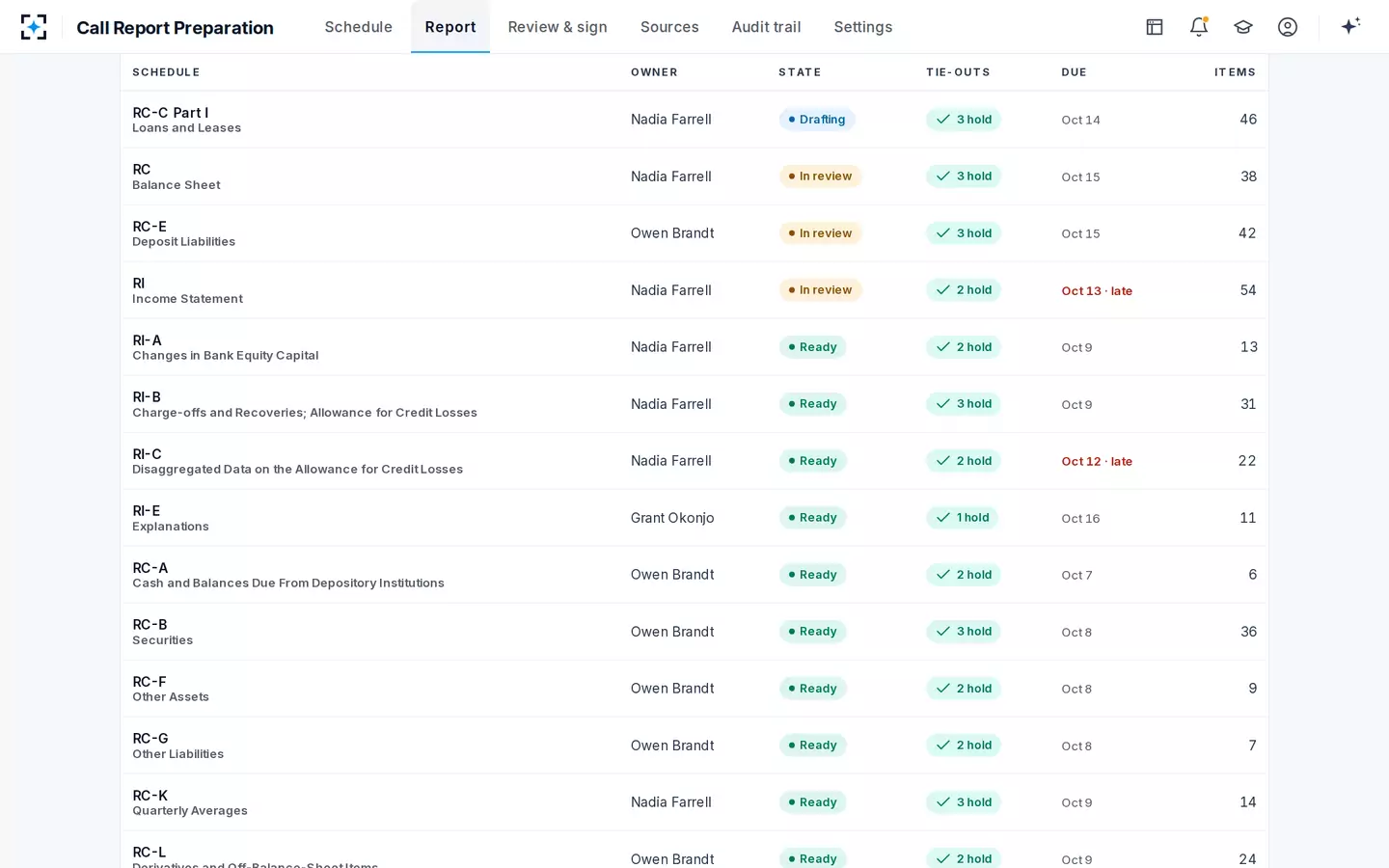
The days the agents give back come from the three mechanical blocks in the timeline. The agents pull and prove the trial balance and the subledger extracts, carry unchanged placements forward, propose a line for every new or changed account with the instruction paragraph attached, and re-foot every schedule after every change. A person still decides every new placement, the Assistant Controller approves it, and nothing is filed by the agents: the bank's own regulatory reporting system submits to the CDR.
The edits run inside the window, not on the last day
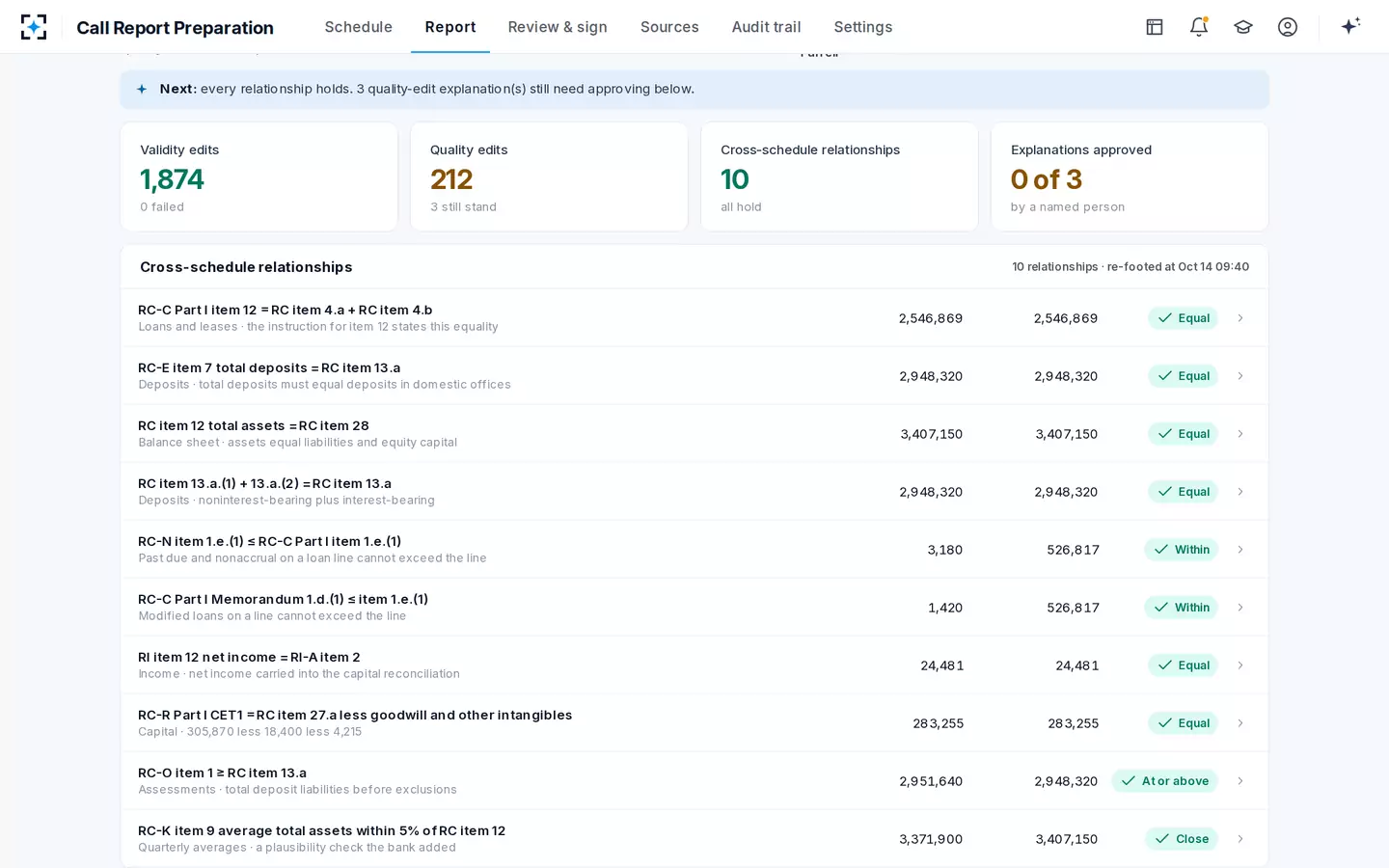
The edits sit on day 9, not day 29, which is the point of the whole calendar: a quality edit found three weeks before the due date is an explanation to write; found on the last afternoon, it is a late filing in waiting. New preparers learning the calendar for the first time will find the reading order in Call report training for a new preparer.
Questions people ask
When is the December 31, 2026 call report due?
The due date counts out to Saturday, January 30, 2027. Under the rule the agencies adopted for the September 30, 2026 report date, a bank may file it on Monday, February 1, 2027 instead. A bank with more than one foreign office, other than a shell branch or IBF, has until Thursday, February 4, 2027.
Does the weekend rule apply to federal holidays too?
Yes. The General Instructions say a due date that falls "on a weekend or holiday" moves to the next business day, and the agencies' October 2026 letter describes the option as applying to a weekend or a federal holiday. None of the published due dates from June 2026 through June 2027 falls on a federal holiday.
Is a call report on time if it is submitted but then rejected?
Only if the corrected file is received by the due date. The General Instructions say a rejected report needs correction and resubmission, and if the resubmission reaches the CDR after the due date the bank may face late-filing penalties. Banks are told to submit with enough time to research and resolve any edit exceptions.
Are call report due dates the same for credit unions?
No. Credit unions file the NCUA's Form 5300, which has its own rules and calendar. The dates on this page are for banks and savings associations filing the FFIEC 031, 041 or 051 with the FFIEC's Central Data Repository.
Which call report items are reported only in December?
Among others, preferred deposits in Schedule RC-E, the reverse mortgage items in Schedule RC-C, two Schedule RC-M questions and, for banks below its quarterly fiduciary thresholds, Schedule RC-T. The FFIEC 051 also moves many components of other income, expense, assets and liabilities to December or to June and December.
Where are the official call report due dates published?
In the Financial Institution Letter that the OCC, the Federal Reserve and the FDIC issue for each quarter, which carries a table of the next four report dates. The FDIC posts it with that quarter's forms, instructions and Supplemental Instructions on its Bank Financial Reports pages.