Call report training for a new preparer works best as a reading plan tied to a real quarter, not a course. The agencies publish everything a preparer needs to learn the Consolidated Reports of Condition and Income: the General Instructions, line item instructions for every schedule, a Glossary, each quarter's Supplemental Instructions and the guidelines for resolving edits, all free on the FDIC's and the FFIEC's websites. The difficulty is order and context: the instruction book is long, cross-referenced and revised every quarter, and none of it says which parts matter for your bank. Botminds' Call Report Preparation helps from the other direction: every figure a trainee opens shows the general ledger accounts behind it and the instruction paragraph that decides its line, so the book is read where the work is. The 13 weeks below assume a new preparer joins as a quarter begins and has a reviewer to learn from.
This guide is for new regulatory reporting accountants and the managers who train them. It sets out what to read first, a week-by-week plan, what the OCC expects of training and staffing, and where a new preparer's questions should go. The examples from the solution use its fictional sample bank, a $3.4 billion state nonmember bank filing the FFIEC 041.
A new preparer's first Call Report quarter, document by document
- General InstructionsWk 1–2
- Your schedulesWk 3–5
- GlossaryWk 6–7
- ChangesWk 8
- ShadowingWk 9–10
- EditsWk 11–12
- Sign-offWk 13
How do I learn the call report?
Read the instructions the way the agencies built them, then prepare one schedule under supervision. The General Instructions describe the book's own structure: General Instructions on the overall requirements, line item instructions for each schedule of the Report of Income and the Report of Condition, and a Glossary of definitions and accounting topics. They also warn that "The instructions and definitions in sections (2) and (3) are not necessarily self-contained; reference to more detailed treatments in the Glossary may be needed" (FFIEC 031 and 041 General Instructions). Reading line items without the Glossary entries they rely on is an easy way to learn a rule half-way.
Two habits make the reading stick. Read each schedule beside your own bank's last filed report, so every instruction has a number attached to it. And keep a list of every Glossary entry a schedule sends you to; that list becomes the bank's own short glossary, and the next trainee's reading list. The Glossary itself is modest about what it is: it "is not, and is not intended to be, a comprehensive discussion of the principles of bank accounting or reporting." It is written for a reader who already knows the accounting.
What should a new call report preparer read first?
The General Instructions, all of them, in the first two weeks. They are short, and they set the rules every later choice depends on: which form the bank files, what close of business means, how amounts are rounded, who signs, when the report is due, when an amendment can be required and how long workpapers are kept. Many of the questions a new preparer asks in the first quarter have their answer, or their starting point, there.
The reading order, and what each document answers
| Order | Document | What it answers | Where |
|---|---|---|---|
| 1 | General Instructions | Which form; close of business; rounding; signatures; due date; amendments; retention | FFIEC 031 and 041 instruction book (FDIC, FFIEC) |
| 2 | Line item instructions for your largest schedules | What goes on each line of RC, RC-C, RC-E, RI and RI-B, and what is excluded | Same book, one PDF per schedule |
| 3 | Glossary entries those schedules cite | Definitions such as loan secured by real estate, nonaccrual status, allowances for credit losses | Same book |
| 4 | The quarter’s Financial Institution Letter and Supplemental Instructions | What changed this quarter, due dates, new accounting standards | FDIC, each quarter |
| 5 | Guidelines for Resolving Edits | How validity and quality edits work and what an acceptable explanation contains | FFIEC and FDIC |
| 6 | Your bank’s own procedures and last filed report with workpapers | Who prepares, who reviews, how the bank maps its accounts | Your bank |
The fourth row changes every quarter, and the agencies make a point of saying who should read it. The September 2026 Supplemental Instructions open by asking each bank to make sure the person who prepares its Call Report has been told that the quarter's forms, instructions and Supplemental Instructions are online (Supplemental Instructions, September 2026; the quarterly letter's own wording is quoted in call report due dates 2026). A new preparer should be on that distribution from the first week, not the first filing.
What the OCC expects of training and staffing
Training is an examination topic, not a nicety. The OCC's booklet on regulatory reporting sets the expectation in one paragraph on personnel:
“The bank should provide adequate training for new and existing regulatory reporting personnel on software, policies, and procedures, and should verify that training reflects any regulatory reporting or system changes that affect the bank. Periodically, there should be a rotation of duties to plan for succession, increase the depth and knowledge of employees, and prevent or detect fraud.”
OCC Comptroller's Handbook, Regulatory Reporting, Personnel
When examiners assess how a bank's regulatory reporting is organised, the handbook lists among the things to consider "the expertise, training, and number of staff" and "the level of staff turnover." A 13-week plan with a reviewer's sign-off at the end is evidence of training; a new hire learning from a workbook nobody else can read is evidence of the turnover risk the handbook names.
Rotation is the part most small teams skip, because it costs a quarter of slower work. The handbook's reasons for it are the same reasons to train well: succession, depth and the detection of errors that one person repeats every quarter. A preparer who has prepared RC-C and reviewed RC-E is a better reviewer of both.
How long does it take to learn the call report?
One full year to see it all, because the four report dates are not the same report. Some items are reported only in December, others only in June and December, and size thresholds measured on June 30 change what the bank reports from March. A preparer who joined in October and has filed one September report has not yet met the December annual items or a March shift in reporting status. The 13 weeks above make a preparer useful; the following three quarters complete the cycle.
What a new preparer meets in each quarter of the first year
- September
The plain quarter: quarterly items only, and on the FFIEC 051 the reduced report. A good first quarter.
- December
Annual items such as preferred deposits and reverse mortgages, semiannual items again, and the bank’s own year-end close in the same 30 days.
- March
Shifts in reporting status from last June’s total assets begin; external audit and fiscal year end are reported once a year.
- June
Semiannual items, and the June 30 total assets that decide next year’s form and thresholds.
The calendar that ties those quarters together, with every 2026 and 2027 due date, is set out in call report due dates 2026.
What is the hardest call report schedule?
No regulator ranks them, and the agencies are asking banks the same question: their December 2025 Request for Information opens by asking banks which items and schedules take the longest or need the most manual adjustment (Federal Register, December 1, 2025; the question is quoted in regulatory reporting automation). For a new preparer, the useful rule is that the hard schedules are the ones the general ledger cannot fill on its own.
Schedule RC-C needs collateral, purpose and occupancy fields from the loan system, and a test of real estate collateral at origination; call report codes for loans walks through it. Schedule RC-E needs deposits by type of depositor. Schedule RC-O, the data for deposit insurance assessments, has its own definitions and its own treatment of items such as late deposits posted through general ledger contra accounts. Schedule RC-R turns the balance sheet into regulatory capital and, in Part II, risk-weighted assets. A trainee should prepare the general-ledger-driven schedules first and come to these four with a reviewer.
What does a regulatory reporting accountant do?
Prepares the report and proves it; someone else reviews it. The OCC describes effective procedures as giving preparation to one person, group or department and the review for accuracy and compliance, before filing, to another that is independent of it (regulatory reporting analyst job description quotes the passage). In the solution's sample bank that is a regulatory reporting accountant preparing, an assistant controller reviewing, a controller signing off internally, and the CFO signing the declaration on the cover page.
The four people a new preparer works with, in Call Report Preparation
Today
Can tell you the number in a minute; spends the day proving where it came from, in a workbook nobody else can read.
With agents
Opens a schedule already drafted, with the general ledger under every figure, and decides the twelve accounts that need judgment.
Still theirs: every new placement
Today
Reviews a whole report again every quarter to find the handful of things that moved.
With agents
Reads only what changed since the last report date, each with its maker, reason and paragraph.
Still theirs: approval of each change; signing each schedule ready
Today
Signs on the assurance of a team she cannot audit line by line.
With agents
Signs when every schedule is signed, with the instruction behind each signature on screen.
Still theirs: the only authority to accept a difference
Today
Asks for evidence after the fact and gets a workbook and an email chain.
With agents
Opens the same screens the preparer used and exports the evidence himself.
Still theirs: read-only access to everything
The four roles above are also a training map. A new preparer learns the Call Report fastest by sitting with each of those four for part of a quarter: preparing with the accountant, reviewing a change with the assistant controller, reading the sign-off with the controller, and walking an audit sample with internal audit. Each sees the same figures from a different question.
Where should a new preparer take questions?
First to the bank's own reviewer, then, for questions the instructions do not settle, to the bank's primary federal regulator. The General Instructions send questions and requests for interpretation to the bank's primary federal supervisor, and warn that where the supervisor reads an instruction differently from the bank, it can make the bank report its way and amend reports already filed (call report analyst quotes the passage). For FDIC-supervised banks the first stop is the assigned Call Report analyst (FDIC, Important Information for New Call Report Filers).
A new preparer should keep the answer with the question. An interpretation that lives in one person's inbox is lost the day that person leaves, which is exactly the turnover risk the OCC's booklet names. In Call Report Preparation, a placement carries the paragraph it relies on and the reason code and note of the person who made it, so the reasoning a trainee learns from is the reasoning the bank actually used.
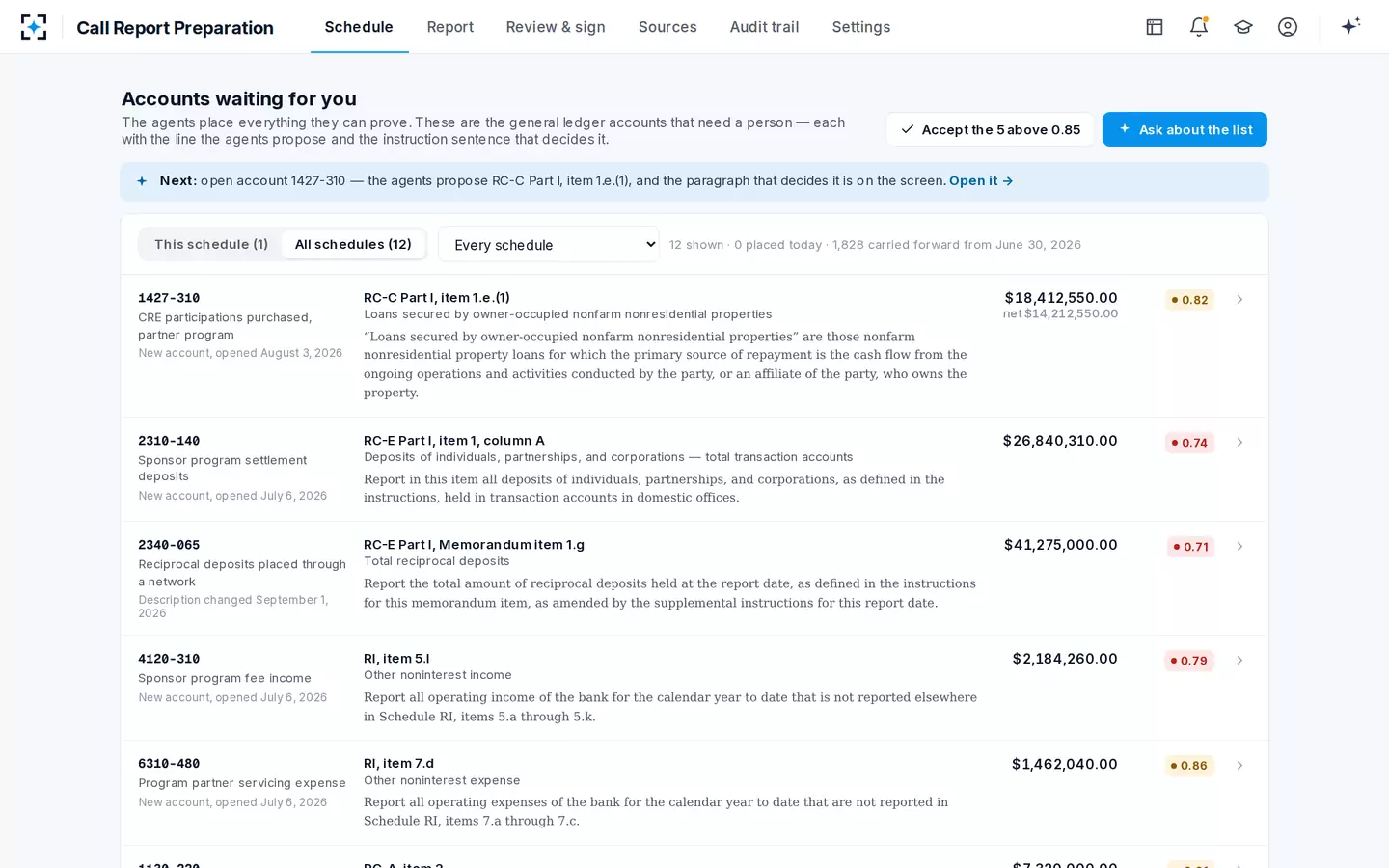
Every proposed line arrives with the sentence that decides it
How Call Report Preparation shortens the first quarter
It turns the instruction book into context. A trainee opening Schedule RC-C, Part I sees the form as it reads, item by item; unfolding a line shows the general ledger accounts behind it in dollars and cents and the amount reported in thousands; opening a placement shows the agent's evidence and the quoted paragraph, not a summary of it. The Instruction agent is built never to present a paraphrase as the rule, and to say so when the instructions do not settle a question.
The instruction text beside the decision
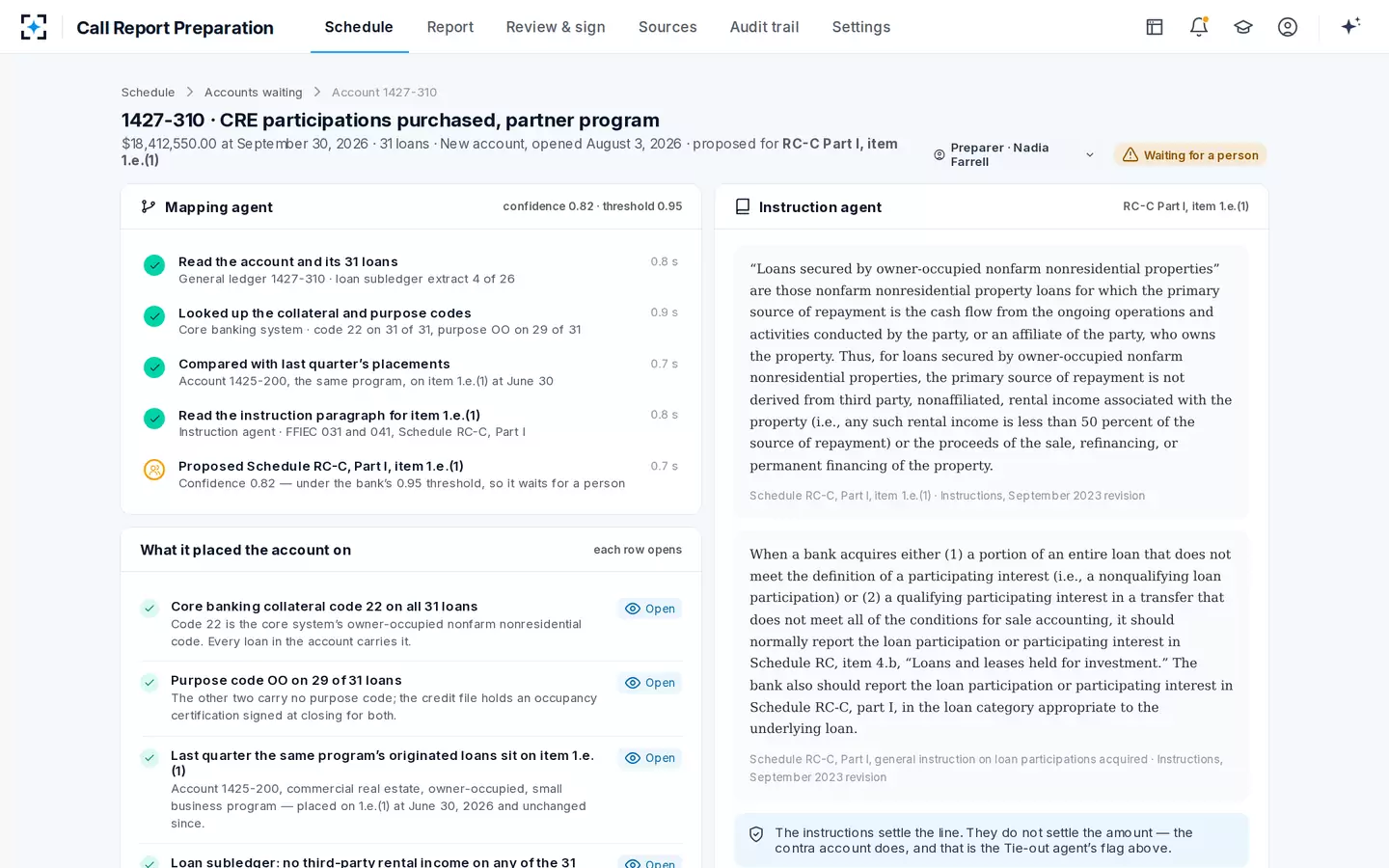
It also keeps a trainee from learning by mistake on the live report. A new or changed account always waits for a person, the reviewer is always someone else, and a schedule cannot be marked ready while a tie-out fails. The trainee can propose, read and decide on real accounts in the first weeks, with the Assistant Controller's approval standing between a misreading and the filed report. A call report checklist that starts with the accounts opened this quarter is a good first assignment once the reading weeks are done.
Questions people ask
Is there call report training for beginners?
The agencies' own materials are the foundation: the instruction books, the quarterly letter and Supplemental Instructions, and the guidelines for resolving edits, all published free. Whatever course a bank adds, a reading plan tied to the bank's own last filed report and a reviewer's sign-off is what turns reading into competence.
Is there free call report training from the FDIC?
The FDIC publishes the instructions, forms, quarterly letters and Supplemental Instructions free on its Bank Financial Reports pages, and its page for new filers explains submission to the Central Data Repository. For specific reporting questions, it directs FDIC-supervised banks to their assigned Call Report analyst.
Should a new preparer start with the FFIEC 051 or 041 instructions?
With the book for the form the bank files. The FFIEC 051 has its own instruction book, and its item numbers and reporting frequencies differ from the FFIEC 031 and 041 book. FFIEC 051 vs 041 explains which form applies.
What accounting knowledge does a call report preparer need?
A working knowledge of U.S. GAAP, especially for loans, the allowance for credit losses, securities and deposits. The Call Report follows GAAP for recognition and measurement, with specific regulatory instructions such as the nonaccrual rules, and its Glossary assumes the reader already knows the accounting.
How should a bank document call report training?
As a plan with dates, the documents read, the schedules prepared under supervision and a reviewer's sign-off, kept with the bank's regulatory reporting procedures. The OCC expects training to cover software, policies and procedures and to be updated for reporting and system changes, so record those updates too.