A useful call report checklist starts with the accounts that changed. Most general ledger accounts sit where they sat at the last report date (in the solution's sample bank, 1,828 of 1,840 did), and a review that re-reads all of them spends its time where the risk is lowest. The risk is in the short list: accounts opened since the last report date, accounts renamed or redescribed, accounts whose contents were reclassified, and accounts closed. Only after those are placed do the ties, the edits, the comparison with last quarter and the signatures mean anything. Botminds' Call Report Preparation is built the same way: its general ledger agent finds the changed accounts on day one, a person decides each one with the governing paragraph in front of them, and the reviewer reads only what changed.
This guide is for preparers and reviewers. It shows how to find the changed accounts, what to ask about each, the mistakes the instructions themselves anticipate, and a full checklist with the rule behind every line. The examples come from the solution's fictional sample bank, a $3.4 billion state nonmember bank filing the FFIEC 041 for September 30, 2026.
The sample bank's account delta: what changed since June 30, and the question each raises
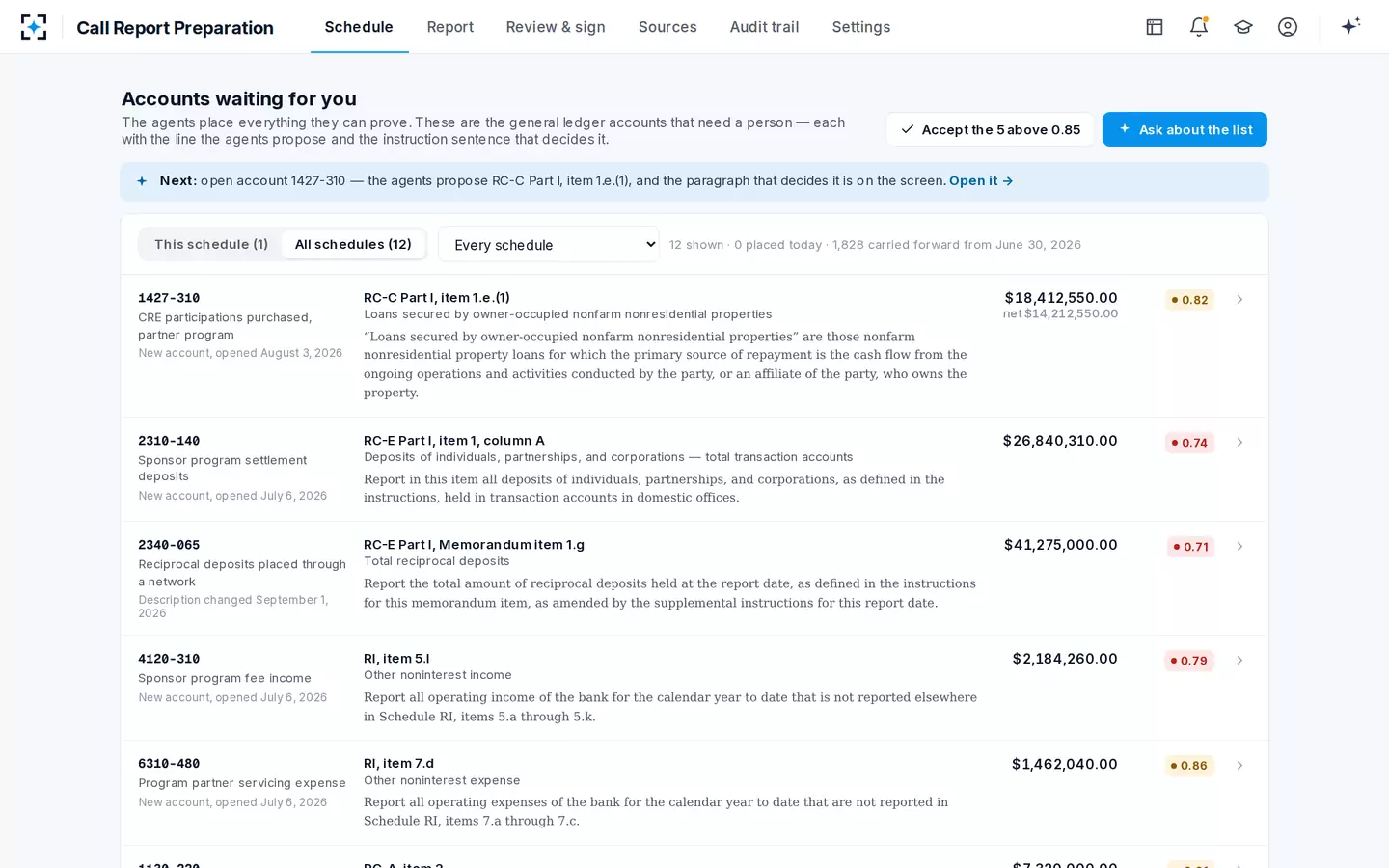
1427-310 CRE participations purchased, partner program
What changed: New, opened August 3
Proposed line: RC-C Part I, 1.e.(1)
Question: Owner-occupied on all 31 loans? Is there a contra account for loans sold on?
2310-140 Sponsor program settlement deposits
What changed: New, opened July 6
Proposed line: RC-E Part I, item 1, column A
Question: Whose deposits are these, and are any brokered or custodial?
4120-310 Sponsor program fee income
What changed: New, opened July 6
Proposed line: RI, item 5.l
Question: Is there a more specific income line before “other”?
6310-480 Program partner servicing expense
What changed: New, opened July 6
Proposed line: RI, item 7.d
Question: Does it belong in a named expense line, and in the RI-E detail?
2340-065 Reciprocal deposits placed through a network
What changed: Description changed September 1
Proposed line: RC-E Memorandum 1.g
Question: Which instruction text applies after the July 2026 statutory change?
1240-150 Mortgage-backed pass-throughs, U.S. government agency
What changed: Reclassified by the source system
Proposed line: RC-B, item 4.a.(1)
Question: Did the split move any security between residential pass-through lines?
What should be on a call report checklist?
Six blocks, in this order: the account delta; the source data; the ties the instructions state; the edits; the line-by-line comparison with the previous report; and the signatures and file. The order matters because each block depends on the one before it. A tie-out that fails because a new account is unmapped is not a tie-out problem, and an edit explanation written before the placements are final may have to be rewritten.
The OCC's examination procedures give a bank a ready test of whether its checklist is complete. Examiners are asked whether the bank's procedures address "Filing and refiling", "Data quality", "Mapping of items", "Separation of duties", "Dual controls", "Independent reconcilements", "Manual adjustments, if any", "Verifications", "Reviews, including control system activities (e.g., quality control, quality assurance, audit)", "Attestation and signatures", "Filing methods", "Filing dates" and documentation standards, work papers included (OCC Comptroller's Handbook, Regulatory Reporting). A checklist that has a line for each of those thirteen will survive the question.
How do you find new GL accounts for the call report?
Compare this quarter's account master with the one behind the last report, on four fields: the account number, the description, the open and close dates, and the attributes of what sits in it. New numbers are the easy part. Redescribed accounts are harder, because the number has not changed but the contents may have; reclassifications in a source system can move balances between accounts without any account opening; and a closed account needs its placement retired with a reason, or it may linger as a zero line that hides a balance moved somewhere else.
The OCC's handbook names the moment the risk enters: examiners consider whether automated systems are updated as new accounts are added to the general ledger, and what follows if they are not is described in call report mapping, inside the agent. In the sample quarter the general ledger agent proved the trial balance on October 1 and sorted every account it found.
One quarter's account delta in the sample bank
1,840
general ledger accounts at September 30, 2026
1,828
unchanged and carried forward from June 30
8
opened in the quarter
4
redescribed (2), reclassified (1) or changed at the report date (1)
Twelve accounts out of 1,840 is under one percent, and it is the whole of the quarter's placement judgment. A checklist that starts with them can afford to spend real time on each: reading the paragraph, looking at the loans or deposits inside, and asking where the money went if an account closed.
The delta, in Call Report Preparation
The questions to ask of each changed account
Five questions cover most accounts. What is in it, at the level the instructions care about: loans by collateral and purpose, deposits by depositor, income and expense by nature? Is there a related contra or offset account, so that the line takes a net figure? Is there a more specific line before a catch-all such as "other noninterest income"? Did an instruction change this quarter that touches the line? And is anything in it reportable in more than one place, such as a deposit that is both a total deposit and a brokered or reciprocal deposit in the memoranda?
The fourth question had a live answer in September 2026. After the 21st Century ROAD to Housing Act took effect on July 11, 2026, the Supplemental Instructions directed banks to report reciprocal deposits under updated instructions for Schedule RC-E, Memorandum items 1.b through 1.d, and Schedule RC-O, item 9, and allowed custodial deposits to be reported under either the new law or the old instructions for that report date (Supplemental Instructions, September 2026). The RC-E instructions add that all reciprocal deposits, brokered or not, "should be reported in Schedule RC-E, Memorandum item 1.g" (RC-E instructions, September 2026). An account redescribed in September 2026 to mention reciprocal deposits needed its paragraph re-read, even if its line did not move.
What are common call report mistakes?
The instructions are a good guide to them, because many of their rules exist to stop a specific error. The table below lists mistakes the instructions anticipate in their own words or by rule, which makes them the right lines for a checklist: each comes with the text that settles it.
Mistakes the Call Report instructions anticipate, and the rule that settles each
| Mistake | The rule | Where |
|---|---|---|
| A transfer between banks at quarter end appears on both reports, or on neither | The parties agree a reporting period; if not, the transaction is deemed to occur before midnight in the buyer’s time zone, and reports that disagree must be amended | General Instructions, Transactions Occurring Near the End of a Reporting Period |
| Late deposits posted through a general ledger contra account left out of the assessment data | Such deposits must be reported in Schedule RC-O, item 1, and may also be reported in Schedule RC and RC-E | General Instructions, Close of Business |
| Quarter-end adjustments posted after the cut-off left out | They are reported as if posted at or before the cut-off on the report date | General Instructions, Close of Business |
| A real-estate-secured business loan reported as commercial and industrial | Loans meeting the real estate test go in item 1 even if for commercial and industrial purposes | Schedule RC-C, item 4 |
| A construction loan moved out of item 1.a when the building is finished | It stays in 1.a unless refinanced into a permanent loan, the collateral is taken, or it is charged off; construction-permanent loans move when construction ends or amortization begins | Schedule RC-C, item 1.a |
| Negative amounts shown in brackets, or on balance sheet lines that do not allow them | Only listed items may be negative, and then with a minus sign | General Instructions, Negative Entries |
Loan coding errors deserve their own pass, because one wrong field on the loan record repeats every quarter; call report codes for loans maps each Schedule RC-C line to the field that decides it.
How do you review a call report before filing?
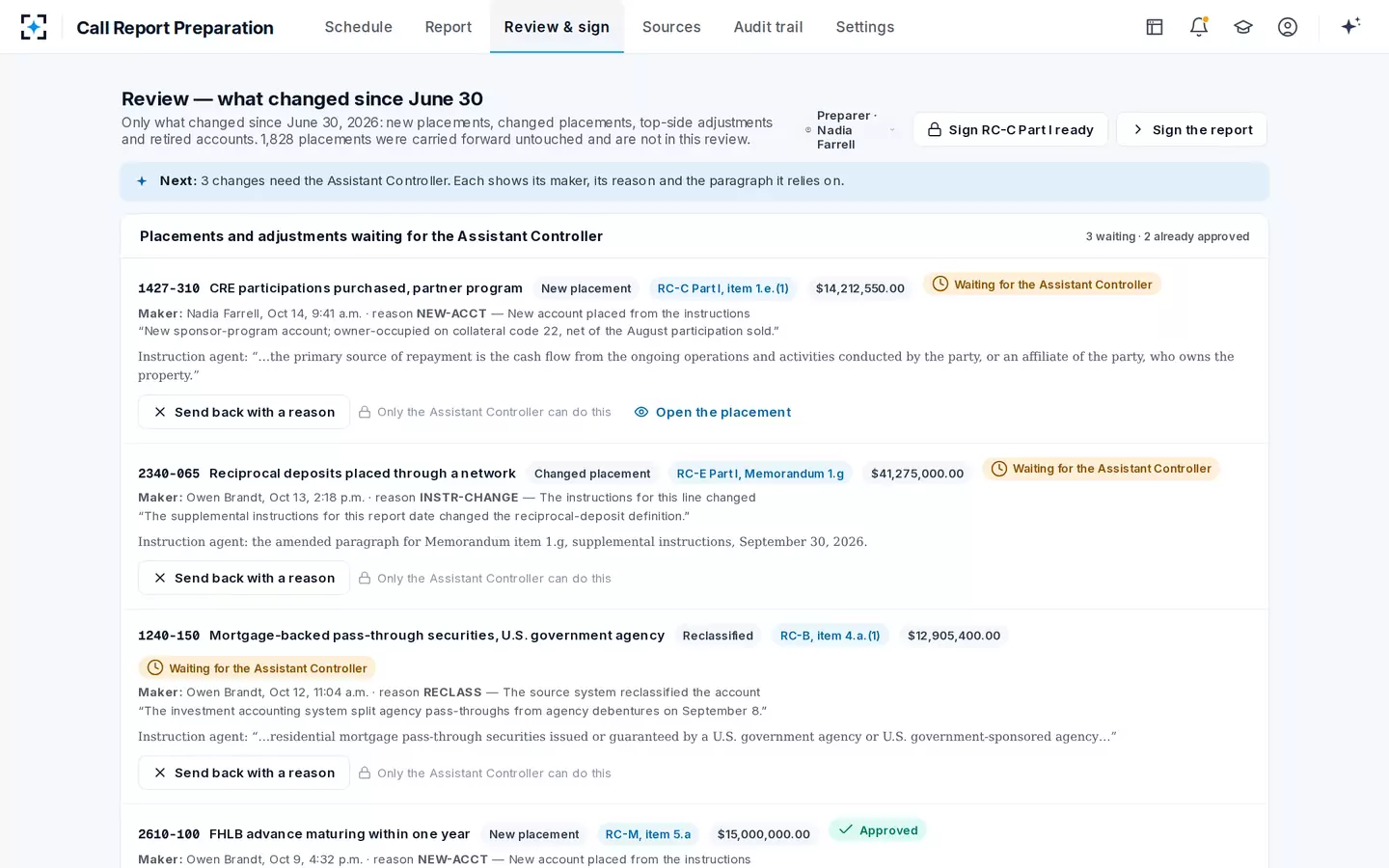
By reading what changed, with the evidence for each change, and then checking that the whole still agrees with itself. A reviewer who re-foots 1,840 placements is doing the preparer's work again; a reviewer who reads the twelve changed placements, each with its maker, reason and paragraph, and then confirms that every stated tie holds and every quality edit is fixed or explained, is doing the review. The OCC's handbook frames the separation that makes this meaningful: one person, group or department prepares, and "another independent individual, group, or department" reviews before filing.
The reviewer reads the changes, not the whole report
The evidence has to be there for the reviewer, and later for the examiner. The handbook's internal control questionnaire asks: "Do work papers allow for a clear audit trail from the report data to the bank's financial records, and are they readily available for review?" A checklist line that says "reviewed" without the trail behind it answers that question badly.
Is there a call report preparation checklist from the regulators?
Not as a bank-facing checklist. The agencies publish instructions, edits and the guidelines for resolving them; the OCC publishes examination procedures and an internal control questionnaire for regulatory reporting, which a bank can read as the questions it will be asked. The checklist below turns those sources into the sequence of a quarter. Each line names its rule.
A call report checklist, starting with the accounts that changed
- 1. List every account opened, redescribed, reclassified or closed since the last report date
Compare account masters; the OCC asks whether systems are updated as accounts are added.
- 2. Place each changed account with its paragraph and a named decision
Maker and checker different people; reason recorded.
- 3. Retire closed accounts with a reason, and say where the balance went
A silent zero can hide a move to another line.
- 4. Prove the trial balance and every extract to its control account
Close of business defined and applied consistently; post-cut-off quarter entries included.
- 5. Check net against contra and offset accounts
The instructions settle the line; the contra account settles the amount.
- 6. Re-read every line an instruction change touches this quarter
Substantive changes are marked by a vertical line in the Supplemental Instructions’ margin.
- 7. Confirm every tie the instructions state
For example, RC-C item 12 equals RC items 4.a plus 4.b; RC items 12 and 29 are equal and derived.
- 8. Run the validity and quality edits; fix or explain each
A report with an unexplained quality edit is not a completed report.
- 9. Compare every amount with the previous report
The General Instructions ask for this before submission, with an explanation of unusual changes.
- 10. Obtain the CFO declaration and the directors’ attestation before submission
Three directors, or two for a state nonmember bank; electronic signatures dated before filing.
- 11. Submit with time to resubmit
A rejected file corrected after the due date can be treated as late.
- 12. File the signed report, workpapers and trail for three years
Longer if state law requires; amendments included.
Lines 4 to 12 are the classic checklist, and every preparer has a version. Lines 1 to 3 are the ones that are usually missing, because they are not about the report at all: they are about the bank's general ledger and what changed in it. Call report preparation, followed for one figure to the signature walks lines 4 to 10 through a single reported amount.
What should a call report reviewer check after the report is filed?
Whether anything learned since filing changes a figure, and whether the file can be found again. The agencies' Supplemental Instructions describe the route for corrections: a bank that needs to revise submitted data changes it, runs the revised file through the FFIEC's published validation criteria again, and sends it to the CDR the same way it sent the original (Supplemental Instructions, September 2026; the FDIC's 2023 letter ordering uninsured-deposit amendments used the same words, quoted in call report uninsured deposits). The General Instructions say when the regulator may require it: for significant errors in which line an item was reported on, and for errors in recognition or measurement that are material for the bank.
“In general, a bank should maintain in its files a signed and attested record of its completed Call Report, including any amended reports, and the related workpapers and supporting documentation for three years after the report date, unless any applicable state requirements mandate a longer retention period.”
FFIEC 031 and 041 General Instructions, Retention of Reports
The account delta is also the right place to start next quarter. Accounts opened late in this quarter, such as the sample bank's three sponsor program accounts opened on July 6, will reach their first full quarter of activity in the next report, and their lines are worth a second look then.
How Call Report Preparation runs the checklist
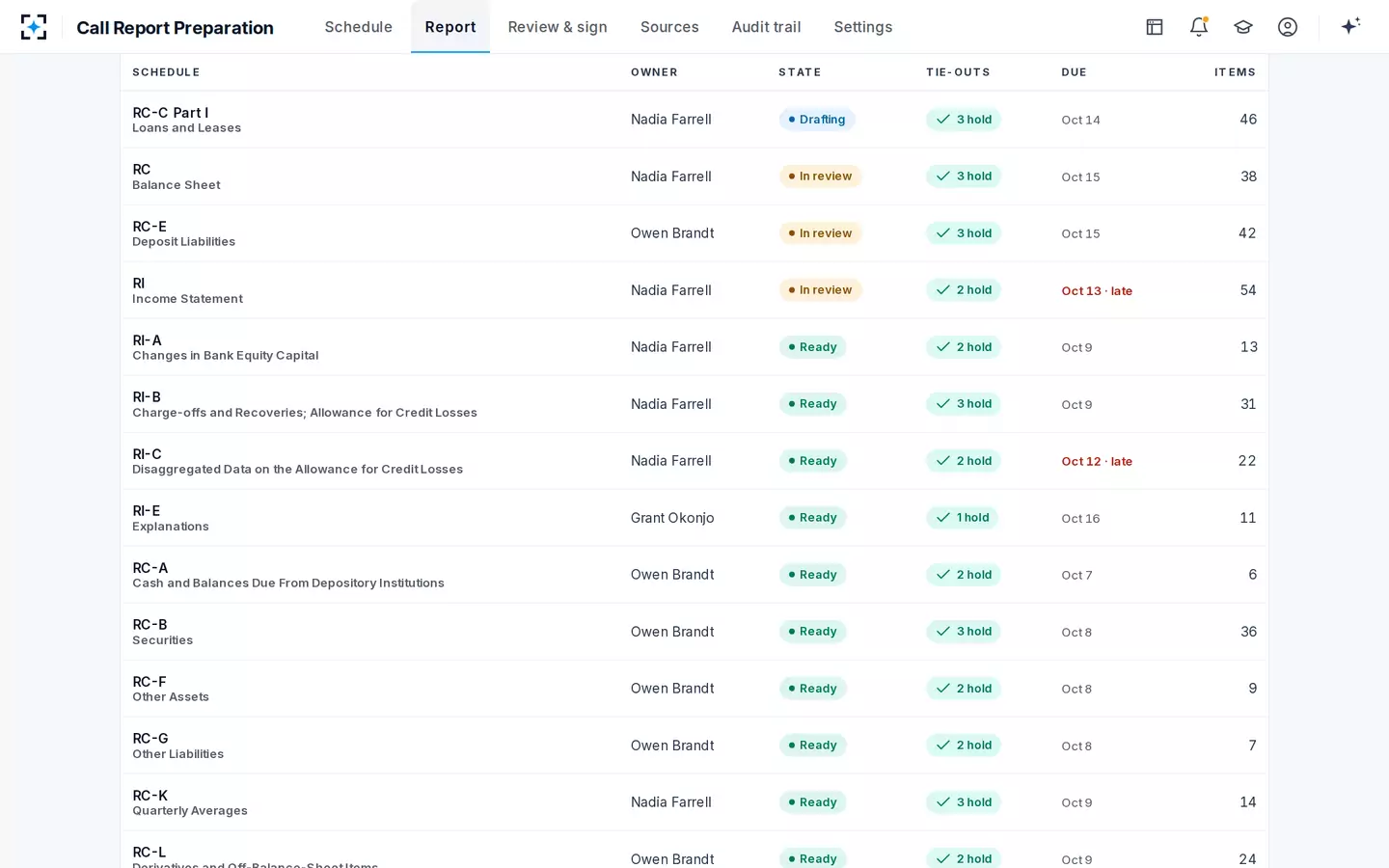
The agents do the lines that are mechanical and hold the ones that are not. The general ledger agent finds every changed account and refuses an extract that does not foot. The Mapping agent proposes a line for each changed account with its evidence, and the Instruction agent attaches the paragraph; a person always decides. The Tie-out agent re-foots every schedule and cross-schedule relationship after every change and will not place a gross balance where a contra account exists. The Edit-check agent runs the agencies' edits before any file leaves the bank and drafts explanations for a named person to approve. Each schedule carries an owner, a state and its own due date inside the close.
Every schedule's place on the checklist, in Call Report Preparation
What the solution does not do is sign or file. The Assistant Controller signs each schedule ready, the Controller signs the report internally, the CFO and directors sign the form, and the bank's own regulatory reporting system submits the file. When to start each block so that all twelve lines fit inside the 30 days is set out in call report due dates 2026.
Questions people ask
How often should the call report checklist be updated?
Every quarter for the lines that depend on the instructions, because the agencies revise them quarterly and mark substantive changes in the Supplemental Instructions. The structure can stay; the specific lines to re-read change with each report date.
Should the checklist be different for the FFIEC 051?
The blocks are the same, but the schedules and frequencies differ: several FFIEC 051 items are reported only in June and December, and some schedules on the FFIEC 041 are not on the FFIEC 051 at all. A checklist should list the schedules required for the form and the report date.
Who should sign off the call report checklist?
The preparer for each line done, and an independent reviewer for the whole, before the CFO signs the declaration. The OCC expects preparation and review to sit with different people, and asks whether the person who attests differs from the people who provide and review the data.
How do you check for closed accounts on the call report?
List accounts with a balance at the last report date and none, or no record, now. For each, find where the balance went: a transfer to a new account, a reclassification, a sale or a write-off. A closed account whose balance moved to an account on a different line changes the report even though the total does not.
Does internal audit use the call report checklist?
It can test against it. The OCC notes that some banks have a periodic call report audit that tests a sample of data and assesses internal controls; a checklist with the evidence attached to each line is what that audit samples.