Call report software vendors sell the tools most U.S. banks use to prepare the Consolidated Reports of Condition and Income and send them to the FFIEC's Central Data Repository. The agencies keep track of them in a narrow way: a vendor whose software has been successfully tested for producing files the CDR can process is listed in the quarter's Financial Institution Letter, and a bank may instead build its own software and test it directly with the CDR. Nothing in that test touches the hard part of the job, which is getting thousands of general ledger accounts onto the right lines with a reason the bank can defend. Botminds' Call Report Preparation is built for that part, with agents that place, cite, re-foot and explain while the bank's people decide and sign. The 12 questions below are the ones to put to any vendor, including us.
This guide is for controllers, procurement teams and the IT owners who will connect the software. It starts with where the agencies point you for a list of vendors, what being on that list proves, and then the questions, each with the rule that makes it worth asking.
12 questions to ask call report software vendors, each with the rule behind it
- 1. Is your software tested with the CDR for this quarter’s forms?
The General Instructions require software that meets the CDR’s technical specifications.
- 2. Which forms, and what happens when we change form?
FFIEC 031, 041 and 051, plus the March shifts in reporting status that follow each June 30.
- 3. How fast do quarterly instruction changes reach the software?
The agencies’ letter and Supplemental Instructions for September 2026 came out on October 5.
- 4. How does the software find accounts opened since last quarter?
The OCC asks examiners whether automated systems are updated as new accounts are added.
- 5. Does every placement carry the instruction paragraph?
The instructions say the General Instructions, line items and Glossary must be used jointly.
- 6. Are the edits the FFIEC’s published edits, run before filing?
Validation criteria are published in advance of each quarter end.
- 7. Who drafts quality-edit explanations, and who approves them?
Agency analysts read them after acceptance and can require resubmission.
- 8. Can the person who prepares also approve or file?
The OCC asks about separation of duties for banks using automated mapping.
- 9. Does the electronic signature meet all five principles?
Intent, association with the full report, authentication, integrity, and a signing date before submission.
- 10. Can we read three years of reports and workpapers if we leave you?
The General Instructions set a three-year retention period, longer where state law requires.
- 11. What do you do when your software is wrong?
Responsibility for accuracy cannot be delegated to a software vendor; the contract cannot change that.
- 12. What drives the price?
Forms, entities, source systems, users and support for amendments; testing and training are costs too.
Who are the call report software vendors?
The agencies point to three places, and they do not agree with each other. The General Instructions say that vendors "whose software has been successfully tested with regard to this ability are listed in each quarter's Financial Institution Letter for the Call Report." The Supplemental Instructions for September 2026 say instead that "Information on vendors that offer Call Report preparation software is available from the CDR Help Desk" (Supplemental Instructions, September 2026). And the FDIC's page for new filers lists six companies, with addresses and telephone numbers, under the heading "Call Report Vendors" (FDIC, Important Information for New Call Report Filers).
Where the agencies send a bank looking for call report software vendors
| Document | What it says about vendors | Date |
|---|---|---|
| FFIEC 031 and 041 General Instructions | Vendors successfully tested for producing CDR-processable files are listed in each quarter’s Financial Institution Letter | Page revised September 2026 |
| FIL-62-2026, the September 2026 quarterly letter | As posted by the FDIC, its text carries no vendor list; it gives the CDR Help Desk as contact | October 5, 2026 |
| Supplemental Instructions, September 2026 | Vendor information is available from the CDR Help Desk | September 2026 |
| FDIC, Important Information for New Call Report Filers | Six companies listed under Call Report Vendors | Last updated March 21, 2022 |
Two practical points follow. The FDIC's own list is four years old, so it is a starting point, not a complete list of the market. And all three sources describe the same kind of vendor: one whose software produces and submits the data file. They say nothing about preparation tools that sit upstream of the file, which is where a growing part of the work, and of the choice, now is.
Which call report software is approved by the FFIEC?
None, in the sense most buyers mean. The FFIEC does not approve, certify or rank call report software. What the agencies recognise is narrower: software "that meets the technical specifications for producing files that are able to be processed by the CDR," with the option for a bank to "develop their own reporting software and test directly with the CDR" (General Instructions, Submission of the Reports). Passing that test proves the file can be read. It proves nothing about whether the figures in it are right.
Being on the list, and being right
What CDR testing proves: It can be processed by the Central Data Repository.
What it does not prove: That the figures in it are the bank’s correct figures.
What CDR testing proves: The CDR runs the published validity and quality edits on what it receives.
What it does not prove: That a figure passing every edit is on the right line.
What CDR testing proves: Nothing; testing is about format.
What it does not prove: That the software applied this quarter’s instruction changes.
What CDR testing proves: That submission will work on the day.
What it does not prove: That the bank met its own responsibility, which stays with the bank.
How do I choose call report software?
Choose on the work it takes off your team and the evidence it leaves behind, after confirming the file will submit. The OCC expects a bank's policies to include "standards for the selection and use of regulatory reporting software," and lists "the use of third parties" among the things examiners consider when they assess how a bank organises its reporting (OCC Comptroller's Handbook, Regulatory Reporting). A selection decision is therefore an examination topic in its own right: write down the criteria before the demonstrations, and the answers after.
The handbook also places software vendors inside the bank's wider risk management. "Some banks use third parties to assist with the preparation, review, and filing of regulatory reports or in aspects of these activities," it says, and "Such third-party relationships should be included in the bank's overall third-party risk management processes." That guidance is itself changing: on September 11, 2026 the Federal Reserve, the FDIC, the NCUA and the OCC proposed principles-based third-party risk management guidance that, once final, would replace the existing guidance, and issued a statement on community banks' engagement with core service providers (Federal Reserve press release, September 11, 2026).
Questions 1 to 4: the file, the forms, the changes and the new accounts
Is your software tested with the CDR for this quarter's forms? Ask for the quarter, not the year. Forms change: the June 2026 Call Report added two data items to the FFIEC 031 only, and the September 2026 report changed the instructions for Schedule RC-R, Part I and for reciprocal and custodial deposits without adding items.
Which forms, and what happens when we change form? A bank files the FFIEC 031, 041 or 051, and it can move between them. Eligibility for the FFIEC 051 is measured on total assets at June 30, and within-form thresholds at $100 million, $300 million, $1 billion and $10 billion start new items the following March. Ask how the software handles the March after you cross one.
How fast do instruction changes reach the software? The quarter's materials arrive after the quarter ends. For the September 30, 2026 report date the agencies' letter came out on October 5, with the Supplemental Instructions. A vendor that updates in week three leaves your team ten days.
How does the software find accounts opened since last quarter? This is where mappings fail. The OCC asks examiners to consider whether automated systems are updated as new accounts are added to the general ledger, so ask the vendor to show, on your trial balance, the accounts that are new since the last report date, and what happens to each before it reaches a line. Call report mapping, inside the agent shows one way to answer.
Questions 5 to 8: the paragraph, the edits, the explanations and who approves
Does every placement carry the instruction paragraph? The General Instructions warn that the General Instructions, the line item instructions and the Glossary "must be used jointly" because no single section gives the complete answer. A mapping row without the paragraph behind it is an answer without its working, and an examiner sampling a coded item will ask for the working.
Are the edits the FFIEC's published edits, run before filing? Banks must submit a report that passes the published validity edits and passes or explains the quality edits, and the General Instructions say these "validation criteria are published in advance of each quarter end." Ask when the vendor loads them and whether they run continuously during preparation or only at the end.
Edits and cross-schedule ties in Call Report Preparation, before filing
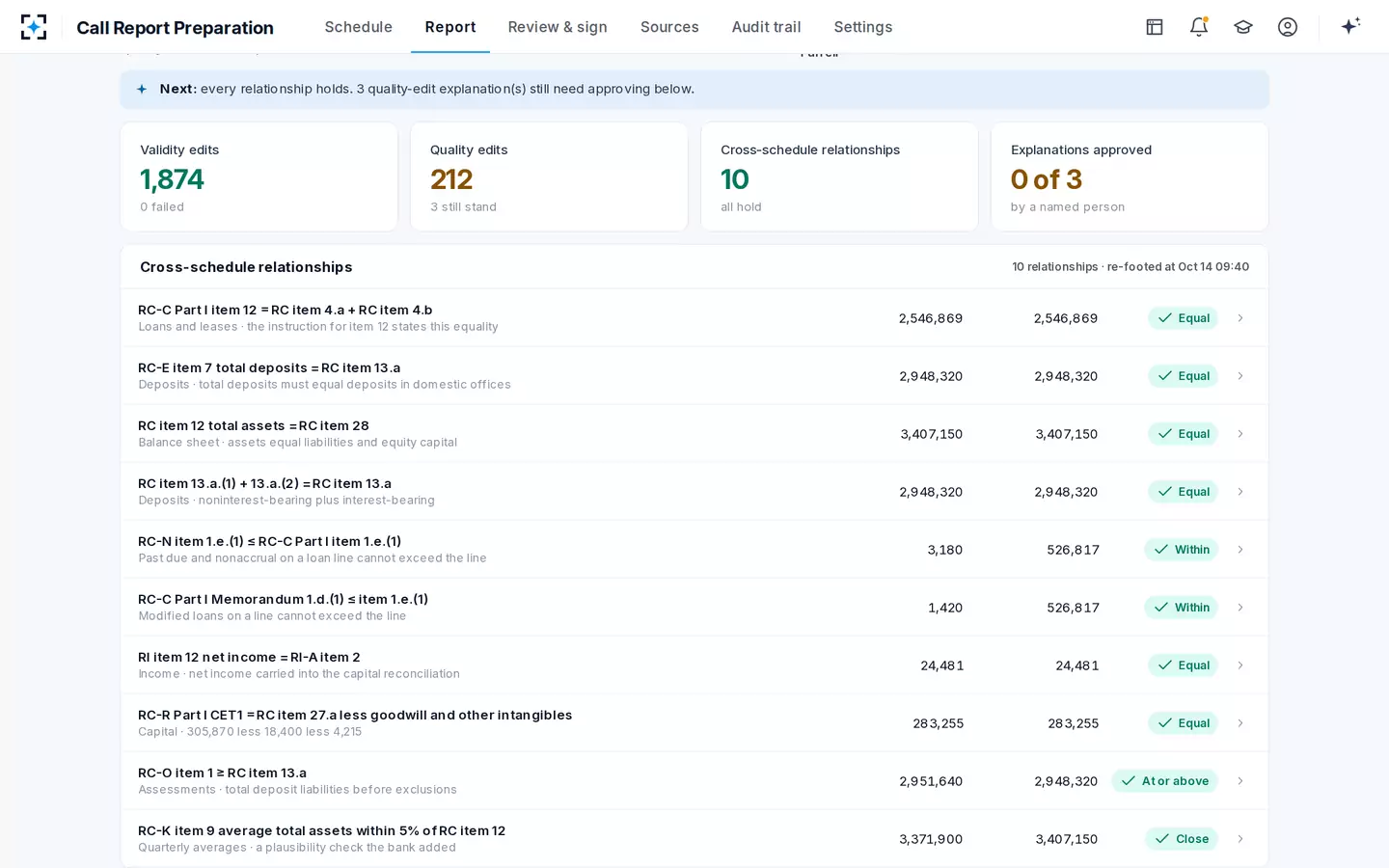
Who drafts quality-edit explanations, and who approves them? Explanations are read by agency analysts after the data are accepted, and an inadequate one can bring a request for resubmission (Guidelines for Resolving Edits). Software that drafts them saves time only if a person who knows the account approves each one, so ask who can release an explanation and whether the software records who did.
Can the person who prepares also approve or file? For banks that use software or automated mapping, the OCC's internal control questionnaire asks whether the person responsible for verifying the accuracy of the data is different from the person who files. Ask the vendor to show the roles, and to show what happens when a preparer tries to approve their own change.
Questions 9 to 12: signatures, records, mistakes and money
Does the electronic signature meet all five principles? The General Instructions allow electronic signatures in place of ink if the process covers the form of signature, the signer's intent, the association of the signature with the full report, the identification of the signer, and the integrity of what was signed.
“An institution must have sufficient data security and data integrity practices to ensure that the Call Report with electronic signature is safely stored, readily retrievable, and cannot be lost or altered. The Call Report with electronic signature must be retained for the same timeframe as if it were a paper Call Report.”
FFIEC 031 and 041 General Instructions, Electronic Signatures
Can we read three years of reports and workpapers if we leave you? The signed and attested report, any amendments and "the related workpapers and supporting documentation" are to be kept for three years after the report date, longer where state law requires. If the evidence lives only inside a vendor's application, ask how you export it, in what format, and what happens to it when the contract ends.
The trail an examiner can take away
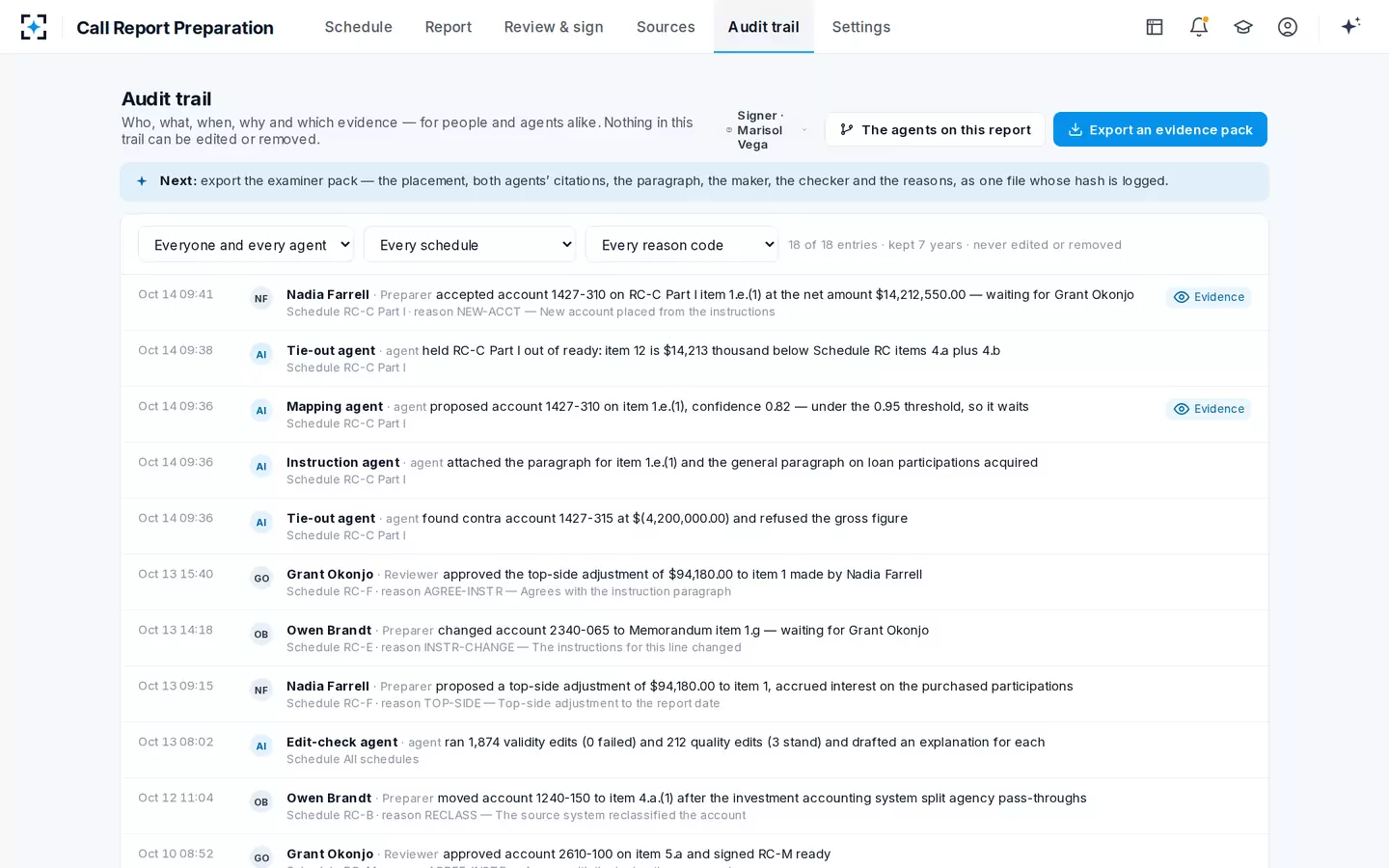
What do you do when your software is wrong? Read the answer against the General Instructions, which leave responsibility for accurate reporting with the bank and rule out delegating it to a software vendor. A contract can allocate costs; it cannot move that responsibility. What a vendor can offer is speed: how quickly it tells you, which past reports it affected, and whether its records show which placements relied on the faulty logic.
What drives the price? List prices are rarely published, so compare on drivers: the forms supported, the number of legal entities, the number of source systems and extracts, the number of users and roles, and whether amendments and prior-period restatements are included. Then add the costs outside the licence: connecting the sources, testing the mapping, and training, which the OCC expects to keep pace with each reporting or system change the bank makes (see call report training for a new preparer). Regulatory reporting automation, priced from the Call Report's own hours sets those costs against the hours.
Three numbers to have in hand before the first vendor meeting
6
companies on the FDIC’s list of Call Report vendors
page last updated March 2022
3years
to keep the signed report, amendments and workpapers
longer if state law requires
30days
from report date to due date, 35 with more than one foreign office
no other extensions; weekend and holiday roll
Where Call Report Preparation answers the 12, and where it does not
Call Report Preparation is a preparation product, not a submission product, so its honest answer to question 1 is that it does not submit: it assembles the signed data file, logs its hash and hands it to the bank's own regulatory reporting system, which files with the CDR. A bank choosing it keeps, or chooses separately, the software that submits.
On the other eleven it was built to answer on screen. The form is a setting covering the FFIEC 041, 051 and 031, and the instruction set follows the form and the report date, including that quarter's Supplemental Instructions. New, renamed, reclassified and closed accounts are found on day one, and a new or changed account always waits for a person. Every placement carries the quoted paragraph. The agencies' validity and quality edits run before any file leaves the bank, and no explanation goes out without a named approver. The preparer and the Assistant Controller are always different people, the Controller alone can accept an unresolved difference, and the trail exports as one evidence pack. How to prove all of that on your own data before signing is in call report preparation software, tested on last quarter's filing.
Questions people ask
Does call report software include the edits?
It should: the General Instructions describe banks using software to prepare their figures and run the edits on them before submitting, and the CDR runs the published validity and quality edits on receipt and rejects a report that has not been adequately validated. Ask whether the edits run continuously during preparation, which turns them from a last-day hurdle into a running check.
How do call report vendors handle instruction changes?
By updating forms, edits and instructions each quarter, on a schedule that should be in the contract. Ask how long after the agencies' letter the update arrives, how the vendor marks what changed, and whether placements that relied on a changed paragraph are flagged for review.
Do core banking providers offer call report software?
Some do, and the agencies' December 2025 Request for Information asked whether software is available "from core system vendor(s) or elsewhere" to increase automation, and what the hurdles are to using it. A core provider's tool may be closest to the data; ask the same 12 questions of it.
Can a bank build its own call report software?
Yes. The General Instructions allow a bank to develop its own reporting software and test it directly with the CDR. The bank then owns the specifications work, the quarterly updates and the testing that a vendor would otherwise carry.
What should a call report software contract say about records?
That the bank can export the signed report, amendments, workpapers and the trail of who changed what, in a usable format, for at least the three-year retention period and after the contract ends. Electronically signed reports must be kept as long as paper ones would be.