Regulatory reporting automation is software that takes over the mechanical parts of preparing a regulatory report: pulling and proving the source data, placing accounts on report lines, re-footing schedules after every change, running the published edits and drafting the explanations, while people keep the judgment calls and the signatures. For a U.S. bank the report every insured institution files is the Call Report, and its cost can be priced from the agencies' own numbers: an average of 55.56 hours a quarter for the FFIEC 041, on their December 2025 estimate. Botminds' Call Report Preparation is regulatory reporting automation built around that report, with agents doing the reading and the checking and a named preparer, Assistant Controller and Controller deciding and signing. The question for a buyer is not whether it saves time but which hours, and whether those are the hours worth paying to move.
This guide is for CFOs, controllers and the people who build the business case. It starts from the published hours, turns them into a cost you can recompute with your own rates, splits a quarter by the kind of work in it, and ends with where automation pays, where it must stop, and how to measure the difference.
The Call Report's cost, in the agencies' own hours
55.56hours
average per quarter for an FFIEC 041 filer
726,366hours
a year across the three agencies’ estimates
our sum of 160,370 + 128,165 + 437,831
4,476
respondents in those estimates
our sum of 971 + 707 + 2,798
What is regulatory reporting automation, and what is it not?
It is the replacement of manual transfer and checking steps with software that can show its work. It is not a transfer of responsibility. The General Instructions keep the accuracy of every reported item with the bank and rule out handing it to a software vendor or servicer (FFIEC 031 and 041 General Instructions). Automation changes who does the work; it does not change who answers for it.
Most banks already automate part of it. The FDIC tells new filers that most institutions prepare and send the report with Call Report software (FDIC, Important Information for New Call Report Filers; call report preparation software, tested quotes it). The General Instructions describe that software by what it must do at the end of the chain: produce files the CDR can process. The middle of the chain, getting from the general ledger to the right line with a reason, is where the agencies' own Request for Information locates the manual work.
How many hours does a call report take?
On the agencies' estimate, 34.99 hours a quarter for the FFIEC 051, 55.56 for the FFIEC 041 and 86.25 for the FFIEC 031, averaged across filers. Each agency also publishes its own average, which differs because of who it supervises: the notice explains that the estimate "is an average that varies by agency because of differences in the composition of the institutions under each agency's supervision."
Call Report burden by agency, as published in December 2025
| Agency | Respondents | Hours per quarter | Hours per year |
|---|---|---|---|
| OCC (national banks, federal savings associations) | 971 | 41.29 | 160,370 |
| Federal Reserve (state member banks) | 707 | 45.32 | 128,165 |
| FDIC (state nonmember banks, state savings associations) | 2,798 | 39.12 | 437,831 |
| All three (our sum) | 4,476 | n/a | 726,366 |
Read those numbers as a national average, not as your quarter. A bank's own hours can sit far from them in either direction, and the published figure says nothing about how the hours fall in time. Fifty-six hours spread over a fortnight is a different problem from fifty-six hours compressed into the last four days before the due date.
What does call report preparation cost?
Hours a quarter, times four, times a fully loaded hourly cost. At the FFIEC 041 average that is 222.24 hours a year, so every $10 of loaded hourly cost adds $2,222 a year; a bank pricing its preparers at $70 an hour, for example, would put the average filer's direct cost near $15,600. Use your own rate and, better, your own hours, because the agencies' figure is an average of very different banks.
That direct cost leaves out the larger number: the cost of being wrong, which is measured in amendments, examination findings and, for a late file, daily penalties rather than in hours. Compliance spending is mostly people; the Federal Reserve Bank of St. Louis found that staff costs were the largest compliance expense for banks of every size (the cost of compliance for banks quotes the study), and that banks under $100 million in assets spent an average 8.7 percent of noninterest expense on compliance against 2.9 percent for banks of $1 billion to $10 billion (Regional Economist, July 2016). The study covered compliance as a whole, not the Call Report alone, but the pattern is the one fixed reporting work produces: the smaller the bank, the larger the share.
Which call report schedules take the most time?
Nobody has published a ranking, and the agencies are asking. The first question in their December 2025 Request for Information is "Which specific line items or schedules on the Call Report are the most time-consuming to prepare or require significant manual adjustments (for example, to convert internal data from core data processing, general ledger, or other systems into the form required) to complete the Call Report? Why is this the case?" (Federal Register, December 1, 2025). In July 2026 they said they were reviewing the comments and planned to put proposed changes to the forms and instructions out for comment (FIL-33-2026). By late October 2026 no such proposal had been published in the Federal Register.
So a bank has to measure its own. The useful cut is not by schedule but by kind of work, because the same kind of work repeats across schedules: proving the source, placing accounts, finding the governing paragraph, re-footing, editing, and judging. Botminds' estimate of how a three-person team filing the FFIEC 041 spends its preparation window, by hand and with the solution, is below. It is an estimate for planning and the second row is a design target, not a measured result at any bank.
A quarter's Call Report work by kind: what moves and what stays
By hand, 12 business days (estimate)
- Pull and prove the general ledger and extracts · 17%
- Place new, changed and closed accounts · 25%
- Find the instruction paragraph · 12%
- Re-foot schedules and tie-outs · 17%
- Edits and explanations · 17%
- Quarter-over-quarter review and judgment · 12%
With the solution, 6 business days (target)
- Pull and prove · 8%
- Place accounts · 17%
- Find the paragraph · 8%
- Re-foot · 8%
- Edits · 17%
- Review and judgment · 42%
The split makes the economic argument by itself. More than half of the manual window is placing, paragraph-hunting and re-footing: work whose answer is determined once the rule and the data are known. Those are the hours worth paying to move. The review share rises from one day and a half to two and a half on purpose, because the time given back is meant to land on judgment. The total falls from twelve business days to six, which is the target the product is designed against.
What parts of regulatory reporting can be automated?
Everything that is deterministic, and the drafting of everything that is not, but never the decision on something new or the signature. The line between them is close to the line the agencies' 2026 model risk guidance draws: it treats neither spreadsheet arithmetic nor fixed rule-based software with no statistical, economic or financial theory behind it as a model, and it puts generative and agentic AI outside its scope while they evolve (SR 26-2, April 17, 2026; both passages are quoted in customer risk rating model). Tie-outs and edits are rules. Proposing a line for a new account and drafting an explanation are judgments, and should stay visible as such.
What regulatory reporting automation can take, and what stays with people
| Kind of work | Automate? | In Call Report Preparation | Who keeps it |
|---|---|---|---|
| Pull and prove the trial balance and subledgers | Yes | General ledger agent; refuses an extract that does not foot | Systems owner |
| Carry forward unchanged placements | Yes | 1,828 of 1,840 accounts in the sample quarter | Reviewer sees the count, not the rows |
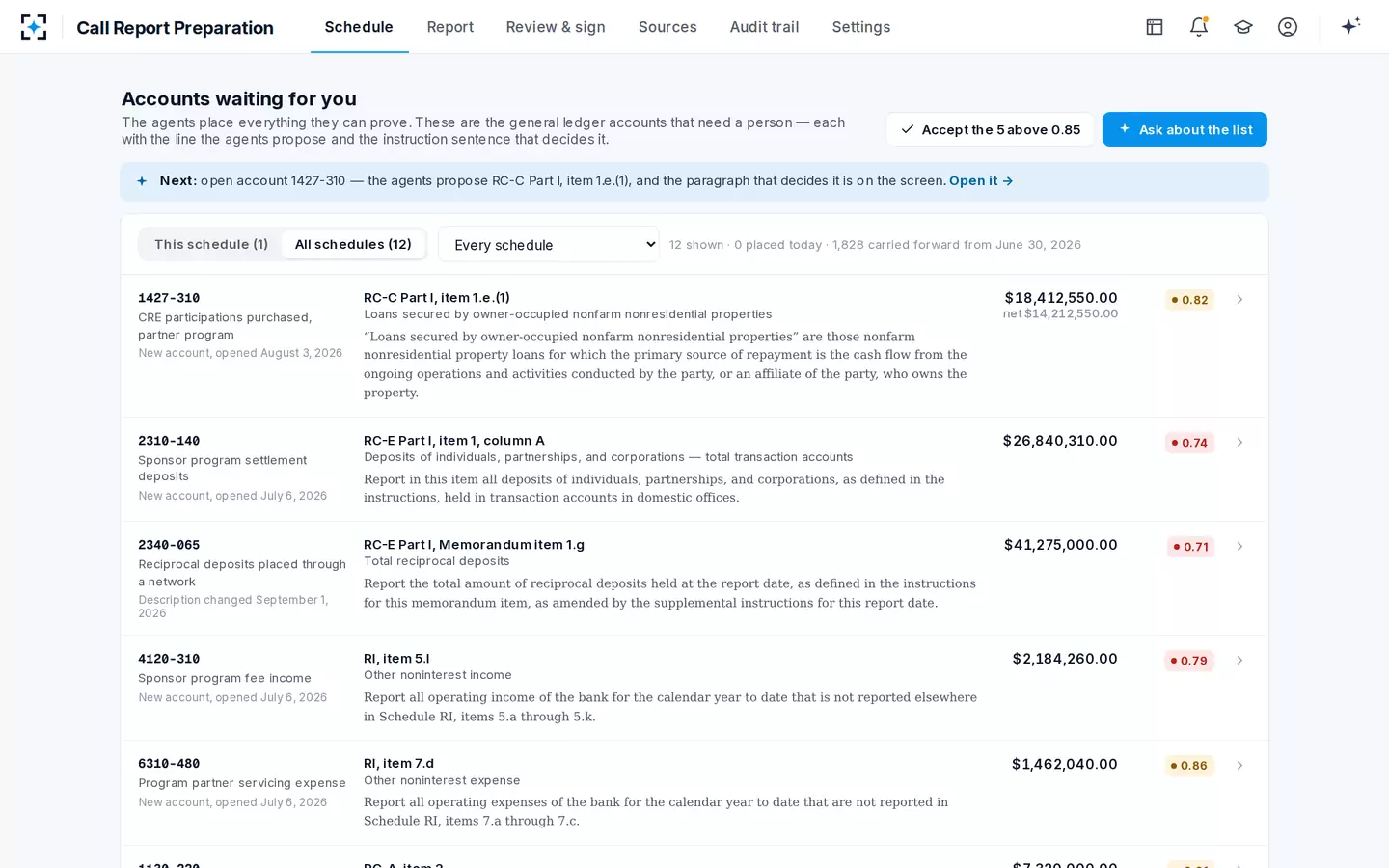
| Place a new or changed account | Propose only | Mapping agent proposes with evidence; a person always decides | Preparer, then Assistant Controller |
| Find the governing paragraph | Yes, quoted | Instruction agent attaches it with schedule and item | Preparer reads it |
| Re-foot and tie out | Yes | Tie-out agent; no preparer can override a failed tie-out | Only the Controller may accept a difference |
| Run edits; draft explanations | Run yes; draft only | Edit-check agent; nothing sent without a named approver | Preparer and reviewer |
| Explain quarter-over-quarter moves | Draft only | Variance agent traces each move to accounts | Reviewer |
| Sign and file | No | No file before every schedule is signed; the bank’s own system submits | CFO and directors |
Automation has a risk of its own, and the OCC names it. Its booklet says automated systems may reduce the likelihood of manual errors but "can introduce other risks", and that failing to test periodically the accuracy of data flows from the bank's reporting or accounting systems could lead to inaccurate reporting (OCC Comptroller's Handbook, Regulatory Reporting). A business case that does not budget for testing the automation is incomplete.
What is left for people after the automation runs
Can small banks automate the call report?
Yes, and they have the most to gain per dollar of assets, because the report's fixed cost is spread over less. Three in four FDIC-insured institutions had less than $1 billion in assets at June 30, 2026.
FDIC-insured institutions by asset size, June 30, 2026
The case at a small bank is different in shape, not in kind. The hours are fewer, but they often sit with one or two people, so the risk is concentration: a single preparer whose mapping lives in a workbook only they can read. For that bank, automation's value is less the hours than the written reason for every placement, which survives the preparer's leave or departure. Which form a small bank files, and what moving from the 051 to the 041 adds, is set out in FFIEC 051 vs 041.
How do you measure ROI on regulatory reporting automation?
As a sum of terms you can each check, with the costs on the same page as the gains. The formula below is the one we would put in front of a CFO; every term is the bank's own number.
Return on Call Report automation, term by term
Hours moved
hours a quarter on placing, paragraph-finding and re-footing × share automated × 4 × loaded rate
Measure the base on last quarter, by kind of work.
Controller
Calendar returned
business days from report date to signed report, before and after
The design target is 6 of 12 days given back to review.
Regulatory reporting manager
Errors avoided
amendments, examiner findings and late days in the last 12 quarters × their cost
Usually the largest term and the least predictable.
CFO
Cost to run it
licence + implementation + testing of the mapping and data flows + training
Include internal audit’s test of the automation itself.
Finance and audit
Four measures tell you, quarter by quarter, whether the automation is earning its keep: the share of accounts carried forward without a look; the number of accounts left for a person and how long each waited; the business day on which the last tie-out came to hold; and the number of quality-edit explanations still unapproved two days before the due date. All four should fall, except the first, which should rise and then stay flat. Testing call report preparation software on last quarter's filing shows how to get a baseline for each before buying.
Where Call Report Preparation fits, and where it does not
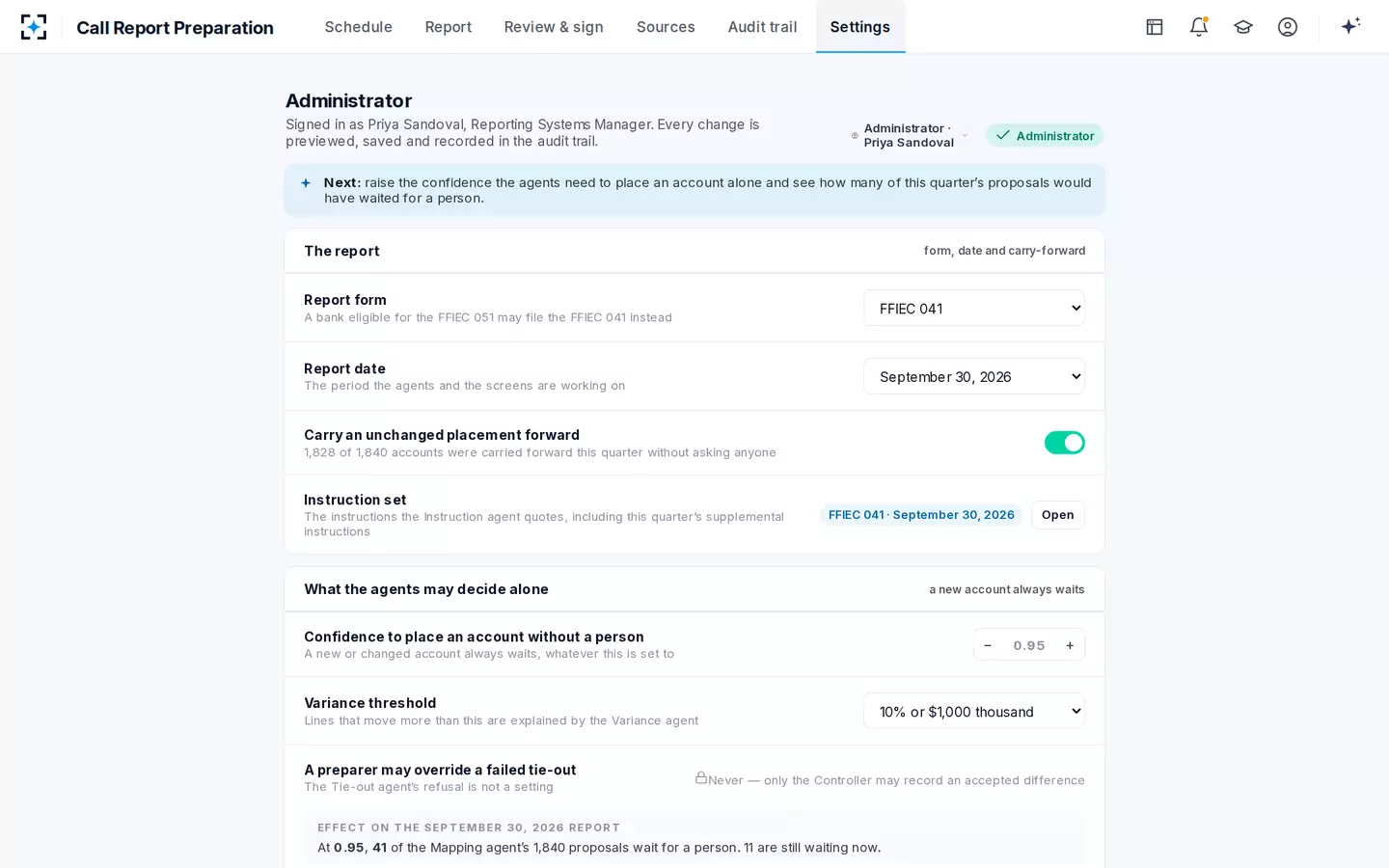
It fits a bank that prepares the Call Report from its own general ledger and subledgers on the FFIEC 041, 051 or 031, and wants the placing, citing, re-footing, editing and explaining done with the evidence shown. The form is a setting, the confidence a new placement needs is a setting, and the close calendar, the variance threshold and the approvers are the bank's own.
The bank's own settings, previewed before they are saved
It does not file. The bank's regulatory reporting system receives the signed data file and its hash and submits it to the CDR. It does not decide a new placement, sign a schedule or accept a difference the instructions do not resolve; people do. And it does not make the instructions simpler. The Financial Data Transparency Act's joint data standards took effect on October 1, 2026, but by the agencies' own account the rule changes no reporting requirement until they act again (Federal Register, June 25, 2026; AI in regulatory reporting quotes it), and the Call Report streamlining the agencies asked about has not yet been proposed. Automation buys back the mechanical hours of today's report; it does not wait for a lighter one.
Questions people ask
Is regulatory reporting automation the same as call report software?
Not quite. Call report software, which most banks use, produces the form, runs the edits and builds the submission file. Regulatory reporting automation in the wider sense reaches back to the general ledger: proving the source, placing accounts with reasons and re-footing, which is where the agencies say the manual work remains.
Does automation reduce the risk of a call report amendment?
It can, if it reduces the errors that cause amendments: wrong lines, missed new accounts, gross figures where a contra account exists. It can also add risk if its data flows are not tested, which the OCC's booklet warns about. The measure is the number of amendments and examiner findings over time, not the hours.
How long does it take to see a return?
The hours term shows in the first quarter run on the new process, because it is measured against the previous quarter. The errors-avoided term shows only over several quarters. A pilot on a quarter already filed gives a baseline for both before any purchase.
Will the agencies' Call Report streamlining reduce the need for automation?
It may reduce the number of items, and the agencies asked in December 2025 whether to open the FFIEC 051 to banks above $5 billion. But the hours in mapping and proving come from the bank's own systems, not from the count of items, and no proposal had been published by late October 2026.
Do we need model validation for regulatory reporting automation?
Rule-based tie-outs and edits fall outside the 2026 model risk guidance's definition of a model. Agents that propose placements or draft explanations use generative AI, which that guidance leaves out of scope while asking banks to set appropriate governance. Treat them as you would a preparer: test their output and keep a person deciding.