Call report uninsured deposits are reported in Schedule RC-O, Memorandum item 2, by every bank with $1 billion or more in total assets: an estimate of the deposits not covered by federal deposit insurance, built from the bank's total deposit liabilities and its account data under the $250,000 limit. In July 2023 the FDIC told the industry that some banks had been estimating it wrongly, by subtracting deposits secured by pledged collateral and by leaving out the deposits of consolidated subsidiaries, and that those banks should amend. The reports had passed the FFIEC edits; they were internally consistent and wrong. Botminds' Call Report Analysis, an agentic solution for the edits and explanations of the Call Report, is built around the gap this case exposes: an edit tests the numbers against each other, and only a reader of the instruction, with the source data, tests them against the rule.
The sample figures below come from the solution's fictional sample bank, Corvane National Bank; the industry figures and rules are the FDIC's and the FFIEC's, linked where they appear.
Call report uninsured deposits, at the scale the FDIC now sees them
$8.69T
estimated uninsured domestic deposits across FDIC-insured institutions, June 30, 2026
44%
of total deposit liabilities after exclusions, our arithmetic from the FDIC's 55.62% insured share
$1B
in total assets: the size at which a bank must report the estimate itself
3years
of revisions the FDIC invited in 2023, "or more, if appropriate"
How do you calculate uninsured deposits for the Call Report?
You start from the deposit base the FDIC assesses, not from the balance sheet, and then remove what insurance covers, account owner by account owner. The September 2026 Schedule RC-O instructions say the estimate "should be based on the bank's deposits included in Schedule RC-O, item 1," total deposit liabilities before exclusions, "less item 2," the allowable exclusions, and should reflect the $250,000 limit for retirement accounts and for other accounts (Schedule RC-O instructions). The item is completed on an unconsolidated single FDIC certificate number basis, and the reporting is mandated by Section 7(a)(9) of the Federal Deposit Insurance Act.
The base is wider than Schedule RC, item 13.a. The instructions list what else it takes in: interest accrued and unpaid on domestic deposits, deposits in insured branches in Puerto Rico and U.S. territories, deposits of consolidated subsidiaries, and deposit liabilities that have been reduced by assets netted against them under GAAP. Then come seven criteria for the estimate itself, one per kind of account.
The seven estimation rules in Schedule RC-O, Memorandum item 2, and what to test
| Kind of deposit | What the instruction requires | What a reviewer tests |
|---|---|---|
| Brokered deposits | Use the work done for RC-E, Memorandum item 1.c (brokered deposits of $250,000 or less). | The uninsured brokered figure ties to RC-E. |
| Fiduciary accounts | Diligently use the available data on beneficiaries and retirement funds to find the uninsured share. | Pass-through coverage is claimed only where the titling shows the fiduciary relationship. |
| Employee benefit plans | Diligently use the data on participants' non-contingent interests. | Recordkeeping conditions for pass-through are met. |
| Benefit-responsive investment contracts | Include the entire amount: not eligible for insurance. | None is counted as insured. |
| Collateralized deposits | Make a reasonable estimate of the uninsured portion using the bank's systems. | Pledged collateral reduces nothing. |
| Privately insured excess | Estimate the portion not insured by the FDIC. | Private cover reduces nothing. |
| All other accounts | Use joint-account coverage and aggregate by owner and ownership capacity before the $250,000 limit, where systems allow. | Aggregation is done before the limit, not account by account. |
A bank without automated systems may use paper files or less formal knowledge of its depositors, the instructions add, unless the errors that introduces "would contribute significantly to an overall error in the FDIC's estimate of the amount of insured and uninsured deposits in the banking system." That sentence says who the number is for. The FDIC sums these estimates into its view of the whole system, and a bank's shortcut is the FDIC's error.
What did FDIC FIL-37-2023 say?
FIL-37-2023, issued on July 24, 2023, said that some insured institutions were "not reporting estimated uninsured deposits in accordance with the instructions" and named two mistakes. Some had reduced the reported amount "to the extent that the uninsured deposits are collateralized by pledged assets." Others had "reduced the amount reported on Schedule RC-O by excluding intercompany deposit balances of subsidiaries" (FDIC FIL-37-2023).
The remedy was blunt. Reports with either mistake "are inaccurate," and banks that made them "should amend their Call Reports by making the appropriate changes to the data, and submitting the revised data file to the Central Data Repository (CDR) using the same processes as the original filing." The letter applied to institutions with $1 billion or more in total assets, the ones that report the estimate. It reminded readers that the CFO and multiple directors attest to every Call Report's correctness.
Can collateral reduce reported uninsured deposits?
No. A deposit above the insurance limit is uninsured whether or not the bank has pledged securities against it. The FIL put it in one line: the existence of collateral, "in and of itself," has no bearing on the portion of a deposit that federal deposit insurance covers. The collateral protects the depositor through the pledge, which is a different promise from insurance.
The mistake is easy to understand. The deposits most often collateralized are public funds, of the U.S. government and of states and political subdivisions, and to a treasurer and a credit officer a fully secured public deposit is not a run risk in the usual sense. The Call Report asks a narrower question, what the FDIC does not insure, and the instruction answers it: make "a reasonable estimate of the portion of these deposits that is uninsured using the data available from its information systems." Secured or not, the excess over the limit is in.
Do subsidiary deposits count in the Call Report's uninsured estimate?
Yes, even though they vanish from the balance sheet. A subsidiary's deposit at its parent bank is eliminated in consolidation, so it never appears in Schedule RC. Schedule RC-O works on a different basis, and the General Instructions say so directly: "all deposits of subsidiaries (except an insured depository institution subsidiary) that are consolidated and, therefore, eliminated from reported deposits on the balance sheet (Schedule RC, item 13.a or 13.b, as appropriate) must be reported in Schedule RC-O, items 1 through 3, Memorandum item 1, and, if applicable, Memorandum item 2" (FFIEC 031 and 041 General Instructions).
Here the two schedules are built to disagree. A preparer who ties RC-O to RC, a sensible habit, will strip out exactly the balances RC-O is supposed to keep. The tie that works is to the deposit system's gross figure before eliminations, with the intercompany balances shown as a reconciling line.
What Call Report errors do edits not catch?
Edits catch arithmetic and improbable relationships; they cannot catch a consistent misreading of an instruction. A validity edit checks that parts add to totals and that related items agree. A quality edit flags a figure that looks unusual, such as a swing or a ratio outside a range. A bank that has always netted collateral produces an estimate that is smaller than it should be, stable from quarter to quarter and in line with its other deposit items. No edit has anything to flag.
Passing the edits and following the instruction are different tests
Passes the edits · follows the instruction
A correct report
Nothing to fix, nothing to explain. Most lines, most quarters.
Fails a quality edit · follows the instruction
A correct but unusual figure
Explain it: the cause, the amounts, the dates, the instruction. The edits did their job.
Fails an edit · breaks the instruction
An error the edits catch
Correct the data before filing. The cheapest error a bank can make.
Passes the edits · breaks the instruction
The error only a reader of the instruction finds
Estimated uninsured deposits net of pledged collateral, or without consolidated subsidiaries’ deposits. Accepted, published, and later amended.
That is why accuracy needs a second test that edits cannot perform: take a sample of the inputs and read them against the instruction. For uninsured deposits that means a list of the largest collateralized accounts and the subsidiaries' accounts, and a check that each sits where the instruction puts it. The same logic applies far beyond RC-O. Any line that depends on a definition, such as owner-occupied real estate or brokered deposits, can be consistently wrong.
Why did banks amend their Call Reports in 2023, and how far back?
Because the FDIC told them to, and because the error was the kind the instructions treat as amendable. The General Instructions allow the primary supervisor to require an amended report for significant errors in how items were classified, and for recognition and measurement errors "that are material for the reporting bank." FIL-37-2023 did not set a single look-back. It said institutions "can submit up to three years of revisions, or more, if appropriate."
How far back is a judgment, and the OCC's examiner booklet says whose. Once examiners decide a report must be amended, "the question is which report or reports and how far back to require refiling," and the answer weighs the nature and root causes of the errors, any history of refilings, and the effect on other public financial statements (OCC, Regulatory Reporting). A three-year restatement of one memorandum item is a modest project. Its cost is the evidence: rebuilding each quarter's estimate from deposit data as it stood, which is only possible if the data were kept. What an amendment, a resubmission or a violation costs in total is laid out in what one call report error costs.
The number is larger now than when the FDIC wrote
The Federal Reserve's review of Silicon Valley Bank's failure, published in April 2023, named the bank's "high level of reliance on uninsured deposits" among the reasons it was an outlier (Federal Reserve, SVB review). Three years on there are more such deposits in the system, not fewer. The FDIC's own series shows estimated uninsured deposits of $7.33 trillion at June 30, 2023, the quarter before the letter, and $8.69 trillion at June 30, 2026, up $317.4 billion in the second quarter of 2026 alone (FDIC Quarterly Banking Profile).
Estimated uninsured deposits, all FDIC-insured institutions, each second quarter
A larger total does not make any one bank's estimate wrong. It does mean that an estimate built on a shortcut matters more to the system total than it did, and that an examiner who reads RC-O is reading a figure the agencies now watch closely.
What a review of RC-O Memorandum item 2 should test each quarter
A useful review asks one question per estimation rule and keeps the answer with the workpapers. The list below is the one we would hand a reviewer who did not prepare the item.
Eight checks on the uninsured deposit estimate, before the report goes
- The base starts at RC-O item 1 less item 2
Not at Schedule RC, item 13.a. Interest accrued and territorial branches are in.
- Subsidiaries' deposits are added back
Every consolidated subsidiary except an insured depository institution, listed by account.
- Collateral reduces nothing
Public funds above the limit are uninsured, pledged or not; the largest ten are read individually.
- Private insurance reduces nothing
Excess cover bought from a private insurer leaves the FDIC-uninsured share where it was.
- Brokered figures tie to RC-E
The uninsured brokered amount uses the RC-E Memorandum item 1.c work.
- Owners are aggregated before the limit
Where systems hold owner and capacity, accounts are combined first, then $250,000 applied.
- Pass-through is claimed only with the records
Fiduciary and benefit-plan coverage needs the titling and records the FDIC's rules require.
- The method matches last quarter, or the change is explained
A method change moves the estimate; say so, with the effect, so the next quarter's quality edit has its answer.
Where Call Report Analysis fits, and where it does not
The solution's job here is to stop a stable figure from being carried forward on trust. In the sample bank, uninsured deposits sit among the recurring explanations: "Estimated uninsured deposits are 42% of deposits, as in June." Before any recurring explanation is accepted in bulk, the Recurrence agent tests it against this quarter's data, as it did when it found that a former branch premises balance had changed after a sale. The same check applies to the uninsured estimate's inputs: the subsidiary balances, the collateralized public funds and the method.
Recurring explanations are rechecked before anyone accepts them in bulk
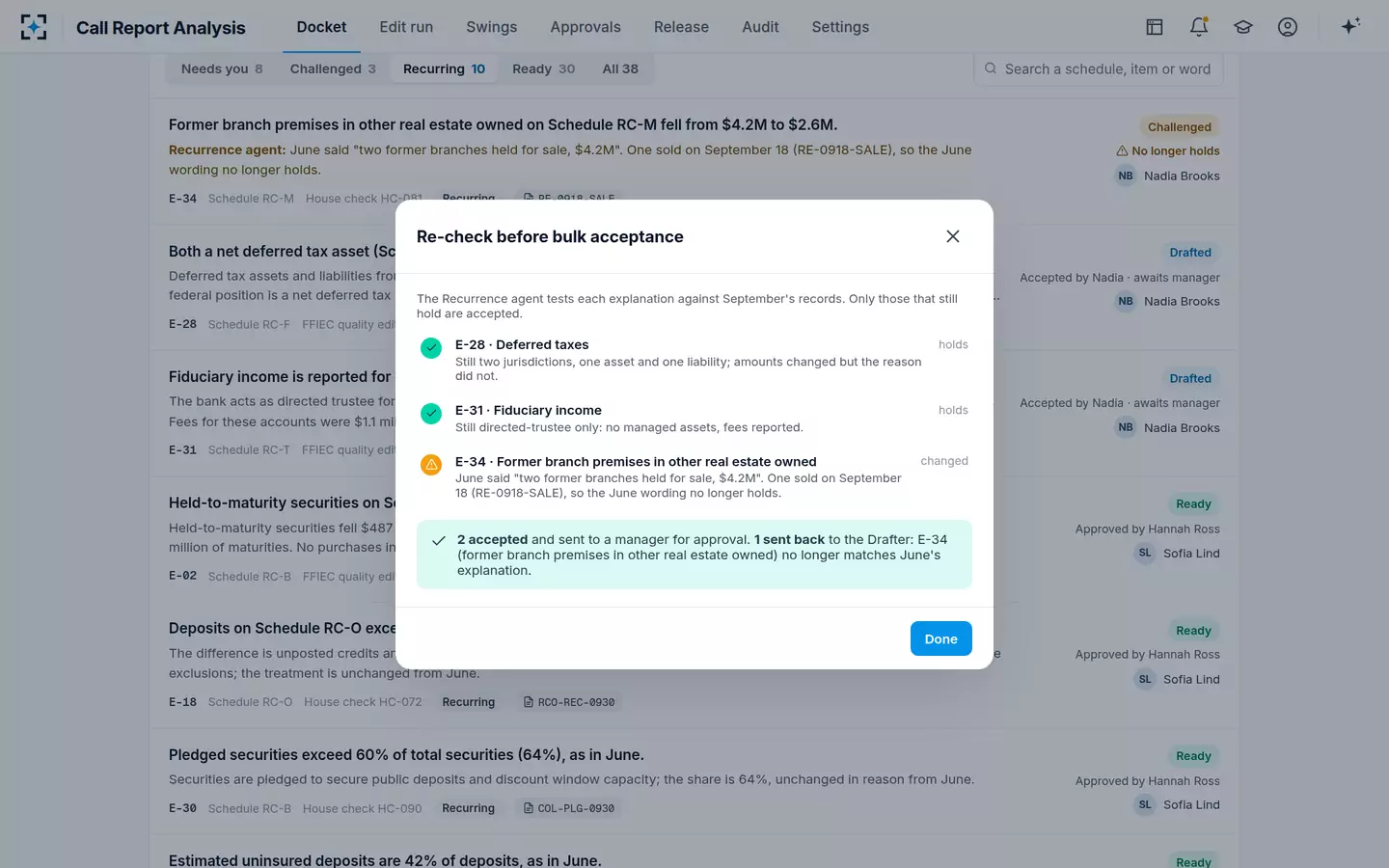
What the agents cannot do is know a deposit's ownership capacity if the bank's systems do not hold it. The estimate is only as good as the account data, and the instruction itself anticipates that systems differ. The solution reads the deposit subledger and the core banking system read only, shows which inputs the estimate rests on, and leaves the method to the people who sign. The broader standard for writing an explanation an agency analyst accepts is in call report edit checks, and the sample bank's quarter from edit run to signature is on the Call Report Analysis page.
The quarter's edit run: what the edits caught, and what they could not
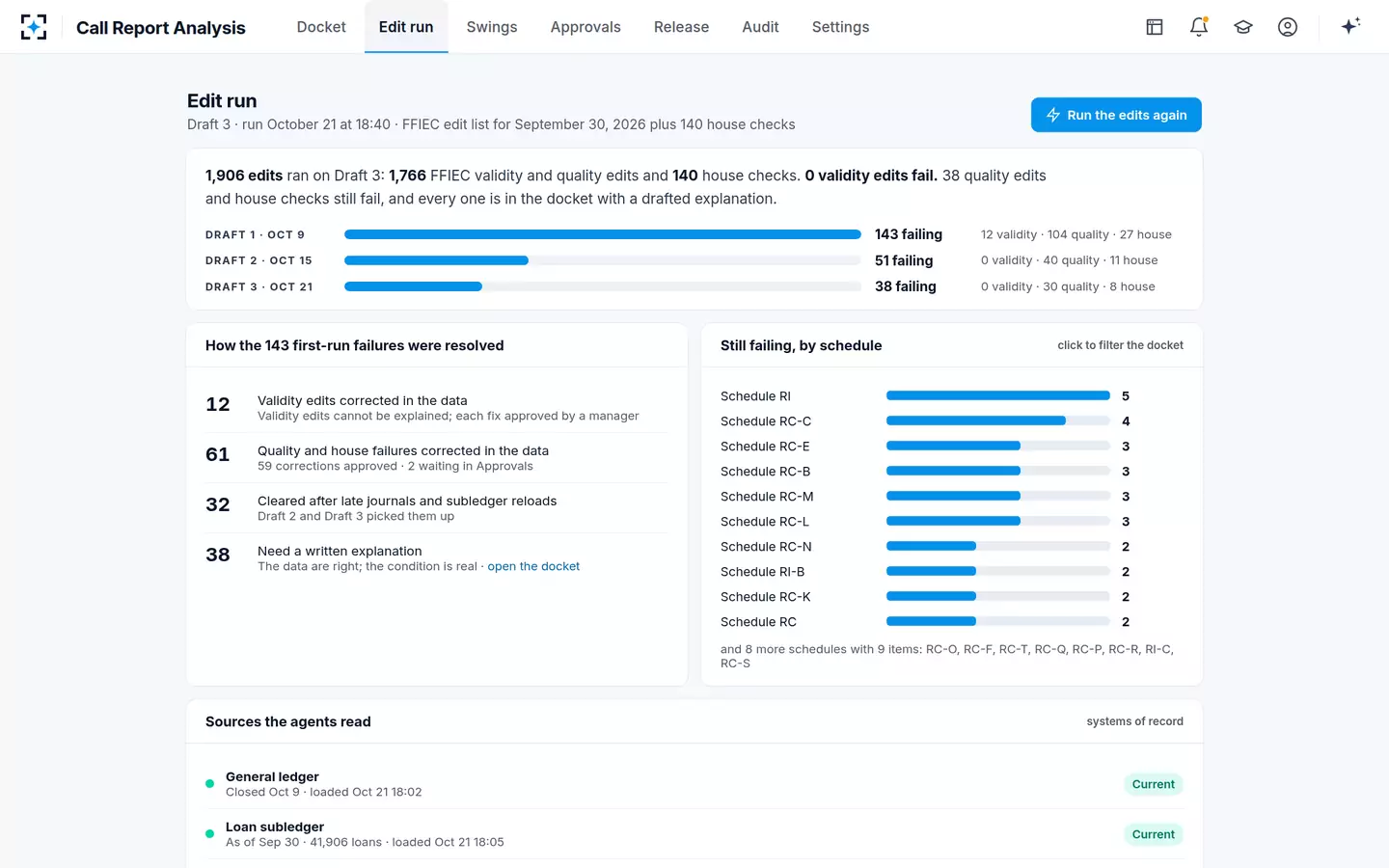
Questions people ask
Which banks report estimated uninsured deposits on the Call Report?
Banks with $1 billion or more in total assets complete Schedule RC-O, Memorandum item 2. For smaller banks, the FDIC estimates uninsured deposits itself from the accounts above $250,000 that banks report in Schedule RC-O.
Where are uninsured deposits reported on the Call Report?
In Schedule RC-O, Other Data for Deposit Insurance Assessments, Memorandum item 2, on an unconsolidated single FDIC certificate number basis. The same estimate also feeds the FDIC's industry series in the Quarterly Banking Profile.
Are preferred deposits of public bodies insured because they are secured?
No. Deposits of states and political subdivisions that are secured or collateralized as state law requires are reported as preferred deposits in Schedule RC-E, but the security does not make the excess over the insurance limit insured.
Does an amendment to uninsured deposits change anything else in the Call Report?
Amended data replace the original on the FFIEC's public data site, and the Uniform Bank Performance Report recalculates the quarters it covers on a set schedule, so the public figure changes too. Check any internal ratio or board report that used the old estimate.
Is an uninsured deposit estimate ever exact?
No, and the instructions accept that: they ask for a reasonable estimate from the bank's information systems, and allow less formal information where systems fall short. What they do not accept is a method that ignores a rule, such as netting collateral.