Loans to nondepository financial institutions are the loans a bank makes to lenders and funds that are not banks — mortgage companies, finance companies, business development companies, private credit and private equity funds, securitisation vehicles, insurers and broker-dealers — reported together on Call Report Schedule RC-C, Part I, item 9.a. Since the December 2024 filing, banks with $10 billion or more in total assets must also split them into five subcategories, and that is where the work is: the category depends on what more than half of the borrower's assets or lending activities actually are, which cannot be read from the borrower's name and often cannot be read from the facility's purpose either. Botminds' Credit Concentration Risk Monitoring reads the borrowing base, the credit agreement and the offering memorandum, applies the test, cites the page it relied on, and leaves a person to confirm before the category counts in a limit or a filing.
The worked examples come from fictional sample data inside the product — Ellsmere Bank & Trust, an $18.4B commercial bank, and its borrowers. The instructions and the research are the agencies' own, linked where they appear.
What the December 2024 Call Report changed, in four numbers
$10B
in total assets — the size at which a bank must report the five subcategories, not just the total
5
subcategories: mortgage credit, business credit, private equity, consumer credit, and everything else
50%
of the borrower’s assets or lending activities — the one test that decides which of the five applies
42s
to read three facility documents and place one lender in its category, with the passage and the page (demo)
What are loans to nondepository financial institutions?
The instructions define the borrowers rather than the loans: "Nondepository financial institutions (NDFIs) encompass a wide range of financial entities that provide services similar to those of traditional banks but do not accept deposits from the general public and are not regulated by the Federal banking agencies. NDFIs include, but are not limited to, mortgage companies, insurance companies, investment funds (such as mutual funds, money market funds, hedge funds, and private capital funds), pension funds, broker-dealers, securitization vehicles, and other financial entities engaged in credit intermediation, asset management, market-making, and other financial services activities" (FFIEC 031 and 041, Schedule RC-C, Part I, item 9.a, 12-24).
Two things follow that are easy to miss. The line is about the borrower's business, not the facility's structure: a term loan, a revolver, a warehouse line and a capital call facility all land in 9.a if the borrower is an NDFI, and a loan to a manufacturer stays out of it however it is secured. And the line is a reporting category, not a risk rating. Nothing in it says these loans are risky; the FDIC's own analysis finds the opposite so far, which is a separate question worth its own numbers.
For concentration purposes the category matters because exposure to other financial institutions aggregates in ways that are easy to under-count. The OCC lists among its examples of transactions that may perform similarly those "extended to other financial institutions, such as due from accounts, federal funds sold, investments, net current exposure of derivatives contracts, and direct or indirect loans" (OCC, Concentrations of Credit, version 3.0). The Call Report line captures the lending; a concentration limit has to capture the rest.
Which banks have to report the five NDFI subcategories, and from when
Every bank reports total loans to NDFIs in item 9.a, plus unused commitments and performance data — amounts 30 to 89 days past due, 90 days or more past due, and nonaccrual. Banks with $10 billion or more in total assets report the five subcategories on top of that, in Memorandum items 10.a through 10.e, with unfunded commitments for each. Banks filing the FFIEC 051 do not report the subcategories at all.
The tie-out is arithmetic and unforgiving: "For institutions with $10 billion or more in total assets, the amounts reported in this item must equal the sum of Schedule RC-C, Part I, Memorandum items 10.a through 10.e, columns A and B, respectively." Reporting began with the December 2024 report. Institutions that needed more time could report on a best-efforts basis at the December 2024 and March 2025 dates, and comprehensively no later than 30 June 2025, which is why the subcategory series moves for reasons that have nothing to do with lending for its first two quarters.
The one test that decides: more than 50% of assets or lending activities
Three of the five categories use the same words, and a fourth uses a near-twin. A borrower belongs in mortgage credit, business credit or consumer credit if its underlying assets are "predominately (greater than 50% of assets or lending activities)" mortgages, loans to businesses or loans to consumers; a fund belongs in private equity if more than 50% of its assets are equity investments in private, non-listed companies — a test on assets alone. The residual category takes everything the first four do not.
That phrasing settles three arguments before they start. The test is about the borrower's book, not the facility: a revolving line secured by a mixed pool is classified by what is in the pool. It is a majority test, so a lender that is 49% auto paper and 51% equipment leases is a business credit intermediary, and will stop being one if the mix shifts. And "assets or lending activities" allows either stock or flow, which matters for a forward-flow lender whose balance sheet is small and whose originations are not.
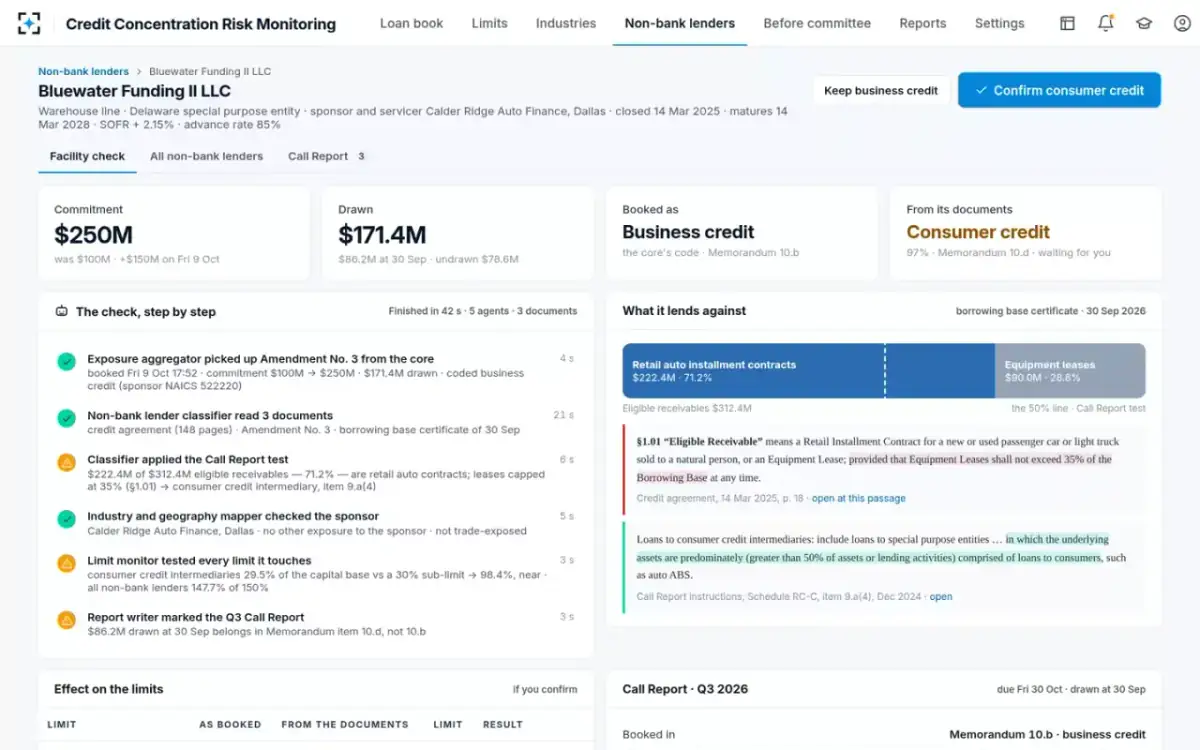
What it is not is a test on the borrower's name. "Bluewater Funding II LLC" discloses nothing. In the worked example, Bluewater's line went from $100M to $250M on a Friday, still coded as business credit from when it was booked. Its borrowing base certificate at 30 September shows $222.4M of $312.4M eligible receivables — 71.2% — as retail auto installment contracts, with equipment leases capped at 35% of the borrowing base by section 1.01 of the credit agreement. On the majority test that is a consumer credit intermediary, and the facility belongs in Memorandum item 10.d rather than 10.b.
The 50% test applied to one facility, with the passages it rests on
The five categories side by side, with what the instructions put in each
Which of Memorandum items 10.a to 10.e a facility belongs in
| Item | The category | What the instructions put in it |
|---|---|---|
| 10.a | Mortgage credit intermediaries | Mortgage companies specialising in residential or commercial origination or servicing, warehouse facilities, REITs, CDOs, CLOs, private debt funds and ABCP conduits whose underlying assets are more than 50% residential or commercial mortgages. CLO tranches reported as loans under GAAP are included; outright purchases of loans secured by real estate are not. |
| 10.b | Business credit intermediaries | Special purpose entities, finance companies, direct lenders, CDOs, CLOs, private debt funds, leasing companies, ABCP conduits, business development companies and small business investment companies whose book is more than 50% loans to businesses — including internet lending platforms and other marketplace lenders. |
| 10.c | Private equity funds | All loans to private equity funds, including capital call and other subscription-based facilities to private equity and venture capital funds, and general partnership funds whose investment assets are more than 50% equity in private, non-listed companies. |
| 10.d | Consumer credit intermediaries | Special purpose entities, finance companies, direct lenders, private debt funds, leasing companies and ABCP conduits whose underlying assets are more than 50% loans to consumers, plus facilities that support auto, credit card and student-loan asset-backed securitisation, and non-bank consumer lenders including online platforms. |
| 10.e | Other loans to NDFIs | Everything not in 10.a to 10.d: holding companies of other depository institutions, insurers, federally sponsored lending agencies, investment banks and broker-dealers, publicly listed funds, hedge funds, pension funds, endowments, family offices, sovereign wealth funds, securitisation vehicles, and loans to a bank’s own trust department. |
Is a private credit fund a private equity fund? The 10.c and 10.e overlap
No, and the distinction is the one most often got wrong. The FDIC's own explanation of item 10.c draws the line: private equity funds pool investor money "to invest in the equity of private firms", and this "differs from private credit or private debt funds, which use investor capital to lend directly to similar firms" (FDIC, Banking Issues in Focus No. 1). A loan to a fund that buys companies is 10.c. A loan to a fund that lends to companies is not.
Where it goes instead is the genuine ambiguity in the instructions, and it is worth naming rather than papering over. Private debt funds are listed by name inside 10.a, 10.b and 10.d — whichever of mortgages, business loans or consumer loans makes up more than half of the fund's book. They are also listed by name under 10.e, in the bullet for "loans to private capital funds, including private equity and private debt funds." Read on its own, that bullet would sweep every private credit fund into the residual category.
The resolution is in the instruction for the item itself: 10.e takes all other loans to NDFIs "that are not included in Memorandum items 10.a through 10.d, above." The residual is a residual. A private debt fund that passes one of the three majority tests belongs in that category; one whose book is genuinely mixed, or whose assets cannot be established, falls to 10.e. What a bank owes itself here is a written convention, applied the same way every quarter, because the alternative is a series that moves whenever a different analyst looks at it.
Which document answers the question: borrowing base, credit agreement, offering memorandum
The 50% test needs a composition, and compositions live in three places with different authority. The borrowing base certificate is the most recent and the most specific: it says what the collateral actually is, by category, as of a date. The credit agreement says what the collateral is allowed to be — eligibility definitions, concentration caps, advance rates — and so it bounds what future certificates can say. The offering memorandum or the fund's governing documents describe the strategy, which is the weakest evidence of composition and the easiest to find.
The documents to read in order, and the figure to pull from each
- The latest borrowing base certificate.
Take the eligible receivables by category and the total. This is the numerator and denominator of the 50% test, as of a date you can cite.
- The credit agreement, and every amendment to it.
Read the eligibility definitions and any sub-limits. A cap on one asset class — equipment leases at 35% of the borrowing base, say — tells you what the mix can become, not only what it is.
- The offering memorandum or fund documents, for a fund rather than a lender.
Use it to establish whether the vehicle lends or takes equity, which decides 10.c against the credit-intermediary categories. Use it for composition only if nothing better exists.
- The servicer or portfolio report, where the borrower originates and sells.
A forward-flow lender with a small balance sheet is classified on lending activities, so the origination mix is the figure that matters.
- The core’s own code, read last and never first.
It records what the facility was when it was booked. Keep it beside the answer from the documents and explain any difference; do not let it be the answer.
The practical consequence is that the category changes when the documents change, not when the relationship manager notices. An amendment that adds a new asset class, a new borrowing base that shifts the mix past 50%, a fund that starts lending as well as investing — each is a reclassification event, and each arrives as a document long before it arrives as a question.
What moved into item 9.a in December 2024, and what moved out
The same filing rewrote the boundaries of the line itself, which is why a chart of NDFI lending has a step in it at the fourth quarter of 2024 that is not lending. Loans to brokers and dealers, and to investment companies and mutual funds, had been reported under loans for purchasing and carrying securities in item 9.b.(1); they moved into 9.a unless they meet the definition of purchasing-and-carrying loans. Loans to special purpose entities and other securitisation vehicles were added explicitly. In the other direction, all loans secured by readily marketable securities were combined into purchasing and carrying securities under "Other loans", which took some balances out of 9.a.
The FDIC records the effect on the data: "The Call Report instructions also were updated to clarify which loans should be included in NDFI lending. These revisions resulted in some banks reclassifying lending from other categories into NDFI lending." Between the third and fourth quarters of 2024, total commercial and industrial loans fell $128 billion and "all other" loans fell $60 billion — movements that include real lending changes as well as reclassification, and cannot be separated. A bank writing a trend commentary for its board needs to say which quarters are comparable.
How do you decide a borrower's NDFI category, step by step
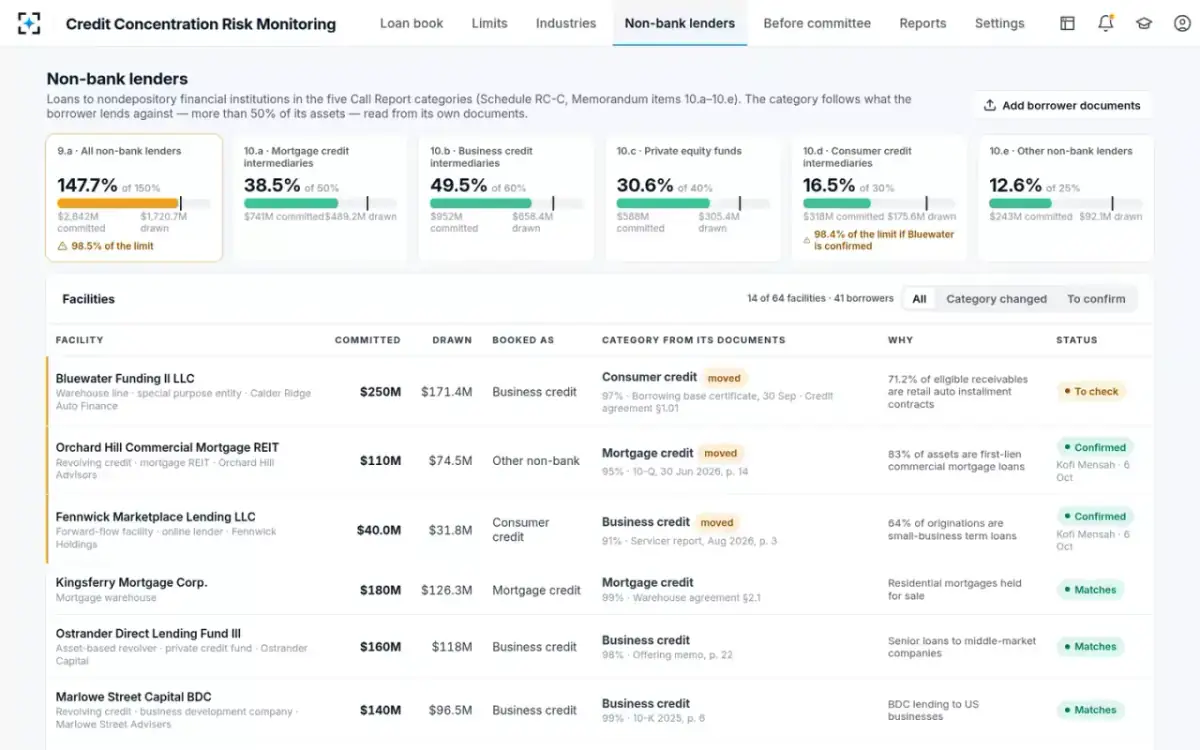
Three facilities at one bank: the code they were booked under, and the category their documents support
Booked in the core: Business credit intermediary, 10.b — the code it carried when the line was $100M.
From the documents: Consumer credit intermediary, 10.d. The borrowing base at 30 September is 71.2% retail auto installment contracts; equipment leases are capped at 35% by section 1.01. Waiting for a person to confirm.
Booked in the core: Other non-bank lender, 10.e — the residual, used because nothing better was chosen at booking.
From the documents: Mortgage credit intermediary, 10.a. The 10-Q at 30 June 2026, page 14, shows 83% of assets are first-lien commercial mortgages. Confirmed on 6 October.
Booked in the core: Consumer credit intermediary, 10.d.
From the documents: Business credit intermediary, 10.b. The servicer report of August 2026, page 3, shows 64% of originations are small-business term loans — a lending-activities test rather than a balance-sheet one. Confirmed on 6 October.
The method underneath those three rows is the same every time. Establish whether the borrower lends or invests, which separates 10.c from the rest. Pull the composition from the strongest available document. Apply the majority test on assets or on lending activities, whichever the borrower's model makes meaningful. Record the figure, the passage and the page. Then have a person confirm — and if the booked code is to be kept, have them say why, because a difference that is resolved silently will be resolved differently next quarter.
The five categories against their sub-limits, with the booked code beside the documented one
When a category changes after the Call Report has been filed
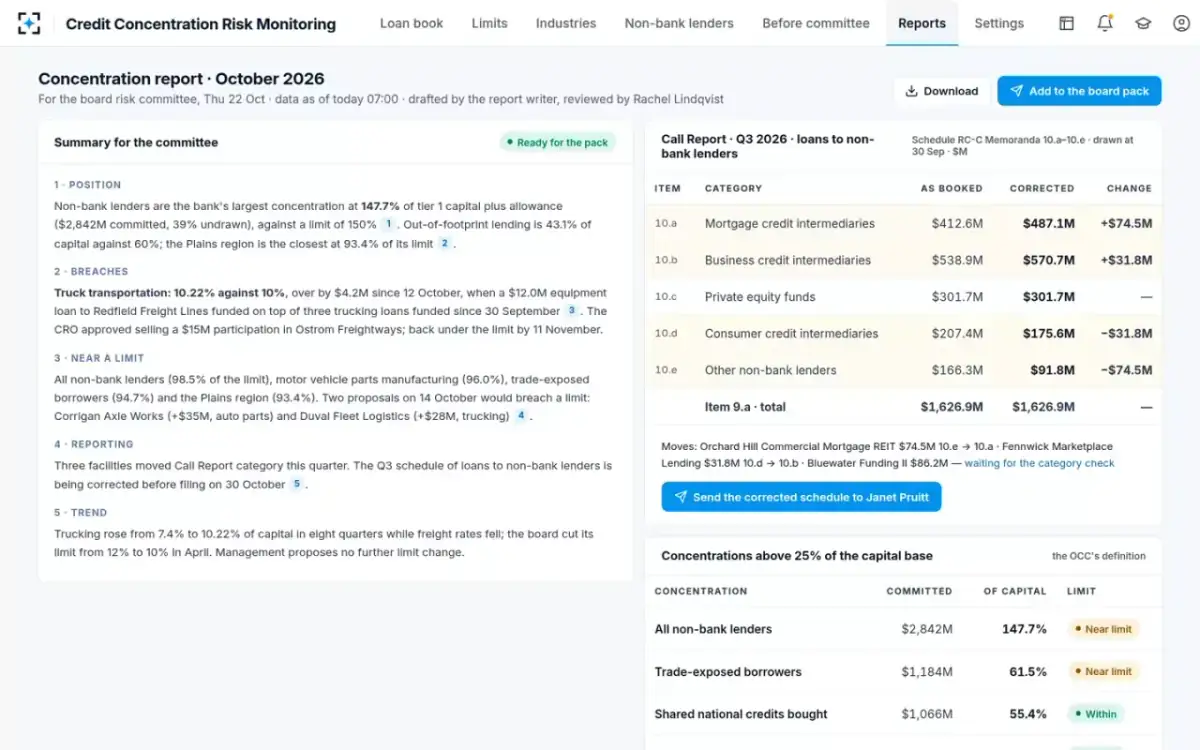
A reclassification does not change item 9.a. It moves balances between Memorandum items, and the five still have to sum to the total. That is a comfort for the filing and a problem for the limits, because sub-limits are set per category: moving a facility out of business credit and into consumer credit uses up room under one limit and releases it under another, and at this sample bank it takes consumer credit intermediaries to 98.4% of their 30% sub-limit.
The schedule the sample bank sends to regulatory reporting shows both columns — as booked and corrected — with the document behind each move, and the total unchanged at $1,626.9M. Three facilities moved in the quarter: $74.5M from 10.e to 10.a, $31.8M from 10.d to 10.b, and $86.2M from 10.b to 10.d once the category check is confirmed. It goes to the reporting team eighteen days before the 30 October filing, which is the only version of this that avoids an amendment.
A corrected schedule before the filing date, rather than an amendment after it
Getting the five right is reporting work with a risk consequence, and the risk consequence is the reason to do it early. Sub-limits under a broad pool only mean something if the facilities underneath them are in the right pool. To see the register, the facility checks and the schedule on one book, start from Credit Concentration Risk Monitoring.
Questions people ask
What is Call Report Schedule RC-C item 9.a?
It is the line on the quarterly Consolidated Reports of Condition and Income where a bank reports its loans to nondepository financial institutions. It sits inside item 9, "Loans to nondepository financial institutions and other loans", beside loans for purchasing or carrying securities and all other loans. Every bank reports it; banks with $10 billion or more in total assets must also break it into five subcategories that sum back to it exactly.
What are Memorandum items 10.a through 10.e?
They are the five subcategories of item 9.a: loans to mortgage credit intermediaries, to business credit intermediaries, to private equity funds, to consumer credit intermediaries, and all other loans to NDFIs. They are completed only by institutions with $10 billion or more in total assets, and banks of that size also report unfunded commitments for each of the five.
Is a business development company a business credit intermediary?
Yes — BDCs are named in the instructions for 10.b, alongside small business investment companies, finance companies, direct lenders and marketplace lenders. The FDIC describes a BDC as a publicly traded vehicle that funds small and midsize businesses (some BDCs are placed privately rather than listed, and they are classified the same way), so the majority test it has to pass is that its book is more than 50% loans to businesses. The FDIC describes an SBIC as the same idea, privately owned and licensed by the Small Business Administration.
What is a mortgage credit intermediary?
A company that specialises in originating, servicing or securitising residential or commercial mortgages, or a vehicle built to facilitate that — a warehouse facility, a REIT, a CDO or CLO, a private debt fund or an ABCP conduit — where more than 50% of assets or lending activities are mortgages. The FDIC notes that residential mortgage credit intermediaries originate most residential mortgages but do not hold them, which is why the lending-activities half of the test matters for them.
Does a warehouse line to a mortgage company belong in 9.a or in loans secured by real estate?
In 9.a, as a loan to a mortgage credit intermediary, provided it does not itself meet the definition of a loan secured by real estate. The instructions are explicit that outright purchases of mortgages or other loans meeting that definition are excluded and reported in item 1 instead. The distinction is between lending to the lender and buying the loans.
What happens to the item 9.a total when a facility changes category?
Nothing. The subcategories must sum to item 9.a, so a reclassification is a transfer between Memorandum items and the total is unchanged. What does change is the bank's own sub-limits, if it sets them by category, and its trend series, which will show a step in a category for a reason that is not lending. Both are worth a sentence in the board report.