The FR Y-9C instructions are the Federal Reserve Board's "Instructions for Preparation of Consolidated Financial Statements for Holding Companies," published on the Board's reporting forms page with each quarter's supplemental instructions and listing of revisions (Federal Reserve, FR Y-9C). They govern the quarterly report that bank holding companies, savings and loan holding companies, intermediate holding companies and securities holding companies with $3 billion or more in total consolidated assets file for the top-tier company. The Board says that in 1985 it rebuilt the report to run parallel to the banks' Call Report (Call Report vs FR Y-9C quotes the history), and most of Schedule HC-C reads like Schedule RC-C. But parallel is not identical: some amounts land on different lines, the due dates differ, the books are dated and numbered differently, and each has its own quarterly supplemental instructions. A reporting team that answers a holding company question from the Call Report book, or the reverse, will be right most of the time and wrong in ways nobody notices. Botminds' Call Report Instructions Search loads the FR Y-9C book beside the FFIEC 031 and 041 and names the matching HC-C line when an answer is on RC-C.
The FR Y-9C instruction book, page by page, by the year each page was last revised
Where are the FR Y-9C instructions?
On the Federal Reserve Board's reporting forms page for the FR Y-9C, which links the current form, the current instructions as one PDF, and an archive of "Supplemental Instructions and Listing of Revisions" back to March 2003 (Federal Reserve, FR Y-9C). Unlike the Call Report book, which the FDIC and FFIEC post schedule by schedule with an "as of" date on each file, the FR Y-9C instructions come as one book: 613 pages in the version posted for September 2026, created on September 29, 2026 (FR Y-9C instructions).
Inside, each page carries the report name, the schedule and a month-and-year date in its footer, "March 2026" rather than the Call Report's "(3-26)". That makes it easy to see when a page last changed and easy to miss that a page changed, because the date is in a different place and format from the bank's other instruction book.
Who must file the FR Y-9C?
Holding companies with total consolidated assets of $3 billion or more, at the top tier of the organization, plus any the Federal Reserve requires to file regardless of size. The General Instructions say holding companies of that size "must file" the FR Y-9C quarterly, together with the parent-only FR Y-9LP, and that in a tiered structure "only the top-tier holding company must file the FR Y-9C" unless it is exempt (FR Y-9C General Instructions). The threshold has risen over time: from $150 million to $500 million in March 2006, to $1 billion in March 2015, and to $3 billion in September 2018, according to the Board's description of the report (Federal Reserve, FR Y-9C).
When is the FR Y-9C due?
Forty calendar days after the March, June and September report dates, and 45 days after December 31. If the deadline falls on a weekend or holiday, "the report must be received on the first business day after the Saturday, Sunday, or holiday," reports are due "by the end of the reporting day on the submission date (5:00 P.M. at each district Reserve Bank)," and "No extensions of time for submitting reports are granted" (FR Y-9C General Instructions). The bank subsidiaries' Call Reports are due ten days earlier, 30 days after the report date (FFIEC 031 and 041 General Instructions), so in practice the bank subsidiaries' placement decisions are usually settled first, and a holding company answer that departs from them needs a stated reason.
The FR Y-9C at a glance
$3bn
total consolidated assets at which a holding company files, at the top tier
40days
after the March, June and September report dates; 45 after December 31
613
pages in the current instructions, one PDF, created September 29, 2026
1985
the year the report was revised to parallel the Call Report
How do the FR Y-9C instructions differ from the Call Report instructions?
In who publishes them, who you ask, how pages are dated and numbered, and in a handful of lines where the holding company report collapses or splits what the Call Report does differently. The table sets the document differences side by side; the line differences follow.
Two instruction books for one banking organization
Call Report (FFIEC 031 and 041): The FFIEC agencies; posted by the FDIC and the FFIEC, schedule by schedule
FR Y-9C: The Federal Reserve Board, as one book
Call Report (FFIEC 031 and 041): To the primary federal supervisor, referred to the FFIEC Task Force on Reports
FR Y-9C: "to the appropriate Federal Reserve Bank," in the district where the report is submitted
Call Report (FFIEC 031 and 041): 30 days after the report date (35 with more than one foreign office)
FR Y-9C: 40 days (45 for December), by 5:00 p.m. at the Reserve Bank
Call Report (FFIEC 031 and 041): Under the page number: "(12-24)"
FR Y-9C: In the footer, as month and year: "March 2026"
Call Report (FFIEC 031 and 041): Item 9.a; Memorandum item 10.c
FR Y-9C: Line item 9(a); Memorandum item 10(c)
Call Report (FFIEC 031 and 041): Supplemental Instructions with the FFIEC Financial Institution Letter
FR Y-9C: Supplemental Instructions and Listing of Revisions, from the Board
The questions route is the difference most often overlooked. The FR Y-9C General Instructions say "Questions and requests for interpretations of matters appearing in any part of these instructions should be addressed to the appropriate Federal Reserve Bank (that is, the Federal Reserve Bank in the district where the holding company submits this report)" (FR Y-9C General Instructions). A national bank subsidiary's Call Report question goes elsewhere: who answers Call Report questions depends on the bank's charter.
Does Schedule HC-C follow Schedule RC-C?
Line for line in most places, and with deliberate differences in a few. Leases to municipalities are a case where the two agree: both books put every lease to a U.S. state or political subdivision in lease financing receivables, item 10 (generative AI in financial reporting quotes the sentence) (RC-C instructions; HC-C instructions). Loans to the same municipalities are a case where they do not. On the Call Report, obligations of states and political subdivisions other than securities and leases have their own line, RC-C item 8. On the FR Y-9C, HC-C "Line Item 8" reads "Not applicable," and those obligations are listed among "All other loans" in item 9(b)(2).
The same exposure, on each book's line
| Exposure | Call Report, Schedule RC-C, Part I | FR Y-9C, Schedule HC-C |
|---|---|---|
| Leases to counties, school districts and other political subdivisions | Item 10; item 10.b, All other leases | Item 10; item 10(b) for holding companies with $5 billion or more, item 10(c) below that |
| Loans to states and political subdivisions (not securities or leases) | Item 8 | Item 8 not applicable; item 9(b)(2), All other loans |
| Capital call and subscription facilities to private equity funds | Item 9.a; Memorandum item 10.c | Item 9(a); Memorandum item 10(c) |
| Loans to nondepository financial institutions, by kind | Memorandum items 10.a to 10.e, if applicable | Memorandum items 10(a) to 10(e); for holding companies of $10 billion or more, they must sum to item 9(a) |
Size thresholds are a second source of drift. On the FR Y-9C, items 10(a) and 10(b) "are to be completed by holding companies with $5 billion or more in total consolidated assets," and item 10(c) by smaller ones; on the FFIEC 041, the split of leases between 10.a and 10.b applies to banks with $300 million or more. A memo that says "report in 10.b" is right for one entity and wrong for another in the same organization unless it names both reports. How the two reports' totals are tied out each quarter is the subject of Regulatory Reporting Reconciliation's guide to the Call Report vs FR Y-9C.
What changed in the FR Y-9C instructions in 2026?
Capital, in two steps, and a large share of pages re-dated in March. The Board's supplemental instructions for March 2026 added a topic on the enhanced supplementary leverage ratio for holding companies that chose to adopt the revised rule early, from the March 31, 2026 report; June 2026 removed that topic "since the FR Y-9C instructions have been updated for these revisions this quarter" and added one on the community bank leverage ratio; September 2026 updated Schedule HC-R, Part I for the 8 percent requirement and removed the community bank topic in turn (March 2026; June 2026; September 2026). By our count, 151 pages of the current book carry a March 2026 date, and three each carry June and September 2026.
What are the FR Y-9C supplemental instructions?
The Board's quarterly guidance for holding companies, the counterpart of the FFIEC's supplemental instructions for banks, and not a copy of them. For September 2026 the FR Y-9C edition covers the leverage-ratio change, four new accounting standards, transfers of debt securities from available-for-sale to held-to-maturity, and non-recurring expenses in Schedule HI. It has no topic on reciprocal or custodial deposits, which dominate the Call Report edition the same quarter (Call Report Supplemental Instructions, September 2026). The Call Report's September 2026 supplemental instructions are covered topic by topic in their own guide.
Small wording differences matter too. On transfers between securities categories, the Call Report edition says transfers "are recorded on the date of transfer"; the FR Y-9C edition says they "are reported on the date of transfer at fair value." On early adoption of ASU 2025-08, the Call Report sends initial allowances on purchased seasoned loans to Schedule RI-E, item 6.a, and the FR Y-9C to the Notes to the Income Statement (Other), item 2 (FR Y-9C Supplemental Instructions, September 2026).
How Call Report Instructions Search answers for both reports
From both books, cited separately, with each report's line named. The FR Y-9C instructions load into the same quarterly corpus as the FFIEC 031 and 041 books and the supplemental instructions, approved by the Regulatory Reporting Manager. An answer about Schedule RC-C names the matching Schedule HC-C line when asked, and the Mapping agent shows which general ledger accounts feed each. Take a sample bank, a fictional $92 billion institution in the solution's sample data: its leases to municipalities sit in accounts mapped to RC-C 10.b and HC-C 10.b, and the answer says, citing the HC-C text, that the FR Y-9C follows the same split.
A Call Report answer that names the FR Y-9C line too
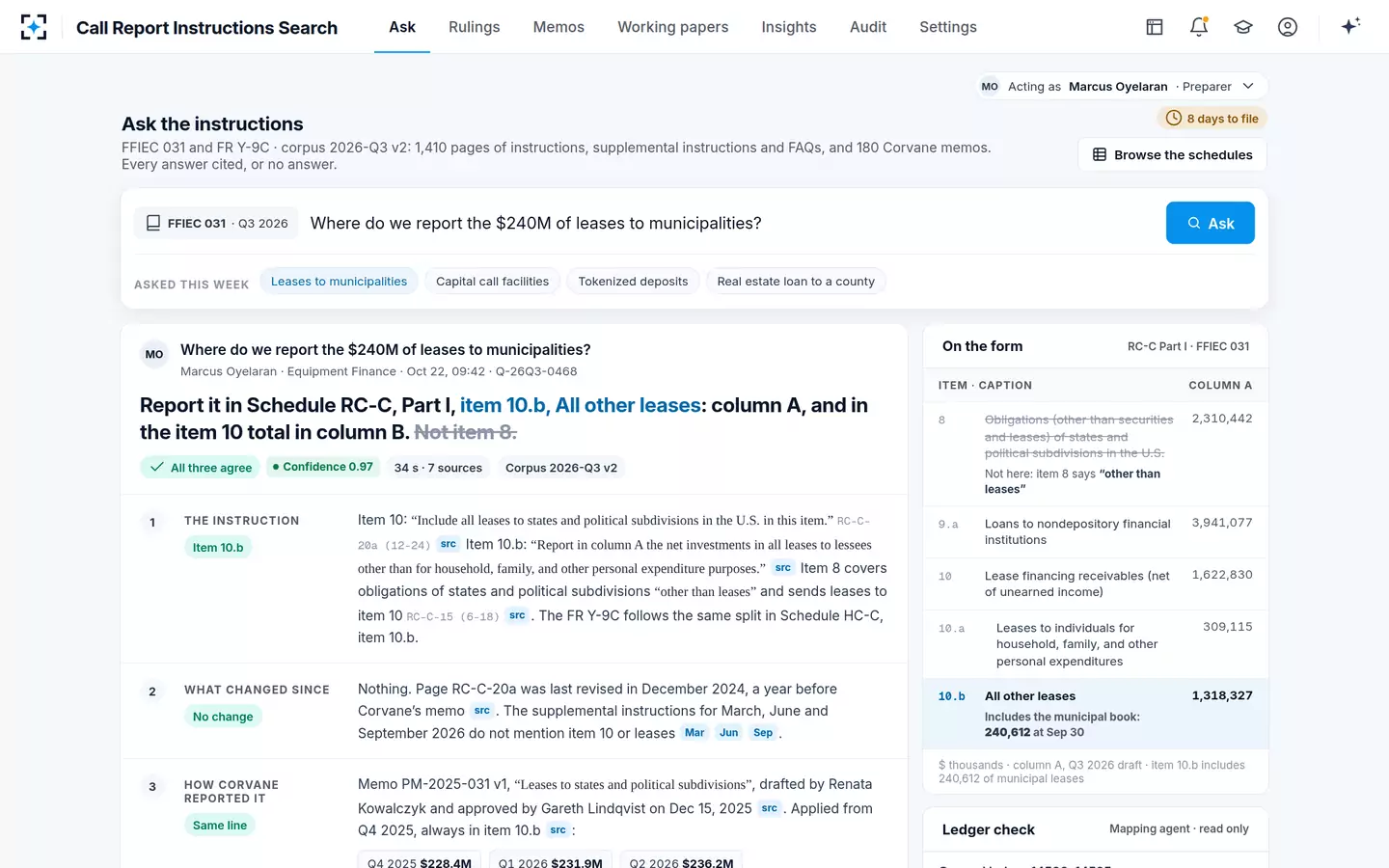
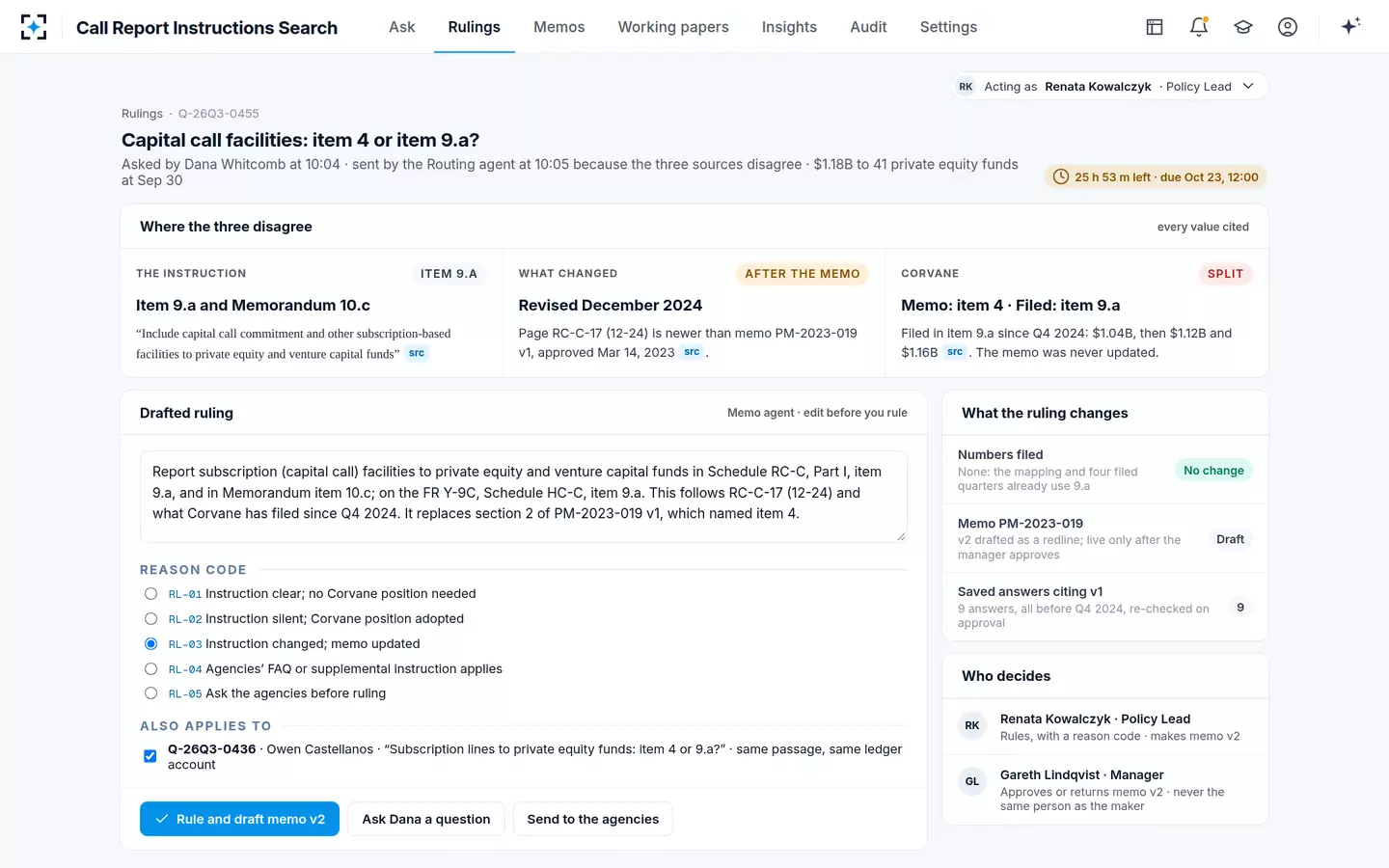
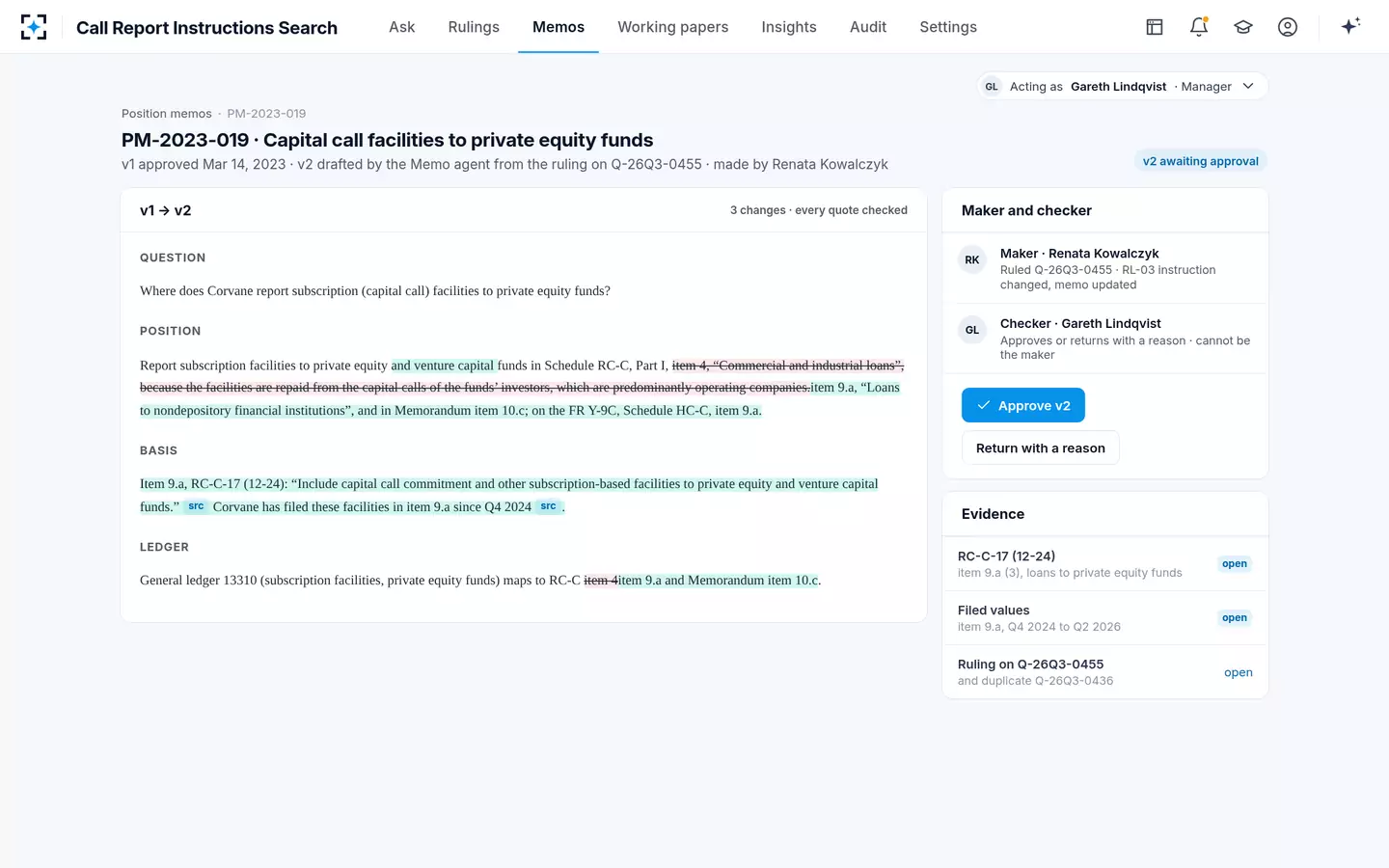
Where the books part ways, the answer has to say so rather than mirror one into the other. On the sample data, questions about Schedule HC-C item 9.a drew 12 questions in three weeks, three of which needed the Policy Lead, and 38 answers were saved to the FR Y-9C working papers. When the Policy Lead rules on a Call Report line, the drafted ruling and the memo redline carry the FR Y-9C line with it, so the holding company's preparers get the same position, in their own book's numbering.
One ruling, both reports: RC-C item 9.a and HC-C item 9.a
The memo redline carries the holding company line
Before applying a Call Report answer to the FR Y-9C
- Find the HC line in the FR Y-9C book itself
Do not assume the same item number; HC-C item 8 is "Not applicable".
- Check the size thresholds for the holding company
HC-C items 10(a) and 10(b) apply from $5 billion; NDFI memoranda must sum to 9(a) from $10 billion.
- Check the page date in the FR Y-9C footer
Month and year, such as "March 2026", against the quarter's listing of revisions.
- Read the FR Y-9C supplemental instructions too
Topics and wording differ from the Call Report edition in the same quarter.
- Send interpretation questions to the Reserve Bank
The district Reserve Bank where the holding company submits, not the bank's Call Report analyst.
- Name both lines in the memo
One position, two reports, each in its own numbering.
Questions people ask
Is the FR Y-9C the same as the Call Report?
No. The Call Report is filed by each insured bank; the FR Y-9C by holding companies with $3 billion or more, on a consolidated basis that includes nonbank subsidiaries. The FR Y-9C was revised in 1985 to parallel the Call Report, so many lines match, but some, such as loans to states and political subdivisions, are reported differently.
Where are the FR Y-9C instructions for 2026?
On the Federal Reserve Board's FR Y-9C reporting forms page, as one PDF of 613 pages for September 2026, with the September 2026 Supplemental Instructions and earlier quarters' editions back to 2003.
Does the FR Y-9C have a glossary?
Yes. The FR Y-9C General Instructions point holding companies to the Glossary entries for technical detail on applying accounting standards, and say the Glossary's accounting entries are an aid in specific reporting situations rather than a comprehensive statement on accounting for holding companies.
What is the FR Y-9LP?
The parent company only financial statements for large holding companies. The FR Y-9C General Instructions require each holding company that files the FR Y-9C to submit the FR Y-9LP for its parent company, quarterly.
Why is the FR Y-9C due later than the Call Report?
The instructions set different deadlines: 40 days after the quarter, 45 for December, for the FR Y-9C, against 30 for the Call Report. If a bank later amends its Call Report for a placement error, the holding company should check whether its own report carries the same error.