A regulatory reporting system is the software a bank uses to turn its general ledger and source data into regulatory returns: it maps accounts to report lines, applies the calculations, runs the agencies' validity and quality edits and produces the file the FFIEC's Central Data Repository will accept for the Call Report. Most banks prepare and file the Call Report with such software, the FDIC tells new filers (FDIC, New Call Report Filers). What such a system holds is the result of many judgments, the mapping, and what it rarely holds is the reasoning: which instruction sentence put an account on a line, from which page and revision date, and which approved memo applied it. That gap is where instruction questions pile up in the filing window. Botminds' Call Report Instructions Search is built to sit beside the reporting system, not replace it: it reads the line mapping and filed values without changing them, answers placement questions from the instructions with citations, and leaves the mapping, the edits and the filing exactly where they are.
Who reads, who writes and who files: a regulatory reporting system with an answer layer beside it
Sources
General ledger and subledgers
Instruction books by quarter: FFIEC 031 and 041, FR Y-9C, supplemental instructions
Position memo library
Regulatory reporting system
Owns the account-to-line mapping, calculations, edits and the CDR file
Changes only through the bank's maker and checker
Files after the CFO declaration and directors' attestation
Call Report Instructions Search
Reads mapping, filed values and balances, read only
Answers why a balance belongs on a line, cited in three layers
Writes answers to the working papers; memo versions only after approval
Never changes a mapping or a filed value, or files anything
What is a regulatory reporting system?
In a bank, it is the layer between the books and the regulators: source data in, validated returns out. For the Call Report, the General Instructions set its minimum job. Banks, or the parties they arrange to submit for them, must use software whose files meet the CDR's technical specifications and can be processed by it, vendors whose software has been tested are listed in each quarter's Financial Institution Letter, and a bank may instead build its own software and test it directly with the CDR (General Instructions, page 10). The report it produces must pass the FFIEC's validity and quality edits, which the agencies publish before each quarter end, or carry explanations for the quality edits it does not pass.
Some banks run the Call Report, the FR Y-9C and other returns from one platform with shared mappings; others use a Call Report package fed by spreadsheets. Either way, the agencies acknowledged in December 2025 that, for many banks, data does not flow untouched from the core system through the Call Report software into each item (Request for Information: Streamlining the Call Report). The manual part is judgment: where a new product goes, whether a borrower is a nondepository financial institution, whether a lease to a county is a loan to a municipality. How the mapping itself is built and tested, with the agencies' passage quoted, is covered in Call Report Preparation's guide to Call Report mapping.
Does a regulatory reporting system include the Call Report instructions?
It includes their results, not their text in any usable form. Edits, line definitions and calculations encode the instructions; some packages link schedule help or the PDF. What the system does not do is answer a preparer's question in plain words, show the sentence that decides it, say whether the page changed since the bank last decided, or find the bank's own memo. Those live in PDFs, a memo folder and the policy lead's email, which is why the agencies asked in the same request how the forms and instructions could be laid out, organised and published so they are easier to use (call report instructions 051 quotes the question).
A further change is coming slowly. A joint rule under the Financial Data Transparency Act took effect on October 1, 2026, setting data standards meant to "Render data fully searchable and machine-readable"; by its own terms it changes no reporting requirement until the agencies act further (Financial Data Transparency Act Joint Data Standards, June 25, 2026). It concerns the data banks file, not the instruction books they read.
Who owns what around one Call Report line
| Piece of the work | Regulatory reporting system | Call Report Instructions Search | A person |
|---|---|---|---|
| Account-to-line mapping | Holds and applies it | Reads it; proposes a change with the sentence behind it | Makes the change; a second person approves |
| Filed values by quarter | Holds them | Reads them as precedent | Signs the report |
| Validity and quality edits | Runs them before submission | Not its job | Resolves or explains each one |
| Instruction text, by quarter and page date | Rarely | Searches and quotes it, with the revision date | Approves each quarter's corpus version |
| Position memos | No | Finds approved versions; drafts redlines | Policy Lead rules; manager approves |
| Why a balance is on a line | No | Answers in three cited layers, saved to the working papers | Reviews and relies on it |
| Submission to the CDR | Produces the file | Never | Files after the CFO and directors sign |
How does an instructions search tool connect to Call Report software?
Read-only, through the data the reporting system already exposes. Call Report Instructions Search is described with six connections: the instruction books by quarter, read nightly; the bank's position memo library, synced nightly, with a new memo version written back only after approval; the regulatory reporting system, for line mapping and filed values, read only; the general ledger, for balances by account, read only; the document management system, where answers are saved to each schedule's working papers; and email and chat, for rulings and escalations. Nothing in that list writes to the reporting system.
That design choice is the point, not a limitation. The General Instructions keep responsibility for accurate reporting with the bank and say it cannot pass to a software vendor or anyone else outside it (General Instructions, page 10), and the OCC tells examiners to check that automated systems keep up with new general ledger accounts, software releases and changes in accounting and reporting rules (Comptroller's Handbook, Regulatory Reporting; quoted in call report mapping). A second tool that could rewrite mappings would be a second place to test for those controls. One that only reads leaves the incumbent system, its change control and its CDR testing exactly as they were.
Can instruction answers link to Call Report lines?
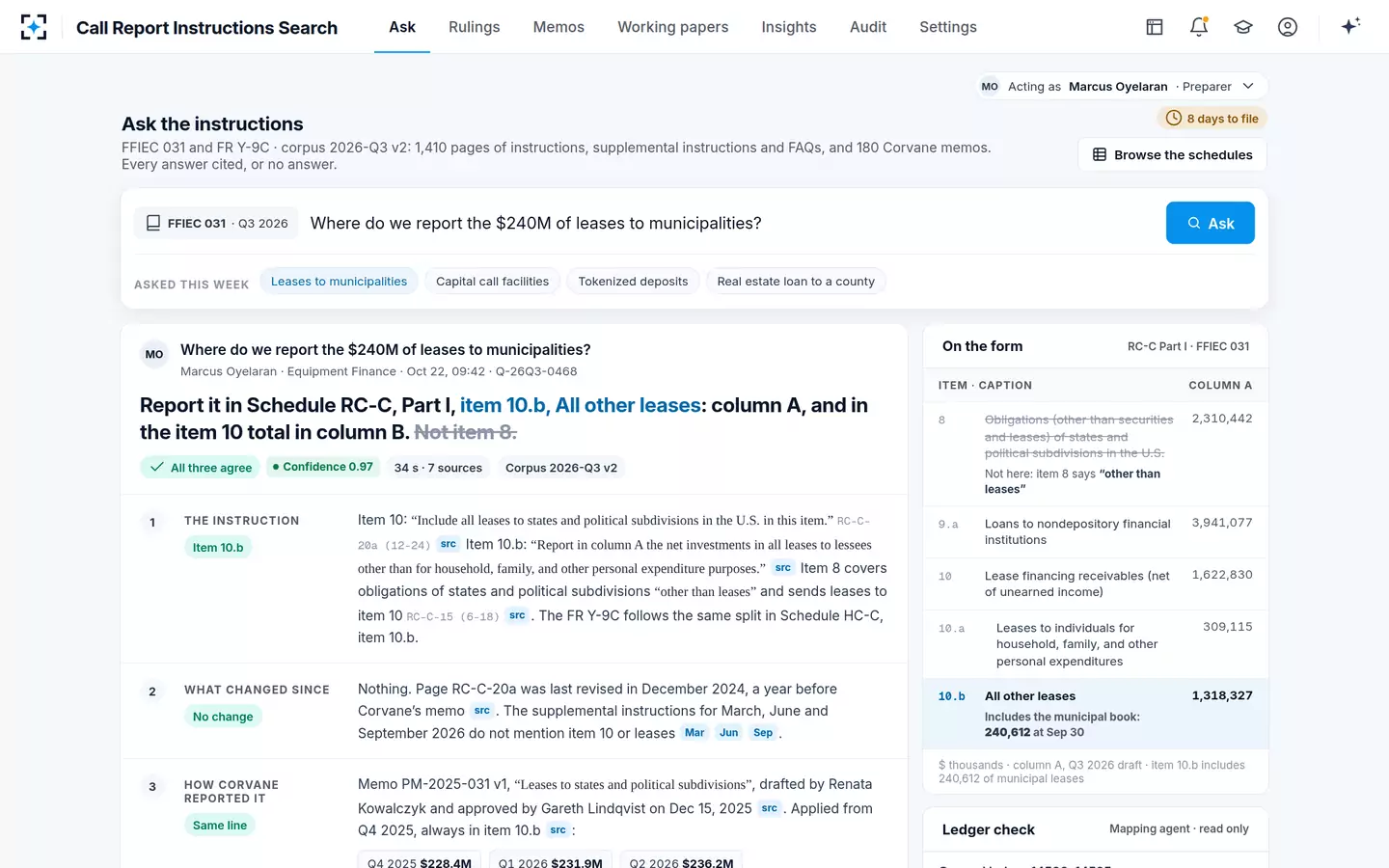
They should, and to the general ledger accounts behind the line, because that is what turns an answer into evidence. Take a sample bank's question in Call Report Instructions Search, on sample data about a fictional $92 billion bank: where do $240.6 million of leases to counties, school districts and water authorities go? The answer names Schedule RC-C, Part I, item 10.b, All other leases, shows item 8 struck through with the sentence that rules it out ("other than leases"), and cites RC-C-20a (12-24), the page that puts all leases to U.S. states and political subdivisions in item 10 (the same answer is followed step by step in generative AI in financial reporting). Its general ledger check shows general ledger accounts 14520 and 14525 mapped to RC-C 10.b and to HC-C 10.b on the FR Y-9C, up $4.4 million on the second quarter.
One answer, tied to the form and to the general ledger accounts behind it
Who maintains the mapping when a policy answer changes?
The same people who maintain it today, through the same maker-and-checker control; the answer layer only proposes. The OCC counts separation of duties and dual control among the fundamental internal controls for regulatory reporting (Comptroller's Handbook), and a mapping change is exactly where those controls bite: it moves amounts between lines for every future quarter.
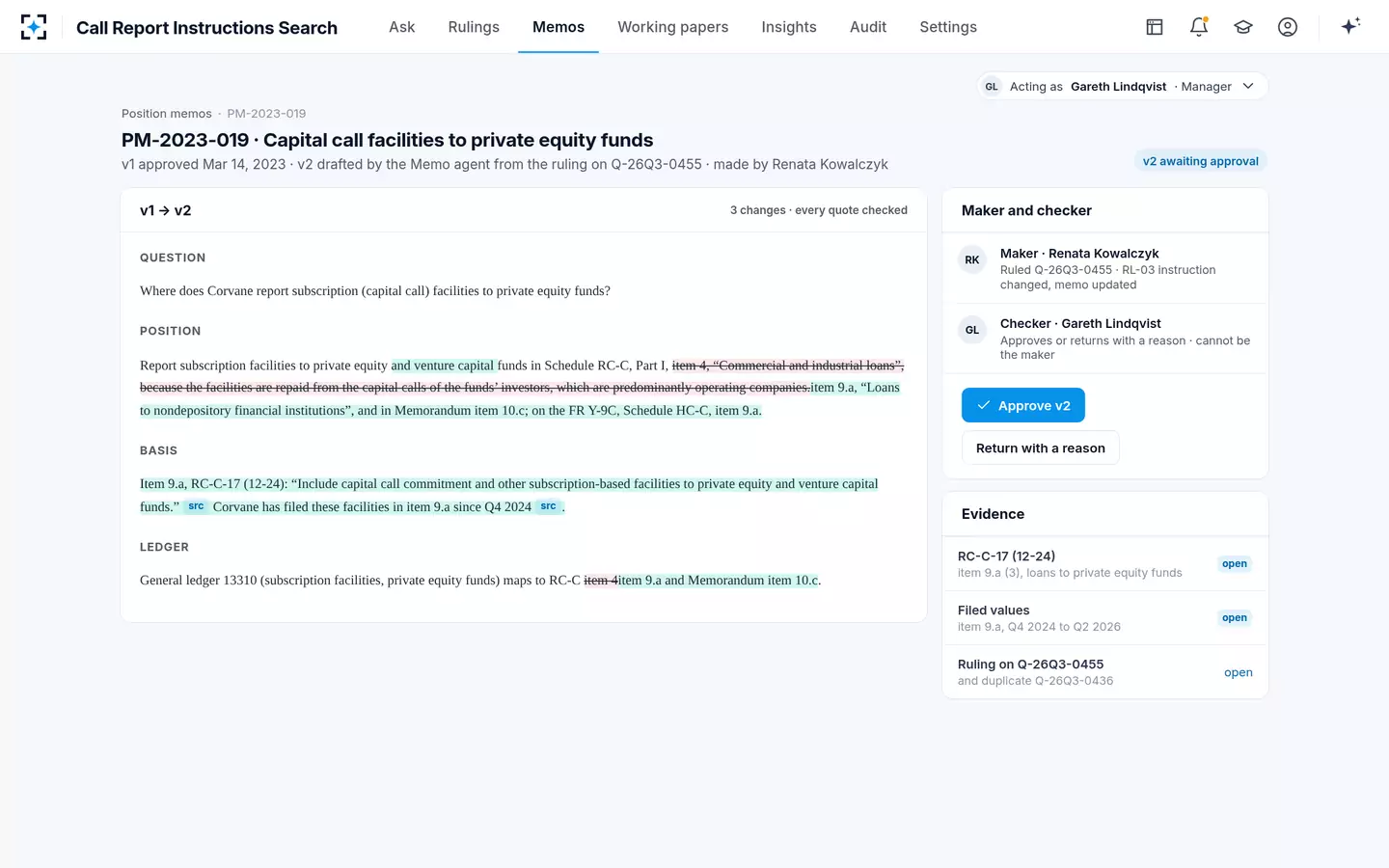
In Call Report Instructions Search the Mapping agent compares an account's mapping with the instruction and the bank's precedent, and when they disagree it proposes a change for maker and checker; it never makes one. On the sample data, the Policy Lead's ruling that capital call facilities belong in RC-C item 9.a changes no filed number, because the reporting system already maps general ledger 13310 to item 9.a and has done since the fourth quarter of 2024. The memo was the stale part, and the ruling becomes a redline of the memo, approved by the Regulatory Reporting Manager, not by its maker.
A memo redline with maker and checker, and the general ledger mapping it records
Can an answer tool change call report mapping?
It should not be able to, and a buyer should test that it cannot. The risk is not that a tool proposes a wrong placement, which a reviewer can catch, but that a placement changes without a person deciding it and without the change showing in the reporting system's own change log. A tool that answers questions and also edits mappings becomes a second, less controlled path into the figures the CFO declares correct. The defensible pattern is the one examiners already know: the answer layer cites, compares and proposes; the reporting system's mapping owner makes the change; a second person approves; and the answer, the ruling and the approval are kept together.
Two ways to add instruction answers to a regulatory reporting system
Answers written into the reporting system: Tool can update account-to-line mapping from its answers.
Answers beside it, read-only: Tool reads mapping; proposes changes for maker and checker.
Answers written into the reporting system: Two paths into the mapping, each needing its own testing.
Answers beside it, read-only: One path, the reporting system's existing control.
Answers written into the reporting system: May need re-testing if the file-producing system changes.
Answers beside it, read-only: Unchanged; the tool produces no files.
Answers written into the reporting system: Answer and mapping change may sit in different systems.
Answers beside it, read-only: Answer, ruling, memo version and approval kept together.
Answers written into the reporting system: Removing the tool means unpicking its changes.
Answers beside it, read-only: Removing the tool leaves the reporting system as it was.
What should a bank ask before adding a tool to its regulatory reporting system?
Ask what it reads, what it writes, what it refuses to do, and how its answers are kept. Most of the risk in adding anything to a regulatory reporting system is in the writes and in the evidence, not in the user interface. The questions below are the ones we would want answered in writing, by any vendor, ours included.
Questions for any tool that answers Call Report instruction questions
- What does it write, and where?
It should write nowhere in the reporting system. Ask for the list of every connection and its direction.
- Which instruction version does each answer cite?
Page number, revision date and the corpus version for the report date, not "the instructions".
- What happens when no passage decides the question?
The right answer is a routed question, not a best guess. Ask to see one.
- How are the bank's own memos used?
Only approved versions should count as precedent, never drafts or superseded versions.
- Who approves a new quarter's instructions before answers use them?
A named person, after known questions are re-run.
- Can the maker of a ruling or mapping proposal approve it?
It should be impossible, not just discouraged.
- How long are answers kept, and can they be exported for examiners?
At least as long as the bank keeps its Call Report workpapers, which the instructions set at three years.
- What happens to customer names typed into a question?
They should be masked in queues, insights and exports.
Where answers go: the working papers, not an inbox
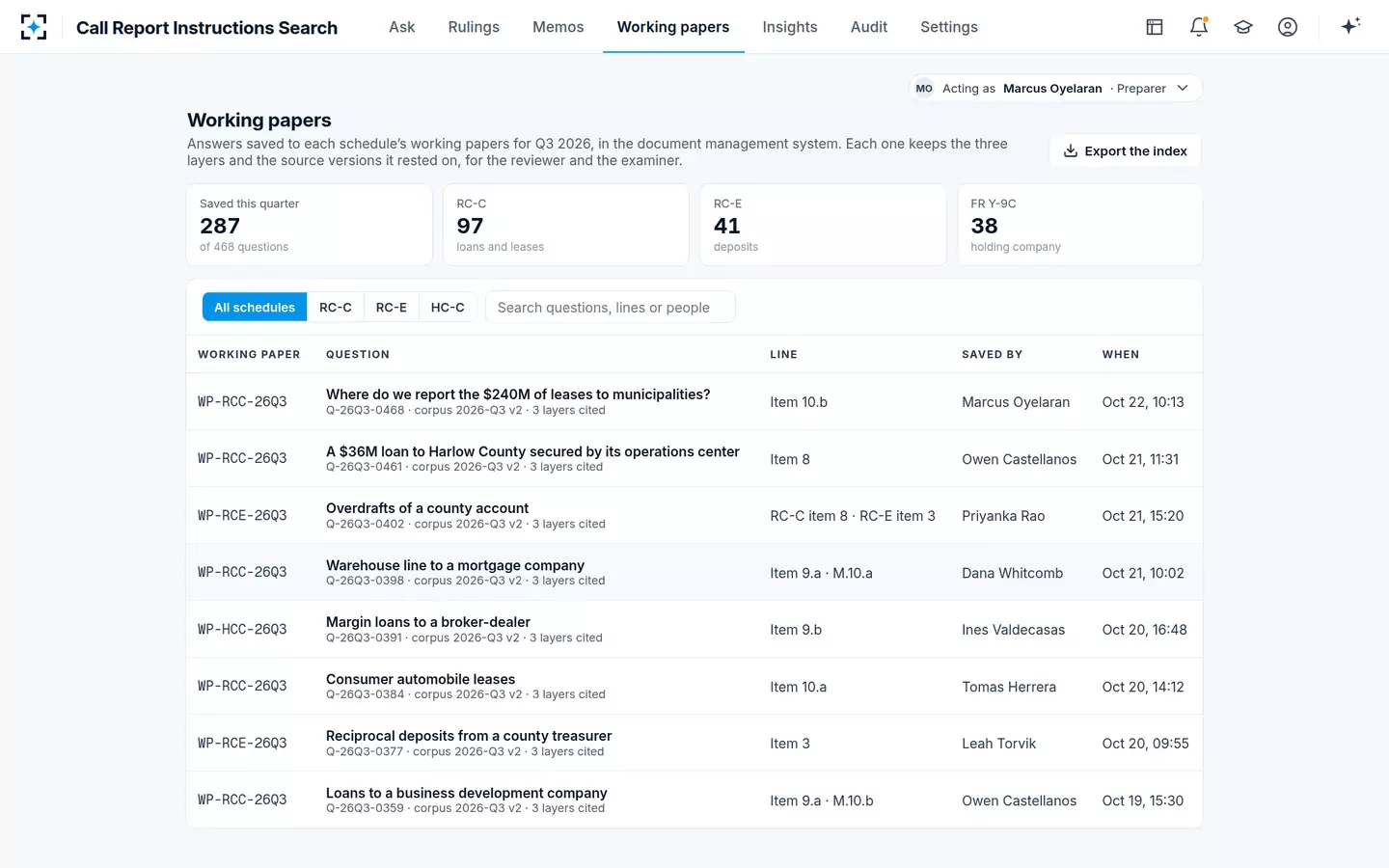
An answer that a reviewer can find next quarter is worth more than one that was merely right. The General Instructions ask banks to keep the signed report with its workpapers and support for three years from the report date (General Instructions; quoted in the call report checklist); the OCC expects a bank's reporting policies to set standards for documentation and for keeping work papers. In Call Report Instructions Search a preparer saves an answer to the schedule's working papers in the document management system, with the three layers and the source versions it rested on. On the sample data, 287 of 468 questions in the first three weeks of the quarter were saved that way, 97 of them to the RC-C working papers.
Answers as working papers, on the solution's sample data
287
answers saved to schedule working papers in three weeks, of 468 questions asked
97
saved to the RC-C working papers, loans and leases
38
saved for the FR Y-9C, the holding company report
7yrs
retention set for every question, answer and ruling; the bank's policy, at least 5
Answers saved to each schedule's working papers, with the corpus they rested on
Where an instructions layer fits, and where it does not
It fits a bank whose reporting system works but whose questions do not: many preparers in the business lines, one or two people who know the instructions, and memos nobody re-reads when a page changes. It does not replace the reporting system, the edit engine or the reconciliations, and it should not be bought as if it did. A bank choosing or replacing Call Report software itself should start from Call Report Preparation's guide to Call Report software vendors; a bank whose problem is explaining edits after the numbers are in needs a review tool, not an answer layer, and call report edit checks covers that work.
The honest test is to run last quarter's questions through it. Take the questions the policy lead actually answered by email, with the answers she gave, and see how many come back with the same line and a citation, how many are routed and why, and whether any answer would have changed a filed number. Which questions an agent should route rather than answer explains what a good result looks like.
Questions people ask
What are regulatory reporting tools in banking?
The software banks use to produce returns such as the Call Report and FR Y-9C: data integration, account-to-line mapping, calculations, validity and quality edits, and the file the agencies accept. Around them sit reconciliation, review and, increasingly, tools that answer instruction questions.
Does Call Report software keep up with instruction changes?
Software can carry each quarter's forms and edits, but the bank remains responsible for reporting fully and accurately, and the General Instructions say that responsibility cannot be delegated to software vendors. Changed instruction text still has to be read and applied to the bank's own products.
Can an instructions search tool file the Call Report?
It should not. Call Report Instructions Search produces no files and sends nothing to the agencies; the reporting system produces the CDR file, and the bank files it after the CFO declaration and the directors' attestation.
Does an answer layer need access to the general ledger?
Read-only access to balances by account and to the line mapping is what lets an answer show which accounts sit on the line and how the balance moved since last quarter. It does not need, and should not have, write access to either.
How long does it take to connect an answer layer to a reporting system?
The connections are reads of data the reporting system and general ledger already hold, plus the memo library and the document management system. The longer step is loading and approving the bank's own memos and a quarter's instructions, then testing answers on the bank's past questions.