The Call Report supplemental instructions are a short document the FFIEC agencies issue for every report date, attached to the quarter's Financial Institution Letter, that tells preparers what is new, what to do about rules that changed after the instruction books were printed, and how to report recent accounting standards. The September 30, 2026 edition, headed "THIRD 2026 CALL, NUMBER 317," opens: "There are no new Call Report data items in the FFIEC 031, FFIEC 041, and the FFIEC 051 Call Report forms this quarter" (Supplemental Instructions, September 30, 2026). No new items is not the same as no change. The quarter changed how reciprocal and custodial deposits are reported after a statute took effect mid-quarter, put the 8 percent community bank leverage ratio into Schedule RC-R, and gave every bank the option to file on the next business day when the due date falls on a weekend or holiday. For a reporting team, the work is matching each change to the memos and answers it touches, inside a 30-day window; Botminds' Call Report Instructions Search reads each quarter's supplemental instructions and flags every position memo and saved answer that relies on what changed.
What the September 2026 supplemental instructions changed, topic by topic
| Topic | What the supplemental instructions say | Where it lands |
|---|---|---|
| Reciprocal deposits | Housing Act section 902 changes the general cap and the definition of agent institution; the FDIC's interim final rule took effect September 1, 2026 | RC-E, Memorandum items 1.b to 1.d; RC-O, items 9 and 9.a, now confidential |
| Custodial deposits | Section 901 excludes a capped amount for eligible institutions under $10 billion; best-efforts estimate, or keep the old method, for September 30 | RC-E, Memorandum items 1.b to 1.d; RC-O |
| Community bank leverage ratio | RC-R, Part I updated for the 8 percent requirement and a four-quarter grace period; the topic leaves the supplemental instructions | RC-R, Part I, all three forms |
| Weekend and holiday due dates | Option to file on the next business day; December 31, 2026 report may be filed Monday, February 1, 2027 | General Instructions, all three forms |
| FDIC special assessment | Account for it under ASC 450-20; adjust the accrual for payments in the collection period that ended March 30, 2026 | RC-G item 1.b; RI item 7.d; RI-E item 2.g |
| New accounting standards | ASU 2025-06, 2025-08, 2025-09 and 2025-10, with effective dates and early-adoption reporting | RI-E item 6.a for early adopters of ASU 2025-08; RI items 5.l or 7.d for grants |
| AFS to HTM transfers | A transfer not documented with evidence of its date cannot be reported retroactively by amendment | Securities classification, and amended reports |
What are the call report supplemental instructions?
They are the agencies' quarterly bulletin to preparers: where the instruction books say how to report, the supplemental instructions say what is different this quarter and what is coming. Each edition carries standing sections, on submitting through the Central Data Repository and amending earlier reports, and topical ones, which come and go as rules and accounting standards change. They are published in a clean and a redline version with the quarter's letter (FIL-62-2026), and the agencies ask each bank to make sure whoever prepares its Call Report has been told they are available.
Topics leave when the books absorb them, which is itself a signal. In September 2026 the "Community Bank Leverage Ratio" topic was removed because Schedule RC-R had been updated, and a new topic, "Reporting Custodial and Reciprocal Deposits," was added in response to the 21st Century ROAD to Housing Act (Supplemental Instructions, September 2026). A memo that cited the old topic now has to cite the RC-R pages instead. Which instruction pages were replaced the same quarter is set out in a companion guide.
What does the vertical line in the supplemental instructions mean?
It marks where the text changed since the previous quarter. The supplemental instructions say: "The locations of substantive changes to the text of the previous quarter's Supplemental Instructions, if any, are identified by a vertical line in the right margin." The redline version shows the same changes as marked-up text (Supplemental Instructions, September 2026, redline). Reading only the marked passages is the fastest way through a familiar document, with one caution: a removed topic leaves no line to see, so compare the list of topics too.
How do reciprocal deposits change in 2026?
The cap on reciprocal deposits that can be excepted from brokered treatment is now calculated differently, and the brokered portion is no longer published bank by bank. Section 902 of the Housing Act, effective on enactment on July 11, 2026, "changes the method for calculating an institution's general cap with a graduated scale based on an agent institution's total liabilities and amends the definition of 'agent institution'" (Supplemental Instructions, September 2026). The FDIC adopted an interim final rule on August 27, effective September 1, 2026, to conform its regulations (91 FR 56022).
For the September 30, 2026 report, institutions complete Schedule RC-E, Memorandum items 1.b through 1.d, and Schedule RC-O, item 9 and, if applicable, item 9.a, under the updated instructions; and "brokered reciprocal deposits reported in Schedule RC-O, item 9 and, if applicable, item 9.a will be confidential and will no longer be made available to the public on an individual institution basis." The Glossary page carrying the Brokered Deposits entry, A-20a, was replaced the same quarter (Glossary, September 2026).
From statute to due date: one change inside one reporting quarter
- Law in force, no FDIC rule yetJul 11 to Aug 27
- FDIC rule adopted, then in forceAug 27 to Sep 30
- Report date to due dateSep 30 to Oct 30
Are custodial deposits still brokered deposits?
For eligible institutions, some of them no longer are, up to a cap, and for September 30, 2026 a bank could choose how to report them. Section 901 of the Housing Act provides that "custodial deposits of eligible insured depository institutions with less than $10 billion in total assets would not be considered brokered deposits up to a capped amount." Institutions that wished to report under the new law could "reasonably estimate and report as brokered deposits ... only those deposits that are still considered brokered deposits under the new law on a best-efforts basis"; alternatively, "institutions may continue to report custodial deposits as brokered deposits in Schedules RC-E and RC-O" under the instructions in effect before the law (Supplemental Instructions, September 2026).
The guidance is openly provisional. Once the FDIC adopts a final rule, "the FFIEC anticipates issuing additional instructions for reporting custodial deposits," and institutions may use those to amend their September 30 and later reports. For a policy team that means a dated position: which option the bank took, why, and a reminder to revisit it when the final rule and instructions arrive. An answer to a preparer's custodial-deposit question that quarter should name both options and the bank's choice.
What is the community bank leverage ratio in 2026?
Eight percent, from July 1, 2026, down from 9 percent. The agencies' final rule, published April 29, 2026, "lowers the community bank leverage ratio (CBLR) requirement from 9 percent to 8 percent" and extends the time a qualifying organization can stay in the framework while not meeting all its criteria "from two consecutive quarters to four consecutive quarters, subject to a limit of eight quarters in the previous five-year period" (91 FR 22973). The September 2026 instructions for Schedule RC-R, Part I, in all three forms, were updated to match (FIL-62-2026).
The September 2026 Call Report in four numbers
0
new data items on the FFIEC 031, 041 or 051
8%
community bank leverage ratio requirement from July 1, 2026, down from 9%
4
accounting standards updates described, effective from 2027 to 2030 depending on the standard and the entity
Feb 1
the latest filing date, in 2027, for the December 31, 2026 report, whose due date is a Saturday
What is the call report due date if it falls on a weekend?
From September 2026, the next business day. The General Instructions now say that when the due date falls on a weekend or holiday, the report must reach the CDR on the next business day, and that no other extension exists (General Instructions, page 10a (9-26); the full Due Date paragraph is quoted in call report due dates 2026). The letter frames it as an option given "in response to" comments on the agencies' 2025 request for information: the December 31, 2026 report is due Saturday, January 30, 2027, and any institution may file on Monday, February 1, 2027 (FIL-62-2026). The 30-day rule itself, and the 35 days allowed a bank with more than one foreign office, are unchanged.
When does ASU 2025-08 affect the call report?
For calendar-year banks, from the first quarter of 2027, unless they adopt early. ASU 2025-08 extends the gross-up approach for credit losses to purchased seasoned loans: "All non-PCD loans (excluding credit cards) that are acquired in a business combination are deemed seasoned," and other non-PCD loans are seasoned if purchased at least 90 days after origination by an acquirer not involved in originating them. It is "effective for all financial institutions for annual reporting periods beginning after December 15, 2026," applied prospectively; early adopters "should report initial ACLs recognized upon acquisition of PSL on Schedule RI-E, item 6.a" (Supplemental Instructions, September 2026).
Three other standards appear with it: ASU 2025-06 on internal-use software, effective for annual periods beginning after December 15, 2027; ASU 2025-09 on hedge accounting, effective for public business entities after December 15, 2026 and a year later for others; and ASU 2025-10 on government grants, effective for public business entities after December 15, 2028. The agencies say the instructions "will be revised to conform to these ASUs at a future date, as appropriate," so for now the supplemental instructions are the only Call Report text on them, which is exactly the kind of passage a memo should cite by quarter.
The FR Y-9C supplemental instructions for the same quarter differ
A holding company that files both reports reads two supplemental documents, and they are not copies. The Federal Reserve's September 2026 FR Y-9C supplemental instructions carry the same leverage-ratio note and the same four accounting standards, but no topic on reciprocal or custodial deposits, and a topic of their own on non-recurring expenses (FR Y-9C Supplemental Instructions, September 2026). How the FR Y-9C instruction book parallels the Call Report is a guide of its own.
Two supplemental instructions for September 2026, side by side
Call Report (FFIEC): RC-R, Part I updated for the 8 percent CBLR; topic removed
FR Y-9C (Federal Reserve): HC-R, Part I updated the same way; topic removed
Call Report (FFIEC): New topic, with RC-E and RC-O reporting and a best-efforts option
FR Y-9C (Federal Reserve): No topic
Call Report (FFIEC): ASU 2025-06, 2025-08, 2025-09, 2025-10; early adopters of 2025-08 use RI-E item 6.a
FR Y-9C (Federal Reserve): The same four; early adopters of 2025-08 use Notes to the Income Statement (Other), item 2
Call Report (FFIEC): Transfers recorded on the transfer date
FR Y-9C (Federal Reserve): Transfers reported at fair value on the transfer date
Call Report (FFIEC): FDIC special assessment; weekend due dates
FR Y-9C (Federal Reserve): Non-recurring expenses in Schedule HI
How Call Report Instructions Search reads each quarter's supplemental instructions
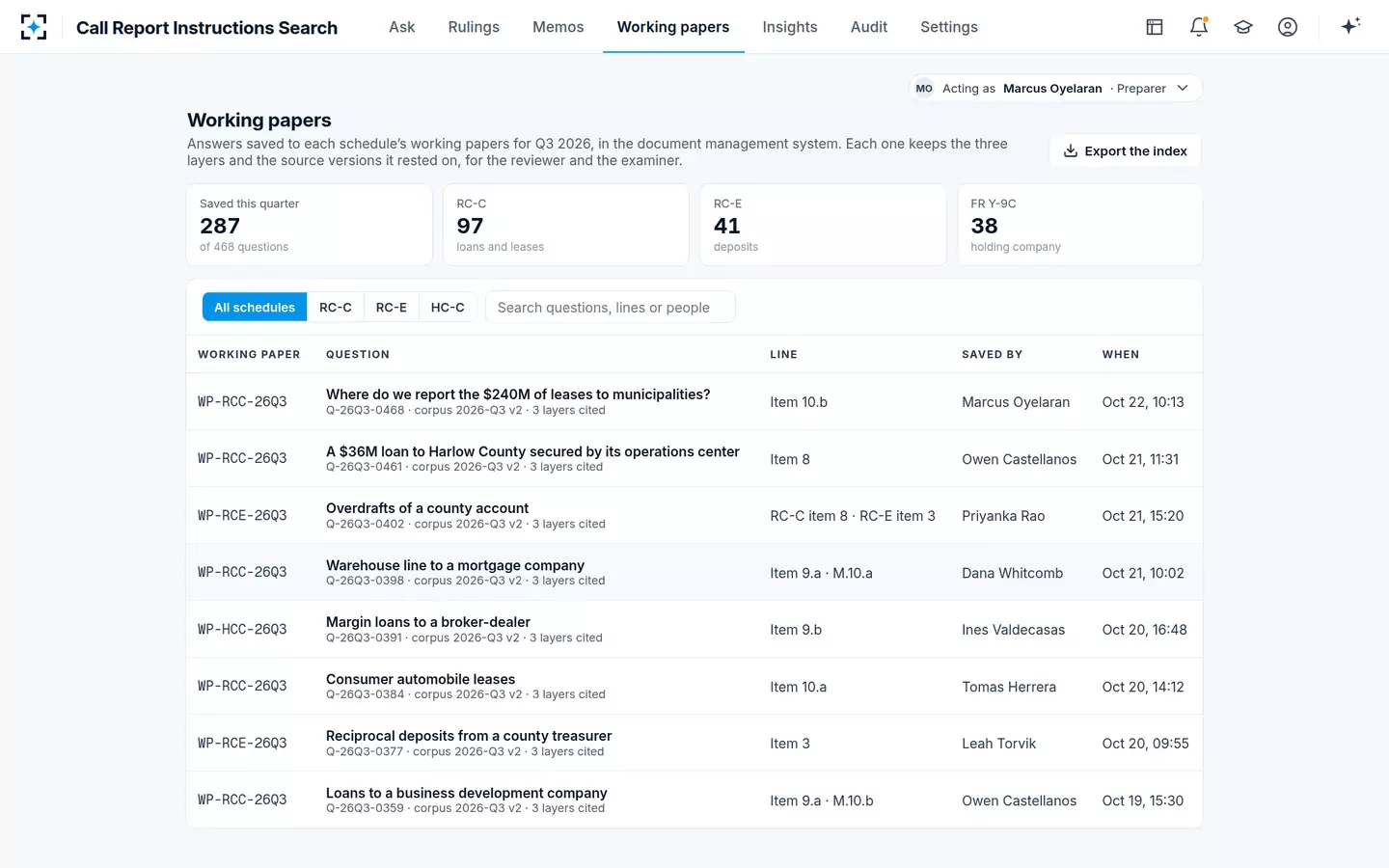
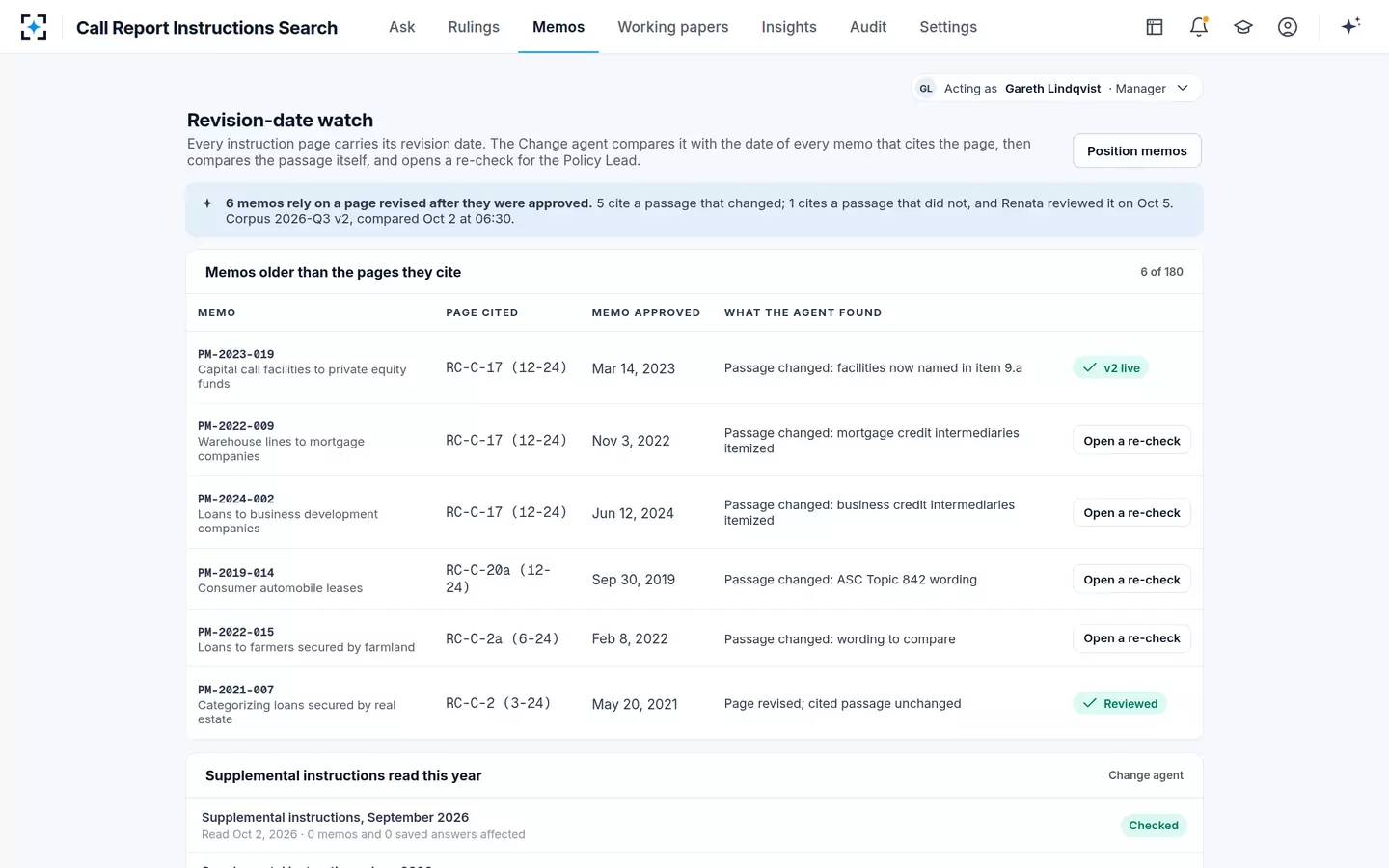
As part of the quarter's instructions, loaded as one corpus version that the Regulatory Reporting Manager approves after 120 golden questions are re-run. The Change agent reads every quarter's supplemental instructions, says whether anything in them touches a line a memo or saved answer relies on, and opens a re-check for the Policy Lead when it does; it never edits a memo. Every answer's second layer, "what changed since," names the supplemental instructions it checked. On sample data about a fictional bank, the September 2026 edition was read on October 2 and affected none of its 180 memos and none of its saved answers, while the answers its preparers saved that quarter included a question about reciprocal deposits from a county treasurer, saved to the RC-E working papers against item 3.
Answers saved to the working papers, including this quarter's deposit questions
Supplemental instructions read each quarter, against every memo
Reading a quarter's supplemental instructions in an hour
- Open the redline first
Read the marked passages and compare the list of topics with last quarter's; removed topics leave no mark.
- Map each topic to schedules and items
RC-E Memorandum 1.b to 1.d, RC-O item 9 and 9.a, RC-R Part I, and so on.
- Find the memos and answers on those items
Any that cite the old topic or the replaced pages need a ruling.
- Record the bank's choice where an option is offered
Best-efforts or old method for custodial deposits; early adoption of an ASU.
- Note what the agencies say is coming
Additional custodial deposit instructions; conforming revisions for the new ASUs.
- Check the holding company's supplemental too
The FR Y-9C edition can differ for the same quarter.
Questions people ask
Where do I find the call report supplemental instructions?
On the FDIC's current-quarter Call Report page and attached to the quarter's Financial Institution Letter, in clean and redline versions; earlier quarters' editions are on the FDIC's previous-quarters page. The September 30, 2026 edition is attached to FIL-62-2026, dated October 5, 2026.
Do the supplemental instructions apply to the FFIEC 051?
Yes. One document covers the FFIEC 031, 041 and 051; in September 2026 its deposit, leverage-ratio and due-date changes applied to all three forms.
Are brokered reciprocal deposits still public on the Call Report?
No longer bank by bank. From September 30, 2026, brokered reciprocal deposits reported in Schedule RC-O, item 9 and, if applicable, item 9.a are confidential and no longer made available to the public on an individual institution basis.
Can a bank amend its September 2026 report for custodial deposits later?
Yes. The supplemental instructions say institutions that wish to amend their reporting of custodial and brokered deposits for September 30, 2026 and later may use the additional instructions the FFIEC expects to issue after the FDIC's final rule.
How is the FDIC special assessment reported in 2026?
As an accrued liability in Schedule RC-G, item 1.b, and an expense in Schedule RI, item 7.d, with Schedule RI-E, item 2.g, under ASC 450-20, adjusted for payments in the collection period that ended March 30, 2026. As of June 30, 2026, collections exceeded the estimated loss.