Call report questions, the everyday kind such as "where do our leases to a county go?" or "is a capital call line a commercial loan?", are mostly answered by the instructions themselves: the FFIEC General Instructions, the schedule instructions, the Glossary and each quarter's supplemental instructions. The work is finding the deciding sentence, checking that its page has not been revised since the bank last decided, and matching it to what the bank filed before, inside a 30-day window with no extensions. Botminds' Call Report Instructions Search hands that work to agents that cite every layer, and holds back the rest. The questions an agent should route rather than answer are the ones where the three layers disagree, where the best passage scores below a set threshold, or where no passage decides the question at all. Those go to the bank's Policy Lead, packaged, because the instructions put responsibility for the figure on the bank and the interpretation of the instructions with the agencies, not with software.
How Call Report Instructions Search decides between an answer and a routed question
A person decides
Preparer asksA question in plain words, on the FFIEC 031, 041 or FR Y-9C, for a report date.
Agent
Answer agentFinds the passages that decide it in the quarter's instructions, Glossary and supplemental instructions.
Never: answers without a citation.
Agent
Change agentCompares each cited page's revision date with the bank's memo, and reads the quarter's supplemental instructions.
Never: edits a memo.
Agent
Precedent agentFinds the approved memo and the amounts filed on the line by quarter.
Never: cites a draft or superseded memo as precedent.
Agent
Citation checkMatches every quoted sentence to its source and removes any that do not match.
Never: lets an answer through with an uncited layer.
Agent
Routing agentIf the layers disagree, confidence is under 0.80 or nothing decides it, packages the question with a clock.
Never: rules on a question.
A person decides
Policy LeadRules with a reason code, or takes the question to the agency.
Where can I get answers to Call Report questions?
First from the instruction books, then from the bank's own approved positions, and only then from a person at the agency. The General Instructions require banks to "prepare and file the Call Report in accordance with these instructions" (General Instructions, page 8), so the deciding text is nearly always there: in the schedule instructions for the line, in a Glossary entry they point to, or in the current quarter's supplemental instructions, which carry topics the books have not caught up with. For September 30, 2026, that included how to report reciprocal and custodial deposits after a statute changed mid-quarter (Supplemental Instructions, September 2026).
A bank's approved position memos are the second source, and the one most often missing from the conversation. A memo sets out how the bank applied an instruction to its own products, and a preparer who finds it gets the bank's answer, not just the agencies' text. The agency analyst comes third, for what neither settles; who that analyst is, and what to ask them, is a guide of its own. The order matters because each step costs more time than the one before it, and the filing window does not move.
Who answers call report instruction questions inside a bank?
Often one person, by email, in the last week. In many reporting teams a senior analyst or policy lead becomes the de facto answer desk for every finance team that feeds a schedule: lending for RC-C, treasury for RC-B and RC-E, deposit operations for RC-O. Questions arrive as forwarded emails without the facts that decide them, answers go back the same way, and nothing ties an answer to the instruction page it rested on. The OCC expects policies that name who prepares the reports and a separate, independent party to review them (Comptroller's Handbook, Regulatory Reporting). The business lines' questions arrive before either of those seats is involved, and that is where the time goes.
One quarter of questions, on the solution's sample data
468
questions from finance teams in the first three weeks of the third quarter (611 the quarter before)
90%
answered with the instruction, the change check and the precedent all cited
47
routed to the Policy Lead because the sources disagreed, scored low or said nothing
38sec
median to a cited answer; the design target is under a minute
Can AI answer call report questions?
Yes, when it can show the sentence that decides the question in the instructions for that report date, and no when it cannot. The agencies themselves asked in December 2025 which new technologies they should weigh when they review how the Call Report forms and instructions are built and published (Request for Information: Streamlining the Call Report; AI in regulatory reporting quotes the question). What no technology changes is who answers for the figure: the General Instructions make each bank responsible for reporting "fully and accurately" and say that responsibility cannot be passed outside the bank (General Instructions, page 10).
That combination sets the design. An agent that answers from a model's memory produces a confident paragraph with no page behind it; an agent that answers only from passages it can quote, and checks the page's date and the bank's history, produces something a reviewer can verify in a minute. Why a general chatbot fails the first test is set out in the guide to generative AI in financial reporting. This page is about the second half: knowing when to stop.
Three conditions that turn an answer into a routed question
An agent should route, not answer, when the sources disagree, when its best evidence is weak, or when there is no evidence. Each condition has a different cause and a different remedy, and an answer screen should say which one applied. A routed question without a reason is just a delay.
When the agents answer a Call Report question, and when they route it
Answered, with citations: A passage in the current quarter's corpus decides the line, quoted exactly with its page and revision date.
Routed to the Policy Lead: No passage scores high enough to decide it, or two passages point to different lines.
Answered, with citations: The cited page was last revised before the bank's memo, and no supplemental instruction touches the item.
Routed to the Policy Lead: The page was revised after the memo was approved, so the memo may rest on old text.
Answered, with citations: An approved memo and the amounts filed by quarter agree with the instruction.
Routed to the Policy Lead: The memo says one line and the filings or the instruction say another.
Answered, with citations: At or above the bank's threshold, 0.80 in the sample configuration.
Routed to the Policy Lead: Below it: the question goes with the agents' draft, marked as a draft.
Answered, with citations: One verdict line, three cited layers and the near-miss line struck through.
Routed to the Policy Lead: A plain sentence saying why it was routed, who has it and when it is due.
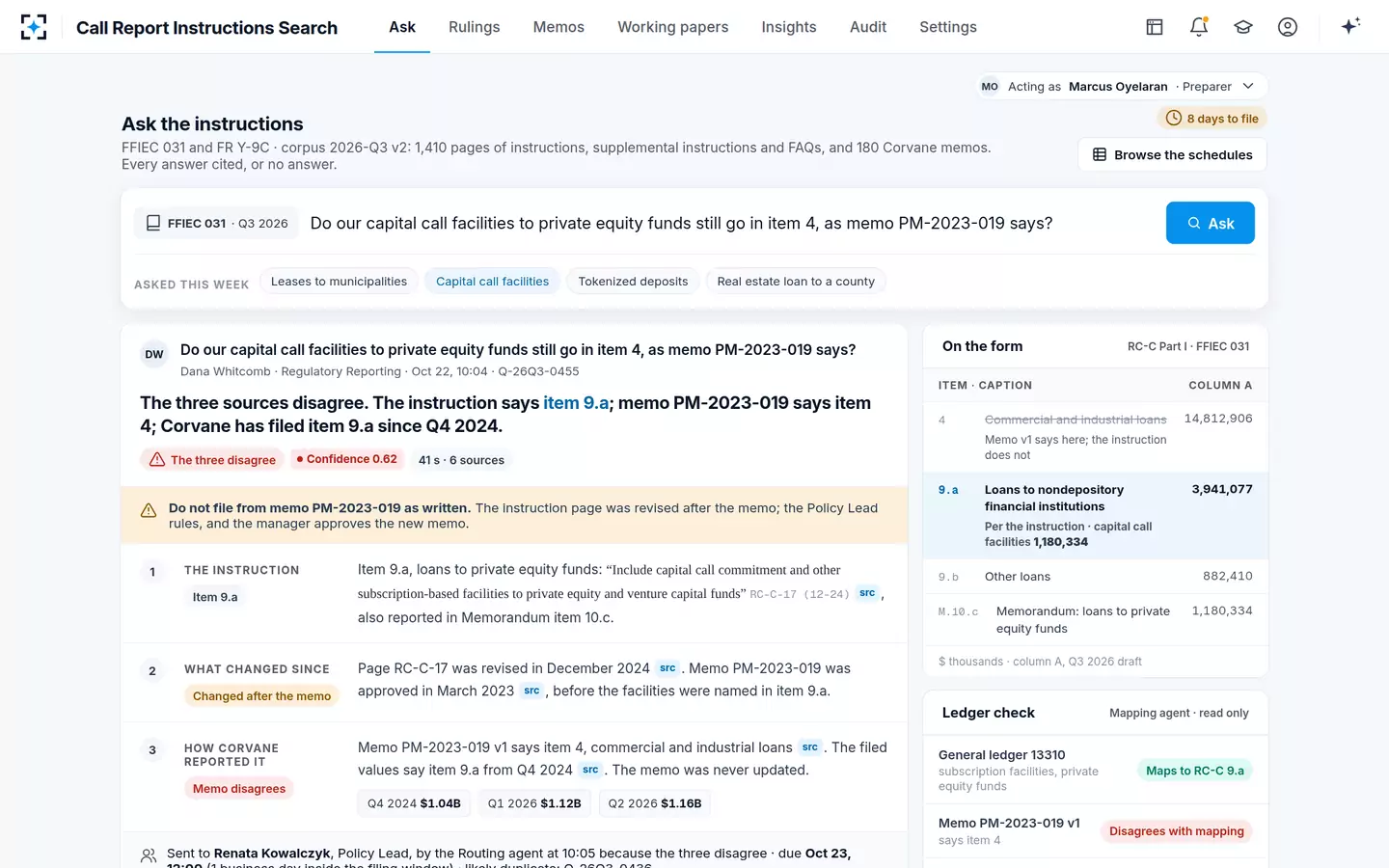
Disagreement is the most valuable of the three, because it is the one a person searching PDFs never sees. On the sample data a regulatory reporting analyst asks whether $1.18 billion of capital call facilities to private equity funds still belong in item 4, as a 2023 memo says. The item 9.a instructions, on pages revised December 2024, name capital call and other subscription facilities to private equity and venture capital funds (Schedule RC-C instructions; the stale-memo guide quotes the item); the bank has filed them in item 9.a since the fourth quarter of 2024; the memo was never changed. The answer screen replaces its verdict with one sentence saying so, at confidence 0.62, and the question goes to the Policy Lead.
When the memo and the instruction disagree, the answer says so
What happens when the Call Report instructions are unclear?
The bank still has to file, and it should say in writing what it decided and why. For events "not covered in principle by Call Report instructions or authoritative U.S. GAAP standards," the General Instructions encourage a bank to discuss the transaction with its primary federal supervisor, and they warn that the supervisor's view prevails if it differs, including by requiring amended reports (General Instructions). An unclear instruction is therefore a question to settle before the due date, not a judgment call to bury in a spreadsheet.
Sometimes the agencies say outright that their instructions are provisional. For custodial deposits on September 30, 2026, the supplemental instructions let eligible institutions estimate "on a best-efforts basis" which deposits remain brokered under the new law, or keep reporting them under the old instructions, and say the FFIEC "anticipates issuing additional instructions" once the FDIC adopts a final rule (Supplemental Instructions, September 2026). A good answer to a custodial-deposit question that quarter names both options and the bank's choice; a bad one picks an option silently.
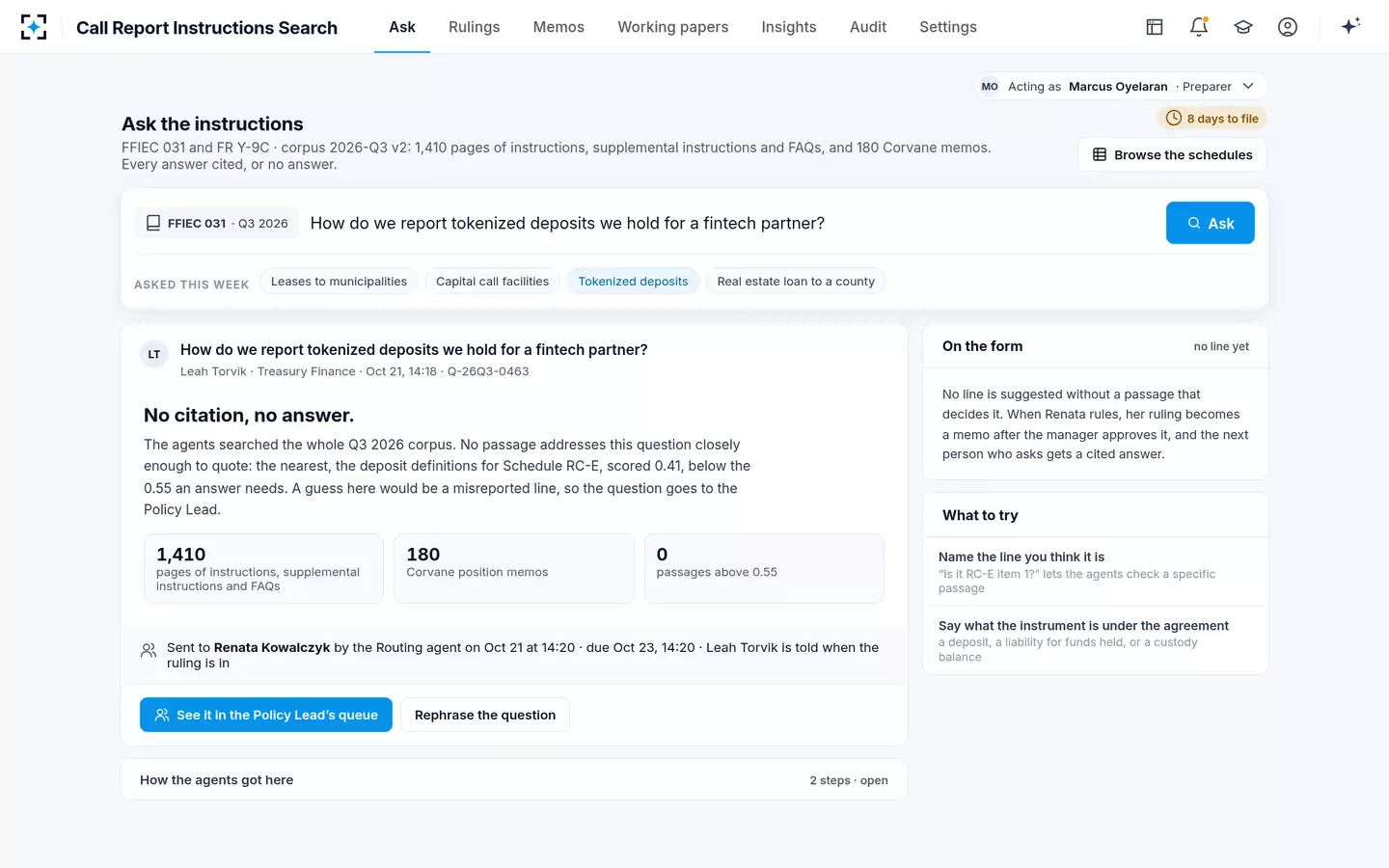
And sometimes nothing in the books addresses the question. On the solution's sample data, a treasury preparer asks how to report tokenized deposits held for a fintech partner. The nearest passage, the deposit definitions for Schedule RC-E, scores 0.41 against the 0.55 a passage needs to support an answer, so the screen says "No citation, no answer," shows what was searched and routes the question. No line is suggested, because a guessed line is a misreported line.
No citation, no answer: the question is routed instead of guessed
What are the most common call report questions?
The ones about lines where a product's form and the instruction's test diverge. On the solution's sample data, the question count by line for one quarter is led by Schedule RC-C item 9.a, loans to nondepository financial institutions, because the instructions sort nondepository lenders into five kinds, mostly by what they lend to or invest in, and a borrower's name rarely says which kind it is. Deposits of states and political subdivisions, loans to public bodies secured by real estate, and past-due status of restructured loans follow.
Which Call Report lines drew the most questions in one quarter
Two things in that list are worth noticing. The line with the most questions is not the line with the most routed questions as a share: past-due status of restructured loans sends more than a third of its questions to a person, where the answer turns on the bank's own modification records. And the leases question, asked six times, routed none: once the sentence is found (item 10's instruction that all leases to U.S. states and political subdivisions belong there), it is found for good. The real cost of a common question is that it is asked again by someone new each quarter.
What should a routed call report question carry?
Everything the person who rules needs, so the ruling takes minutes rather than a day. In Call Report Instructions Search the Routing agent builds the package, sets the clock and looks for duplicates; it does not rule. A preparer sending a question to a policy lead by email can apply the same discipline by hand.
What a routed Call Report question should carry
- The reason it was routed
The sources disagree, confidence below threshold, or no passage decides it. Each needs a different kind of ruling.
- The passages, quoted, with page and date
What the agents found, including the near miss, so the ruling starts from the text.
- The bank's approved memo, if any
And its approval date, against the page revision date.
- What was filed on the line, by quarter
So a change of placement and its size are visible before anyone rules.
- The general ledger accounts and their current mapping
Read only: a ruling may lead to a mapping change, which goes through maker and checker.
- A clock and a duplicate check
Two business days, one in the last six before the due date; questions that cite the same passage and account get the same ruling.
How do banks document call report interpretations?
The ones that hold up in an examination are written as positions with sources, approved by someone other than their author, and dated to the instruction page in force. The General Instructions let a supervisor require an amended report for a significant error in the line an item was reported on (General Instructions, page 10a; quoted in call report preparation software, tested), so a placement decision is exactly the kind of judgment an examiner may test. A misread instruction can also become an industry-wide correction, as with the FDIC's 2023 letter telling institutions that had misreported estimated uninsured deposits to amend their Call Reports (FIL-37-2023).
In Call Report Instructions Search, the Policy Lead rules with one of five reason codes, from "Instruction clear; no position needed" to "Ask the agencies before ruling." The Memo agent turns a ruling into a redline of the position memo, and the Regulatory Reporting Manager approves it; the maker cannot. Once approved, the ruling answers the next person who asks, with citations, instead of waiting in an inbox.
Setting the threshold: how strict should the agent be?
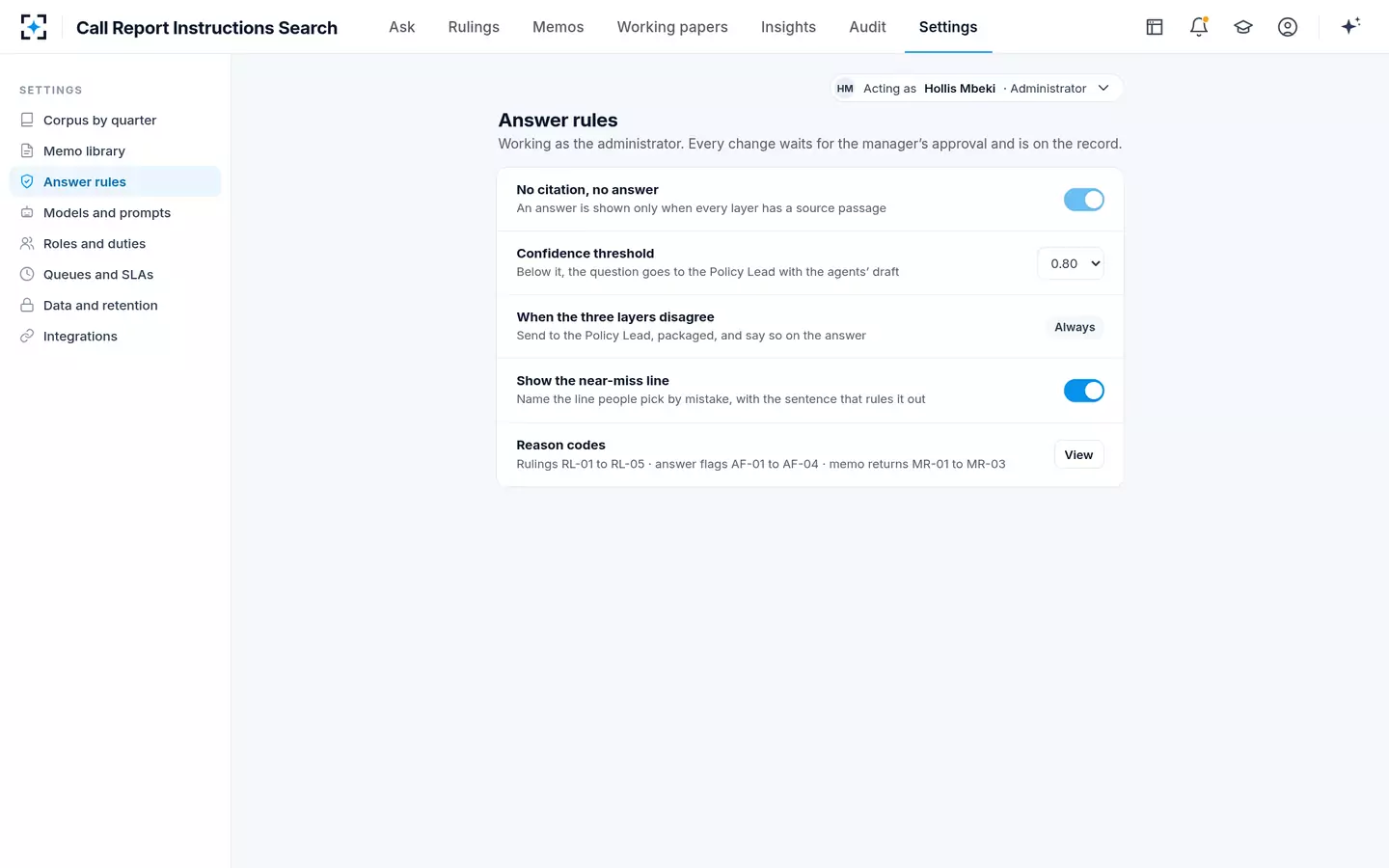
Strict enough that a routed question is worth a person's time and an answered one is worth trusting, and the bank, not the vendor, should choose. The sample configuration routes everything below 0.80 confidence, always routes disagreements, and keeps "no citation, no answer" locked on. Every change to those settings is proposed by an administrator and waits for the manager's approval, and every quarter's instructions load as a new corpus version only after 120 golden questions with known answers are re-run. A threshold set too low turns the agent into a confident guesser; set too high, it sends the Policy Lead questions the instructions answer in a sentence.
The answer rules are settings, and every change waits for the manager
Questions people ask
Who answers call report questions at the agencies?
For national and FDIC-supervised banks, an assigned analyst in the FDIC's Data Collection and Analysis Section; for state member banks, their Federal Reserve District Bank. Formal requests to interpret the instructions go to the primary federal supervisor, which refers them to the FFIEC's Task Force on Reports.
Should every unclear call report question go to the regulator?
No. Most are settled by the schedule instructions, the Glossary or the current supplemental instructions, and the bank's approved memos settle more. Questions the books leave open, or new rules described only in outline, are the ones to take to the analyst before the due date.
How long should a call report question take to answer?
A question an instruction answers should take minutes to answer and cite; the solution's design target is under a minute. A routed question in the sample configuration has two business days, or one in the last six business days before the due date, and the manager is told at 75% of the clock.
What if the bank's memo and the instructions disagree?
Do not file from the memo until someone rules. The instruction page's revision date shows whether it changed after the memo was approved; the ruling should update the memo, and every saved answer that cited the old memo should be checked again.
Can an agent decide a call report interpretation on its own?
It should not. The General Instructions keep responsibility for the figure with the bank and give the supervisor's interpretation the final word, so an agent can find, compare and draft, while a person rules and a second person approves the resulting memo.