Accounting research software is the class of tools a controller's or accounting policy team uses to search authoritative accounting literature, chiefly the FASB Accounting Standards Codification and SEC guidance, together with interpretive guides, and to draft and support technical accounting memos. For a bank's Call Report, that literature is necessary but not sufficient. The FFIEC instruction books add reporting rules of their own, the agencies change them most quarters, and each page carries its own revision date; the bank's answer to "where does this go?" lives in a position memo approved on some earlier date. The risk that research tools are not built to catch is the memo that went stale: approved against one version of an instruction page, still cited after the page was replaced, and nobody comparing the two dates. Botminds' Call Report Instructions Search is built around that comparison: its Change agent reads the revision date of every page each memo cites and opens a re-check when the page is newer than the memo. On sample data about a fictional bank, it found 6 of 180 memos relying on a page revised after they were approved.
How far each stale memo's approval trails the instruction page it cites
What is accounting research software?
Software for finding, reading and citing accounting authority: the codification, its basis-for-conclusions material, regulator releases and the interpretive literature built around them, usually with search, cross-references and tools for writing memos. Its users are technical accounting and policy teams answering questions such as how to account for a purchased loan under a new standard or whether a lease is a sales-type lease. It is valuable for the GAAP half of a Call Report question, and the September 2026 supplemental instructions show how much of that half there is: four new accounting standards updates, from internal-use software to government grants, described with their Call Report consequences (Supplemental Instructions, September 2026).
The other half is the instruction books, and there GAAP does not have the last word. The General Instructions say "The Call Report instructions contain certain specific reporting guidance that falls within the range of acceptable practice under U.S. GAAP," adopted "to achieve safety and soundness and other public policy objectives and to ensure comparability," and they list examples: the nonaccrual rules in the Glossary, the allowance for collateral-dependent loans, the separate-entity method for income taxes of bank subsidiaries, and property dividends. Where the agencies find a GAAP principle inconsistent with supervisory objectives, they "may prescribe an accounting principle for regulatory reporting purposes that is no less stringent than U.S. GAAP" (General Instructions). A memo built only from accounting research can be right on GAAP and wrong for the Call Report.
What is a regulatory reporting position memo?
It is the bank's written answer to a recurring reporting question, approved by someone with the authority to set the bank's position: how a product, a counterparty type or a transaction is reported, on which line of which report, and why. Unlike a GAAP memo, its subject is placement as much as measurement, and its authority is mostly the instruction books. Good ones are short, cite exact pages, and say which report dates they apply from.
What a Call Report position memo should contain
- The question, in the words people ask it
So the next preparer finds it by searching for the question, not the accounting term.
- The facts that decide it
Counterparty type, collateral, purpose, terms; the tests the instruction applies.
- The instruction passages, quoted, with page and revision date
For example RC-C-20a (12-24); the book named (031 and 041, 051, or FR Y-9C).
- The GAAP basis, where measurement is involved
With any Call Report-specific guidance that overrides a GAAP choice.
- The line on every report the bank files
RC-C item and the FR Y-9C HC-C line in its own numbering.
- The general ledger accounts and their mapping
So a change of position can be traced to the figures.
- Maker, approver, approval date and effective report date
Approved by someone other than its author.
- What would make it stale
The pages and topics to re-check when an instruction update or supplemental instruction touches them.
The memo that went stale, step by step
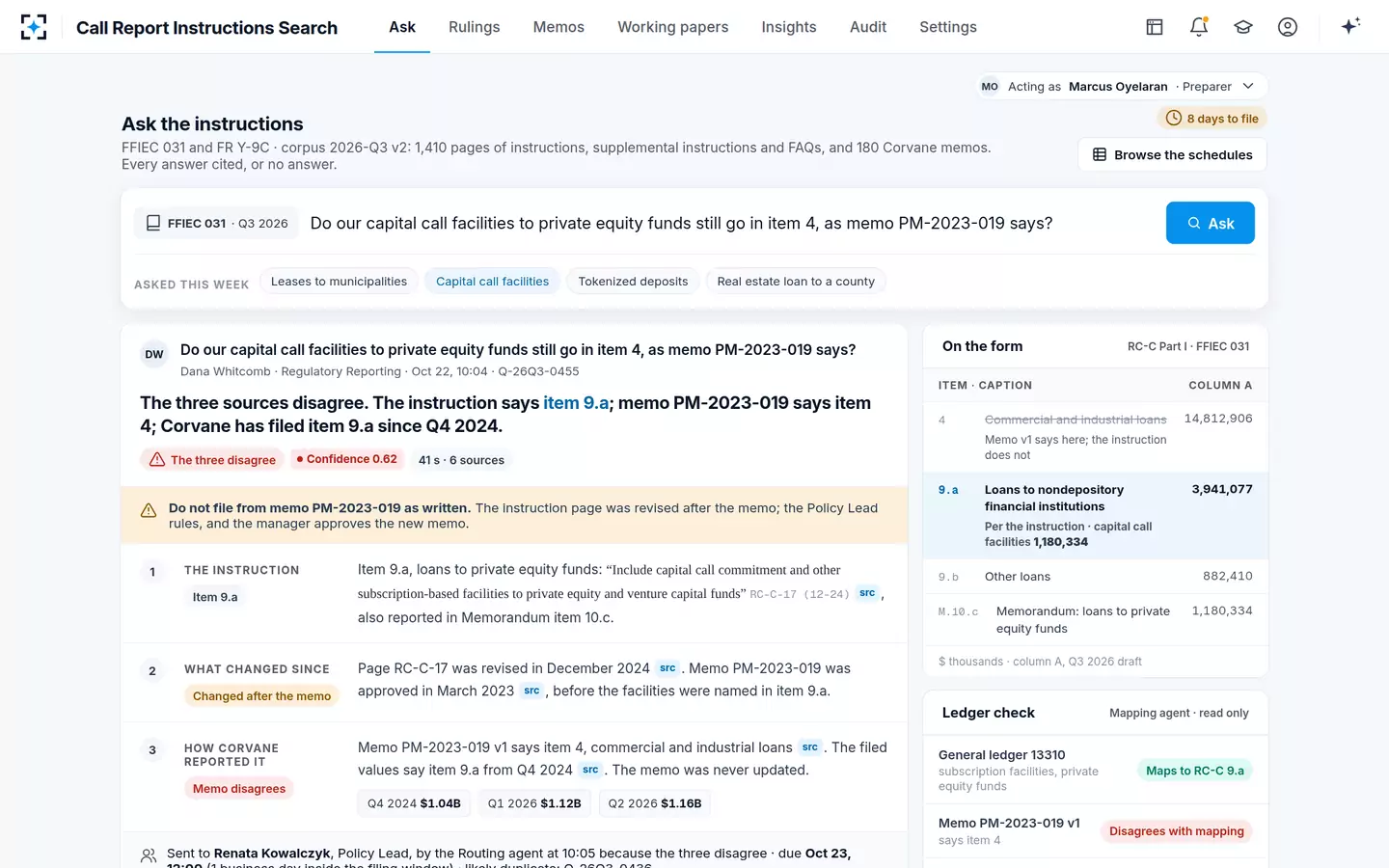
Take the sample bank's memo on capital call facilities to private equity funds, approved in March 2023, which places them in Schedule RC-C, item 4, Commercial and industrial loans. The pages of the item 9.a instructions now carry a December 2024 date and say to "Include capital call commitment and other subscription-based facilities to private equity and venture capital funds" in item 9.a, loans to nondepository financial institutions, and in Memorandum item 10.c (Schedule RC-C instructions). The bank's reporting system moved the balances to item 9.a from the fourth quarter of 2024. The memo was never changed.
Twenty-two months between the page revision and the ruling
- Memo current: item 421 months
- Page revised, filings in 9.a, memo unchanged22 months
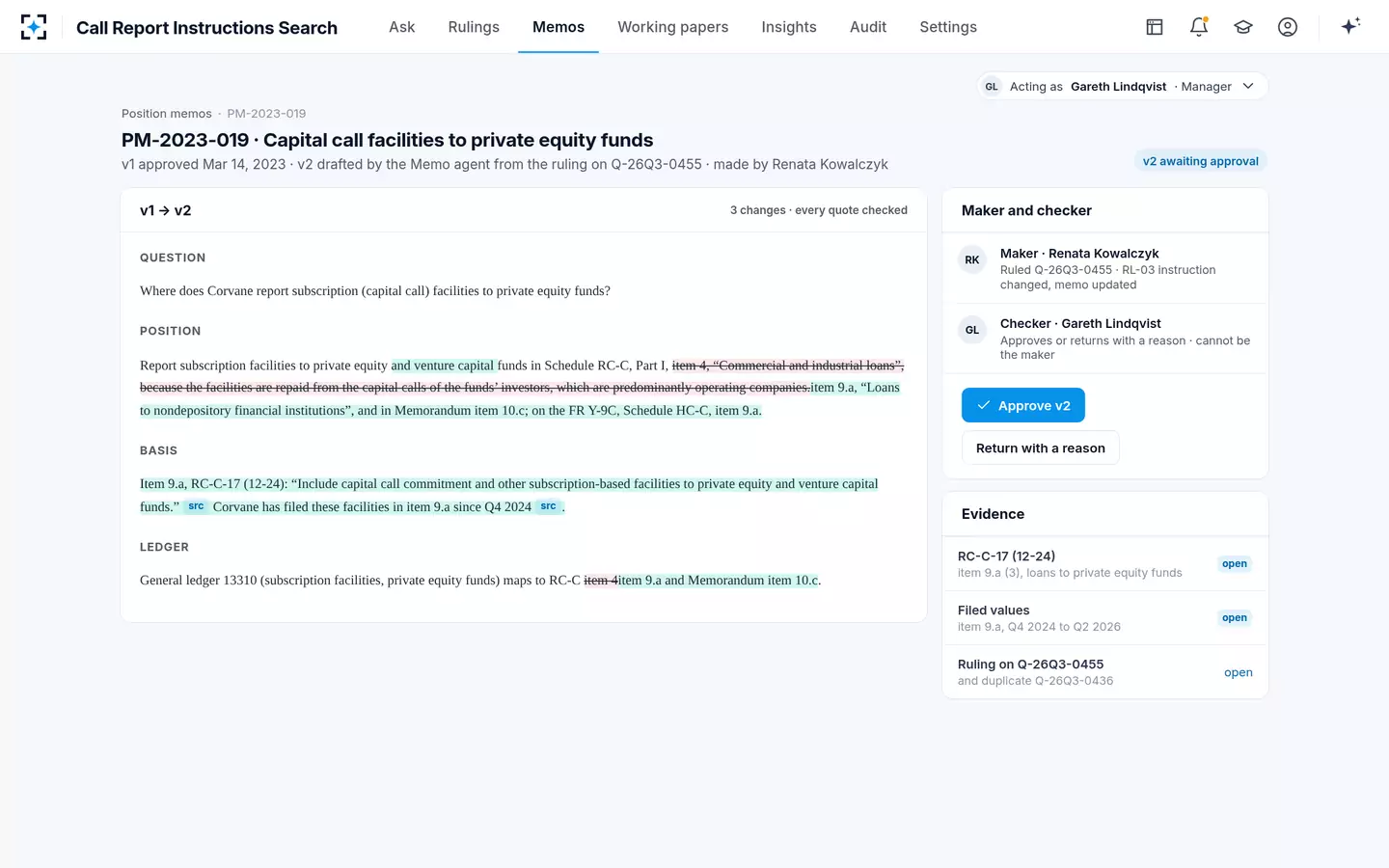
Nothing failed in a way an edit check could see. The filed numbers were in the right line; the memo, the document an examiner or a new preparer would read first, said the opposite. It surfaced when a regulatory reporting analyst asked whether the facilities "still go in item 4, as the memo says," and the answer screen replaced its verdict with one sentence: the three sources disagree. The Policy Lead ruled with reason code "Instruction changed; memo updated," the Memo agent drafted version 2 as a redline, the manager approved it, and the Change agent re-checked the nine saved answers that had cited version 1. None needed amending, because every filing since the fourth quarter of 2024 already used item 9.a.
The day the stale memo surfaced: the three sources disagree
How do banks keep accounting policy memos current?
By tying each memo to the pages it relies on and checking those pages every time the instructions change, not by re-reading every memo on a calendar. The OCC lists change management for the systems that new or revised reporting requirements touch (quoted in call report instructions update) and "standards for documentation, including work paper requirements and maintenance" among the subjects regulatory reporting policies generally address (Comptroller's Handbook, Regulatory Reporting). The instruction updates make the trigger concrete: in September 2026 the FFIEC 031 and 041 update replaced pages in Schedules RC-E, RC-O, RC-R Part I and RC-S, two General Instructions pages and five Glossary pages (Instructions Update, September 2026). Every memo citing one of those pages owes a comparison.
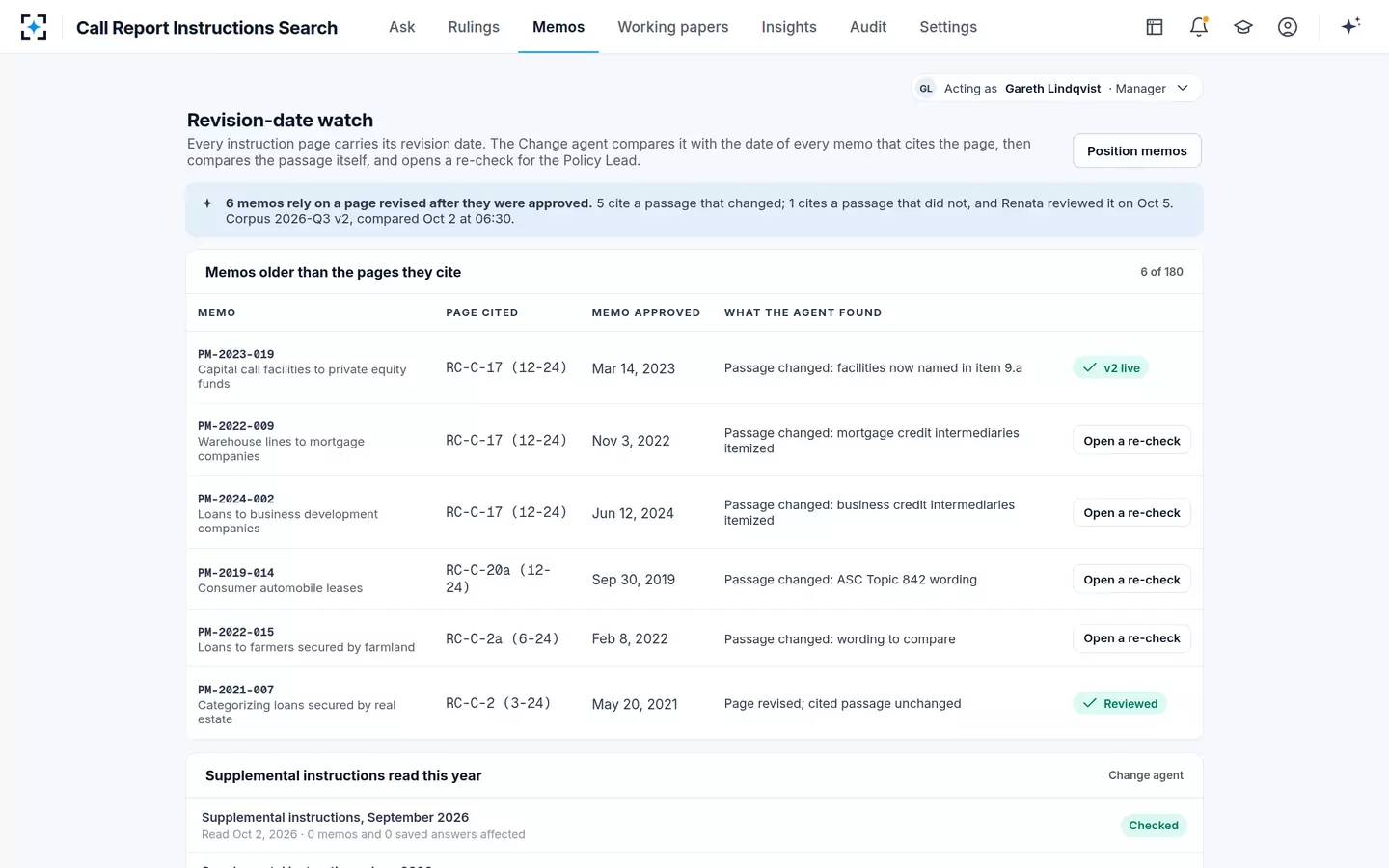
The comparison has to be of passages, not just dates. On the sample data, one of the six flagged memos cites page RC-C-2 (3-24), revised after the memo's 2021 approval, but the sentence it relies on did not change; the Policy Lead marked it reviewed. A date check alone would have produced a false alarm, and a team that gets enough false alarms stops reading them.
The revision-date watch: six memos of 180, and what changed in each
How often should regulatory reporting memos be reviewed?
Whenever a page or topic they cite changes, and at least once a year as a sweep for everything else. The General Instructions frame the duty quarterly: each bank must meet in full the requirements in force for that report date, including whatever has changed since the last one (General Instructions, page 10; quoted in call report preparation software, tested). An annual review alone can leave a memo stale for most of a year after a December update; an event-driven check catches it in the quarter it happens, before the report is prepared.
The cost of not doing it can be large. In 2023 the FDIC found that some institutions were not reporting estimated uninsured deposits in accordance with the instructions and told those that had reported incorrectly to amend their Call Reports, for up to three years or more where appropriate (FIL-37-2023). A misread instruction compounds every quarter it is repeated.
One quarter's memo check, on the solution's sample data
180
approved position memos in the bank's library, each compared with the pages it cites
6
relying on a page revised after approval; 5 with a changed passage
9
saved answers re-checked after one memo changed; none needed amending
0
memos affected by the September 2026 supplemental instructions, read October 2
Can AI do technical accounting research?
It can find and summarize guidance quickly; it should not be the one deciding what the bank's position is. The same limits apply as for any generated answer: without the source text in front of it a model answers from memory, it cannot tell which revision of a page was in force, and research on models classifying financial facts against a large taxonomy shows they extract well and categorize much less reliably. Why a general chatbot misreads the Call Report instructions covers the evidence. The useful division is the one this solution applies: agents search, quote, compare dates and draft redlines; the Policy Lead rules; the manager approves.
Accounting research software vs a Call Report answer layer
They answer different questions and are bought for different people. A research platform answers "what does GAAP require?" for the accounting policy team; a Call Report answer layer answers "where does this go on our report this quarter, and does our memo still say so?" for everyone who feeds a schedule. Many banks will want both. The mistake is to buy one expecting the other.
What each kind of tool is built to answer
Accounting research software: FASB Codification, SEC guidance and interpretive literature
Call Report Instructions Search: FFIEC 031 and 041 and FR Y-9C instruction books, Glossary, supplemental instructions, by quarter
Accounting research software: Technical accounting and policy specialists
Call Report Instructions Search: Preparers in every business line, the reporting team, the Policy Lead
Accounting research software: Memos written in the tool or stored beside it
Call Report Instructions Search: Approved memos read as precedent, with the amounts filed on the line by quarter
Accounting research software: New standards and amendments in the literature
Call Report Instructions Search: Each cited page's revision date compared with each memo's approval date
Accounting research software: The researcher keeps researching
Call Report Instructions Search: The question is routed to the Policy Lead with a clock
Accounting research software: Research and memo drafts
Call Report Instructions Search: A cited answer saved to the schedule's working papers, or a ruling and a memo redline
What should you ask before buying accounting research software?
Ask whether it covers the authorities your questions actually rest on, and what it does when those authorities change. For a bank, the second question is the one most demonstrations skip. The checklist below applies to research platforms and to Call Report answer tools alike, ours included.
Buyer's questions for any research or answer tool used on regulatory reports
- Does it hold the FFIEC and FR Y-9C instruction books, by quarter?
Not just GAAP. Ask which quarters, and how fast a new quarter loads.
- Can it cite a page with its revision date?
A citation to "Schedule RC-C instructions" cannot be checked for currency.
- Can it tell you which of your memos a new page touches?
Ask for the list after the last instruction update, and how many were false alarms.
- Does it compare the passage, or only the date?
Date-only checks flag reissued pages whose sentences did not move.
- Does it treat only approved memos as the bank's position?
Drafts and superseded versions should never be cited as precedent.
- Who approves a memo change, and can the author approve their own?
Maker and checker should be enforced, not optional.
- Can it show what the bank filed on the line before?
Precedent is the memo and the amounts, read from the reporting system without changing it.
- What is kept, for how long, and can examiners see it?
Answers, rulings and memo versions, with the sources each relied on.
A stale memo, rewritten as a redline and approved by someone else
Questions people ask
What is the difference between an accounting policy memo and a Call Report position memo?
An accounting policy memo usually settles recognition and measurement under GAAP; a Call Report position memo settles where an amount is reported, on which line of which report, under the FFIEC instructions. Many questions need both, because the instructions sometimes prescribe treatment within the range of GAAP, such as the nonaccrual rules.
Do the Call Report instructions follow GAAP?
Generally, yes: banks prepare the Call Report in accordance with U.S. GAAP except where the instructions give specific reporting guidance within GAAP's range, and the agencies may prescribe a principle no less stringent than GAAP where supervisory objectives require it. The General Instructions list examples, including the Glossary's nonaccrual rules.
How do you know a memo is stale?
Compare the revision date printed on each instruction page the memo cites with the memo's approval date; if the page is newer, compare the cited passage with the current text. A changed passage needs a ruling before the next report is prepared.
Should AI write accounting policy memos?
It can draft them, as a redline with every quotation checked against its source, but a person with authority should rule and a second person approve. In Call Report Instructions Search the Memo agent drafts and never approves or publishes; a memo is live only after the manager approves it.
What are AI accounting research tools good at?
Finding relevant passages fast across large bodies of text and summarizing them. They are weaker at choosing the right category in a large rulebook and at knowing which version of a rule applies on a date, which is why answers should quote the source and show its date.