The Call Report and the FR Y-9C report the same kinds of balances for two different entities. The Call Report (FFIEC 031, 041 or 051) is the consolidated report of one insured bank and the subsidiaries it owns, due 30 days after the quarter. The FR Y-9C is the consolidated report of the top-tier holding company with $3 billion or more in assets: it adds the parent, its nonbank subsidiaries and any other banks it owns, eliminates what they owe each other, and is due 40 days after the quarter, 45 after December. So the same balance can legitimately differ between them for three reasons, scope, eliminations and timing, and every difference that none of the three explains is a break someone has to trace. Botminds' Regulatory Reporting Reconciliation ties the two every night of the close and names, for each concept, which of the three reasons applies and the source that proves it.
The figures in the examples come from a fictional sample bank, about $92 billion in assets with one foreign branch, owned by a holding company and closing its third quarter of 2026 in the solution. The rules are the agencies', current for the September 30, 2026 report date.
One sample quarter, five concepts, and what makes each FR Y-9C figure different
Call Report: $71,482.6M, the bank's deposits including its parent's operating cash.
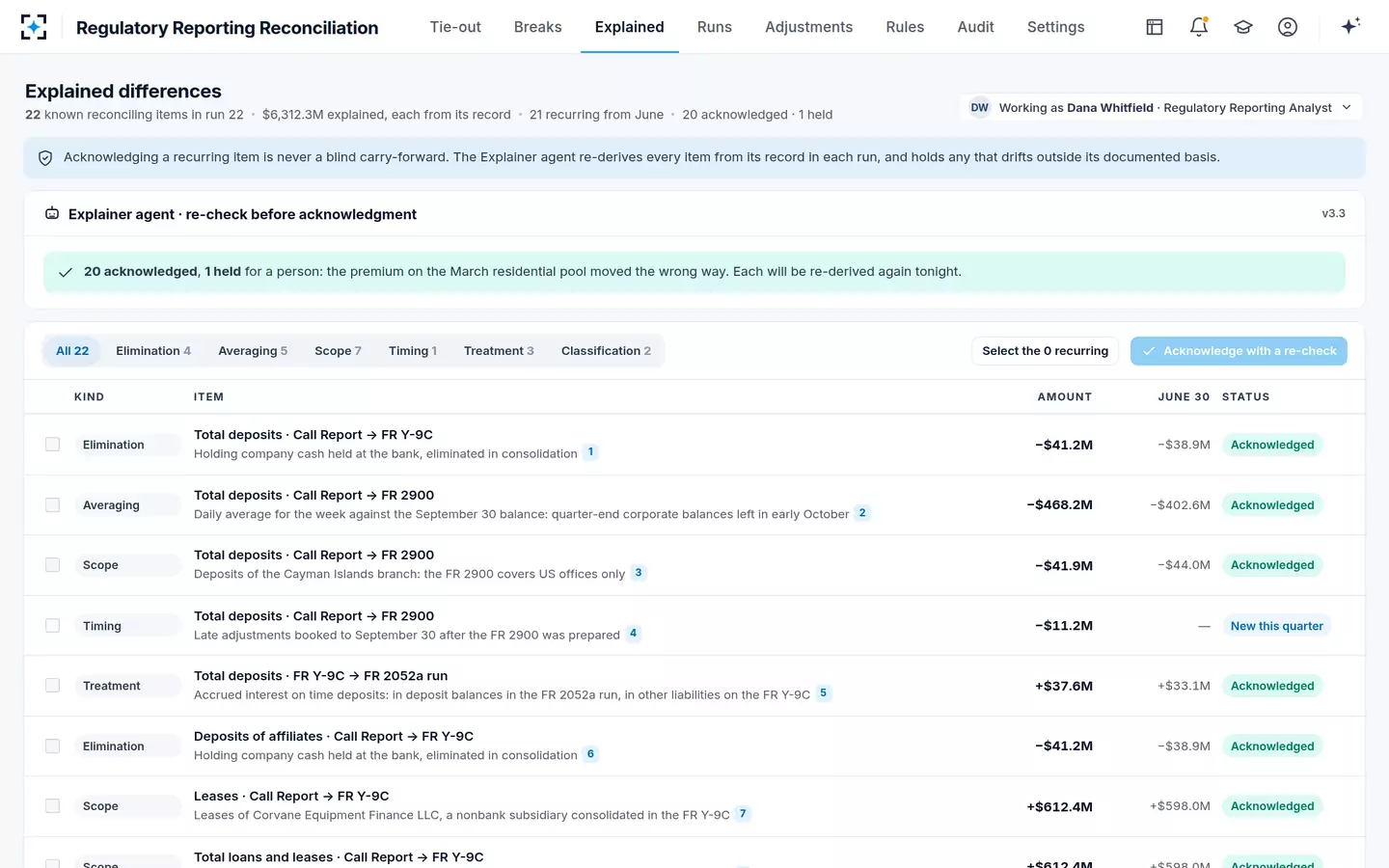
FR Y-9C, and why: $71,441.4M. The parent's $41.2M at the bank is eliminated in consolidation (legitimate: elimination).
Call Report: Excludes a leasing company the parent owns directly.
FR Y-9C, and why: $612.4M higher: the nonbank leasing subsidiary is consolidated (legitimate: scope).
Call Report: The bank's dividends to its parent are paid out of its equity.
FR Y-9C, and why: Eliminated with the parent's dividend income: $420.0M year to date in the same journal (legitimate: elimination).
Call Report: Priced at the quarter-end close.
FR Y-9C, and why: $8.9M lower: a holding company bond priced from the prior day (a break, sent to investment accounting).
Call Report: Reported where the bank's books put them.
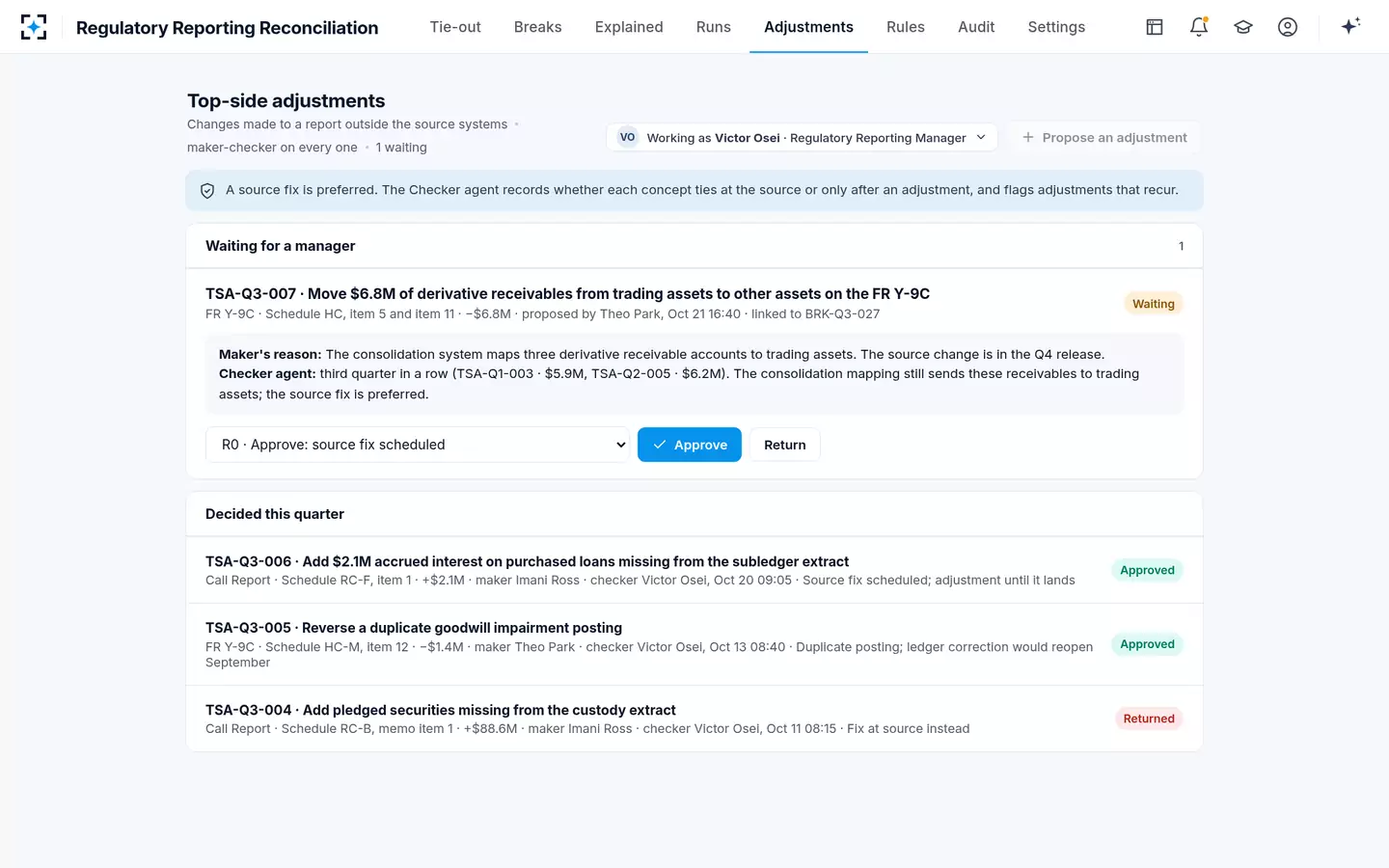
FR Y-9C, and why: Moved by a $6.8M top-side adjustment from trading assets to other assets, for the third quarter running (a mapping error, not a legitimate difference).
What is the difference between the Call Report and the FR Y-9C?
The Call Report is filed by every FDIC-insured bank and describes the bank; the FR Y-9C is filed by holding companies with $3 billion or more in total consolidated assets and describes the whole group. The Federal Reserve's own history of the form explains why they look alike: the report began as the FR Y-9 in 1978, and "In 1985, the report was revised to parallel the Reports of Condition and Income (Call Report) for commercial banks" (Federal Reserve, FR Y-9C). Its schedules follow the Call Report's with an H prefix, so Schedule HC is the balance sheet, HI the income statement and HC-R regulatory capital, where the Call Report has RC, RI and RC-R.
Call Report vs FR Y-9C, line by line
| Call Report | FR Y-9C | |
|---|---|---|
| Who files | Every FDIC-insured bank and savings association | Top-tier holding companies with $3 billion or more in total consolidated assets |
| Entity | The bank, its branches and the subsidiaries it consolidates | The holding company, all its banks and nonbank subsidiaries, consolidated |
| Forms | FFIEC 031 (any foreign office, or $100 billion or more), 041, or 051 (eligible domestic banks under $5 billion) | One form, FR Y-9C; parent-only statements go on the FR Y-9LP |
| Due | 30 calendar days after the report date; 35 with more than one foreign office | 40 calendar days after March, June and September; 45 after December |
| Signed by | The chief financial officer, with directors attesting | The chief financial officer, attesting the statements are true and correct |
| Public? | Yes, except selected items and text | Yes, with certain exceptions |
| Agencies' burden estimate | 34.99 to 86.25 hours a quarter, by form | 5 to 1,250 hours per response; averages of 35.59 to 49.80 |
Who files the FR Y-9C, and when is it due?
Holding companies with total consolidated assets of $3 billion or more file the FR Y-9C, and only the top tier files it when one holding company owns another. The form page sets out the threshold's history: $150 million until 2006, then $500 million, then $1 billion from March 2015 and $3 billion from September 2018. A holding company that reaches $3 billion as of June 30 begins filing the following March, and one that falls below $3 billion for four consecutive quarters may revert to the smaller FR Y-9SP (FR Y-9C instructions, effective September 2026).
The submission date is 40 calendar days after the March 31, June 30 and September 30 report dates and 45 after December 31, moved to the next business day when it falls on a weekend or holiday. The report is due by 5:00 p.m. at the district Reserve Bank on the submission date, and the instructions allow no extension (FR Y-9C instructions quotes the rule). For the September 30, 2026 report date that is Monday, November 9, ten days after the Call Report's Friday, October 30 (FDIC FIL-62-2026).
The FR Y-9C's burden, by kind of holding company
Does the FR Y-9C have to match the Call Report?
No rule says the two must match, and for most holding companies they cannot, because they describe different entities. What the rules require is that each be right on its own terms, and that differences between them have reasons. The FR Y-9C instructions say "All reports shall be prepared in a consistent manner", and both reports follow generally accepted accounting principles, so the same transaction should be recognized and measured the same way in both. Where they differ, the difference should come from what each report includes, what it eliminates, or when it was prepared.
That gives a reconciliation its shape. Start from the Call Report of each bank subsidiary, add the parent and the nonbank subsidiaries, remove the intercompany balances, account for anything that happened between the two filing dates, and the result should be the FR Y-9C. Every dollar that does not land is a break. The three legitimate reasons are worth taking one at a time.
Difference one: what each report consolidates
The Call Report consolidates the bank and the subsidiaries it controls; the FR Y-9C consolidates the holding company and everything it controls, which can include businesses the bank does not own. The Call Report instructions list what the "consolidated bank" includes: the head office, "All branches of the bank, domestic and foreign", any international banking facility, majority-owned Edge subsidiaries and other significant majority-owned subsidiaries (Call Report General Instructions). The FR Y-9C applies the holding company's own reporting basis: generally, "holding companies should consolidate any company in which it owns more than 50 percent of the outstanding voting stock" (FR Y-9C instructions).
The practical consequences are three. A nonbank subsidiary of the parent, such as the sample holding company's leasing company, appears on the FR Y-9C and on no Call Report, which is why the sample's leases are $612.4 million higher at the holding company. A holding company with two banks reports both on one FR Y-9C, so its deposits will not equal either bank's Call Report. And the FR Y-9C's deposit schedule, HC-E, splits deposits between "commercial bank subsidiaries of the reporting holding company" and "other depository institutions that are subsidiaries of the reporting holding company", a split that has to be mapped back to the separate Call Reports (FR Y-9C form, Schedule HC-E).
Difference two: the eliminations
The eliminations are the largest source of legitimate difference and the easiest place to hide an error. The FR Y-9C instructions require that "the results of all transactions and all intercompany balances (e.g., outstanding asset/debt relationships) between offices, subsidiaries, and other entities included in the scope of the consolidated holding company are to be eliminated in the consolidation". Their own example includes "a consolidated subsidiary's deposits in another holding company consolidated subsidiary and the corresponding cash or interest-bearing asset balance of the subsidiary".
The parent's own deposit at its bank shows why the two reports must differ. On the Call Report the parent is a customer outside the consolidated bank, so its operating account is a deposit like any other. On the FR Y-9C the parent is inside the group, so the deposit and the parent's matching cash are eliminated. In the sample, the elimination journal in the consolidation system removes $41.2 million of deposits and cash on this account, and the same journal eliminates $420.0 million of dividends paid by the bank to the parent so far this year.
An elimination is legitimate only if it is re-derived from the consolidation system each quarter. A figure carried forward from June, when the parent's balance was $38.9 million, would have hidden a $2.3 million difference in September. The sample bank's agents re-read the journal every run, and an elimination that no longer matches its journal is held for a person.
Every Call Report to FR Y-9C difference in Regulatory Reporting Reconciliation, typed and sourced
Difference three: ten more days of information
The FR Y-9C is filed ten days after the Call Report, and in those ten days the bank can learn things it did not know when it filed. Both reports follow the accounting standard on subsequent events. The FR Y-9C instructions require recognizing "the effects of all subsequent events (not addressed in other ASC Topics) that provide additional evidence about conditions that existed at the date of the FR Y-9C balance sheet". An event that surfaces on day 35, such as confirmation of a loss that existed at quarter-end, can be in the FR Y-9C and not in the Call Report already filed.
That is a legitimate difference only for as long as it takes to decide whether the Call Report must be amended. The OCC tells examiners that failing to recognize a subsequent event that reflects conditions at the report date is a misstatement, "because this is an oversight or misuse of facts that existed when the call report was prepared" (OCC Comptroller's Handbook, Regulatory Reporting). A timing difference between the two reports should therefore come with an explicit decision about the earlier one, not just an explanation.
Why do Call Report and Y-9C deposits differ?
Call Report and FR Y-9C deposits differ mainly because of eliminations and scope: the parent's and affiliates' deposits at the bank are eliminated on the FR Y-9C, and deposits at any other bank or savings association the holding company owns are added. For a holding company with one bank, total deposits on the FR Y-9C should equal the bank's Call Report deposits less intercompany deposits, and nothing else; the sample's $41.2 million gap is exactly that.
The FR Y-9C uses the Call Report's deposit categories, and its instructions flag the one place where the Federal Reserve's own deposit definitions part company: Regulation D counts savings deposits among transaction accounts, while for Call Report purposes they are a kind of nontransaction account (FR Y-9C instructions, Schedule HC-E). The FR 2900, which follows Regulation D, groups the same deposits differently again, which is one reason the same balances look different in the FR 2900 and the other places a deposit balance appears.
The two reports' clocks for the September 30, 2026 report date
Oct 30
Call Report due, a Friday; November 4 for banks with more than one foreign office
Nov 9
FR Y-9C due, a Monday, by 5:00 p.m. at the district Reserve Bank
10days
between the two, in which subsequent events can change the second report
What is FR Y-9C Schedule HC-R?
Schedule HC-R is the FR Y-9C's regulatory capital schedule, the holding company counterpart of the Call Report's RC-R. Part I holds the capital components and ratios; Part II holds risk-weighted assets. A holding company that elects the community bank leverage ratio framework answers yes at item 31.a and, per the form, completes items 32 through 36 and does not complete Part II (FR Y-9C form, Schedule HC-R).
The schedule changed this quarter in both reports at once. The Federal Reserve's September 2026 supplemental instructions say HC-R Part I has been updated to follow the agencies' final rule cutting the community bank leverage ratio requirement from 9 to 8 percent and stretching the grace period from two quarters to four (FR Y-9C Supplemental Instructions, September 2026; the Call Report side is in call report supplemental instructions, September 2026), and the Call Report instructions changed the same way. Capital is also where the two reports can legitimately diverge: holding company debt, goodwill recorded at the parent and minority interests in subsidiaries change the group's capital without touching the bank's.
Anything else is a break
Once scope, eliminations and timing are accounted for, any remaining difference between the Call Report and the FR Y-9C is a break with a cause in some source system. In the sample quarter there were two. A holding company bond was priced from the prior day, leaving FR Y-9C available-for-sale securities $8.9 million below the Call Report, and went to investment accounting. Three derivative receivable accounts were mapped to trading assets in the consolidation system and moved to other assets by a top-side adjustment for the third quarter running, while the mapping fix waited for a release.
A top-side adjustment on the FR Y-9C, flagged by Regulatory Reporting Reconciliation as the third in a row
The difference between the two kinds of gap is the whole point of reconciling the reports. A legitimate difference is re-derived and accepted; a break is traced and fixed at its source. Reconciling items between regulatory reports covers how to keep the first honest, and what a top-side adjustment is covers what happens when the second is patched instead of fixed. To see the two reports tied every night on the sample bank's close, start from Regulatory Reporting Reconciliation.
Questions people ask
What is the FR Y-9C report?
It is the Federal Reserve's quarterly consolidated financial statement for holding companies with $3 billion or more in total consolidated assets: "a balance sheet, an income statement, and detailed supporting schedules, including a schedule of off balance-sheet items", in the form page's words. The Federal Reserve calls it "a primary analytical tool used to monitor financial institutions between on-site inspections".
Is the FR Y-9C public?
Mostly. The Federal Reserve publishes FR Y-9C data in its Uniform Bank Holding Company Performance Report, and "With certain exceptions, microdata are considered public information". The form's cover asks whether confidential treatment is requested for any portion of a submission.
What is the difference between the FR Y-9C and the FR Y-9LP?
The FR Y-9C is consolidated: the whole group as one entity. The FR Y-9LP holds parent-company-only statements; the two were split from a single report in June 1986. A reconciliation between the Call Report and the FR Y-9C often uses the FR Y-9LP to see the parent's own cash, debt and investments in subsidiaries before they are eliminated.
When is the FR Y-9C due in 2027?
Forty calendar days after March 31, June 30 and September 30, and forty-five after December 31, moved to the first business day after a weekend or holiday. The December 31, 2026 report falls due on day 45, Sunday, February 14, 2027, so it moves to the next business day; the March 31, 2027 report is due Monday, May 10.
Does a bank without a holding company file the FR Y-9C?
No. The FR Y-9C is a holding company report; a bank with no parent holding company files only its Call Report. Holding companies under $3 billion generally file the semiannual FR Y-9SP instead, unless the Federal Reserve requires the FR Y-9C.