Reconciling items in financial reports are the named, documented reasons two figures that should agree do not. In a bank statement reconciliation they are deposits in transit and outstanding checks; between regulatory reports they are eliminations, averaging, differences in scope, timing differences and differences in accounting treatment, each one a legitimate reason the Call Report, the FR Y-9C, the FR 2900 and the FR 2052a show the same balance differently. What makes an item legitimate is not that it was accepted last quarter but that it can be proved this quarter from its source. And whatever is left after the items, if it is inside the tolerance, is accepted as noise, so the tolerance decides which errors anyone ever sees. Botminds' Regulatory Reporting Reconciliation re-derives every reconciling item from its source on every run and holds any that drifts, because a carried-forward item is the easiest place for a break to hide.
The examples come from a fictional sample bank, about $92 billion in assets, closing its third quarter of 2026 in the solution. The definitions come from the Federal Reserve, the OCC, the FFIEC agencies and the Basel Committee, linked where they appear.
Twenty-two reconciling items in one quarter: scope and averaging lead
What are reconciling items?
A reconciling item is a specific, documented difference between two figures that should otherwise agree, with a cause that is legitimate under the rules of both. In regulatory reporting, the rules of each report create most of them. The Federal Reserve's guide to its own comparison of the FR 2900 with the Call Report says the comparison exists to sort them: "Such discrepancies may be the result of a reporting error or may instead reflect legitimate differences between item definitions associated with the two reports" (Federal Reserve, Summary of Legitimate Interseries Differences, September 2024).
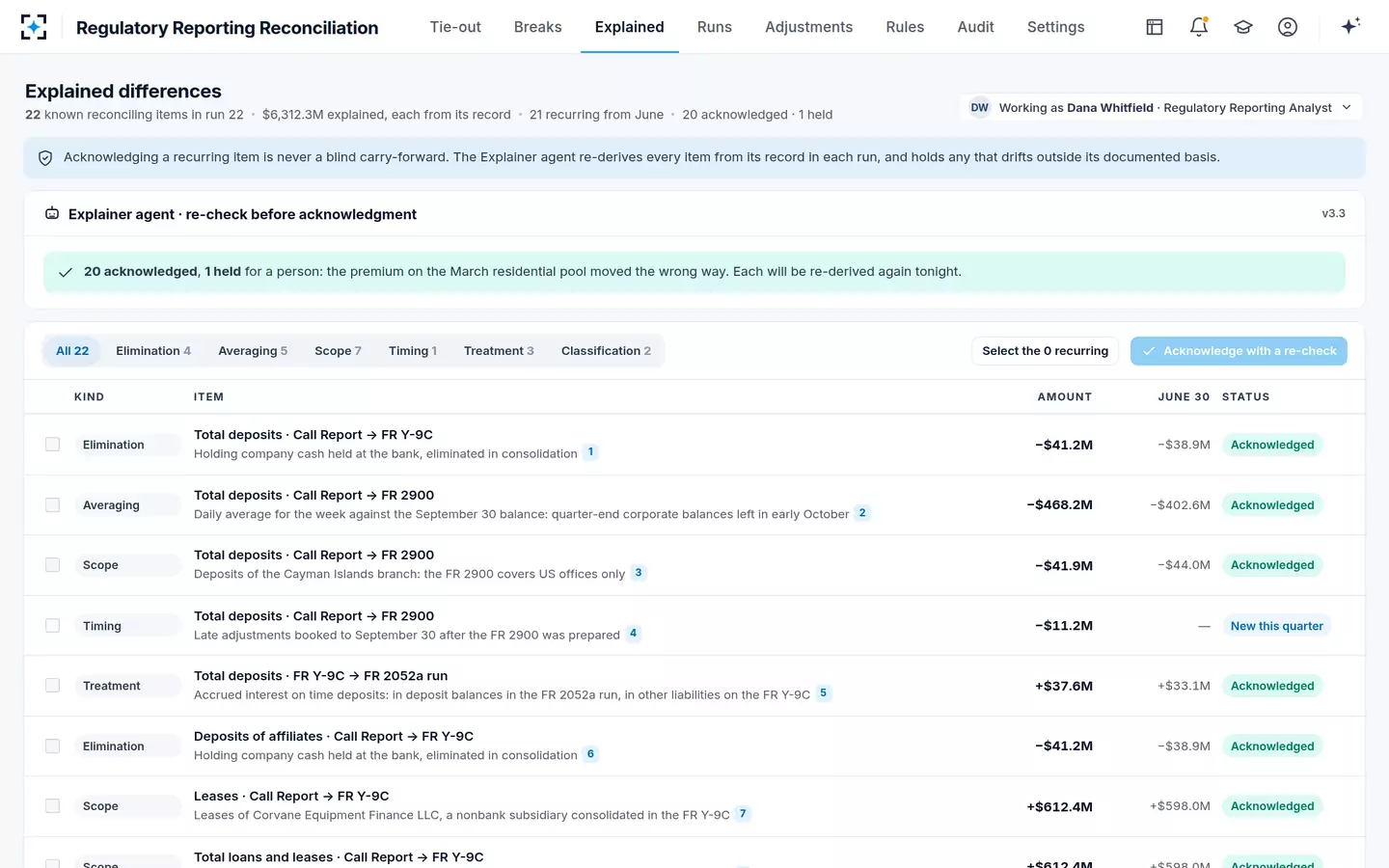
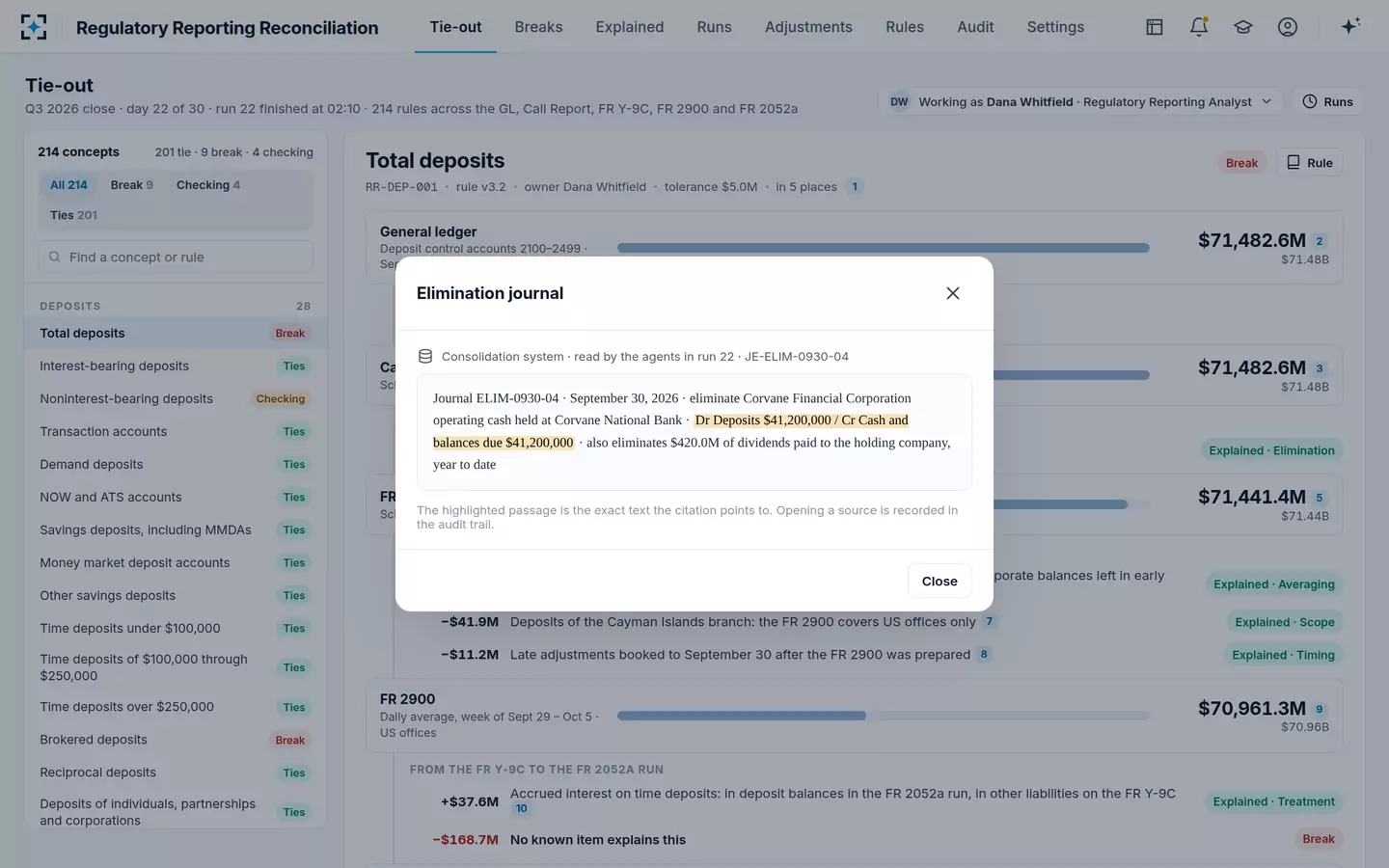
In the sample bank's quarter the items fall into six kinds. A $41.2 million elimination of the holding company's cash at the bank separates the Call Report from the FR Y-9C. A $468.2 million averaging item separates the quarter-end Call Report from the FR 2900's week of daily balances. A $612.4 million scope item adds the leases of a nonbank subsidiary to the FR Y-9C. An accrued interest treatment of $37.6 million separates the FR Y-9C from the FR 2052a run. Each has a source that proves it: a journal, a set of daily balances, a subsidiary's package, a memo.
What is not a reconciling item?
A difference with no source behind it is not a reconciling item, however familiar it is. Four things regularly pass for reconciling items and are not. A plug, the amount needed to make two figures agree, has no cause. An item copied forward from last quarter's explanation tab has a cause that may no longer hold. A known error, such as "the feed sends escrow to the wrong line", is a break that someone has decided not to fix yet; it belongs with top-side adjustments, approved and counted, not among the legitimate differences. And a difference that is legitimate in one direction is a break in the other: the Federal Reserve's guide says which report should be higher for each difference it lists.
Examiners have asked the basic questions about reconciling items for decades. The Federal Reserve's examination manual, in its internal control questionnaire for due-from-bank accounts, asks "Are all reconciling items clearly described and dated?" and whether, "Whenever a delay occurs in the clearance of deposits in transit, outstanding drafts and other reconciling items", such delays are investigated (Federal Reserve, Commercial Bank Examination Manual, section 2320.4). The questions transfer directly to regulatory reports: what is the item, since when, and why has it not cleared.
The Federal Reserve's own list of legitimate differences
For the FR 2900 and the Call Report, the Federal Reserve has written the list of legitimate differences down, which makes it the best public model of what a documented reconciling item looks like. Each entry names the difference, says which report it makes larger, and points to the instruction that causes it.
Legitimate differences between the FR 2900 and the Call Report, as the Federal Reserve lists them
| Difference | Which is larger | Why the reports differ |
|---|---|---|
| Edge and agreement subsidiaries | FR 2900 | Edges file their own FR 2900 and are not consolidated in it; the Call Report consolidates them and eliminates balances between them and the bank |
| Deposits from a non-U.S. office of an affiliate | FR 2900 | Included on the FR 2900; eliminated from the domestic portion of the Call Report |
| Certain deposits at non-U.S. branches | FR 2900 | Those payable or guaranteed at a U.S. office, and U.S. residents' deposits under $100,000, are included on the FR 2900 |
| Definition of the United States | Call Report, for cash items | The FR 2900 means the 50 states and DC; the Call Report also covers Puerto Rico and U.S. territories |
| Late adjustments | Either | The FR 2900 is prepared a day or two after its date; the Call Report weeks later, with adjustments included |
| Suspense accounts | FR 2900, usually | The FR 2900 puts suspense items in demand deposits; the Call Report puts them where they finally belong |
| Primary obligations | FR 2900 | Some liabilities, such as certain notes and repurchase agreements, are deposits for the FR 2900 but not for the Call Report |
| Interpretive items | FR 2900 | Items such as advance payments of taxes and insurance, or funds received in servicing loans for others, may be other liabilities on the Call Report but deposits on the FR 2900 |
| Fair value | Either | The FR 2900 uses the contractual liability; the Call Report may carry deposits at fair value |
| Teller's checks and foreign currency vault cash | FR 2900 for checks; Call Report for vault cash | Teller's checks stay longer on the FR 2900; foreign currency is excluded from FR 2900 vault cash |
Two entries carry lessons beyond the FR 2900. The interpretive items show that one balance, such as advance payments of taxes and insurance held in escrow, can sit on different lines in two reports for legitimate reasons, which is why the sample bank's mortgage escrow break needed a trace to prove it was a mapping error and not an interpretation. And the direction column is a control in itself. A difference that the guide says should make the FR 2900 smaller, such as foreign currency excluded from vault cash, is a break if it makes the FR 2900 larger.
Should reconciling items recur?
Many should: an elimination of the parent's deposit at its bank recurs every quarter for as long as the parent banks with its subsidiary. What should not recur is the amount. A legitimate recurring item moves with its driver, and the movement is information. In the sample bank, the parent's cash eliminated on the FR Y-9C moved from $38.9 million in June to $41.2 million in September, and the averaging item between the Call Report and the FR 2900 grew from $402.6 million to $468.2 million with quarter-end inflows. Both moves have a cause in their sources.
One item in the sample did not. An unamortized premium on a residential loan pool bought in March rose from $18.2 million in June to $26.9 million in September, when a premium should fall as it amortizes. The solution's explainer agent re-derived it, found it outside its documented basis, and held it for a person rather than acknowledging it with the other twenty. A process that copies last quarter's amount, or re-explains only the items that changed visibly, would have carried it forward.
Twenty acknowledged, one held: Regulatory Reporting Reconciliation re-derives every recurring item
What is a reconciliation tolerance?
A reconciliation tolerance is the amount of unexplained difference a bank accepts without investigation, after every reconciling item has been applied. It exists for noise: regulatory reports are filed in thousands of dollars, sources close at slightly different moments, and some measurements are estimates. Set too tight, it buries analysts in rounding. Set too wide, it hides exactly the errors that matter, because a remainder inside the tolerance is never traced.
Tolerances should differ by area. The sample bank uses $5.0 million for deposits, off-balance-sheet items and liquidity flows; $2.0 million for loans, securities, cash and other liabilities; $1.0 million for capital and credit quality; and $0.5 million for income and expense. Those are its settings, written down and versioned, not a standard. The question for any bank is what its own figures should rest on, and the agencies' answer is materiality.
One sample bank's tolerances, by area
$5.0M
deposits, off-balance-sheet items and liquidity flows
$2.0M
loans, securities, cash and other liabilities
$1.0M
capital and credit quality
$0.5M
income and expense
When is a difference material for the Call Report?
A difference is material for the Call Report when it could change the judgement of someone relying on the report, and the agencies measure that both in amount and in kind. The Call Report instructions borrow the accounting definition: "Information is material if omitting it or misstating it could influence decisions that users make on the basis of the financial information of a specific reporting entity" (FFIEC 031/041 General Instructions, September 2026). The OCC puts it in examiner's terms: a misstatement is material when correcting it would probably change, or sway, the judgment of a reasonable person relying on the report (OCC Comptroller's Handbook, Regulatory Reporting; quoted in what one call report error costs).
The OCC adds the part a dollar tolerance cannot capture. A qualitative assessment matters because a small misstatement can still be material when it bears on a regulatory requirement, turns a loss into income, moves management pay or hides an unlawful transaction (what one call report error costs quotes the OCC's list). It also distinguishes estimates, where some imprecision is inherent, from items that "can be precisely measured", such as the value of marketable securities. A tolerance that is reasonable for an allowance estimate can be far too wide for a securities balance.
A tolerance is not materiality, and the difference decides what gets traced
A reconciliation tolerance: A dollar amount below which a remainder is not traced.
Materiality, as the agencies use it: Whether a misstatement could change a reasonable reader's judgement.
A reconciliation tolerance: Against one rule's remainder.
Materiality, as the agencies use it: Against the balance sheet, income statement and capital, in amount and in kind.
A reconciliation tolerance: Always accepted.
Materiality, as the agencies use it: Material if they cross a regulatory threshold, turn a loss into income or hide something.
A reconciliation tolerance: Each accepted on its own.
Materiality, as the agencies use it: Weighed together as well as one by one.
A reconciliation tolerance: Same tolerance as precise items, unless set otherwise.
Materiality, as the agencies use it: Judged with their inherent imprecision; precise items get less room.
A reconciliation tolerance: The bank, in its settings.
Materiality, as the agencies use it: Applied by examiners, case by case, in the bank's own context.
The Basel Committee asks the largest banks to make the same link explicitly for risk reports: "Supervisors expect banks to consider accuracy requirements analogous to accounting materiality" (BCBS 239, paragraph 56). For regulatory reports the practical rule follows. Set each tolerance well below the smallest amount the bank would treat as material for that area, tighten it where a small error can cross a threshold, such as capital, and look at what accumulates under it each quarter, because many accepted remainders can add up to one material misstatement.
How do you document reconciling items?
Document a reconciling item so that someone who did not create it can re-derive it from its source and see who accepted it. The Federal Reserve's list and the examination manual's questions point to the same few elements.
Six things a reconciling item needs before it can be accepted
- A kind
Elimination, averaging, scope, timing, treatment or classification: the kind says which rule of which report causes it.
- A source that proves the amount
The elimination journal, the daily balances, the subsidiary's package, the treatment memo or the instruction itself.
- An amount re-derived this period
Recalculated from the source, never copied from last quarter.
- An expected direction
Which report should be larger; the wrong sign makes it a break.
- A date and a history
When it first appeared and how it has moved, so drift is visible.
- An approver for the kind
Who accepted that this kind of difference is legitimate, separate from whoever re-derives the amount.
In Regulatory Reporting Reconciliation, every reconciling item opens the passage that proves it
A new instruction can create a new kind of item overnight. For the September 30, 2026 report date the agencies clarified on Schedule RC-E that trust funds without beneficiary data are reported as deposits of individuals, partnerships or corporations, and updated the instructions for all three Call Report forms after a new law and an interim final rule changed when certain reciprocal and custodial deposits count as brokered (FDIC FIL-62-2026). Where one report's instruction changes and another's does not, a difference appears that did not exist in June, and it needs a basis before it can be accepted.
Who approves a reconciling item?
Someone other than the person who explains it should approve each new kind of reconciling item; recurring items that re-derive cleanly can then be acknowledged in bulk after the re-check. That split follows the OCC's preparer and independent reviewer and keeps the approval where the judgement is. In the sample bank the explainer agent re-derives every item each run, an item that drifts is held for a person, the regulatory reporting manager approves closures, adjustments and rule changes, and a change to a tolerance needs a second administrator.
What nobody should approve is a reconciling item that is really a known error. That is a top-side adjustment and should be counted as one, so that the break behind it stays open with an owner until the source is fixed. To see the sample bank's 22 items with their sources, start from Regulatory Reporting Reconciliation.
Questions people ask
What are reconciling items in a bank reconciliation?
In a bank statement reconciliation, the usual items are deposits in transit, outstanding checks, bank fees not yet booked and errors on either side. Between regulatory reports the items are structural, such as eliminations, scope and averaging, and they recur every quarter. Suspense accounts sit between the two worlds: the Federal Reserve lists them as a legitimate difference between the FR 2900 and the Call Report, and how a suspense account in a bank ages unexplained differences covers them at the branch.
Is a reconciliation tolerance the same as materiality?
No. A tolerance is a bank's working threshold for when to trace a difference; materiality is whether a misstatement could change a reasonable reader's judgement, assessed in amount and in kind. A tolerance should sit well inside materiality, and the remainders it accepts should be reviewed together, because several small ones can be material in aggregate.
How many reconciling items are normal?
No benchmark exists, and the number depends on how many reports a bank files and how its group is structured. The sample bank's 22 items across 214 rules are a design example. More telling than the count is how many were re-derived rather than copied, and whether any moved against their documented basis.
What is a plug in reconciliation?
A plug is an amount entered to make two figures agree without a cause behind it. It is never a reconciling item, because it cannot be proved from a source. If a difference cannot be explained before filing, the honest options are a documented, approved adjustment with an owner for the fix, or a decision that it is inside the tolerance.
Can a reconciling item have the wrong sign?
Yes, and that makes it a break. The Federal Reserve's guide says, for each legitimate difference, whether it makes the FR 2900 larger or smaller than the Call Report; foreign currency in the vault, for instance, can only make the FR 2900 smaller. A rule that checks only the size of a difference, and not its direction, will accept the error.