Data reconciliation tools compare two sets of figures and list what does not agree. For regulatory reports that is the easy third of the work. The Call Report, the FR Y-9C, the FR 2900 and the FR 2052a are built from the same general ledger and source systems but differ by design, so almost every difference needs an explanation, a trace to the accounts behind it, and a decision by the person who owns the source. Botminds' Regulatory Reporting Reconciliation moves the reading, explaining, tracing, drafting and checking to agents, and leaves sending, fixing at the source and approving with people. Before comparing products, a buyer should settle which tasks move and why the line falls where it does; this guide draws that line one task at a time.
The examples come from a fictional sample bank, about $92 billion in assets, closing its third quarter of 2026 in the solution. The regulatory text comes from the OCC, the Federal Reserve, the Basel Committee and the GAO, linked where it is used.
On one concept, the match is one step; the explaining is the rest
4reports
plus the general ledger, holding the same total deposits figure in the sample quarter
5items
known differences explaining $600.1M, each cited to its source
$168.7M
left after the explaining: the only part that needed a trace
2,118accounts
behind that remainder, found by matching 5.7 million accounts one to one
What do data reconciliation tools do for regulatory reports?
Data reconciliation tools for regulatory reports run comparison rules between two places and report what falls outside a tolerance. The rules themselves are simple to state. The Federal Reserve publishes its own: on the Call Report date it compares the FR 2900's demand deposits due to the public with Call Report items RCON2210 less RCON2202, RCONB551 and RCON2213, and does the same for other liquid deposits, cash items in process of collection, small time deposits and vault cash (Federal Reserve, Summary of Legitimate Interseries Differences, September 2024). A cross-report rule is a formula over report codes, and any competent tool can run one.
What the same Federal Reserve document goes on to show is why running the rule is not the job. It lists, item by item, the legitimate reasons the two reports differ: primary obligations counted as deposits on one and not the other, teller's checks kept for more days, Edge subsidiaries consolidated on one and filed separately on the other, a narrower definition of the United States, late adjustments. Each difference the rule finds has to be sorted into one of those reasons, or into none of them. That sorting, with evidence, is the work.
Three kinds of tool get offered for it. Matching tools align two datasets row by row and flag what does not pair. Data quality tools test one dataset against rules for completeness and validity. Reporting systems run the agencies' edits on the report they produce. None of the three, on its own, explains a difference between two reports from the sources that justify it, and none decides who has to fix what is left.
Matching is the easy third; explaining and tracing are the rest
Matching finds that two figures differ; it does not say why, and in regulatory reporting the why is most of the effort. On the sample bank's total deposits, the comparison step produced four gaps between five places in seconds. Explaining them took the elimination journal from the consolidation system, the daily balances behind the FR 2900, the list of late adjustments and a treatment memo on accrued interest. Tracing the one remainder took account-level files from the deposit system and the liquidity data mart.
The time split follows the same shape. Botminds' estimate for one analyst who owns a set of cross-report rules is about twelve and a half working days a quarter by hand, of which only four and a half go on exporting the data and lining up concepts, the part a matching tool speeds up. The other eight go on re-explaining known items, chasing remainders to owners, assembling evidence and deciding. An estimate is not a measurement, and a bank should time its own close, but the proportion is the reason a matching tool alone rarely shortens it.
What a matching step answers, and what the rest of the work needs
A matching step alone: Yes, by $41.2M between the Call Report and the FR Y-9C.
With agents doing the reading: Yes, and the difference is the holding company's cash at the bank, eliminated in consolidation, with the journal entry cited.
A matching step alone: Copied forward from June's tab.
With agents doing the reading: Re-derived from its source this run; one item held because a premium rose when it should have fallen.
A matching step alone: A net figure, if someone subtracts the known items by hand.
With agents doing the reading: $168.7M, one line, with one next step: trace it.
A matching step alone: Only if someone extracts both sides at account level and matches them.
With agents doing the reading: 2,118 mortgage escrow accounts, one product code, one feed, one mapping row added in August.
A matching step alone: Whoever the analyst emails.
With agents doing the reading: The deposit data owner, with the evidence and a proposed fix at the source.
A matching step alone: The next comparison ties, possibly because someone adjusted the report.
With agents doing the reading: The rerun ties and the source mapping changed, with no adjustment on the concept.
Which reconciliation tasks should stay with people?
Four tasks should stay with people: sending a break to another team, changing a source system, approving a closure or an adjustment, and changing the rules themselves. Each one either commits someone else's time, changes data that other reports depend on, or is the independent review the supervisors expect. The OCC's examiner booklet describes sound policy as separating whoever prepares the regulatory reports from an independent party who reviews them before filing (OCC Comptroller's Handbook, Regulatory Reporting).
Responsibility for the result does not move either. The Federal Reserve's FR 2900 instructions say that a bank whose data are "prepared or transmitted by a private vendor" remains "responsible for the timeliness and accuracy of data to the same extent as if it had prepared and transmitted the data itself" (FR 2900 instructions, effective June 2024), and the Call Report instructions say the same of software vendors. The holding company's chief financial officer still attests on the FR Y-9C cover that the statements "are true and correct to the best of my knowledge and belief" (FR Y-9C form). A tool can make that attestation better informed; it cannot sign it.
Fourteen reconciliation tasks, and who does each one
| Task | Agents | People | Why the line is there |
|---|---|---|---|
| Run every cross-report rule each night of the close | Yes | Review the results | Mechanical and repetitive; a person reads what changed. |
| Read each value from its source, with a citation | Yes | Open any source | Every figure must be checkable without asking. |
| Explain known reconciling items | Yes, from their sources | Accept a new kind of item | Explaining is reading; admitting a new legitimate difference is judgement. |
| Re-derive recurring items every run | Yes | Decide on items held | An item that drifts against its basis may be hiding a break. |
| Trace a remainder to accounts, feed and mapping row | Yes, read-only, data masked | Read the finding | Matching millions of accounts is a machine task; conclusions need a reader. |
| Draft the break with evidence and a proposed fix | Yes | Edit it | Drafting saves hours; the words go out under a person's name. |
| Send the break to a data owner | No | Analyst | Sending commits another team's time. |
| Fix the source system | No | Data owner, under change control | Source changes affect every report built on them. |
| Rerun the rule and check the fix landed at the source | Yes | Read the check | A rerun is objective; it shows source fix or adjustment. |
| Propose a closure or a top-side adjustment | No | Analyst, as maker | A proposal states a reason someone must own. |
| Approve a closure or an adjustment | No | Manager, as checker, never their own | This is the independent review. |
| Change a rule, tolerance or agent setting | No | Two administrators | Rules are policy; a second person approves each version. |
| Chase late breaks | Remind and alert | Reassign, extend, escalate | Clocks run themselves; exceptions are decisions. |
| Sign the report | No | Chief financial officer and directors | Attestation cannot be delegated. |
How is AI used in reconciliation, task by task?
In regulatory reconciliation, AI is useful for reading and matching, not for deciding. The rule run itself is deterministic arithmetic and does not need a language model at all. Where agents earn their place is in the steps a person used to do by opening documents: finding the elimination journal that explains a gap, reading a treatment memo, grouping two thousand accounts by product and feed, comparing this quarter's mapping table with last quarter's, and writing the result in plain words with each claim pointing at its source.
One break in ten steps: six by agents, four by people
Agent
Tie-out agentRuns rule RR-DEP-001 at 02:10 and finds total deposits differ across five places.
Never: changes a figure in any report
Agent
Explainer agentCites five known items worth $600.1M; one line of $168.7M is left.
Never: explains a difference without a source
Agent
Trace agentMatches account-level files and names 2,118 escrow accounts, the feed and mapping row 318.
Never: shows customer names or account numbers
Agent
Break agentDrafts the break with six pieces of evidence and a proposed fix at the source.
Never: sends or closes a break
A person decides
AnalystReads the draft, edits it and sends it to the deposit data owner.
Agent
Close watcherStarts a three-business-day clock tied to the Call Report date.
Never: reassigns a break without the manager
A person decides
Deposit data ownerPoints the mapping row at the right line and reloads the feed under a change ticket.
Agent
Checker agentReruns the rule, confirms the source changed and that no adjustment was used.
Never: approves a closure
A person decides
AnalystProposes the closure as maker: fixed at source, confirmed by the rerun.
A person decides
ManagerApproves the closure as checker, or returns it with a reason code.
Supervisors have drawn the same line for their own use. The GAO reported in 2025 that the NCUA uses AI to predict Call Report values and flag outliers, and then asks the credit union to review and correct them; officials of all the regulators using AI said it neither made decisions on its own nor served as their only source (GAO-25-107197, May 2025; quoted in AI regulatory change management).
Governance has a gap a buyer should know about. The agencies' revised model risk guidance of April 2026 excludes "deterministic rule-based processes" from its definition of a model, so a tie-out rule is not a model, and it leaves generative and agentic AI models outside its scope altogether (SR 26-2; quoted in customer risk rating model). Until the request for information the agencies promised produces something firmer, a bank governs its agents by its own policy. The sample bank versions each agent's prompt, model and confidence threshold, tests every change against last quarter's 38 breaks, and has a manager and an administrator approve it.
Ask why two reports differ, and get the answer with its sources
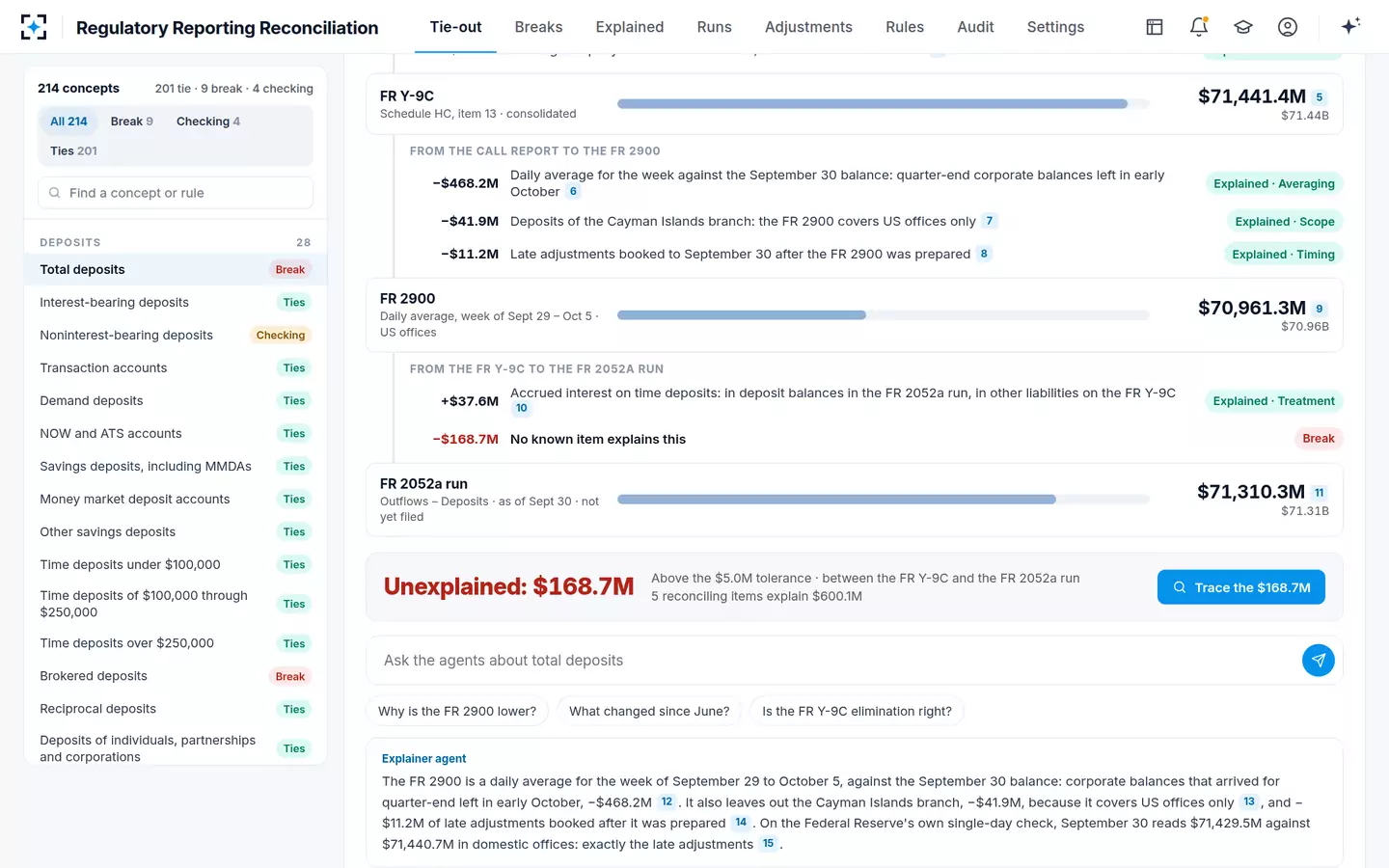
Can AI close reconciliation breaks?
It should not, and in this solution it cannot. Closing a break is a judgement that the evidence supports the fix, and approving a top-side adjustment is a judgement that reporting a figure the source does not hold is acceptable this once. Both are the independent review the OCC asks for, and the same booklet's description of quality assurance gives a concrete test: a reviewer checks that controls worked as bank policy requires, for example that nobody could override an automated feed without the right approval (OCC Comptroller's Handbook, Regulatory Reporting; quoted in regulatory reporting quality assurance). An agent that could approve its own output would fail that test by design.
What an agent can do is make the approval better informed. The checker agent in the sample notes whether a concept ties at the source or only after an adjustment, and it flags an adjustment that recurs. The manager sees that note when approving and has to give a reason code to return a closure: evidence does not support the fix, fix at source instead, or wrong owner. Nobody approves their own work, and an agent is never the approver.
In Regulatory Reporting Reconciliation, a closure waits for a manager, never an agent
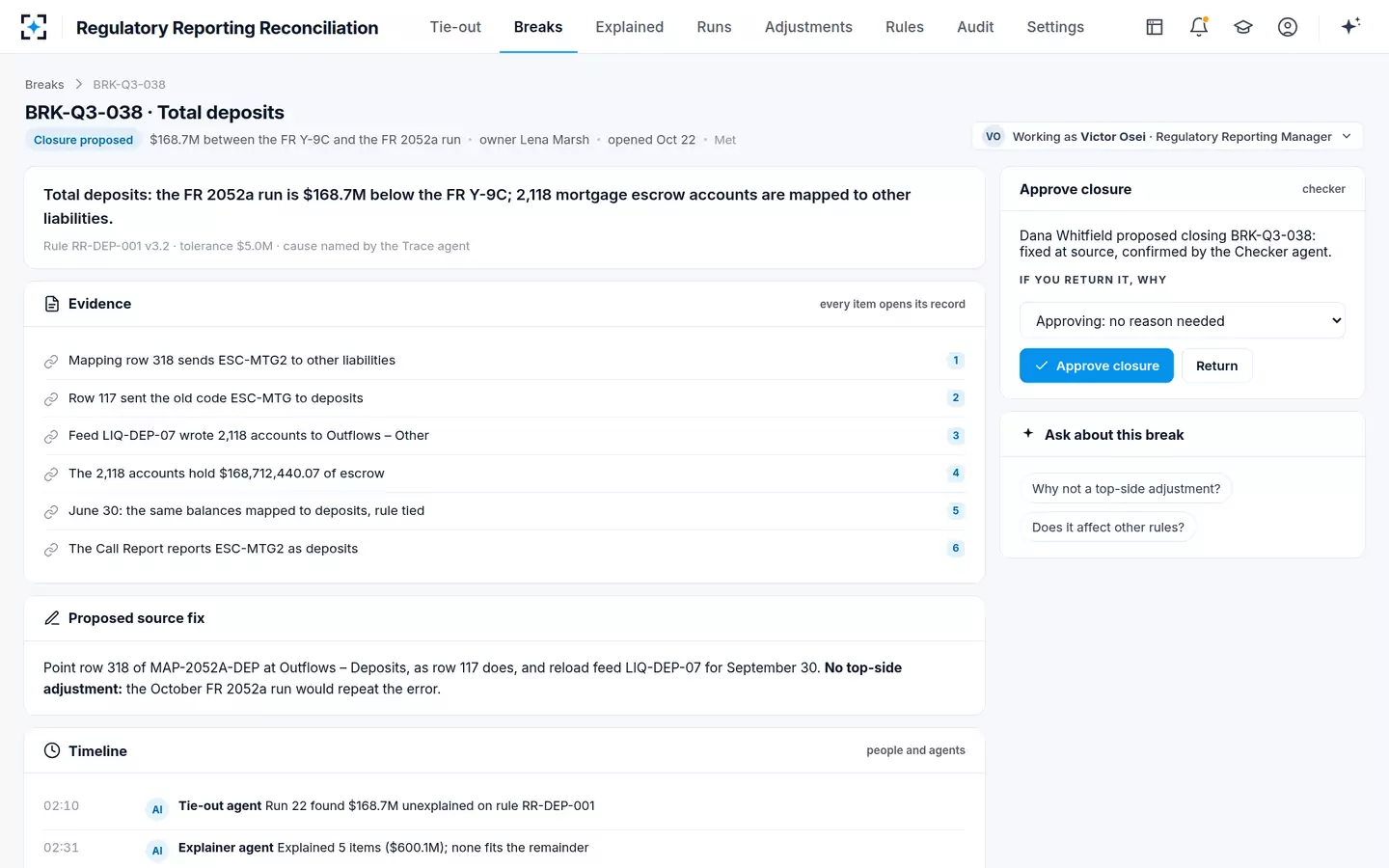
Data reconciliation tools for data quality and data audit: what examiners test
For data quality and data audit, examiners test whether the bank's controls catch errors in what flows into the reports, not whether it owns a tool. In the OCC's description of quality control, "a reviewer assesses the accuracy of information from manual or automated data feeds before the report's filing", and its examination procedures send examiners through the work papers behind each line item and supporting schedule to test whether the reported figures are accurate (quoted in call report preparation, followed for one figure). A reconciliation tool helps on both counts only if its own output can be audited: which rule, which version, which sources, who decided.
The Basel Committee's principles for risk data, written first for the largest, globally systemic banks, set the same balance in one sentence: "There should be an appropriate balance between automated and manual systems. Where professional judgements are required, human intervention may be appropriate" (BCBS 239, paragraph 38). They also expect an inventory of the validation rules applied to quantitative information. A cross-report rule library with versions and owners is that inventory for regulatory reports; how to test that the rules and agents actually catch errors is a separate exercise, worth running before go-live.
What to ask before you buy data reconciliation tools
The useful questions are about evidence and roles, not features. A demonstration on clean data will tie; what separates tools is what happens to the difference that does not.
Nine questions for any data reconciliation tool for regulatory reports
- Does every value open its source?
Not a cell in a workbook: the general ledger balance, the report line, the journal or memo behind an explanation.
- Can it run your cross-report rules as formulas over report codes?
Including the agencies' own comparisons, such as the FR 2900 to Call Report interseries items.
- Does it re-derive recurring explanations, or carry them forward?
A copied item can hide a break; ask what happens when one moves against its basis.
- Can it trace a remainder to accounts, read-only, with customer data masked?
The trace is where days go; masking is where privacy officers say no.
- Who can send, close and approve, and can the tool approve its own output?
The answer should be people, under maker and checker, and no.
- Does it change any figure in any report?
It should not. Fixes belong in the source; adjustments belong to people.
- How is a change to a rule or an agent tested and approved?
Against a known set of past breaks, with a second approver and a version.
- What does it do when a feed is late or an instruction changes?
Rerun held rules, and show which rules a new instruction touches.
- What can an examiner or internal audit export?
Rules with versions, runs, breaks with sign-offs, adjustments with maker and checker, masked.
A remainder traced to its cause, read-only and masked
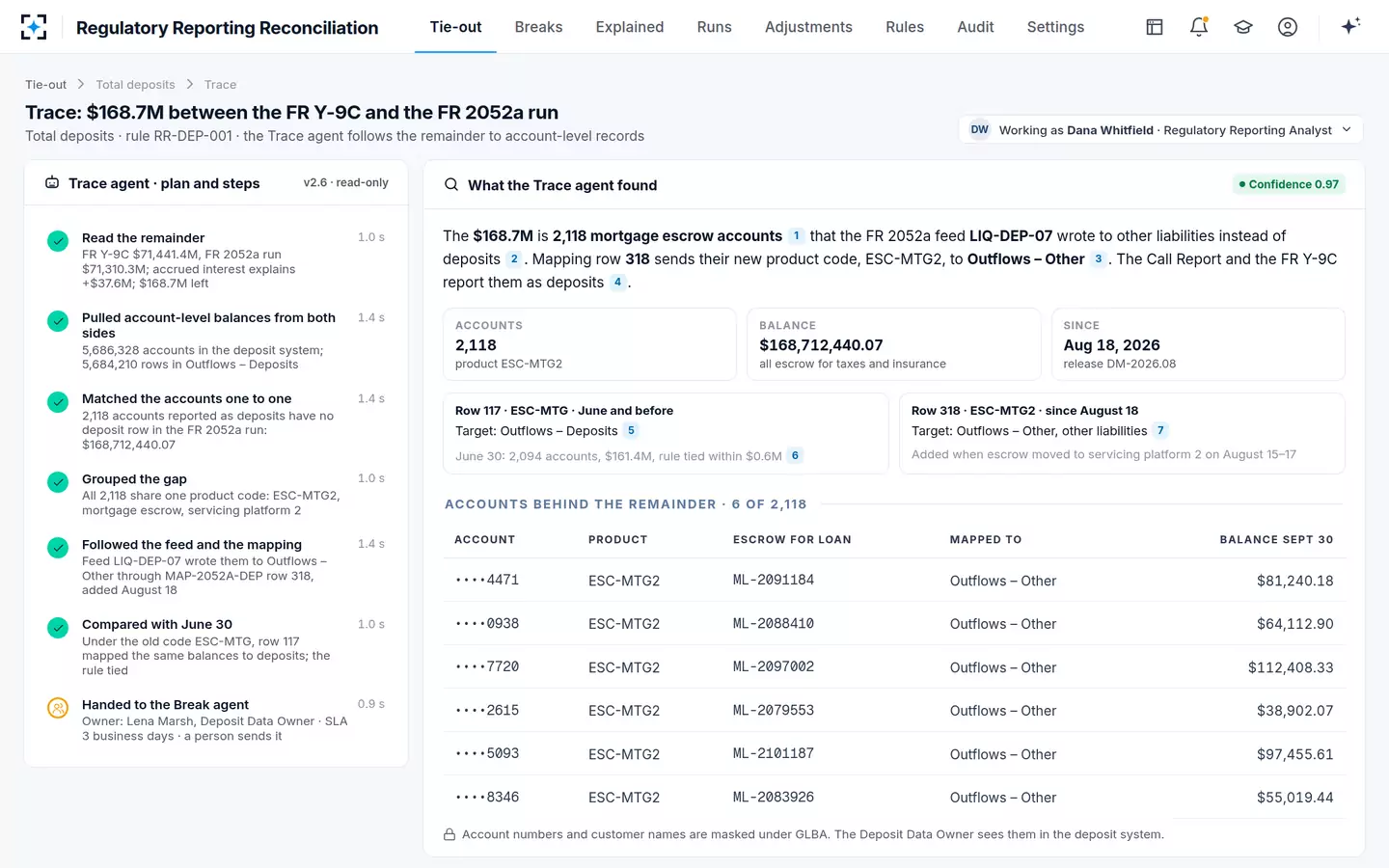
Where Regulatory Reporting Reconciliation fits among reconciliation tools
Regulatory Reporting Reconciliation fits a bank or holding company that files several of the Call Report, the FR Y-9C, the FR 2900 and the FR 2052a and has to prove each quarter that they agree with the general ledger and with each other. It reads the drafts from the existing regulatory reporting system and the source systems, and it does not prepare, change or file any report. Banks still need a reporting system to produce the reports; this sits beside it.
It is not a cash or account reconciliation product for operations. Matching a correspondent account statement, balancing ATMs and tellers, or reconciling custodial accounts for fintech partners are different problems with different owners; reconciliation software for banks at the ATM and teller level and AI for bank reconciliation of FBO accounts cover those. And it depends on things only the bank can bring: the cross-report rules it already ties, the known reconciling items with their basis, and a named owner for every source system. What a bank brings to a reconciliation project lists them. To see the agents on the sample bank's close, start from Regulatory Reporting Reconciliation.
Questions people ask
Can AI do reconciliations?
It can do most of the reading: running rules, finding the source that explains a known difference, matching account-level files and drafting the result. It should not decide that a break is closed or that an adjustment is acceptable. Regulators who use AI on filed data describe the same split: in the GAO's 2025 review, they said they were not using it to make decisions autonomously.
What is the best data reconciliation tool for regulatory reporting?
The one that can show, for any difference, the source that explains it, the accounts behind what is left and the person who approved the outcome. Matching speed matters less, because the rule run is a small share of the work. Ask to see a remainder traced and a closure approved on your own last quarter, not a clean demonstration.
Do reconciliation tools satisfy examiners?
Examiners assess controls and data flows, not tools. The OCC's booklet expects independent reconcilements, separation of duties and periodic testing of data flows; a tool satisfies examiners only if its output lets them see who prepared, who reviewed, from which sources, and what changed when an error was found.
Is a cross-report rule a model under the model risk guidance?
A deterministic comparison is not: the April 2026 guidance excludes "simple arithmetic calculations" and deterministic rule-based processes from its definition of a model. Agents built on generative models are outside that guidance's scope altogether, pending a promised request for information, so banks govern them under their own policies.
Can data reconciliation tools fix the source data?
They should not. A fix in the deposit system, the loan subledger or a mapping table changes every report built on it, so it belongs to the system's owner under change control. A tool can propose the fix and check afterwards that it landed, which is how the sample bank's checker agent confirms a closure.