A claims data analyst in a property and casualty insurer prepares, explains and defends the claims data that other people rely on: the quarterly claim and payment extract, the coding tables that map each coverage to a line of business, and the log of system changes that quietly alters both. For reserving, that makes the seat decisive. Whether next quarter's loss triangles are right is settled when the extract is cut, long before a reserving actuary selects a single development factor. The work is hard because nothing in an extract announces its own errors: a recoded coverage, a back-dated payment batch or a renumbered claim still loads, and company totals still look close. Botminds' Reserving Data Validation is a data quality solution for actuaries that checks each claim extract before it becomes a triangle, and it sends every break to this seat with the claims behind it.
The examples below come from a fictional mutual insurer's third-quarter 2026 extract as it runs through the solution: 486,215 claims and 3,118,440 transactions in nine reserving segments, compared claim by claim with the extract locked the quarter before. The standards and research are linked where they appear.
Where a break travels: from the extract to the claims data owner, and back
Agent
Extract profilerReads the extract as it lands: counts, totals, open-claim roll-forward, negative case reserves, reopened claims and dates, per segment.
Never: edits the extract
Agent
Quarter-on-quarter comparerMatches every claim to the same claim in last quarter’s locked extract and lists what moved: line, dates, state, cause, catastrophe code, vanished claims.
Never: calls a change expected without a cited change-log entry
Agent
Change-log readerTies each break to the change ticket and coding-table row behind it, quoting the passage, or says the cause is unknown.
Never: infers a cause it cannot cite
A person decides
Claims data ownerConfirms the cause, fixes the source where the source is wrong, and says whether a fix is coming or the change is permanent.
A person decides
Reserving actuaryDecides what reaches the triangles: release, restate for reserving, or hold the segment until the source is fixed.
What does a claims data analyst do in insurance?
A claims data analyst turns the claims system's transactions into data that finance, actuarial and management can use, and answers for it when it looks wrong. The title covers two different jobs. In health insurance it usually means analysing medical claims for cost, utilisation or provider patterns. In property and casualty insurance, the seat this guide is about, it means owning the claim and payment data that feeds the general ledger, the annual statement and the reserving team's triangles.
The core of the week is unglamorous and exact. The analyst cuts the extract at the valuation date and checks that it is complete, keeps the coding tables that map coverages and causes of loss to reporting lines, tracks what the claims platform team changed and when, and reconciles claim data to finance's view of the same money. When a reserving actuary asks why a cell moved, the analyst is the person who can open the claims behind it.
The vocabulary is a trap of its own. Friedland's study text for the Casualty Actuarial Society warns that "incurred losses means different things to different people": to finance it is a period's payments plus the change in unpaid claims, usually including IBNR; to an actuary building a triangle it is cumulative payments plus case outstanding at a valuation date (Friedland, CAS, 2010). An analyst who knows which definition each requester means saves both sides a week.
Who prepares the data reserving actuaries use?
In most insurers the claims data or claims reporting team prepares the reserving extract, sometimes with an actuarial data team between it and the reserving actuaries. The actuarial standard on data quality is explicit about where responsibility sits when someone else supplies the data. ASOP No. 23 says the actuary "may rely on data supplied by others", subject to a review, and states plainly who answers for accuracy:
The accuracy and completeness of data supplied by others are the responsibility of those who supply the data.
Actuarial Standards Board, ASOP No. 23, Data Quality, section 3.5
That sentence is the claims data analyst's job description in one line. The actuary reviews the data for reasonableness and consistency; the supplier owns whether it is accurate and complete. Where the preparer is itself an actuary, the standard goes further: "If an actuary prepares data, or is responsible for the preparation of data, to be used by other actuaries in performing actuarial services, the actuary should apply the relevant portions of this standard as though the actuary were planning to use the data" (ASOP No. 23, section 1.2). How the review itself works, and what it does not require, is set out in ASOP 23 data quality in plain words.
Regulators expect the same chain to be visible at year end. The NAIC's 2026 guidance on actuarial opinions says reconciling "the data provided to the Appointed Actuary to Schedule P is not sufficient"; the data the actuary actually used must tie (NAIC Actuarial Opinion (C) Working Group, 2026). Every hand-off between the claims data team and the actuary is therefore a place where the tie can break.
What is a claims extract, and what has to travel with it?
A claims extract is a snapshot of every claim and every payment and reserve transaction through a valuation date, with the fields a reserving analysis needs: claim number, accident date, report date, line and coverage codes, state, cause of loss, catastrophe code, paid and case amounts, and status. It is what the reserving team builds this quarter's diagonal from.
An extract on its own cannot be checked. Four things have to travel with it, and the claims data analyst usually owns all of them:
- Last quarter's extract, locked. Without it, nobody can tell which claims changed line, date or amount since the triangles were last built.
- The coding tables, every version kept. A coverage-to-line mapping that changes in August explains a triangle that jumps in September.
- The system change and migration log. Claims platforms are migrated in waves and patched in between; each ticket is a candidate cause.
- The general ledger close. Paid in the quarter and case reserves by segment, so the extract can be tied to the money finance has booked.
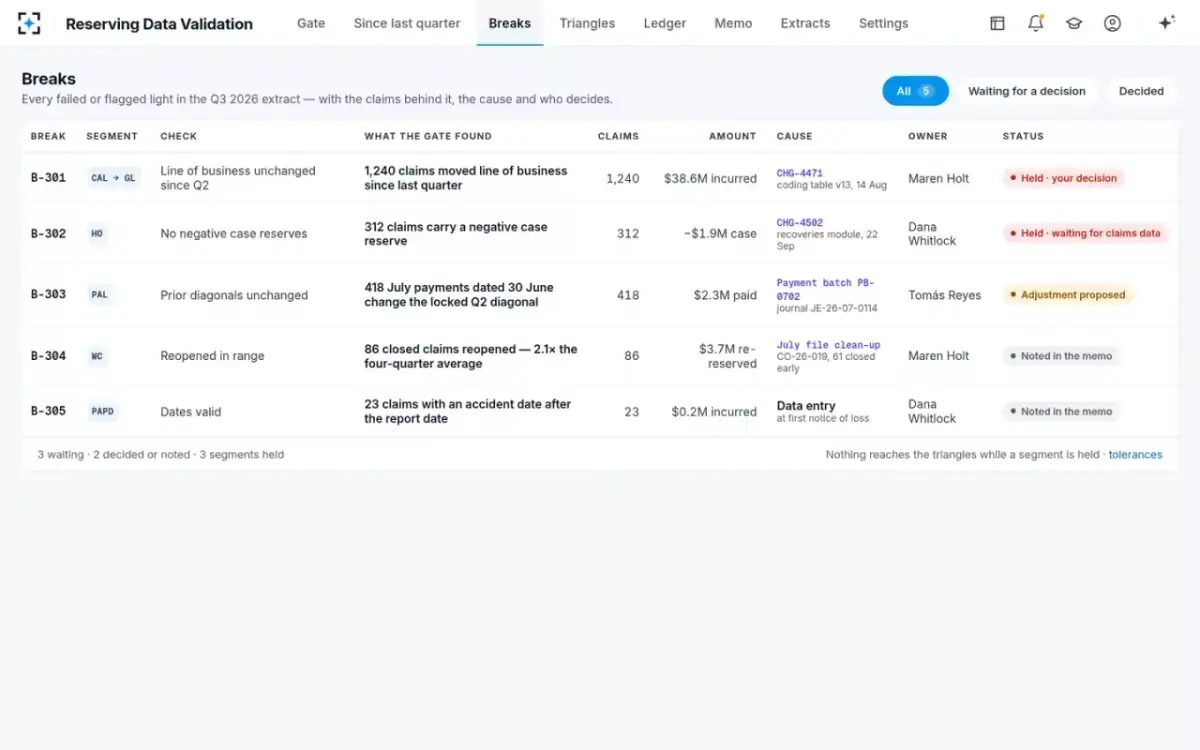
In the sample quarter, those four sources explained four of the five breaks before anyone asked a question. The fifth, 23 claims with an accident date after the report date, was entered that way at first notice of loss and went into the data memo as an item noted. How the same extract becomes a triangle, cell by cell, is in how to create a loss triangle from a claims extract.
Why do actuaries bring claims data questions to this seat?
Because reserving methods assume the past is consistent with the present, and only the claims side knows when it is not. Development methods project this quarter's diagonal from the pattern of earlier ones; a change in how claims are coded, closed or dated changes the pattern without changing the losses. The actuary sees the symptom in a factor. The claims data analyst knows the cause.
The profession has said this for almost fifty years. Berquist and Sherman's 1977 paper in the Proceedings of the CAS paired its reserving methods with an appendix of interview questions for each department, including data processing, and argued that "When such questions are directed to top management as well as underwriters, claims and data processing personnel, and accountants, they can yield invaluable insights into the interpretation of the history of losses which often could never have been obtained through the most sophisticated statistical analyses" (Berquist and Sherman, PCAS, 1977). Friedland's CAS study text reprints the list, updated, and it is still how many reserving reviews begin.
The questions a reserving team asks, and where the answers live
The questions are predictable, which is what makes the seat manageable. Most have an answer in a system the analyst already controls; the delay comes from finding which claims to look at. The updated Berquist and Sherman list asks a data processing or accounting executive, among other things, "How far back can the claims data be actively re-compiled by various key criteria?" and "How are claim payments handled for claims which have already been paid, but which have not yet been processed to the point where they can be allocated to accident quarter?" (Friedland, CAS, 2010, chapter 4).
Five questions actuaries bring to the claims data seat, and where each answer lives
| The actuary asks | Where the answer lives | What the analyst needs first |
|---|---|---|
| Why did a line’s incurred fall at one age and rise in another line? | The coding-table version history and the change ticket that moved a coverage | The list of claims whose line differs from last quarter |
| Why does last quarter’s locked diagonal no longer match? | Payment batches posted after the close and dated before it | The payments whose accounting date sits in a closed quarter |
| Why are some case reserves negative? | Posting rules for recoveries, and the release that changed them | The claims below zero and the date each went negative |
| Are reopened claims counted as new claims? | Claim numbering rules and the reopening workflow | The reopened claims, with original and current numbers |
| How far back can you recompile this split? | The warehouse history and any migration cut-over date | The first date each field was captured consistently |
In the sample quarter, each of those questions arrived already answered in part. The quarter-on-quarter comparer had listed 3,714 matched claims that changed something; 2,104 catastrophe codes added for a July hailstorm and a merger of bodily injury codes were tied to their change-log entries and passed as expected. One move held the segment: 1,240 claims, $38.6 million incurred, from Commercial Auto to General Liability after a coding-table change. The question to the claims data owner was no longer "why did the triangle jump?" but "is this mapping permanent?"
Every break with its claims, cause and owner
What skills does a claims data analyst need?
The seat needs three skills in roughly equal measure: query fluency, claims system knowledge and enough reserving to know which errors matter. SQL against the claims warehouse is the daily tool. Knowing how the claims platform stamps a line of business, assigns a report date to a reopened claim or posts a recovery is what turns a query into an explanation. And knowing that a recode in an old accident year moves an age-to-age factor, while the same count of claims in the latest year barely matters, is what lets the analyst rank a backlog.
The actuaries on the other side of the hand-off are a small, well-paid profession. The Bureau of Labor Statistics counts them separately; it does not count claims data analysts as an occupation of their own, so the figures below describe the people the analyst serves rather than the analyst.
The profession that consumes the extract
31,200
actuary jobs in the United States in 2025
$130,000
median annual wage for actuaries, May 2025
78%
of actuaries work in finance and insurance
9%
projected growth in actuary employment, 2025–35
Who fixes claims data errors, and who decides what reaches the triangle?
Two different people, and the distinction is the most useful thing a reserving team can write down. The claims data owner fixes the source: re-posts recoveries that landed in the wrong field, corrects a date, reverts a mapping. The reserving actuary decides what the triangle uses this quarter, which may be the source as it stands, a restatement for reserving only, or nothing at all until the source is fixed. The general ledger belongs to financial reporting, and neither side posts to it.
The sample quarter had one of each. The recode was a deliberate product decision on the claims side, with no back-conversion planned, so the source was right on its own terms and wrong for the triangle; the reserving lead restated the 1,240 claims to the prior coding for reserving and listed the adjustment for the appointed actuary. The 312 negative case reserves were a source error from a recoveries module change, so Homeowners stayed held and a drafted note went to the claims data owner with the claims and a due date.
The same extract, four seats: what changes when breaks arrive with their claims
Today
Asked why a triangle jumped, weeks after the extract, with no list of claims to look at.
With agents
Notified on the day the extract lands, with the claims, the amount and the change ticket the agents tied it to.
Still theirs: fixing the source and saying whether a change is permanent
Today
Builds triangles, then traces a jump back through spreadsheets when a factor looks wrong.
With agents
Receives each segment as extracted and as restated, with both rows of age-to-age factors.
Still theirs: preparing the analysis; releasing is not theirs
Today
Learns the data was wrong after the factors are reviewed.
With agents
Decides each held segment from the claims behind it before any factor is selected.
Still theirs: every release and every adjustment for reserving
Today
Sees the extract disagree with the general ledger with no claims to explain it.
With agents
Sees each difference to the general ledger named by a break, or marked unexplained.
Still theirs: signing the general ledger tie-out
How the seat changes when every break arrives with its claims
The work moves from detective to decision. By hand, the claims data analyst hears about an error when an indication looks odd, often in the third week of a reserve review, and spends days reconstructing which claims moved. In the sample insurer's history, a general liability jump found in week three of a quarter cost six days of rework; the four quarters checked by hand took 16 to 21 days from extract to released triangles. With the checks run on landing, the same team released triangles in one or two days in each of the next three quarters. Those are fictional sample figures, and one day is the design target, not a measured result.
Three things make the difference for the claims data seat specifically. Every flag lists its claims, so there is no reconstruction. A change is called expected only when a change-log entry says so, which makes the claims platform team's tickets part of the reserving evidence and gives the analyst a reason to keep them complete. And the cause is quoted, not guessed: where nothing in the log explains a break, the agents say the cause is unknown and the question comes to the analyst as a question.
What changed since last quarter, claim by claim
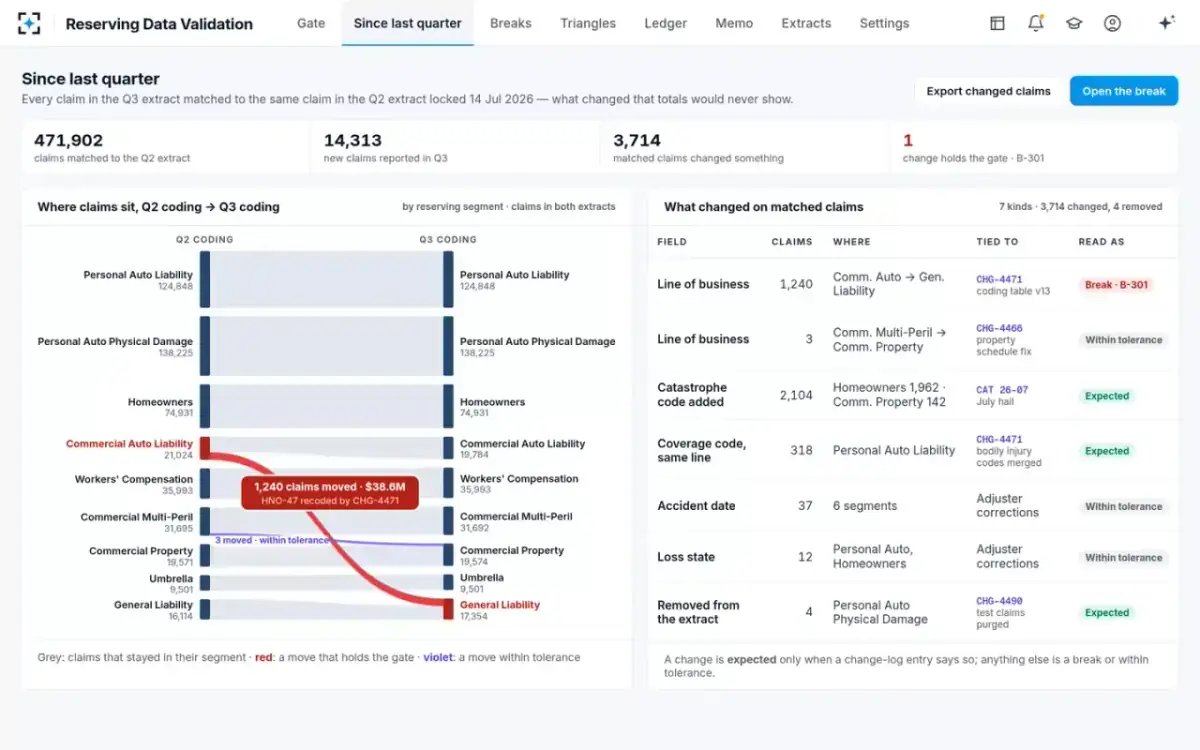
Migration quarters are where the seat earns its keep. In the sample insurer's history, the first wave of a claims platform migration renumbered 3,880 personal auto claims, which would otherwise have looked like 3,880 closed claims and 3,880 new ones. The checks a reserving team should run before, during and after each wave are set out in the claims system migration guide for reserving, and the coding-table changes behind most line moves in line of business mapping. How the agents divide the checks, and what each is never allowed to do, is on the Reserving Data Validation page.
Questions people ask
Is a claims data analyst the same job in health insurance and in property and casualty?
The title is shared, the work is not. Health insurance claims data analysts mostly study medical claims for cost, utilisation and provider patterns. In property and casualty insurance the seat owns the claim and payment data behind the general ledger, the annual statement and the reserving triangles, so accounting and reserving knowledge matter as much as analytics.
Does a claims data analyst need actuarial exams?
No, but it helps to speak the language. If an actuary prepares data for other actuaries, ASOP No. 23 asks that actuary to apply the standard as though planning to use the data; a non-actuary preparer is not bound by the ASOPs, though the reserving actuary still reviews the data and discloses reliance on it.
What is a coding table in claims?
A coding table maps the codes the claims system stamps on a claim (coverage, cause of loss, product) to the categories reporting needs, such as an annual statement line or a reserving segment. Changing one row can move thousands of claims between triangles while company totals stay the same, which is why every version should be kept and dated.
How do claim system migrations affect actuaries?
A migration can renumber claims, change how reopened claims are counted, alter payment dates or drop fields, and each breaks the consistency development methods rely on. The NAIC's 2026 opinion guidance names changes in claim systems among the circumstances that can make it hard to reconcile analysis data to Schedule P.
What should a claims data analyst send with an answer to the reserving team?
The claims, not a summary: claim numbers, accident years, amounts, the field that changed with its old and new value, and the ticket or rule that caused it. A list the actuary can join to the extract turns a conversation into a decision about restating, holding or releasing a segment.