AI data validation tools for claims data do four jobs a reserving team used to do by hand or skip: profile every extract as it lands, compare each claim with the same claim last quarter, tie paid and case amounts to the general ledger, and read the system change log for the cause of each break. Done well, they find the recode, the back-dated payment batch or the vanished claim on the day the extract arrives instead of in week three of the reserve review. In reserving, though, the question a buyer should ask first is not what the AI finds but what it is never allowed to do. An agent that edits the extract, declares a change expected without evidence, or nudges a development factor has moved a judgment that belongs to the actuary. Botminds' Reserving Data Validation splits the work across six agents, each with a written limit, and holds any failing segment until a person releases it.
The limits below are the solution's configuration; the examples come from a fictional mutual insurer's third-quarter 2026 claim extract, 486,215 claims in nine reserving segments, as it runs through the solution.
Six agents, six limits: what each may do with a claims extract, and must never do
| Agent | May | Never | Leaves behind |
|---|---|---|---|
| Extract profiler | Count, total and profile every field; roll open claims forward; flag negative case reserves, reopened claims and impossible dates | Edit the extract | Each flag with the list of claims behind it |
| Quarter-on-quarter comparer | Match every claim to last quarter’s locked extract and list changes in line, dates, state, cause, catastrophe code, and claims that vanished | Decide a change is right or wrong; call it expected without a cited change-log entry | Changed claims by kind, each tied to a ticket or marked a break |
| General ledger reconciler | Tie paid in the quarter and case reserves to the general ledger by segment, and year-end incurred to Schedule P, Part 1 | Post or propose journal entries | Every difference named by a break, or marked unexplained |
| Change-log reader | Read the change and migration log and the coding tables; tie each break to the ticket and table row | Infer a cause it cannot cite | The quoted passage, or “cause unknown” |
| Triangle builder | Build paid and incurred triangles as extracted and as adjusted; price each break’s effect on factors and an all-year chain-ladder indication, for comparison | Select factors; send an unreleased segment to the reserving workbook | Both triangles and both rows of factors, side by side |
| Memo drafter | Draft the data memo from accepted adjustments and noted items, in ASOP No. 23 terms | Sign; include an adjustment no person has accepted | A draft for the reserving actuary to sign |
What are AI data validation tools, and what should they do with claims data?
"AI data validation tools" covers three kinds of product. Data-observability platforms learn the normal shape of a table and alert when volume, nulls or distributions drift. Assistant tools write validation rules or SQL from a plain-language request. Agent-based tools give separate models defined jobs, inputs and limits, and chain them into a review. All three can help; only the last is built to explain a break in terms an actuary can act on.
For reserving data the job is narrower and stricter than drift detection. The checks the actuarial literature asks for are specific: tie the data to financial statement figures, compare it with the data used last time and ask why it differs, look for questionable values such as negative paid amounts, and know how each field is defined (the eight-error test shows which kinds of tool catch which). A tool that flags "row count up 3%" has not done that work. A tool that says "1,240 claims moved from Commercial Auto to General Liability after coding table v13 went live on 14 August" has.
Can AI validate claims data for reserving? Six jobs, six agents
Yes, if validation means the review an actuary would do, and if every finding comes with its claims. Splitting the work into six agents is not decoration; it keeps each agent's inputs, outputs and limits small enough to test, and it means the agent that finds a break is never the one that explains it or the one that prices it.
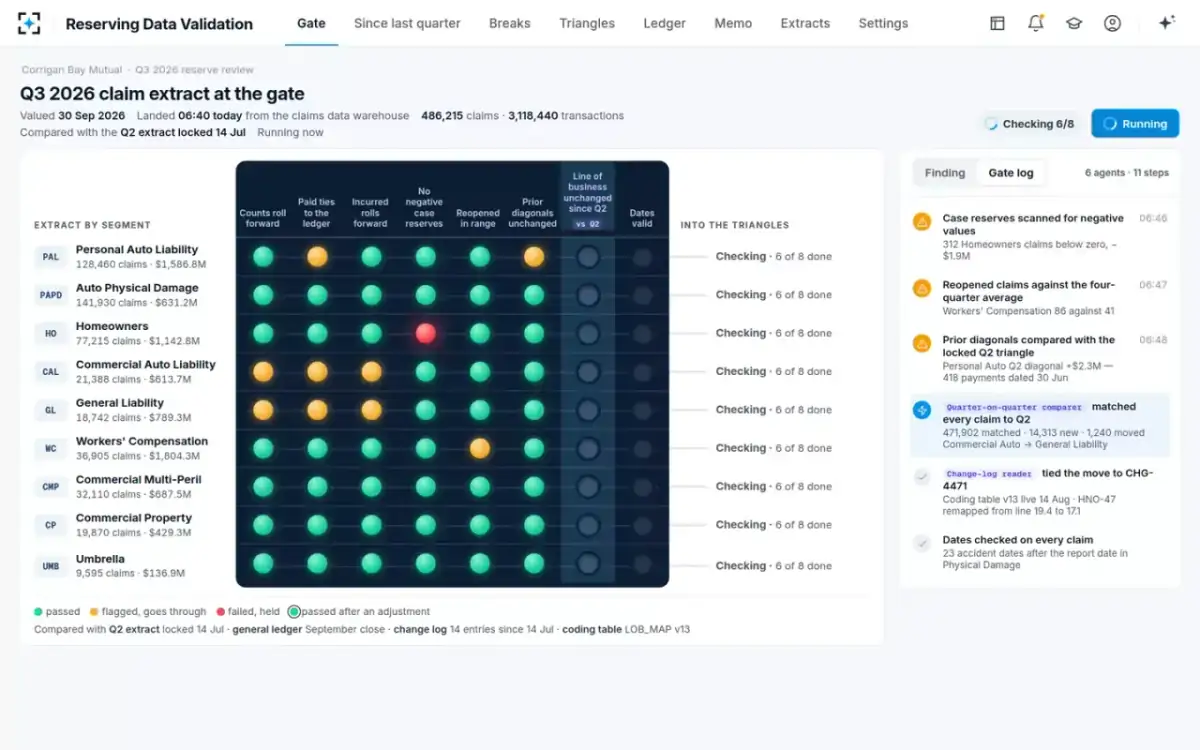
In the sample quarter the six ran in eleven minutes. The extract profiler flagged 312 Homeowners claims with negative case reserves (−$1.9 million) and 86 reopened workers' compensation claims against a four-quarter average of 41. The comparer matched 471,902 claims to the second-quarter extract, found 14,313 new claims and listed 3,714 that had changed something. The change-log reader tied the largest move to its ticket. The general ledger reconciler explained a $2.3 million Personal Auto difference to the September close by 418 July payments dated 30 June. Six segments went through; three were held.
The checks running, step by step, with each agent named
Should AI edit claims data?
No. The actuarial standard on data quality puts the accuracy and completeness of supplied data on the people who supply it (ASOP No. 23, section 3.5), and a tool that silently corrects the extract blurs that line and destroys the evidence of what was wrong. The source is fixed at the source, by the claims data owner, with a ticket. What the triangle uses this quarter is a separate decision.
That decision has a name in the standard: a judgmental adjustment to the data, which the actuary discloses in summary form. In Reserving Data Validation it is an adjustment the reserving actuary accepts, listed with its claims, amount, cause and approver. In the sample quarter the 1,240 recoded claims were restated to the prior coding for reserving as adjustment A-01; the claims system itself kept the new code, because no back-conversion was planned. The extract was never touched, and the locked prior extract stayed read-only.
How does AI compare two quarters of claims data?
By matching every claim, not every total. The comparer joins this quarter's extract to last quarter's locked extract on claim identity and compares the fields that decide where a claim sits in a triangle: line and coverage, accident date, report date, state, cause of loss, catastrophe code, and paid and case amounts by accounting period. Totals can tie while thousands of claims move, because a move out of one line is a move into another.
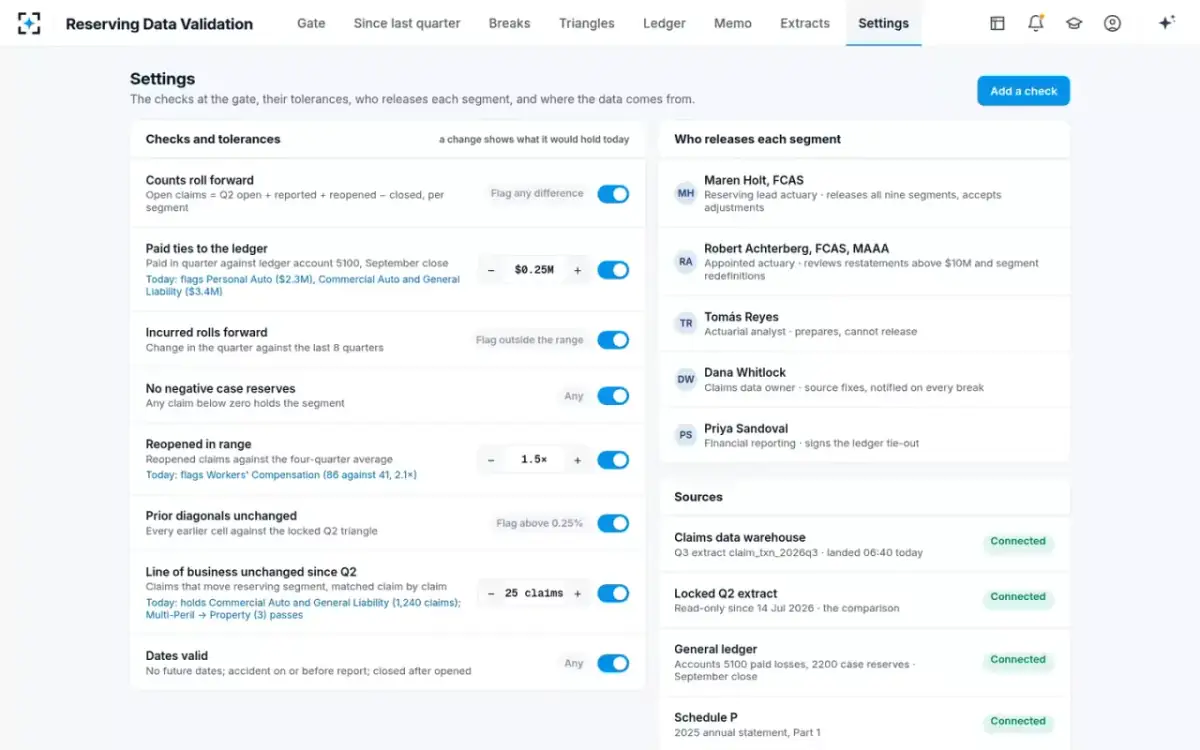
Two refinements make the comparison usable. Tolerances separate noise from breaks: in the sample configuration, a move of more than 25 claims out of a segment holds it, and a change of more than 0.25% in any earlier cell of the triangle is flagged. And expected changes need evidence: the comparer calls a change expected only when a change-log entry says so. In the sample, 2,104 catastrophe codes added for a July hailstorm, 318 bodily injury codes merged within the same line and four test claims purged were all tied to tickets; 37 accident dates and 12 loss states changed by adjusters were within tolerance.
Can AI find the coding change behind a break?
It can find the ticket that says so, which is different from guessing. The change-log reader searches the system change and migration log and the coding-table history for an entry that explains the claims in a break, and quotes it. Where nothing does, it says "cause unknown" and the break goes to the claims data owner as a question, not an answer.
The cause, quoted from the change ticket, and who decided
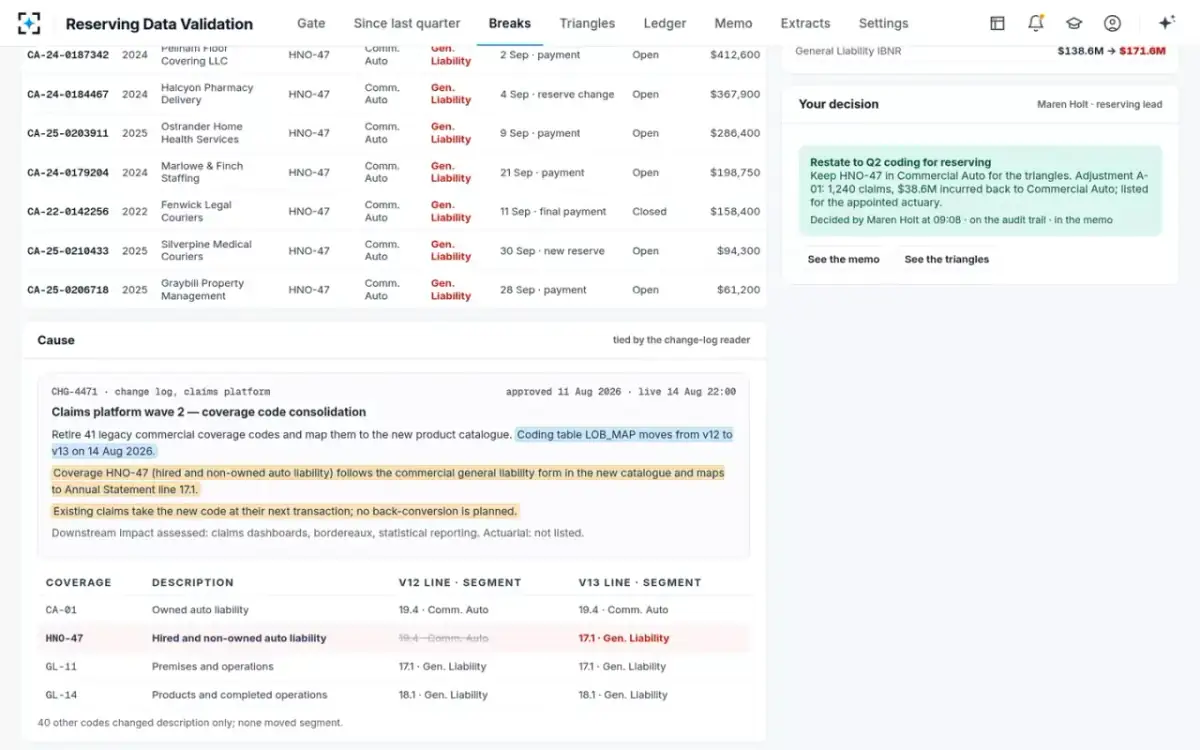
The sample ticket is a good example of why this matters. The claims platform team retired 41 legacy commercial coverage codes and remapped them to a new product catalogue. One of them, hired and non-owned auto liability, moved to a general liability line, and existing claims took the new code only at their next transaction. Half-migrated history is the worst case for a triangle: both segments now mix two codings, and the age-to-age factor for one accident year read 0.974 as extracted against 1.175 restated. How a recode like this moves indicated IBNR is worked through in line of business mapping.
Does ASOP 23 apply when AI checks the data?
Yes, and so does the modeling standard. The data the AI reads is data under ASOP No. 23, and the actuary still reviews it, compares it with the prior period and discloses what was done. The tool itself is a model. ASOP No. 56, effective for work on or after 1 October 2020, asks the actuary to check that a model's output fairly represents what it models (ASOP No. 56, section 3.6.2; quoted and applied to reserving tools in AI in actuarial reserving). The American Academy of Actuaries' professionalism committee applied that directly to generative AI in 2024:
GenAI is a model; thus ASOP No. 56 applies.
American Academy of Actuaries, Committee on Professional Responsibility, 2024
The same paper is blunt about accountability: the actuary answers for the work, including the decision whether and how to rely on an AI tool (Academy, Contingencies, 2024; what that means for documentation is in AI for actuarial documentation). It is professional commentary rather than a standard, but it describes what an appointed actuary will ask. Europe's supervisor says much the same in governance terms: EIOPA's 2025 opinion on AI makes the actuarial function responsible for the controls on AI used in its own area, and says that undertakings remain responsible for AI systems whether built in-house or bought (EIOPA Opinion on AI governance and risk management, August 2025). In the United States, insurers told the Treasury in 2024 that state insurance regulators oversee their use of AI (U.S. Treasury, December 2024); where states have adopted it, the NAIC's model bulletin on insurers' use of AI applies, and its adoption is tracked in the NAIC AI model bulletin adoption map.
In practice this favours tools whose output can be validated cheaply. A break that lists its claims can be checked by opening five of them. A finding that says "anomaly score 0.91" cannot.
Who approves a data adjustment, and what must the audit trail show?
The reserving actuary approves adjustments for reserving; larger ones go further. In the sample configuration only the reserving lead releases segments and accepts adjustments, the actuarial analyst prepares but cannot release, the claims data owner fixes the source, financial reporting signs the general ledger tie-out, and restatements above $10 million or any change to segment definitions are listed for the appointed actuary. The recode, at $38.6 million incurred, went to the appointed actuary with its claims.
One adjustment, from break to signed data memo
Agent
Break found and explainedThe comparer lists the 1,240 moved claims; the change-log reader quotes the ticket and the coding-table row.
Never: declares the move expected
Agent
Effect pricedThe triangle builder shows Commercial Auto and General Liability as extracted and as restated, with an all-year chain-ladder indication for comparison.
Never: selects factors
A person decides
Reserving actuary decidesRestate to the prior coding for reserving, accept the move as a true change and restate history in both lines, or send it back to claims data.
Agent
Memo draftedThe memo drafter adds the accepted adjustment with its claims, amount, cause and approver; open items are listed separately.
Never: signs, or includes an unaccepted adjustment
A person decides
Reserving actuary signs; appointed actuary reviewsThe memo is signed with the meaning “Prepared and reviewed”; restatements above $10 million are listed for the appointed actuary.
What to ask before buying AI data validation tools for reserving
Ask to see the limits, not the dashboard. A demonstration on the vendor's sample proves the interface; a run on two quarters of your own extracts, with a break you already know about, proves the tool. The questions below can each be answered on screen.
Eight questions for any AI data validation tool that will touch reserving data
- Does any agent write to the extract, the claims system or the general ledger?
The right answer is no. Fixes belong at the source; adjustments for reserving belong to the actuary.
- Does every flag list its claims?
A count or an anomaly score cannot be validated; a list of claim numbers can be checked in minutes.
- Is last quarter’s extract locked and read-only?
Without a frozen comparison point, a claim-by-claim comparison measures nothing.
- When is a change called expected?
Only with a cited change-log entry. A model that decides on its own what is normal will normalise the recode.
- What happens when no cause is found?
The tool should say “cause unknown” and route the question, not invent a plausible story.
- Who can release a held segment, and can that be configured?
Name the releasers, the reviewers of large restatements and the people who may only prepare.
- Can you see what a new tolerance would hold before saving it?
Tolerances are judgments; seeing their effect on today’s extract keeps them honest.
- What does it leave for the appointed actuary and the auditor?
A signed data memo, the adjustments with their claims, and a replayable log of every check and decision.
Tolerances and releasers are settings, and a change shows what it would hold
Where these tools do not fit is worth saying too. They review the data an analysis uses; they do not estimate reserves, select factors or replace the reserving software, and data validation software for actuaries sets out where the checks sit beside the tool a team keeps. Nor do they detect deliberate falsification, which ASOP No. 23 does not ask the actuary to find either. The full set of agents is on the Reserving Data Validation page.
Questions people ask
Are AI data validation tools the same as data observability tools?
They overlap. Observability tools watch tables for drift in volume, nulls and distributions, which catches broken pipelines. Reserving needs claim-level comparison with last quarter and a tie to the general ledger, because a recode can leave every distribution looking normal while moving claims between triangles.
Can AI find coding changes in claims data?
It can detect that claims changed line and find the change ticket or coding-table version that explains it, if the change log is available to read. In the sample quarter, the change-log reader quoted the ticket that moved coverage HNO-47 to a general liability line on 14 August; without that entry it would have reported the cause as unknown.
Does an appointed actuary have to disclose that AI checked the data?
ASOP No. 23 asks for disclosure of the data sources, the review performed, significant adjustments and reliance on others; the Academy's 2024 paper treats generative AI as a model under ASOP No. 56. How a tool's use is described is the actuary's judgment, but the review and any adjustments it led to belong in the actuarial communication.
What does AI data validation log?
A useful tool logs every check run with its inputs and result, every flag with its claims, every cause with the passage quoted, every tolerance change with its author, and every release and adjustment with who and when. That log is what lets an auditor or regulator replay the quarter.
Can AI data validation replace the reserving actuary's data review?
No. It does the finding and the arithmetic so the review can happen before factors are selected, but the judgments stay with people: whether a change is a true change, whether to restate, and whether a segment is fit to release. The actuary remains responsible for reliance on the tool.