Line of business mapping is the table that assigns each code an insurer's systems stamp on a policy or claim (product, coverage, form) to the categories reporting needs: the NAIC annual statement line, the Schedule P line, the reserving segment and often a statistical plan line. It looks like reference data, and it behaves like a lever. When one row of the coding table changes, every claim carrying that code can move from one line's triangle to another's. Company totals do not move, so control totals and the general ledger total still tie, but both triangles now mix two codings and their development factors are wrong in opposite directions. Only a claim-by-claim comparison with the extract used last quarter shows the move directly. Botminds' Reserving Data Validation, a data quality solution for actuaries, runs that comparison on every claim extract and holds any segment that loses or gains more claims than its tolerance allows.
The example follows a fictional mutual insurer whose coding table moved one coverage, hired and non-owned auto liability, from its commercial auto line to a general liability line during a claims platform migration.
Half a coverage moved: where one coding-table change left the claims
Hired and non-owned auto claims: 2,907
- Re-stamped to General Liability at their next transaction · 43%
- Still coded Commercial Auto · 57%
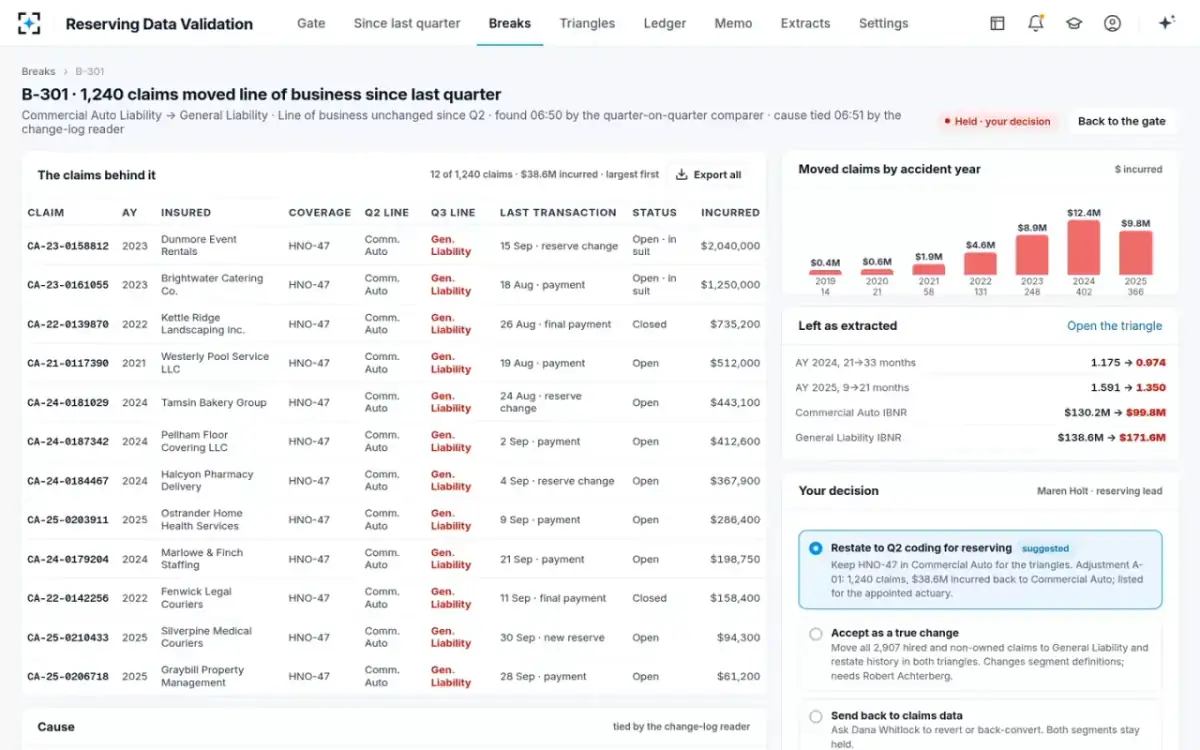
The 1,240 moved claims’ $38.6 million incurred, by accident year
- 2019–2022 · 19%
- 2023 · 23%
- 2024 · 32%
- 2025 · 26%
What is line of business mapping?
It is the crosswalk from operational codes to reporting categories, and an insurer usually keeps several. The NAIC's annual statement uses numbered lines of business. Its Uniform Certificate of Authority Application matrix lists them, among others "17.1 Other liability—occurrence", "17.2 Other liability—claims-made", "17.3 Excess workers' compensation", "19.3 Commercial auto no-fault (personal injury protection)", "19.4 Other commercial auto liability" and "21.2 Commercial auto physical damage" (NAIC UCAA Lines of Business Matrix). Schedule P groups business into its own, fewer lines, and the reserving team chooses segments that suit its analysis.
Mapping is rarely one code to one line. The NAIC's Uniform Property & Casualty Product Coding Matrix, effective 1 January 2026, maps each product filing type to annual statement lines and shows how often one product spans several. Its notes also warn that "States may require annual statement to be completed differently from the recommendation" (NAIC Product Coding Matrix, 2026).
One product, several lines: examples from the NAIC Product Coding Matrix
| Product filing code | NAIC annual statement line(s) | What it shows about mapping |
|---|---|---|
| 20.0001 Business Auto | 19.3, 19.4, 21.2 | One policy feeds three lines: no-fault, other liability and physical damage |
| 05.0000 Commercial multiple peril, combinations | 5.1, 5.2, 17 | Property and liability portions split; some liability can sit in other liability |
| 16.0002 Employers liability, workers’ compensation | 16 | As an endorsement or within a statutory workers’ compensation policy |
| 17.0009, 17.1009, 17.2009 Employers liability | 17 | The same coverage written stand-alone or as an endorsement to a package policy goes to other liability |
| 16.0003 Excess workers’ compensation | 17 | Filed under workers’ compensation, reported on an other liability line |
| 17.0020, 17.1020, 17.2020 Commercial umbrella and excess | 17 | Other liability, with separate filing codes for occurrence and claims-made forms; excess workers’ compensation excluded |
How do annual statement lines map to reserving segments?
Through the insurer's own coding table, usually in two steps: coverage code to annual statement line, then line (or coverage directly) to reserving segment. The segments rarely match the lines exactly. A reserving team may split a line by state or limit to get homogeneous data, or combine lines that develop alike; the Academy's practice note on loss reserve opinions describes both cases and how each is reconciled back to Schedule P (Academy practice note, 2025; the Schedule P reconciliation guide follows it in detail).
The sample insurer's coding table shows the usual shape, and the row that changed:
Four rows of one insurer's coding table, before and after a version change
| Coverage | Description | Version 12: line · segment | Version 13: line · segment |
|---|---|---|---|
| CA-01 | Owned auto liability | 19.4 Other commercial auto liability · Commercial Auto | Unchanged |
| HNO-47 | Hired and non-owned auto liability | 19.4 Other commercial auto liability · Commercial Auto | 17.1 Other liability—occurrence · General Liability |
| GL-11 | Premises and operations | 17.1 Other liability—occurrence · General Liability | Unchanged |
| GL-14 | Products and completed operations | 18.1 Products liability—occurrence · General Liability | Unchanged |
What happens when a coding table changes?
Claims move, and how many move depends on when the new code is applied. If every existing claim is converted at once, a whole coverage's history moves between segments in one quarter. If claims take the new code only at their next transaction, as in the sample (the change ticket said "Existing claims take the new code at their next transaction; no back-conversion is planned"), the move is partial: active claims move, dormant ones stay. Of 2,907 hired and non-owned auto claims, 1,240 had been re-stamped by the third-quarter valuation.
Partial moves are the worst case for a triangle. The locked earlier diagonals still hold all 2,907 claims in Commercial Auto; the newest diagonal holds only the unmoved ones. Commercial Auto's latest cells fall and General Liability's rise, so the ratios between the new diagonal and the old one, the age-to-age factors, are wrong in both lines. The profession's earliest systematic reserving review saw this coming. Berquist and Sherman listed, among the questions for a data processing or accounting executive:
Have there been any changes in coding procedures which would affect the data supplied?
Berquist and Sherman, Loss Reserve Adequacy Testing, Proceedings of the CAS, 1977
Their reason is the reason recodes matter: incurred projections assume case reserves are equally adequate from year to year, and paid projections assume claims settle at a steady rate (Berquist and Sherman, 1977; what that means on the claim desk is in case reserve adequacy). Hired and non-owned auto claims that settle and are reserved like auto claims, dropped into a general liability triangle, change both lines' mix, and with it both lines' patterns.
How do you detect claims that moved lines?
Compare every claim's line and segment with the same claim in last quarter's locked extract, and hold any segment where more than a set number moved without a change-log entry that says so. Totals will not show it, and nor will field rules, because the new code is a valid code. In the sample configuration a move of more than 25 claims out of a segment holds it; three claims moving from Commercial Multi-Peril to Commercial Property after a property schedule fix were within tolerance and passed.
Every claim matched to last quarter: where claims sat, and where they sit now
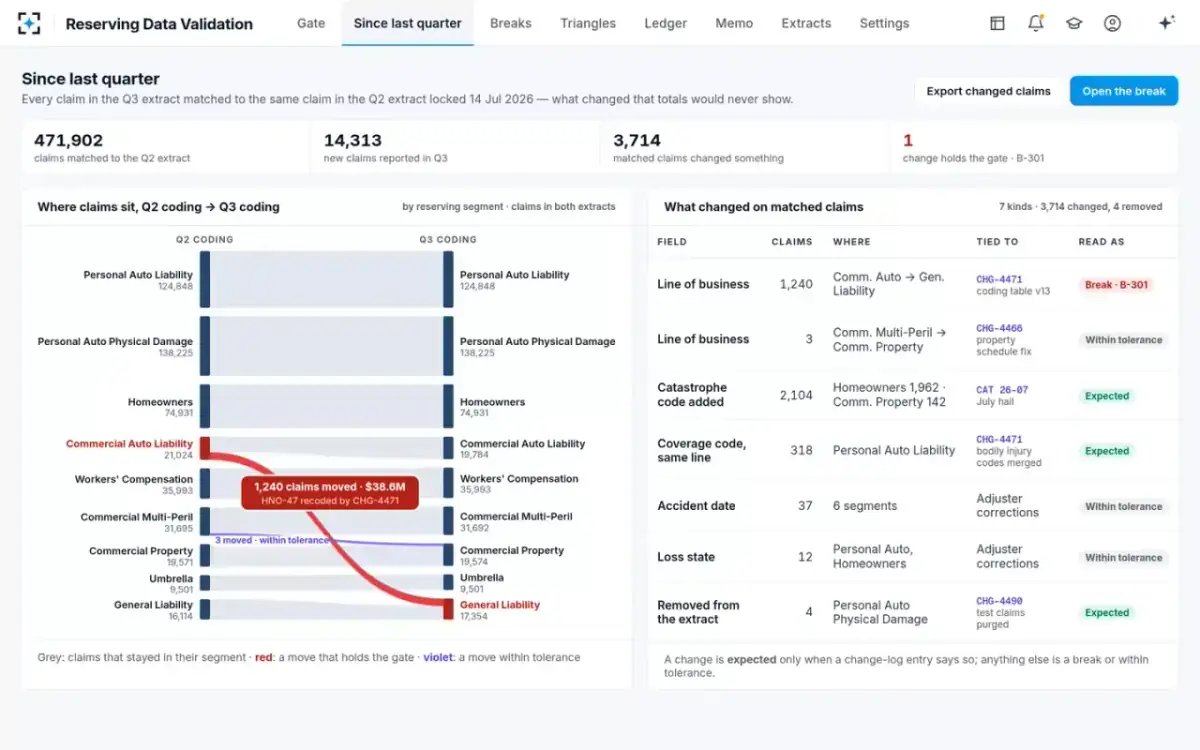
Two refinements keep the check useful. First, separate moves that change a segment from moves that do not: in the sample, 318 bodily injury coverage codes merged within Personal Auto Liability, a change that touched coding but not any triangle. Second, keep every version of the coding table with its effective date. A move with no table change behind it is a different problem, usually a data error or an adjuster's correction, and should be investigated as one.
Can a recode change IBNR? The arithmetic
Yes, often by more than the claims that moved. A chain-ladder indication multiplies each accident year's latest value by factors estimated from the triangle's history. A recode lowers the latest values in one line and the factors estimated from them, and raises both in the other, so the indicated IBNR moves in each line by more than the amount moved.
Indicated IBNR in two lines, restated and as extracted after the recode
The factor tells the story. For accident year 2024, Commercial Auto's incurred development from 21 to 33 months reads 0.974 as extracted against 1.175 restated: negative development no actuary would select. The moved incurred was concentrated in recent accident years, $12.4 million of it in 2024, where factors to ultimate are largest. That is why the amount moved understates the effect, and why the comparison has to happen before factors are reviewed, not after an indication looks odd. Reserving software will not object; it will simply project the mixed data. The seeded-error test shows which kinds of validation catch a recode and which do not.
Should triangles be restated after a recode?
Yes, to one consistent basis, but which basis is a judgment. ASOP No. 43 asks the actuary to consider significant changes in conditions that the experience data may not reflect, and gives as examples changes in the reinsurance programme and in how the company's claims staff work, where they are likely to move the estimate materially (ASOP No. 43, section 3.6.7; the claims side is covered in claims reserving best practices). A recode is a change in practice that is visible in the data, which makes it one of the easier ones to correct.
One recode, two legitimate views
What the claims system needs: The new product catalogue’s code, applied going forward; no back-conversion.
What the reserving triangle needs: One coding for every cell in the triangle, old or new.
What the claims system needs: Acceptable: dormant claims keep the old code until they move.
What the reserving triangle needs: Unacceptable: the latest diagonal and the earlier ones describe different populations.
What the claims system needs: None needed if the new code is right for claims handling.
What the reserving triangle needs: Restate the moved claims to the prior coding for reserving, or restate all history to the new coding.
What the claims system needs: Claims and product owners.
What the reserving triangle needs: The reserving actuary; a change in segment definitions also goes to the appointed actuary.
Restating to the old coding is quick and keeps segment definitions stable, but it must be repeated every quarter until the history is re-cut. Restating the history to the new coding is a one-off, but it changes what the segment means and needs every past extract with the coverage code intact. Either way, keep the triangle as extracted alongside the restated one. The choices, and who signs them, are set out for migrations generally in the claims system migration guide for reserving.
The moved claims, their amounts by accident year, and the decision
Who owns line of business codes?
Usually product or claims operations own the codes, finance or statutory reporting owns the mapping to annual statement lines, and the reserving team owns the mapping to segments. That split is where recodes slip through: each owner changes its part for good reasons and the consumers downstream learn from the data. The fix is procedural. Every coding-table change should carry a ticket whose impact assessment names actuarial, the table's versions should be kept with effective dates, and the reserving team should see the change before the extract does. In the sample, the ticket for the recode assessed claims dashboards, bordereaux and statistical reporting; actuarial was not listed.
How does Schedule P line mapping work?
The appointed actuary maps the analysis segments to Schedule P lines and reconciles through the map; the NAIC's 2026 guidance accepts that the two often do not correspond directly, but expects detail rather than a summary. A recode can therefore break two reconciliations at once: the triangles no longer match last quarter's, and, if the statutory line changed too, the segment-to-Schedule P map no longer describes the data. Keeping one coding-table history for both is the simplest protection. How the checks run on every extract is on the Reserving Data Validation page, and the claims data seat that usually maintains the coding tables is described in the claims data analyst guide.
Questions people ask
What is NAIC line of business mapping?
It usually means mapping an insurer's products or coverages to the NAIC annual statement lines, such as 17.1 other liability—occurrence or 19.4 other commercial auto liability. The NAIC's Uniform Property & Casualty Product Coding Matrix maps product filing codes to those lines, and its Uniform Certificate of Authority Application matrix maps the lines to each state's statutory lines of authority.
Can a recode change claim counts by line?
Yes. Moved claims leave one line's reported and open counts and join another's, so frequency and severity methods are affected as well as development methods. Open-claim roll-forwards fail in both segments: in the sample, Commercial Auto's open count missed its roll-forward by 639 claims and General Liability's exceeded it by the same 639.
What is the difference between a line of business and a reserving segment?
A line of business is a reporting category defined outside the company, such as an annual statement or Schedule P line. A reserving segment is a grouping the actuary chooses for analysis, which may split a line, combine lines or cut across them, so long as it can be mapped back to the statutory lines for reconciliation.
How often do coding tables change?
Whenever products, forms or systems change, which in a migration can mean several times a year. The number matters less than the discipline: every change versioned and dated, every change ticket listing actuarial among the affected teams, and every quarter's extract compared claim by claim with the last.
Does a line of business recode need to be disclosed?
If it led to a significant adjustment to the data, ASOP No. 23 asks for summary disclosure of the adjustment, and a material change in methods or segment definitions is explained in the actuarial communication. Keeping the adjustment's claims, amount, cause and approver in the data memo makes that disclosure short and checkable.