A liquidity risk analyst measures and explains a bank's ability to meet its cash and collateral obligations: each morning the analyst recomputes the early warning indicators, works out which deposits moved and why, re-runs the stress scenarios and hands the confirmed facts to the treasurer, who decides whether to watch, escalate or act. It is a hard seat because the facts live in five systems and arrive overnight, while the decision is wanted by mid-morning, and because three other people depend on what the analyst writes: the treasurer who decides, the liquidity risk officer in the second line who checks, and the CFO and ALCO who ratify. Botminds' Liquidity Risk Monitoring is an agentic solution built for that desk. Seven agents recompute, trace and draft before the analyst arrives; the analyst confirms the facts, the treasurer decides and the liquidity risk officer checks, with every reason written down.
The desk scenes below come from the solution's fictional sample bank, Corvane National Bank, a US regional bank of about $92 billion in assets, on Thursday, October 22, 2026; its people are fictional characters. The rules come from the banking agencies and the pay figures from the Bureau of Labor Statistics, linked where they appear.
The liquidity risk analyst's job in four numbers
$117,330
median annual wage of financial risk specialists, the occupation that includes risk analysts, 2025
66,000
people employed in the occupation in the United States, 2025
7%+
projected growth, 2025 to 2035: "much faster than average"
Monthly
the least often senior managers should see liquidity risk reports in normal times; the board, quarterly
What does a liquidity risk analyst do?
A liquidity risk analyst does four things: measures the bank's liquidity position, explains why it moved, stresses it, and reports it. The regulators' description of the work is close to a job description. The 2010 Interagency Policy Statement, still the base text for US banks, expects liquidity measurement to project the cash flows of every asset, liability and off-balance-sheet item over a range of horizons (the survival horizon guide quotes the sentence), and lists what the reports may carry: "cash flow gaps, cash flow projections, asset and funding concentrations, critical assumptions used in cash flow projections, key early warning or risk indicators, funding availability, status of contingent funding sources, or collateral usage" (Interagency Policy Statement).
In practice that list becomes a morning routine. The analyst pulls balances from the core banking system and ties them to the general ledger, reads payments from the payments hub, takes the stress cash flows from the ALM model, recomputes each early warning indicator against its warning level and limit, and writes a note. When an indicator moves, the analyst works out which depositors moved it, a job that at most banks still means tracing payments one client at a time. O*NET's task list for the occupation reads the same way in general terms: gather risk data from inside and outside the firm, "Devise scenario analyses reflecting possible severe market events," and report findings and risk positions with recommendations (O*NET 13-2054.00; what an ALM analyst does quotes the list for the interest rate side).
What the analyst does not do is decide. The policy statement asks banks to "clearly identify the individuals or committees responsible for implementing and making liquidity risk decisions," and in most banks that is the treasurer, with the CFO and the asset/liability committee above. The analyst's product is a set of facts that the person who decides can rely on.
Liquidity risk management in banks is four seats, not one
Liquidity risk management in banks is shared between at least four seats, and each one answers for something different. The board "is ultimately responsible for the liquidity risk assumed by the institution," the policy statement says, and senior management executes within "the lines of authority and responsibility designated for managing and controlling liquidity risk." Between those two sentences sits a desk: the analyst who confirms the facts, the treasurer who decides, the liquidity risk officer who checks, and the CFO and ALCO who approve and ratify. Internal audit tests the whole program from outside it.
The four seats in Liquidity Risk Monitoring, before and after the agents
Today
Builds the morning view by hand from the core, the payments hub and a spreadsheet, then works out who moved the money one client at a time.
With agents
Opens a 7:30 a.m. note with the move already traced to the clients and channels behind it, checks the citations, and confirms the facts by 8:15 a.m.
Still theirs: confirming or overriding each explanation, with a reason
Today
Gets a mid-morning report that says deposits are down, and has to ask who moved and why before deciding.
With agents
Decides on confirmed facts with the survival horizon and its what-ifs beside them, and records a reason code and a reason in the same step.
Still theirs: watch, escalate or act
Today
Hears about a tripped indicator after the fact and pieces the decision together from email and spreadsheets.
With agents
Checks the contingency funding plan notice before it goes, approves or returns every limit change, and sees the limit, the reading and the decision together.
Still theirs: the second-line check on escalations and limits
Today
Want one liquidity number that treasury and risk both trust.
With agents
Receive every decision with its reason and a weekly liquidity summary, with depositor cohorts rather than client names.
Still theirs: approval of any funding action; ratifying limits
The separation is the point. In the sample bank, nobody checks their own proposal: the treasurer decides only on facts the analyst has confirmed, a stage 1 notice from the contingency funding plan needs the treasurer's decision and the liquidity risk officer's check, and any funding action that moves money also needs the CFO. An agent's explanation can be overridden, but only with a reason code and a note.
What is the difference between treasury and liquidity risk?
Treasury runs the bank's funding and decides what to do about it; liquidity risk, in the second line, measures and limits that activity independently and challenges the decisions. The two are often confused because the analyst's measurement work can sit in either. Where it sits in treasury, the analyst is first line and a separate liquidity risk officer reviews; where it sits in risk, the analyst's numbers are the second line's own.
For large bank holding companies the separation is law. Regulation YY requires firms of $100 billion or more to keep a liquidity review function independent of the managers who execute funding, which must at least annually "review and evaluate the adequacy and effectiveness of the company's liquidity risk-management processes, including its liquidity stress test processes and assumptions" (12 CFR 252.34(d)). Smaller banks meet the same idea more simply: the policy statement says "Smaller, less-complex institutions may achieve independence by assigning this responsibility to the audit function or other qualified individuals independent of the risk management process."
What the second line adds is most visible when it is missing. The Federal Reserve's review of Silicon Valley Bank found, on interest rate risk, that the firm had no second line able to review and challenge its decisions and model assumptions (Federal Reserve, April 2023; the finding is quoted in what interest rate risk back-testing checks). The same review's list of 2021 liquidity findings includes one that reads like a job description for the liquidity risk officer: "Liquidity risk limits and supporting processes are insufficient for the size and complexity of activities."
Who decides to escalate a liquidity event?
The person the bank's contingency funding plan names decides, usually the treasurer or a crisis team the treasurer leads, and the plan should say so before the day it is needed. The FDIC's examination manual expects contingency funding plans to say who is responsible for what and who may decide, and to provide "a dedicated crisis management team and administrative structure" (FDIC RMS Manual, Section 6.1).
A named decision-maker is necessary but not sufficient: the decision is only as good as the facts in front of it. Signature Bank's last Friday shows the gap. The FDIC records that its president was still dismissing examiners' doubts about its uninsured deposits at noon on March 10, 2023, that the run started that afternoon, and that management struggled at first to work out how much it needed to borrow to send the waiting wires (FDIC, April 2023; the stress day, hour by hour quotes the FDIC's account). Authority existed; the facts arrived too late to use it well.
In the sample bank, escalation has three named steps. The treasurer chooses watch, escalate or act with a reason code. Escalating sends the contingency funding plan's stage 1 notice, which the agents keep drafted on standby but never send, only after the liquidity risk officer checks it. Acting, which uses contingent funding now, also needs the CFO's approval. How the plan itself is written and tested belongs to the bank's contingency funding plan work, set out in what a plan you can test must contain; the desk's job is to put the right facts in front of it in time.
Where the morning goes between the seats
Most of a liquidity morning is spent in hand-offs, not in judgement. The analyst waits for files, ties them out, rebuilds a spreadsheet, chases a payments trace through the hub, asks the ALM team for a what-if, then writes for the treasurer, who asks a question that starts the trace again. The flow below is the sample bank's morning after one indicator tripped overnight, with each step's owner.
One tripped indicator, from overnight files to a decision on the record
Agent
Feed Steward and MonitorCheck every file and the core-to-general-ledger tie-out, then recompute all 18 early warning indicators and the survival horizon by 6:55 a.m.
Never: fills a late feed with an estimate without marking it stale.
Agent
Concentration and ExplainerFind the cohort behind the move, trace 2,614 payments to the eleven clients behind 72% of it, and cite each settlement record.
Never: shows client names to a role not permitted to see them.
A person decides
Treasury risk analystOpens the cited records, confirms the facts at 7:52 a.m. or overrides an explanation with a reason. This is the maker step.
A person decides
TreasurerDecides at 8:21 a.m.: watch, with relationship calls by noon and a re-check at 2:00 p.m., reason code "Explained and contained".
Agent
Escalation and Record KeeperHold the stage 1 notice on standby, schedule the calls, and send the decision with its nine citations to ALCO.
Never: sends a notice, changes a limit or edits a recorded decision.
A person decides
Liquidity risk officerChecks the stage 1 notice before it can go, and approves or returns any limit change the morning prompts.
Botminds estimates the hours that morning would take by hand, task by task, at about eleven, and with the agents at a little over one hour of people's time, most of it reading and confirming. The estimate is ours, kept modest, and is shown below so a desk can compare it with its own.
Where an analyst's hours go on a morning with a tripped indicator
Liquidity Risk Monitoring's 7:30 a.m. note: what the analyst opens first
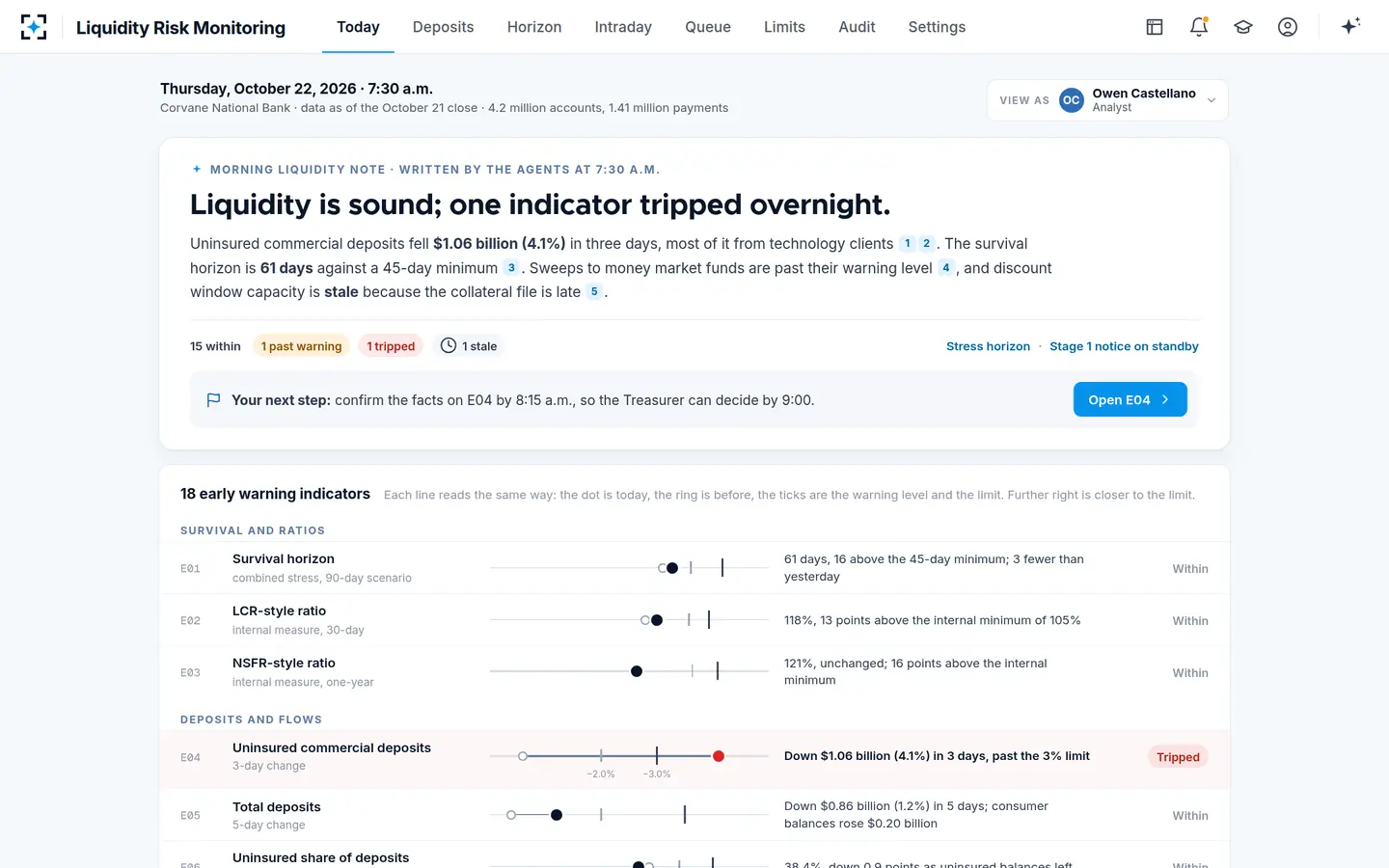
The note answers the first question of the morning before anyone asks it. The same morning traced minute by minute shows what each agent read and when, and where a person had to step in.
Why a 2010 reporting cadence no longer fits a 2023 run
The rules set a floor, not a pace. In normal times, the policy statement says, senior managers should see liquidity risk reports at least monthly and the board at least quarterly, and every institution should be able to report more often at short notice when it has to (ALCO meeting frequency quotes both sentences). The second expectation carries the weight now.
The runs of March 2023 were measured in hours. Silicon Valley Bank lost more than $40 billion of deposits on March 9, and Signature Bank was closed "within 53 hours of SVB's failure" (FDIC). The Federal Reserve's review drew the lesson for every desk: social media, a tightly networked and concentrated depositor base and technology together may have changed how fast a bank run moves (Federal Reserve; the 2023 liquidity risk example quotes the review). A monthly report is still the right cadence for the board. It is not a monitoring cadence.
Who sees liquidity information, how often the rules ask, and how often the sample desk works
| Seat | Rule or guidance floor | Sample bank practice |
|---|---|---|
| Board of directors | Liquidity risk reports at least quarterly; strategies and policies reviewed at least annually | Set by the bank's policy; limits are last approved by the board |
| Internal audit | An independent review of the liquidity risk management process, regularly | Tests the liquidity program twice a year; reads and exports, changes nothing |
| Senior management and ALCO | At least monthly in normal times; more often when needed, at short notice | Every decision with its reason; a weekly liquidity summary to ALCO |
| Treasurer | Set by the bank's policy | Daily note by 7:30 a.m.; a decision by 9:00 a.m. after any trip |
| Treasury risk analyst | Set by the bank's policy | Daily; facts confirmed by 8:15 a.m. after any trip |
| Intraday watch | Active intraday management for banks with material payment, settlement and clearing activity | Hourly; every 15 minutes on a stress day |
What does the second line do in liquidity risk?
The second line sets the limits with the board, checks every change to them, and checks escalations before they go. The liquidity risk officer does not run the bank's funding; the role exists so that the people who do cannot quietly move the line they are measured against.
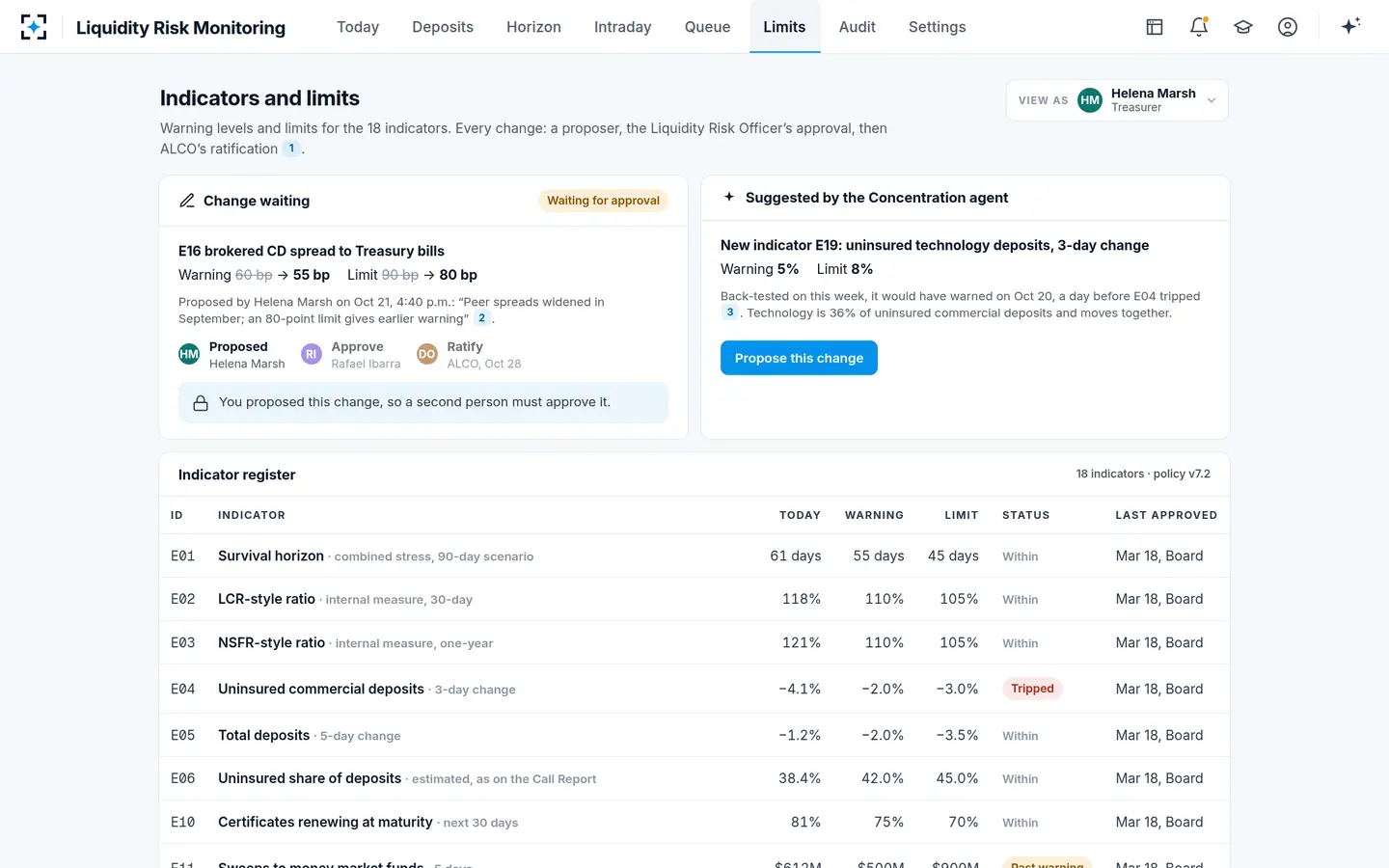
Signature Bank shows why that matters. The FDIC found that in 2021 the bank breached a 10 percent indicator for deposit growth from digital-asset clients and, instead of slowing the growth, raised the limit to 35 percent of total assets (FDIC, April 2023; early warning indicators, replayed on 2023 quotes the finding). A limit that moves when it is breached is a description, not a control. In the sample bank, a change to any warning level or limit needs a proposer, the liquidity risk officer's approval and ALCO's ratification, and the proposer cannot approve their own change. An indicator the agents suggest follows the same route.
A limit change waits for the second line, even when the treasurer proposes it
What skills does a liquidity risk analyst need?
A liquidity risk analyst needs cash-flow arithmetic, a working knowledge of how each kind of deposit and funding behaves under stress, enough of the bank's systems to know where a number comes from, and the judgement to write a sentence a treasurer can act on. O*NET places the occupation in Job Zone Four, where most jobs require a four-year degree and several years of related experience or on-the-job training (O*NET).
The rule book is part of the job. A US analyst should know the 2010 policy statement and its 2023 addendum on contingency funding, the FDIC, OCC or Federal Reserve examination manual for the bank's charter, and, at the largest firms, the Regulation YY stress-testing and buffer rules and the FR 2052a report; liquidity reporting in US banks covers that report's desk. The behavioural knowledge matters more than any formula. The FDIC's manual warns that uninsured business deposits are likely to react faster to signs of serious distress than uninsured retail accounts (FDIC RMS Manual); knowing which of the bank's depositors that warning describes is what makes a stress assumption defensible, and naming who moved the money is where that knowledge earns its keep.
A newer skill is reading evidence an agent has assembled. In the sample bank the Explainer agent cites every statement to a record and, below 70% confidence, shows a cause as a question for a person rather than as a fact. The analyst's job is to open the citation, judge whether the cause is right, and confirm or override it with a reason.
What the analyst still owns when agents do the arithmetic
The analyst owns the facts the treasurer decides on. Agents can recompute indicators, trace payments and draft the note; they cannot be accountable for whether the explanation is true, and the regulators expect a person to be. The OCC's spring 2026 risk perspective finds banks using generative and agentic AI mostly in narrow use cases, with guardrails and a person accountable for each outcome (OCC, Semiannual Risk Perspective).
The maker step: the analyst confirms the facts, and they go to the treasurer
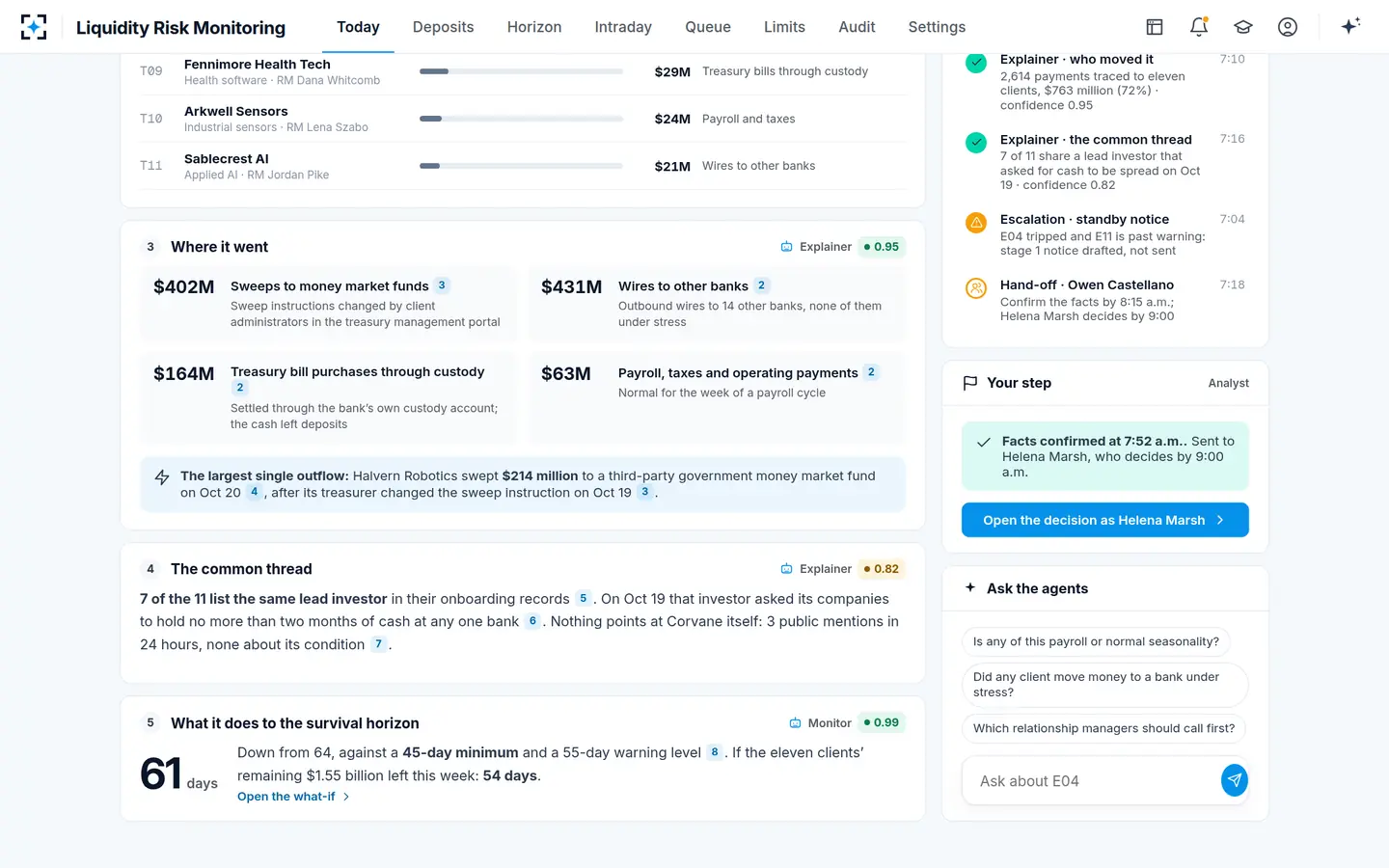
Three things stay with the analyst whatever the agents do. Judging a cause: seven of eleven clients sharing a lead investor is a strong thread, but whether it explains the move is a judgement. Knowing what the data cannot see: a relationship manager's call last week, or a rumour on a trade forum, is not in the payments hub. And saying no: an override with a reason is as much a part of the record as a confirmation. What moves the horizon after the facts are confirmed is worked through in how to calculate a survival horizon. The whole morning, seat by seat, is on the Liquidity Risk Monitoring page.
Questions people ask
What is a liquidity risk analyst job description?
A liquidity risk analyst projects the bank's cash flows over several horizons, monitors early warning indicators and limits, runs stress scenarios, explains movements in deposits and funding, and reports to treasury, the asset/liability committee and the board. Most postings ask for a finance or quantitative degree and several years of banking or treasury experience. The regulators' own list of what liquidity reports carry, from cash flow gaps to collateral usage, is a good checklist of the duties.
How much does a liquidity risk analyst earn?
The Bureau of Labor Statistics does not publish a separate figure for liquidity risk analysts; the closest occupation, financial risk specialists, had a median annual wage of $117,330 in 2025, with 66,000 people employed. Treasurers and controllers sit in the financial managers group, whose 2025 median was $166,570 a year (O*NET 11-3031.01).
Who sees liquidity reports, and how often?
Under the 2010 Interagency Policy Statement, senior managers should see liquidity risk reports at least monthly and the board at least quarterly in normal conditions, with the ability to report more often at short notice. In stress, the contingency funding plan should provide for more frequent and more detailed reporting, which the FDIC's manual says may mean daily computation of liquidity reports.
Is a liquidity risk analyst first line or second line?
It depends where the bank puts the role. An analyst in treasury is first line, and a separate liquidity risk officer reviews and challenges the numbers; an analyst in the risk function is part of the second line. Large bank holding companies must keep a liquidity review function independent of those who execute funding, under 12 CFR 252.34(d).
What does a liquidity risk officer do?
A liquidity risk officer is the second-line owner of the bank's liquidity limits and stress-testing standards: proposing and approving limits with the board, checking escalations under the contingency funding plan, and challenging assumptions such as deposit run-off rates. The role is the check on treasury's decisions, not the maker of them.
Will AI agents replace liquidity risk analysts?
Agents can take the mechanical part of the job, such as recomputing indicators, tracing payments and drafting notes, but the analyst remains the person accountable for the facts. The OCC reported in spring 2026 that banks mostly use agentic AI in narrow cases with guardrails and a person accountable; in the sample desk the analyst confirms or overrides every explanation before the treasurer sees it.