ALCO meeting frequency is not set by any regulation: the interagency guidance expects an asset/liability committee, where a bank has one, to monitor interest rate and liquidity risk actively, and the reporting clocks around it decide how often that has to happen. Liquidity risk reports go to senior managers at least monthly and to the board at least quarterly under the 2010 interagency policy statement; interest rate risk reports go to senior management and the board at least quarterly under the FDIC's manual; and policies, limits, key assumptions and the independent review of the measurement system come round at least once a year. A monthly committee is the simplest way to meet the monthly clock with one document. Botminds' ALCO Reporting keeps that calendar: it drafts the package to a set release lead time before each meeting, tracks every action to the next one, and leaves each decision with the committee.
The calendar example comes from a fictional sample bank, Tessaly Community Bank, as it runs through the solution; its dates and settings are sample data. The rule text is quoted from the agencies, linked where it appears.
A year of ALCO meetings, built from the clocks that require them
- Jan
- Feb
- Mar
- Apr
- May
- Jun
- Jul
- Aug
- Sep
- Oct
- Nov
- Dec
- Q1 board report
- Q2 board report
- Q3 board report
- Q4 board report
- Policies and limits
- Key assumptions approved
- Independent review reported
- Contingency funding plan tested
How often should ALCO meet?
ALCO should meet as often as its reporting clocks and its risk require, which for a committee that receives the monthly liquidity report means monthly, and never less than quarterly. The OCC describes the standard without a number: "Effective ALCOs meet regularly and include representatives from a variety of business lines to promote awareness" (OCC, Interest Rate Risk booklet). The number comes from the clocks.
The shortest of them is liquidity. "In normal business environments, senior managers should receive liquidity risk reports at least monthly, while the board of directors should receive liquidity risk reports at least quarterly" (Interagency Policy Statement on Funding and Liquidity Risk Management). If the ALCO is how a bank's senior managers receive those reports, as it is in the sample bank, then the committee meets at least monthly or the bank needs a second channel for the monthly report.
The clocks that set ALCO meeting frequency
1month
liquidity risk reports to senior managers, at least
1quarter
liquidity and interest rate risk reports to the board, at least
1year
policies, limits, key assumptions and independent review, at least
2days
business days between package release and meeting in the sample bank's settings
Is ALCO required to meet monthly?
No. Nothing in the federal guidance requires a monthly ALCO meeting; it requires monthly liquidity reporting to senior managers and quarterly reporting to the board, and it requires an ALCO, where there is one, to monitor actively. A bank can meet those with a quarterly committee if senior managers get the monthly liquidity report another way and someone is watching the limits between meetings.
The guidance also expects the frequency to rise with risk. The FDIC says that "At least quarterly, senior management and the board should review IRR reports. Institutions that engage in complex or higher risk activities should assess IRR more frequently" (FDIC RMS Manual §7.1). And the liquidity policy statement adds that "Regardless of an institution's complexity, it should have the ability to increase the frequency of reporting on short notice, if the need arises." A calendar is a floor, not a schedule the committee can hide behind.
How often does the board review interest rate risk?
The board reviews interest rate risk reports at least quarterly and reviews the policies and limits at least annually. The quarterly clock is the FDIC's, above. The annual one is in the interagency advisory, which gives the board or its delegated committee a yearly review of the strategies, policies, procedures and limits for interest rate risk (Interagency Advisory on Interest Rate Risk Management; the sentence is quoted in who signs the interest rate risk policy).
Two more annual items belong on the calendar. The OCC's examination questions ask: "Are significant model assumptions reviewed and approved by the board and ALCO at least annually?" And the FDIC expects the independent review of the measurement system at least annually, noting that "Procedures should be established for reporting independent review findings at least annually to the board or board-delegated committee." Credit unions have the same rhythm: NCUA's Appendix A asks the policy to state how often results reach the board, "current and at least quarterly" being its example, and asks the board to assess annually whether the program is working (12 CFR Part 741, Appendix A).
How often must liquidity be reported to the board?
Liquidity must be reported to the board at least quarterly, and to senior managers at least monthly, in normal conditions; in stress, more often. The board's own review of liquidity strategies, policies and procedures is annual: the policy statement says the board or its delegated committee should oversee them "and review them at least annually."
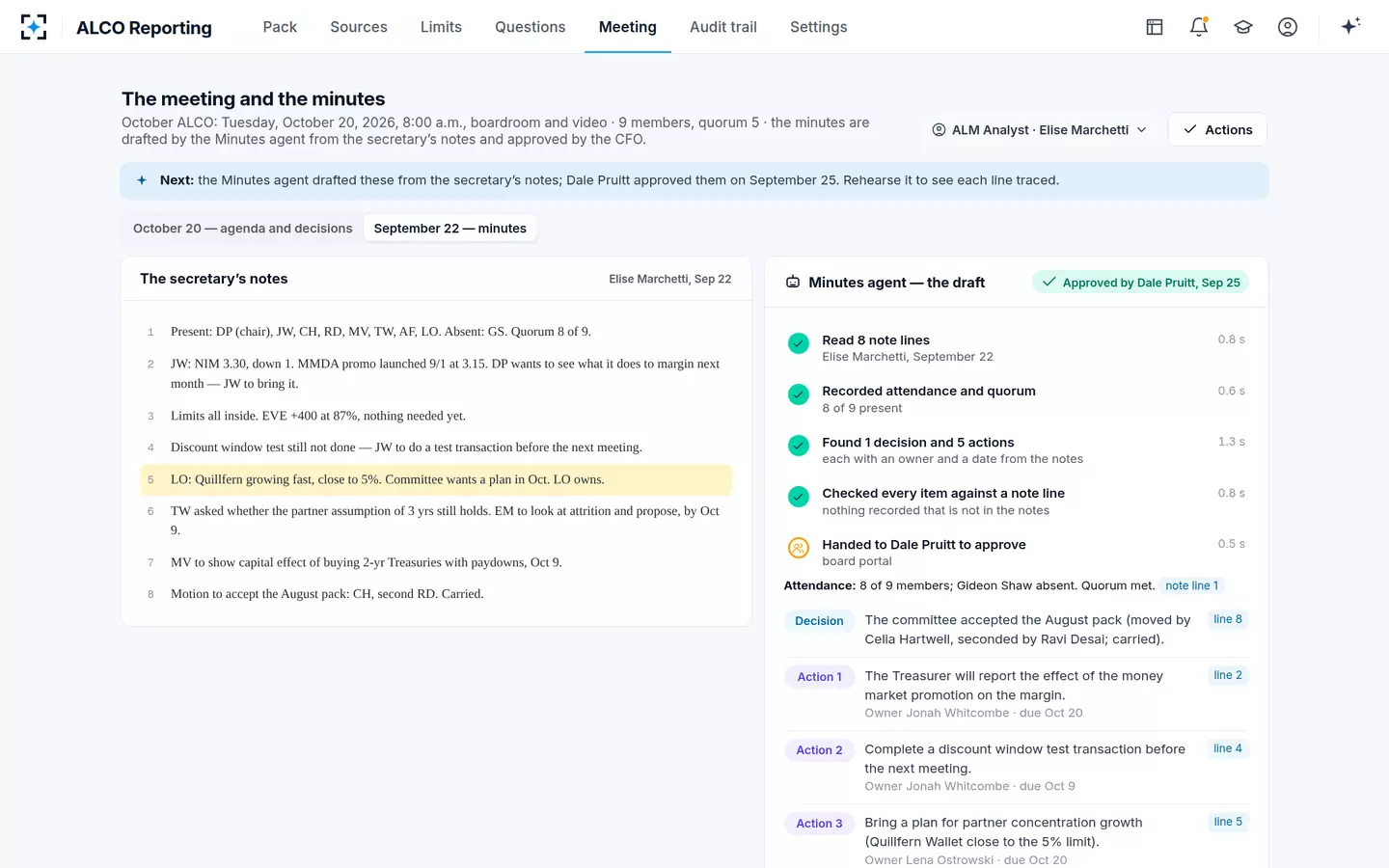
The contingency funding plan adds its own clock. The policy statement expects banks to "review and revise contingency funding plans periodically and more frequently as market conditions and strategic initiatives change", and NCUA's rule for credit unions with $50 million or more in assets requires the plan to state "The frequency that the institution will test and update the plan." When the plan is tested, the result belongs in an ALCO package; the sample bank's September minutes carried an action to complete a discount window test transaction before the October meeting.
Building the year's ALCO calendar from the clocks
To build the year's ALCO calendar, start from the board's meeting dates, work back to the ALCO meeting that feeds each quarterly board report, place the monthly meetings between them, and assign each annual item to one meeting so none is forgotten and no meeting carries all of them. Then work back again from each meeting to the release date and the date the general ledger closes.
ALCO meeting frequency, obligation by obligation
| Obligation | Clock | Source |
|---|---|---|
| Liquidity risk reports to senior managers | At least monthly; more often under stress | Interagency Policy Statement on Funding and Liquidity Risk Management (2010) |
| Liquidity risk reports to the board | At least quarterly | Same |
| Interest rate risk reports to senior management and the board | At least quarterly; more often for complex or higher-risk activity | FDIC RMS Manual §7.1 |
| Sensitivity to market risk reviewed by the board or a board committee | At least quarterly | FDIC RMS Manual §7.1 |
| IRR strategies, policies, procedures and limits | Annual review, overseen by the board | Interagency IRR Advisory (2010) |
| Liquidity strategies, policies and procedures | Reviewed at least annually | Interagency liquidity policy statement |
| Significant model assumptions | Reviewed and approved by the board and ALCO at least annually | OCC Interest Rate Risk booklet, examination questions |
| Independent review of the measurement system | At least annually, findings to the board or its committee | FDIC RMS Manual §7.1 |
| Contingency funding plan | Reviewed periodically; credit unions state their own test frequency | Interagency policy statement; 12 CFR 741.12 |
| Credit union IRR results to the board | "current and at least quarterly", as the example | 12 CFR Part 741, Appendix A |
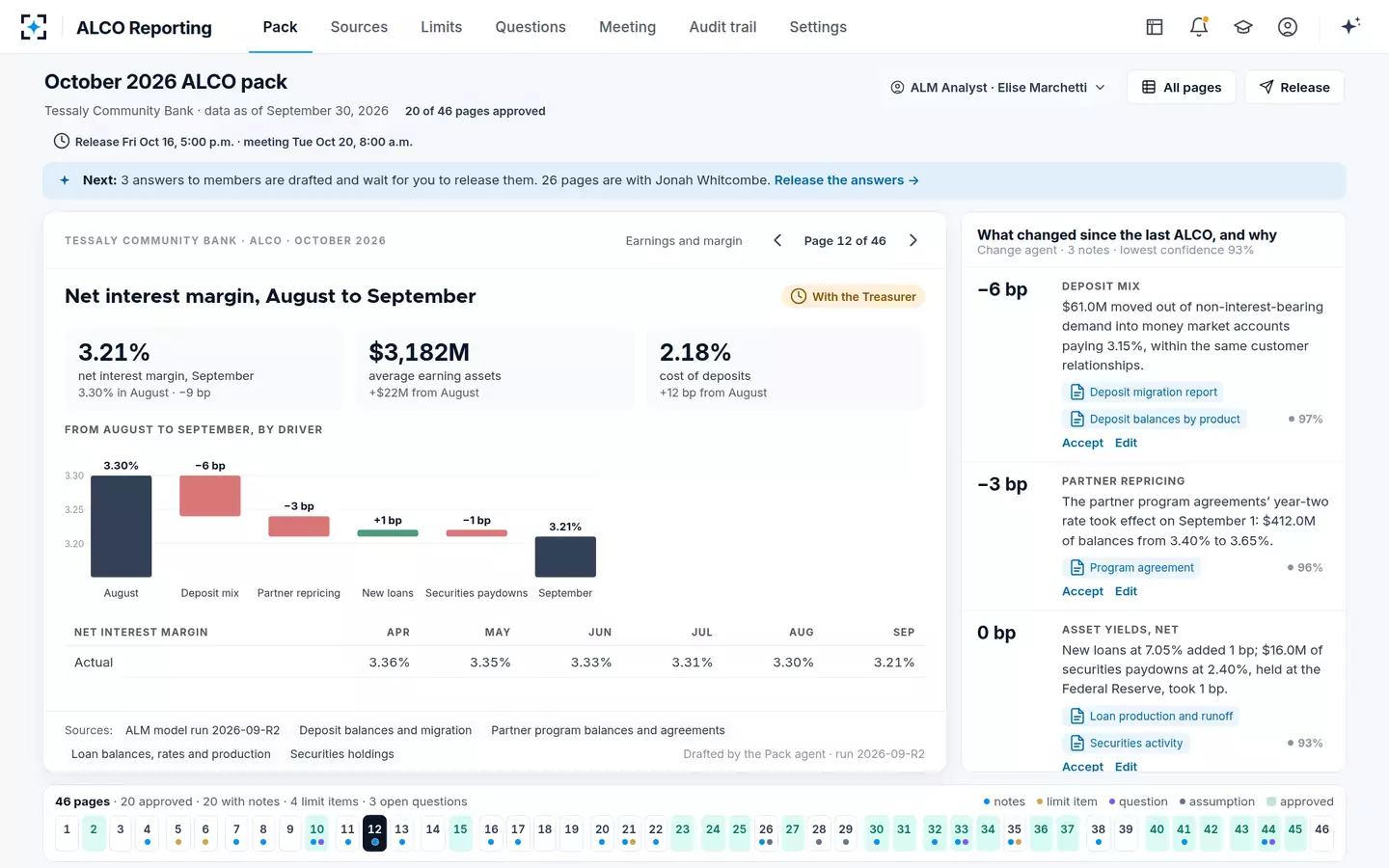
In the sample bank, the result is a monthly committee on the third Tuesday at 8:00 a.m., with the package released two business days before. October's meeting fell on Tuesday the 20th, on September 30 data, with the package due to members on Friday the 16th at 5:00 p.m. The setting allows the second Tuesday or a quarterly schedule instead, and a lead time of two, three or five business days; the choice is the committee's, saved with a reason when it changes.
The release and meeting times sit at the top of every page of the package
Can ALCO meet quarterly?
ALCO can meet quarterly at a simple institution if three conditions hold: senior managers still receive a liquidity report every month, someone monitors every limit between meetings with authority to call the committee, and the quarterly package shows each month's figures rather than only the quarter-end. Without the third, a quarterly committee sees three points a year fewer than a monthly one and loses the trend.
The risk in a long interval is not the meeting itself but what drops out of view between meetings. The Federal Reserve's review of Silicon Valley Bank found that "The ALCO was provided with sensitivity analysis that showed the impact of shifts in key model assumptions only on an infrequent basis" (Federal Reserve, SVB review, April 2023). A committee that meets often but sees the important analysis rarely has the same problem as one that rarely meets. Frequency should be judged by what the committee sees, as well as how often it sits.
What triggers a special ALCO meeting?
A special ALCO meeting is triggered when something the committee is responsible for moves faster than its calendar: a limit breach, a liquidity strain, a large rate move, a material change to the balance sheet or a significant new strategy. The guidance does not list triggers, but it sets the expectations they serve: excessive exposures should get prompt attention, significant exposure should be reported promptly to the board, and the contingency funding plan should "provide for more frequent and more detailed reporting as the stress situation intensifies."
Special-meeting triggers worth writing into an ALCO charter
- A board limit is breached
Cause, plan and owner before the next scheduled meeting, not at it.
- A measure passes its written-note level and keeps rising
The sample bank writes a note at 90% of a limit.
- A contingency funding plan stage is triggered
Reporting becomes more frequent and more detailed as stress intensifies.
- Unusual deposit outflows or concentration shifts
For example, a large depositor or partner moving balances in or out.
- A large market rate move between meetings
Measured against the shocks the board limits are set on.
- A significant new product, strategy or acquisition
The advisory expects their IRR implications integrated into the process.
- A material assumption change proposed mid-cycle
With its effect on limit usage shown before it is approved.
- An examination finding on interest rate or liquidity risk
So the committee owns the response from the start.
The trigger only works if someone is watching between meetings. In the sample, a partner's balances crossed the bank's 5.00% single-partner limit after it moved its settlement float on September 8; the September minutes had already assigned an owner for a concentration plan, and the October package carried the exception note with cause, plan and owner. How the minutes carry such an action from one meeting to the next is set out in ALCO meeting minutes, and the limits themselves in ALCO limits against 791 banks.
Does NCUA require an ALCO?
No. NCUA requires a written interest rate risk policy and an effective program for federally insured credit unions with more than $50 million in assets, and lets the board decide how to delegate. Appendix A says: "Where delegation of management authority by the board occurs, this may be to designated committees such as an asset liability committee or other equivalent. In credit unions with limited staff, these responsibilities may reside with the board or management."
Banks are in the same position. The OCC notes that "Less complex banks often assign these responsibilities to the chief financial officer or an equivalent-level senior management official", while others use "a committee of senior managers, sometimes called a finance committee or asset/liability committee (ALCO)" (OCC, Liquidity booklet). Without an ALCO, the clocks still run; they just land on the CFO and the board directly.
What does an ALCO committee do?
An ALCO committee monitors the bank's interest rate and liquidity risk against the board's limits, decides or recommends the actions that manage it, and reports to the board. The interagency advisory expects a committee that "actively monitors the IRR profile and has sufficiently broad representation across major functions that can directly or indirectly influence the institution's IRR exposure (e.g., lending, investment securities, wholesale and retail funding)." The OCC adds that "ALCO members should be senior managers with clear lines of authority over the units responsible for establishing and executing interest rate positions and should be a communication channel to their units."
The FDIC lists what an ALCO's policies should cover on the liquidity side: "assessing current and projected liquidity positions, implementing board-approved strategies, reviewing policy exceptions" and reporting to the board (FDIC RMS Manual §6.1). Put together, an ALCO's year is the calendar above: monthly monitoring, quarterly reporting to the board, annual review of policies, limits and assumptions, and special meetings when the clocks are too slow. What the committee reads at each meeting is laid out in the ALCO report sample.
Keeping the ALCO calendar with ALCO Reporting
In ALCO Reporting the calendar is a setting the administrator holds: the meeting day, the release lead time, whether pages are released as soon as they are approved, the early-warning and written-note levels, and retention. Each change is saved as a new version with a reason. The agents work to the calendar: the package is drafted on reconciled inputs in time for the Treasurer to approve it before the release date, members' questions are answered within one business day, and actions from the minutes appear on page 2 of the next package, with an overdue action escalated to the chair.
The meeting, its quorum and the minutes, on the committee's calendar
Questions people ask
What is the release lead time for an ALCO package?
No rule sets one. The sample bank releases its package two business days before the meeting and can choose three or five; it also releases each page to members as soon as the Treasurer approves it. A longer lead time gives members time to ask questions before the meeting; a shorter one leaves more time after the general ledger closes.
Should the ALCO meet before or after the board?
Before. The ALCO meeting that closes a quarter should come early enough for its package and minutes to feed the board's quarterly review, so it should be scheduled with enough time for the package and the approved minutes to reach the board before its meeting.
Does ALCO need to meet in person?
The guidance does not say; it asks for active monitoring and broad representation. The sample bank meets in its boardroom with a video link, and its quorum is counted on the attendance line of the minutes either way.
How often should ALCO review the deposit study and assumptions?
At least annually for approval, under the OCC's examination question, and whenever experience diverges. The sample bank reviews its back-test monthly, which is how a mid-year proposal to shorten an assumption reached the committee with its evidence.
Can the board act as the ALCO?
Yes, especially at small credit unions, where NCUA allows the responsibilities to "reside with the board or management". The board then carries the monthly liquidity clock as well as the quarterly one, which is usually the argument for delegating to a committee.