An ALCO report, often called the ALCO package, is the set of pages treasury and finance put in front of a bank's asset/liability committee each cycle: the balance sheet, net interest income and margin, NII and economic value of equity (EVE) under rate shocks, liquidity and borrowing capacity, the assumptions behind the model, and every measure against the limits the board approved. No regulation fixes its layout. What it must let the committee and the examiner see is written down, in the 2010 interagency advisory on interest rate risk, the 2010 liquidity policy statement and the examination manuals. This ALCO report sample for banks is read page by page against those texts. It was assembled in Botminds' ALCO Reporting, where agents prove the ALM model's inputs to the general ledger before a page is drafted, explain each move by driver, and leave every approval with the Treasurer.
The sample is the October 2026 package of Tessaly Community Bank, a fictional $3.4 billion bank, as it runs through the solution; its people, partners and balance sheet are sample data. The regulatory text is quoted from the agencies' own documents, linked where it appears.
One month's ALCO package, by the numbers
46
pages in 13 sections, each listing the sources it draws on
11
sources: the ALM model run and ten systems and documents around it
23
board limits measured, 21 within, one on watch, one over
9
committee members who read the released pages; quorum is five
What is an ALCO report?
An ALCO report is the evidence base for the committee's job, which the OCC describes plainly: "Banks typically operate with an ALCO that is responsible for monitoring the balance sheet and the bank's IRR" (OCC, Interest Rate Risk booklet, 2020). The report is how that monitoring happens. It turns the ALM model's run, the general ledger and the core banking system into pages a committee can decide from, and it is the document the board's own oversight rests on.
It is also the document examiners read backwards. The OCC's request letter for an interest rate risk examination asks for "All ALCO packages since the prior examination", not the latest one. A package is therefore judged twice: by members who need to act this month, and by an examiner who will lay twelve or eighteen of them side by side to see whether the same limit was close every month, whether an assumption quietly changed, and whether last quarter's action was ever closed.
That second reading is why the package has to show change, not just state. The interagency advisory expects directors to know, and to hear regularly, both how large their institution's interest rate risk is and which way it is moving (Interagency Advisory on Interest Rate Risk Management, 2010; quoted in the SR 10-1 gap assessment). A page that shows September's NII sensitivity without August's beside it gives the level and hides the trend.
What goes in an ALCO package? Three sentences decide it
What goes in an ALCO package follows from three sentences in the agencies' texts, one for each question the committee answers. Everything else in the package is supporting detail for one of them.
The first is about exposure. The FDIC's manual says interest rate risk reports should let management and the board "Identify the source and level of IRR; Evaluate key assumptions, such as interest rate forecasts, deposit behaviors, and loan prepayments; and Determine compliance with policies and risk limits" (FDIC RMS Manual §7.1). That is three sections: where the risk comes from (the balance sheet, by repricing and optionality), what it is assumed to do (the assumptions and their back-tests), and whether it is inside the board's tolerance (the limits).
The second is about liquidity. The 2010 policy statement asks liquidity reports to show the board how much liquidity risk the bank carries, whether it is inside its limits, and whether management's tactics fit its strategy and the strategy fits the board's tolerance (Interagency Policy Statement on Funding and Liquidity Risk Management; the liquidity dashboard guide quotes the sentence). That is the funding mix, the sources of contingent liquidity and their capacity, and the liquidity limits.
The third is about detail. The advisory asks that reports "provide aggregate information and supporting detail that is sufficient to enable them to assess the sensitivity of the institution to changes in market rates and important assumptions underlying the metrics used." Aggregate for the decision, detail for the challenge: a summary page per section, then the pages a member opens when the summary surprises them.
The ALCO report sample, page by page
The sample package has 46 pages in 13 sections. The table walks the pages that carry the decisions, with the sentence of guidance each one answers and the source its numbers must agree with before it is drafted. The right-hand column is the part a package built under time pressure tends to skip: a page that cannot name what it ties to cannot be checked by anyone but the person who built it.
The ALCO report sample annotated: what each page answers, and what it must tie to
| Page | What it shows | The guidance it answers | Its numbers must tie to |
|---|---|---|---|
| 1 · Cover and agenda | Meeting date, items for decision and for information | The committee acts on what is put to it; decisions are named in advance | Last month's approved minutes |
| 2 · Actions from the last meeting | Each action, its owner, due date and status | Follow-up of prior decisions, read by examiners in the minutes | The action list in the approved minutes |
| 4 · What changed since the last ALCO | Every measure that moved, and why | Boards informed of "level and trend" (advisory) | Last month's package, page for page |
| 5–6 · Limits, exceptions and watch items | All 23 measures against the board's limits; cause, plan and owner for each exception | "Determine compliance with policies and risk limits" (FDIC §7.1) | The board-approved policy, version and section |
| 7–10 · Balance sheet, loans, deposits | Balances, mix, production and deposit migration | "Identify the source and level of IRR" (FDIC §7.1) | The general ledger trial balance and the core banking system |
| 12 · Net interest margin | The margin, its six-month trend and a bridge by driver | Earnings perspective on interest rate risk (advisory) | General ledger income and average earning assets |
| 17 · NII at risk | 12-month NII under parallel shocks from +400 to −400 bp, against limits | Shocks beyond ±200 bp, out to ±300 and ±400 bp (advisory) | The ALM model run, after its inputs have tied |
| 21 · EVE at risk | Economic value of equity under the same shocks, against limits | Earnings and economic value perspectives both considered (advisory) | The ALM model run |
| 26 · Assumptions and back-testing | Betas, average lives, prepayments, any proposed change and its effect; projected against actual NII | "Evaluate key assumptions" (FDIC §7.1) | The deposit study and the bank's own experience |
| 33 · Liquidity sources and borrowing capacity | On-balance-sheet liquidity, FHLB and discount window capacity | Liquidity exposure and limits (2010 policy statement) | The borrowing capacity statements |
Two things in the table are easy to miss. Page 2 sits second for a reason: an examiner holding a run of packages can check, month by month, whether the actions in one month's minutes show up, closed or explained, in the next month's package. And page 4 comes before the limits, because a member who reads what moved, and why, reads the limit table differently. The ALCO meeting minutes are the other half of that loop.
The page most packages leave out
The sample's model run has nine scenarios: a flat-rate base and eight parallel shocks. For a community bank with a plain balance sheet that can be enough, and the advisory accepts that a non-complex institution may justify fewer and simpler scenarios. But the same advisory names basis risk and yield curve risk among the scenarios that, "depending on an institution's IRR profile", stress testing should include, and the failure that taught the industry most about ALCO reporting turned partly on exactly this page.
SVBFG only used the most basic IRR measurement. Only parallel rate curve changes were modeled. Non-parallel shifts were not being reported to the Asset/Liability Committee (ALCO).
Federal Reserve, Review of the Supervision and Regulation of Silicon Valley Bank, April 2023
The lesson for a package is not that every bank needs a hundred scenarios. It is that the package should say which scenarios it does not show, and why the bank's profile does not need them. A bank funded heavily by deposits that reprice off a short index, or one holding long callable securities, should carry a twist and a basis scenario on the NII and EVE pages; one that does not should be able to say so in a sentence an examiner can test.
Which limits belong in the ALCO report?
Every limit the board has approved belongs in the ALCO report every cycle, not only the ones near their edge. A limit that appears only when it is close gives the committee no sense of trend, and an examiner reading the run of packages cannot tell a limit that was always comfortable from one that was left out in the months it was not.
In the sample, that is 23 measures on two pages. NII and EVE at risk are limited shock by shock, and the other measures cover liquidity and concentration, among them a 5.00% cap on the deposits of any single program partner. On September 30, 21 were within, EVE at +400 bp was at 93% of its limit and on watch, and one partner was over its cap by $5.8 million. The limit pages show each measure with its share of the limit used, last month's value beside it, and the policy section that sets it. How those limit levels compare with what other banks set, using the OCC's data on 791 banks, is the subject of ALCO limits measured against peer banks.
What examiners ask for, and why it shapes the package
Examiners ask for the packages, the minutes and the reasons behind anything that moved, and a well-built package answers the third request before it is made. The OCC's examination procedures tell examiners to establish, in early discussions with management, the "Reasons for limit breaches and management's actual or planned actions in response to such breaches" (OCC, Interest Rate Risk booklet). If the package already carries, for each exception, the cause, the plan, the owner and the date, that conversation starts from the bank's own document.
The same logic applies to assumptions. When a deposit beta or an average life changes, the advisory expects the change and its effect on the model's outputs to be written down where the committee can see them. In the sample, page 26 shows the proposed change to the partner balances' average life from 3.0 to 2.0 years with what it would move: EVE at +400 bp from −26.9% to −27.9%. The page exists so that the decision, and not just its result, reaches the committee.
Pages an ALCO package should not omit
- Actions from the last meeting, with status
Closes the loop examiners test between one month's minutes and the next month's package.
- What changed, explained by driver
Level and trend, with the amounts that add up to each move.
- Every board limit, every cycle
With last month beside it and the policy section that sets it.
- Each exception with cause, plan, owner and date
The board reviews exceptions and management's proposed actions.
- NII and EVE beyond ±200 bp
The advisory names ±300 and ±400 bp; say which non-parallel scenarios the profile needs.
- Assumptions, any change, and its effect
Old value, new value, evidence, and what the change moves.
- A back-test of last year's projection
Projected NII against actual, with a tolerance set in advance.
- Liquidity sources and their capacity
On-balance-sheet liquidity and contingent lines, from the lenders' own statements.
- A sources line on every page
Which run, extract or document each page was drafted from.
What is on an ALCO meeting agenda?
A good ALCO meeting agenda follows the package and separates what the committee must decide from what it only needs to see. The sample's October agenda runs in the package's own order, and four of its items are decisions with a named proposer.
An ALCO meeting agenda that follows the package
| Item | For | Page |
|---|---|---|
| September minutes, approved by the chair on September 25 | Information | 1 |
| Actions from September: five, one of them overdue | Information, with owners | 2 |
| What changed since the last ALCO: margin down 9 bp | Discussion | 4, 12 |
| Limits: one exception, one watch item | Decision on the exception plan | 5–6, 35 |
| Partner balances' average life, 3.0 to 2.0 years | Decision on the assumption change | 26 |
| Liquidity and borrowing capacity | Information | 33 |
| Members' questions and new actions | Owners and dates | — |
The order matters more than it looks. Putting the assumption change after the limits lets members see EVE at +400 bp close to its limit before they are asked to approve a change that would move it from 90% to 93% of that limit. Reversed, the change looks technical; in this order it reads as what it is, a decision that uses up most of the remaining headroom.
How often is the ALCO report produced?
The ALCO report is commonly monthly, but no rule requires a monthly package. The 2010 liquidity policy statement asks for liquidity reports to senior managers at least monthly and to the board at least quarterly, and the FDIC asks for interest rate risk reports to senior management and the board at least quarterly. A monthly package meets both clocks with one document. How those clocks build a committee calendar, and when a meeting is owed between them, is worked through in ALCO meeting frequency.
What should an ALCO report include for a credit union?
A credit union's ALCO report covers the same ground with NCUA's vocabulary and thresholds. Its economic value measure is net economic value, NCUA's name for what banks call EVE (EVE vs NII sets out the two). Its deposits are shares and its interest expense is dividends, and its capital measure is the net worth ratio, which NCUA's own supervisory test sets NEV against.
The obligations attach at stated sizes. Under 12 CFR 741.3(b)(5), a federally insured credit union with more than $50 million in assets must adopt a written interest rate risk policy and run an effective program, with Appendix A to Part 741 as the guidance; under 741.12, one with $50 million or more must keep a documented contingency funding plan, and one with $250 million or more must also document access to a contingent federal liquidity source. The ALCO report is where the board sees those policies working, so a credit union's package should show each policy limit and, above $250 million, the status of the federal source.
How long is an ALCO package, and what makes it long?
There is no standard length for an ALCO package; the sample's 46 pages come from its 13 sections and 23 limits, not from a target. What makes a package long is usually repetition: the same balance sheet in three cuts, a scenario table restated as a chart, last month's commentary carried forward because nobody had time to rewrite it.
What makes it legitimately long is horizon and complexity. The advisory wants earnings exposures projected over two years at least, and says that products with embedded options may need "longer time horizons of five to seven years". A bank that shows year two of its NII simulation beside year one, as the advisory suggests, adds pages that earn their place. A rule of thumb that holds up: every page should either carry a number a member might challenge or explain one.
How ALCO Reporting builds the package
In ALCO Reporting the ALM model still runs the numbers; six agents do the assembling, checking and explaining around it, and people make every decision. The agent that assembles the package loads the run and the ten other sources and checks the model's inputs against the general ledger and the core before drafting anything. In the sample, the first run found $14.21 million of purchased loan participations missing from the model's loan extract, held the 21 pages that depend on loans and drafted the other 25; the tie-out itself is followed hop by hop in the ALM report in a bank.
All 46 pages of the ALCO package, with the clean ones approved in one step
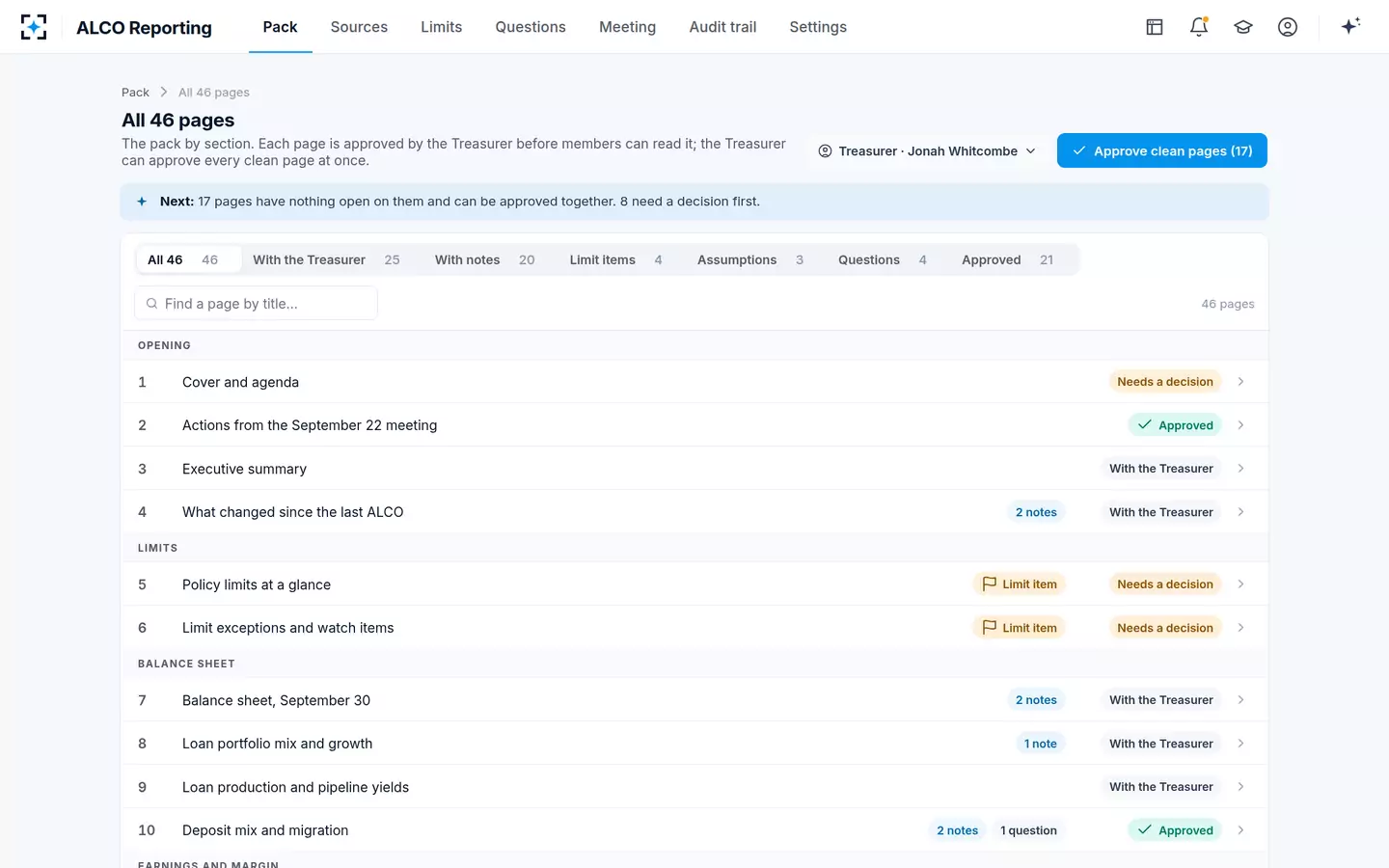
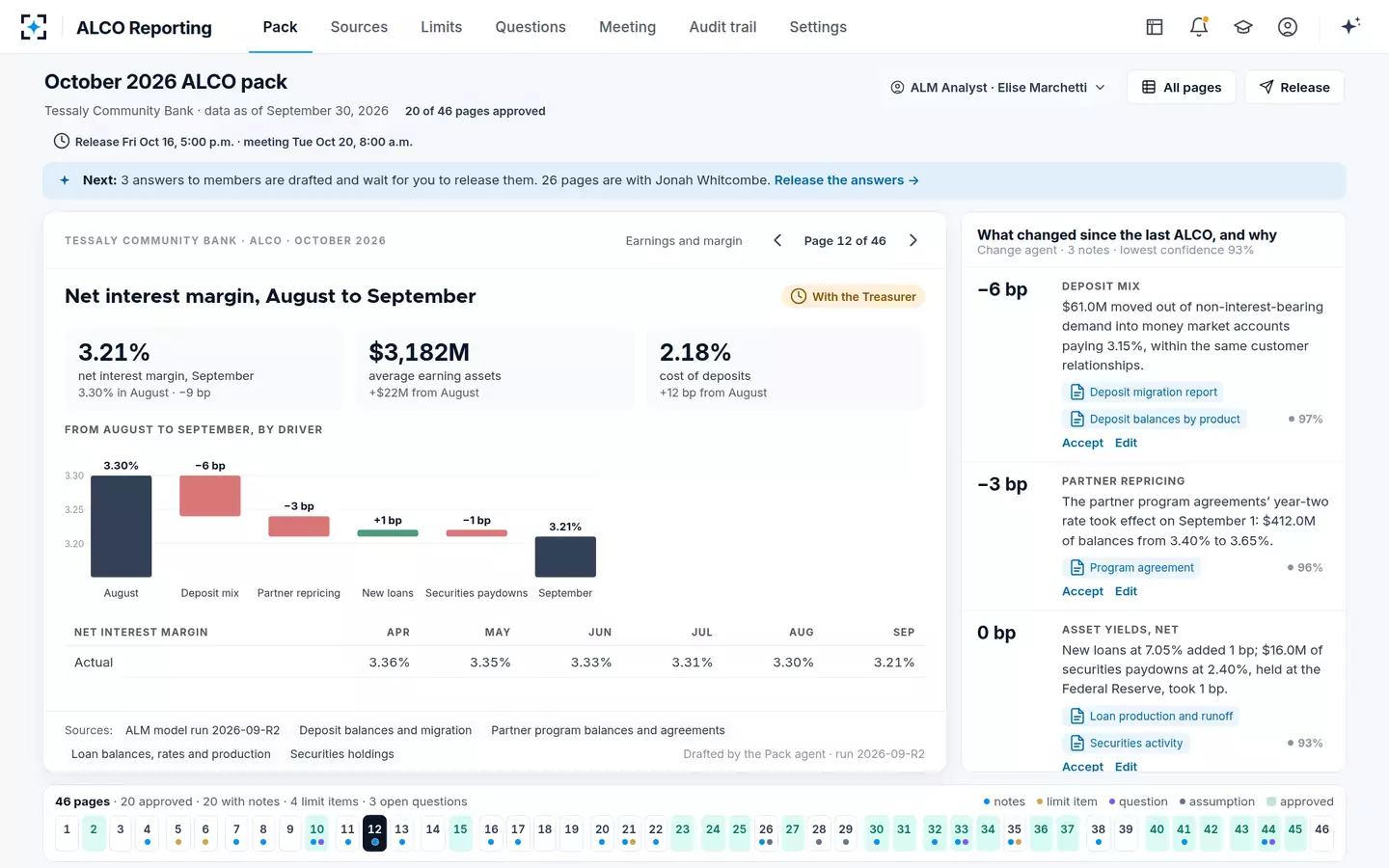
Each page opens like a book, with the agents' notes in the margin: on the margin page, the move is split into drivers that add up to it, each amount citing the passage it came from. The Treasurer approves page by page, as the checker of the analyst's work, and only then can members read it. Members ask their questions on the page, and the answers come back from the package's own sources.
Page 12 of 46 in ALCO Reporting: the margin, with what changed in the margin
Questions people ask
Is there a regulatory template for an ALCO report?
No agency publishes a template. The FDIC, OCC, Federal Reserve and NCUA texts say what the reports must let management and the board do: identify the source and level of interest rate risk, evaluate key assumptions, and determine compliance with limits, with liquidity reported at least monthly to management and quarterly to the board. The layout is the bank's choice.
What is the difference between an ALCO report and a board report?
The ALCO report is management's working document and usually monthly; the board's report is a summary of it, at least quarterly. The FDIC expects the board to receive information "of sufficient detail to allow the board to assess senior management's performance", so a board summary should still show every limit, every exception and every assumption change, not only the main measures.
Who prepares the ALCO package?
At most community banks an ALM analyst or a treasury analyst prepares it and the Treasurer or CFO reviews it, with the ALM model run supplied in-house or by an outside provider. The OCC notes that the ALCO usually delegates day-to-day work to the treasury unit, which should "prepare and provide reports on the bank's current risk to the ALCO".
Should liquidity be in the same package as interest rate risk?
Usually, yes. The interagency texts give the ALCO, where a bank has one, the duty to monitor both the interest rate risk profile and the liquidity profile, with the same breadth of membership. One package lets the committee see that a funding decision, such as moving partner deposits to a reciprocal network, changes both the liquidity limits and the deposit assumptions.
Can an outside provider's ALM report be the ALCO package?
It can be the core of it, but it is rarely the whole package. A provider's report covers the model's measures; the bank still owes the tie-out of the inputs, the explanation of what changed, the limit exceptions with their owners, and the actions. The advisory expects an institution that relies on a third party's model to understand that model's analytics, assumptions and methods in full, as interest rate risk management software sets out.
How far ahead should ALCO members receive the package?
No rule sets a lead time. The sample bank releases the package two business days before the meeting, on a Friday afternoon for a Tuesday meeting, and releases each page early once the Treasurer has approved it, so members can ask questions before the meeting rather than during it.