An ALM analyst runs the numbers behind a bank's or credit union's asset/liability management. The job is to load loan, deposit and securities balances into the ALM model, prove those inputs to the general ledger and the core banking system, run the rate scenarios that produce net interest income (NII) and economic value of equity (EVE), keep the model's assumptions on deposit betas, decay rates and prepayments current and back-tested, and assemble the monthly ALCO package; at many community banks the analyst also takes the committee's minutes. It is hard less because the analysis is difficult than because the calendar is short: the general ledger closes days into the month, the committee meets a couple of weeks later, and most of the time between goes on extracting, tying out and rebuilding pages. Botminds' ALCO Reporting exists for that gap, putting agents on the assembling and checking while the analyst keeps the judgement.
The month followed here belongs to Elise Marchetti, ALM Analyst at Tessaly Community Bank, a fictional $3.4 billion bank; she, her colleagues and every figure about the bank are sample data from the solution. The day counts are Botminds' own estimate for a monthly community-bank package, labelled as such.
Where an ALM analyst's package days go: eight by hand, three as the target
- Pull data into the model1
- Prove inputs to the general ledger1
- Build the pages2
- Write what changed1.5
- Limits and exceptions1
- Treasurer and CFO review1.5
- Pull0.5
- Prove
- Build0.5
- Write0.5
- Limits
- Review1
What does an ALM analyst do?
An ALM analyst measures the bank's interest rate and liquidity risk and reports it to the asset/liability committee. In practice that is five recurring jobs: getting the data into the model, proving the data is right, running and checking the scenarios, maintaining the assumptions, and turning the results into pages a committee can decide from. The first two are data work, the third and fourth are modelling, and the fifth is writing.
There is no "ALM analyst" occupation in the federal classification. The nearest is Financial Risk Specialists (SOC 13-2054), whose sample job titles include "Risk Analyst" and "Risk Manager" (O*NET OnLine). Three of its listed tasks describe the package week almost exactly: "Gather risk-related data from internal or external resources", "Maintain input or data quality of risk management systems", and "Produce reports or presentations that outline findings, explain risk positions, or recommend changes."
The analyst does not take the risk. NCUA's guidance on interest rate risk programs asks that the people who take the risk be kept apart from the people who measure it (12 CFR Part 741, Appendix A; who signs the interest rate risk policy has the wording), and banks draw the same line: the investment officer or Treasurer makes the trades and sets the deposit rates; the analyst measures what those decisions do to NII and EVE and reports it to the people who set the limits.
An ALM analyst job description, in the regulators' words
The clearest job description for an ALM analyst is in the FDIC's examination manual, and it appears by exclusion. Describing who may perform the independent review of a bank's interest rate risk measurement, the FDIC rules out reviewers who do the routine control work themselves, and names three examples: reconciling the data inputs, developing the assumptions and running the variance analysis (FDIC RMS Manual §7.1; quoted in ALM model validation under SR 26-2). Those three routine functions are the analyst's: reconciling the inputs, developing the assumptions, and comparing what the model projected with what happened.
The same section says what the bank owes the people who do it. The board "should provide staffing resources sufficient to ensure: Effective operation of measurement systems, Appropriate analytic expertise, Adequate training and staff development, and Regular independent reviews." NCUA puts it for credit unions as management's duty to "Develop and support competent staff with technical expertise commensurate with the IRR program." An ALM analyst job description that lists those duties, the systems involved and the committee the work reports to is closer to what an examiner will test than a generic list of skills.
Eight business days before the ALCO package
The package week is set by two fixed points: the day the general ledger's final trial balance for the month arrives, and the day the package must go out before the meeting. Everything else is squeezed between them. In the sample month, September's final trial balance arrived on October 6, the core banking system's extracts had arrived on October 1, and the October meeting was on Tuesday the 20th, with the package due to members on Friday the 16th.
By hand, the eight estimated days go like this. A day goes on pulling loan, deposit and securities data into the model. A day goes on proving those inputs to the general ledger and the core, usually on totals, because the detail would take longer than there is. Two days go on building the pages: refreshing tables and charts, and fixing the ones a new product or a renamed account has broken. A day and a half goes on writing what changed since the last meeting, which is the part the committee actually reads, and it gets written last, when time is shortest. A day goes on comparing every measure with its board limit and drafting the exceptions. The last day and a half is the Treasurer's and CFO's review and the corrections it produces.
Most of the ALM analyst's package time is mechanical, until agents take it
By hand, 8 days
- Pull, prove, build, limits · 62.5%
- Explain what changed · 18.75%
- Review · 18.75%
With agents, 3 days (target)
- Pull, prove, build, limits · 50%
- Explain · 16.7%
- Review · 33.3%
The split says something the total hides. With agents, the share of the month spent on review roughly doubles, because the review does not shrink as much as the rest. That is the intended result: the people whose names go on the package spend proportionally more of the month on judgement, and the analyst's own time moves from rebuilding pages to checking the agents' drafts and answering the committee.
Where the days go wrong: pulling, proving, rebuilding
The day most likely to go wrong is the one spent proving the inputs, because a break found late costs more than the day itself. In the sample month, the first model run carried $2,526.24 million of loans against $2,540.45 million in the general ledger: a $14.21 million break, 0.56% against the bank's 0.25% tolerance, from two accounts of purchased commercial real estate participations that were not in the model's loan extract. Found on the Friday before the package week, it is a correction. Found after the margin and NII pages are built, it is a rebuild of every page that touches loans, 21 of the 46.
That is why the order of the work matters more than its speed. Elise Marchetti's fix was simple once the break was visible: add the participations to the model as a fixed-rate commercial real estate segment. On the Monday she added them, the Treasurer approved the fix with a reason code, and the rerun tied on thirteen of fourteen checks, with one explained timing difference. How that check works, hop by hop from the core banking system to the page, is the subject of the ALM report in a bank.
ALM analyst salary: what the BLS data shows
Federal data does not publish an ALM analyst salary, but it does publish the occupation the role sits in. For Financial Risk Specialists, the Bureau of Labor Statistics' May 2025 wage data, released on May 15, 2026, put the national median at $117,330 a year, or $56.41 an hour, with 66,000 people employed, and projects employment growth from 2025 to 2035 that O*NET classes as "Much faster than average (7% or higher)" (O*NET OnLine, 13-2054.00).
The ALM analyst's occupation, and the rung above it, in BLS data
$117,330
median annual wage, financial risk specialists ($56.41 an hour)
66,000
financial risk specialists employed in 2025
7%+
projected employment growth 2025–2035, "much faster than average"
$166,570
median annual wage, treasurers and controllers ($80.08 an hour)
Two cautions apply. The figures cover every industry, so an ALM analyst at a $500 million credit union and a risk analyst at a trading firm sit in the same median. And they are wages, not the employer's full cost: a bank budgeting for the role adds benefits on top, which is the arithmetic pricing an ALCO package works through.
What skills does an ALM analyst need?
An ALM analyst needs four kinds of skill: data, balance sheet, modelling and writing. Data skill means extracting from the core banking system and the investment accounting system and reconciling the results to the general ledger without losing an account. Balance sheet skill means knowing how each product reprices and what options it carries: a callable bond, an adjustable-rate mortgage with caps, a money market account whose rate the bank can change at will.
Modelling skill is mostly about assumptions. The OCC's interest rate risk booklet ranks non-maturity deposit assumptions, deposit betas and decay rates, among the most important in an IRR model (OCC, Interest Rate Risk booklet), and the analyst is usually the one who maintains the deposit study, compares modeled betas with realized ones, and proposes a change when they drift. In the sample bank's back-test, money market deposits were modeled at a beta of 0.42 and realized at 0.47.
Writing is the skill the package tests last and most. A move has to be explained by its drivers, with amounts that add up to it, in a sentence a director can repeat; how that is done for the margin is set out in net interest margin analysis by driver. O*NET places the occupation in Job Zone Four, where most jobs ask for a four-year bachelor's degree and some do not.
ALM analyst vs ALM manager: the next rung
The ALM analyst prepares; the ALM manager, or at a community bank the Treasurer, decides what goes to the committee and answers for it. The manager owns the proposals: a change to an assumption, a plan for an exception, a hedge or a funding strategy. The analyst's work is checked by the manager, and the manager's decisions are checked by the committee and the board.
At a smaller institution the rungs collapse. The OCC notes that "In the absence of a centralized IRR management unit, the ALCO or board might delegate the daily operating responsibilities to an investment officer or chief financial officer" (OCC, Interest Rate Risk booklet), and at many community banks the analyst reports straight to the CFO. The BLS data puts treasurers and controllers at a median of $166,570 in May 2025, inside a financial managers group of 879,700 people. The other path out of the analyst's chair runs through model validation or internal audit, which the FDIC's independence rule makes a real move: the reviewer cannot be doing the reconciling.
What software does an ALM analyst use?
An ALM analyst uses an ALM model, run in-house or by an outside provider, and the systems that feed it: the general ledger, the core banking system, the investment accounting system, and, for banks with partner programs, the partner balances. Around those sit spreadsheets and slides, where, by hand, the pages are built. O*NET lists among the occupation's tasks to "Draw charts and graphs, using computer spreadsheets, to illustrate technical reports."
The FDIC asks examiners to weigh exactly this when judging a measurement system: "the extent to which the model uses automated versus manual processes; whether the model has automated interfaces with the bank's core systems; and the funds, hardware, staff, and expertise needed to run and maintain the model." The spreadsheets themselves are generally not models: the 2026 model risk guidance, SR 26-2, leaves simple spreadsheet arithmetic outside its definition, as the 2026 guidance on what counts as a model explains. But they are where the inputs are copied and the pages are rebuilt, which makes them the part of the process most likely to carry an error to the committee.
Who waits on the ALM analyst
Five people wait on the analyst's week, and each wants something different from it. The sample bank's roles show what changes for each when agents do the mechanical part and people keep every decision.
The ALCO package seen by the five people who wait on it, in ALCO Reporting
Today
Pulls the extracts, proves totals by eye, builds the pages in spreadsheets and slides, and writes the commentary late in the week.
With agents
Starts from pages drafted on inputs that already tie, accepts or edits the agents' margin notes with a reason, and releases members' answers.
Still theirs: Prepares every page and proposes every assumption change
Today
Reviews the package in rounds by email and checks numbers against the limits himself.
With agents
Approves page by page as the checker, and decides the exception and the assumption change with their evidence on screen.
Still theirs: Approves pages, exceptions, assumption changes and the release
Today
Gets minutes a week after the meeting, with decisions and owners vague.
With agents
Approves minutes drafted from the secretary's notes and sees overdue actions escalated.
Still theirs: Chairs the committee and approves the minutes
Today
Hears about an exception at the meeting and is asked for a plan on the spot.
With agents
Reads released pages early, asks on the page, and is named owner of a drafted plan before the meeting.
Still theirs: Owns the plans assigned to their area
Today
Rebuilds who approved an assumption, and when, from emails and slide versions.
With agents
Filters one trail of agent steps and people's decisions and exports it for examiners.
Still theirs: Reads everything, changes nothing
The same eight days with ALCO Reporting
With ALCO Reporting, the analyst's month starts from a check rather than a build. The agent that assembles the package loads the model run and ten other sources and checks the inputs against the general ledger and the core before it drafts a page; a break holds only the pages it touches. In the sample, the loan break held 21 pages on Friday, October 9, at 4:40 p.m., and the other 25 were drafted. The analyst's Monday was spent fixing one input, not rebuilding a package, and by midweek she was reviewing drafted pages such as the NII sensitivity page rather than building them.
A page the analyst prepares and the Treasurer approves: NII at risk
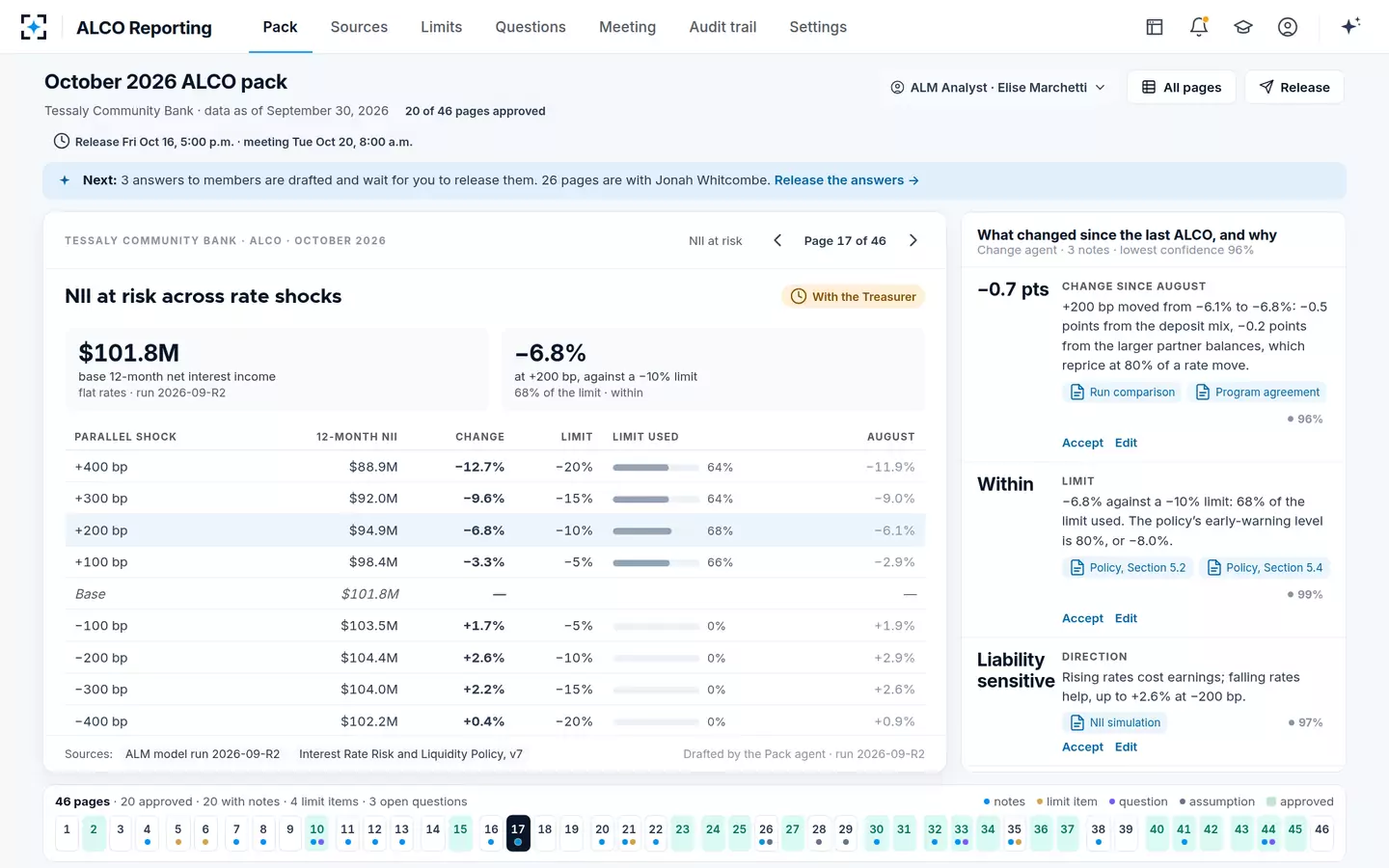
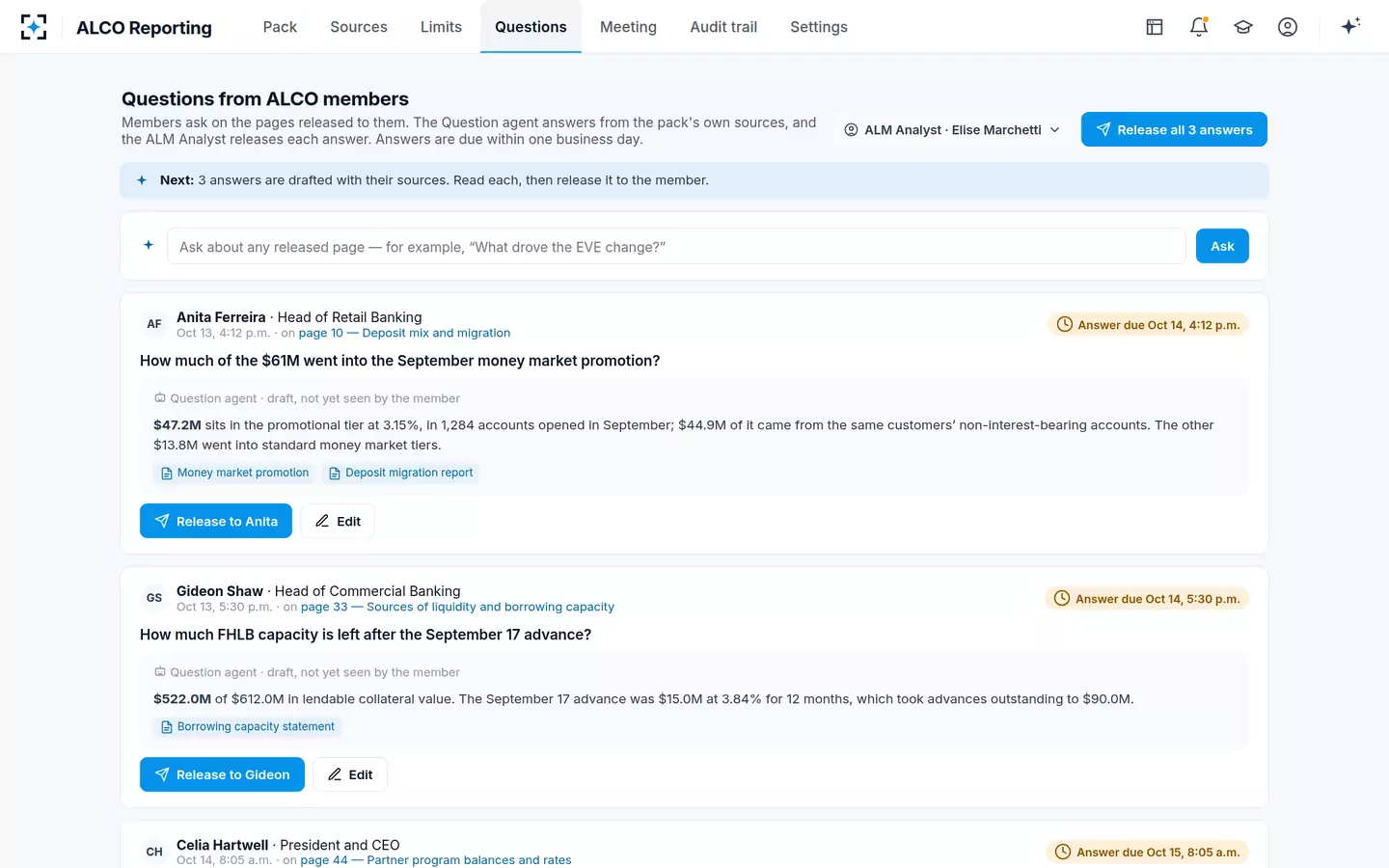
The rest of the week moves the same way. Margin notes arrive drafted, each amount citing the passage it came from, and the analyst accepts or edits them. Exception notes arrive with cause, plan and owner. Members' questions come in on the released pages, and the answers are drafted from the package's own sources for the analyst to release within one business day.
Members' questions, answered from the package's sources and released by the analyst
Questions people ask
Is an ALM analyst the same as a treasury analyst?
Often in practice, not in definition. A treasury analyst may also manage daily cash, investments and borrowings; an ALM analyst measures and reports the balance sheet's interest rate and liquidity risk. At community banks one person frequently does both, which is why the measurement and the risk-taking should still report through different people.
Does a community bank need a full-time ALM analyst?
Not necessarily. Many smaller banks and credit unions buy the model run from an outside provider and give the rest of the work to the CFO or an investment officer, which the OCC recognizes. What cannot be outsourced is understanding the results: the interagency advisory expects institutions using third-party models to understand their analytics and assumptions.
How long does it take to build an ALCO package?
No published study measures it. Botminds' own estimate for a monthly community-bank package is about eight business days of analyst, Treasurer and CFO time by hand, not counting the model run, and its design target with agents is three. The window is usually set by when the general ledger closes and how far ahead of the meeting the package must go out.
Do ALM analysts need to code?
Not to do the job, but it helps. The work rests on extracts from the core banking system and the general ledger, and an analyst who can query those directly spends less time copying data between files, which is where reconciliation errors start.
Is ALM a good career?
The federal projections are favourable for the occupation it belongs to: BLS projects employment of financial risk specialists to grow 7% or more from 2025 to 2035, much faster than average, with about 4,800 openings expected over the decade. The skills, balance-sheet modelling and explaining risk to a committee, also lead directly to treasurer and CFO roles.