ALCO meeting minutes are the written account of what a bank's asset/liability committee saw, decided and asked someone to do, and they are read by examiners as closely as the ALCO package itself. Good minutes name who attended and whether there was a quorum, set down each decision with its mover and vote, write down any change to a model assumption with its effect, give every limit exception a cause, a plan and an owner, and assign each action a person and a date. Minutes that say "the committee reviewed the package and approved the assumptions" leave out the one decision a supervisor will ask about. Botminds' ALCO Reporting drafts the minutes from the secretary's own notes, ties each item to the note line it came from, tracks every action to the next meeting, and leaves approval with the committee's chair.
The examples below come from a fictional sample bank, Tessaly Community Bank, as it runs through the solution. Its September 2026 meeting, its people and its figures are sample data; the supervisory text is quoted from the agencies' own manuals.
Examiners should also review the presentations or analyses provided to senior management, board members, and the ALCO, as well as any relevant meeting minutes.
FDIC Risk Management Manual of Examination Policies, §7.1 Sensitivity to Market Risk (10/2025)
Do examiners read ALCO minutes?
Yes, and in more than one place. The FDIC's manual tells examiners to review the material given to the ALCO "as well as any relevant meeting minutes", and lists "Board or committee minutes" among the items to read before the examination begins. The OCC's interest rate risk procedures tell examiners to "Review the ALCO, board, and other relevant committee minutes for IRR-related information" and to "Assess the adequacy of information reviewed by the committees" (OCC, Interest Rate Risk booklet, 2020). Its request letter asks for "Copies of all ALCO meeting minutes since the prior examination, unless already provided in the ALCO package."
The liquidity side is the same. Among the things the FDIC expects of a board is that it "reviews the minutes of the ALCO", and it expects the committee's policies to cover "documenting committee actions, and reporting to the board" (FDIC RMS Manual §6.1). So the minutes are read three times: by the board, which relies on them for oversight; by internal audit; and by the examiner, who reads a whole cycle of them against the packages they refer to.
That last reading is the one to write for. An examiner is not checking prose. They are checking whether what the package showed, what the committee decided and what happened next line up, month after month.
What should be in ALCO meeting minutes?
ALCO meeting minutes should carry eight things, and each comes from a sentence of supervisory text. The closest written standard is the OCC's for board and board-committee minutes, which an ALCO, as a management committee, can adopt in full: minutes "should be complete and accurate" and "should document the board's review and discussion of material action items on the agenda, any actions taken, follow-up items to be addressed at subsequent meetings, and any other issues that may arise" (OCC, Corporate and Risk Governance booklet).
Eight things complete ALCO minutes carry, and the rule behind each
- Attendance and quorum
Who was present, who was absent, other attendees, and whether the quorum in the charter was met. The OCC expects minutes to show which directors and other people attended.
- What the committee had in front of it
The package version and any papers tabled. The OCC asks that the board's papers include "all materials distributed".
- Each decision, with mover, seconder and vote
Including abstentions and dissent. OCC: "votes or abstentions".
- Every assumption change, with its effect
Old value, new value, the evidence and what it moves. Interagency advisory: changes and effects "documented and clearly identified".
- Every limit exception, with cause, plan and owner
The board reviews exceptions and management's proposed actions (FDIC §7.1).
- Measures noted near their limit
A measure at 87% of its limit this month is next month's trend. One line makes it visible.
- Actions, each with an owner and a due date
"Follow-up items to be addressed at subsequent meetings" (OCC).
- The challenge, not only the conclusion
The questions members asked and the answers. OCC: minutes should show directors "provided credible challenge when necessary".
The list is longer than many committees' minutes, but it is not long on the page. In the sample bank's September minutes, all eight fit in one decision, five actions and an attendance line, because each item is one or two sentences with a number, a name and a date.
How detailed should ALCO minutes be?
ALCO minutes should be detailed enough that someone who was not in the room can tell what the committee knew, what it decided, and who owns what happens next, and no more detailed than that. The OCC frames the test for board minutes as showing that directors knew the relevant facts, weighed the issues with care, challenged management where they needed to and decided in the interests of the bank and its shareholders; what examiners look for in loan committee minutes quotes the OCC's wording. A transcript does not meet that test better than a good minute; it buries the decision.
There is a practical reason to get the level right. The OCC points out that minutes can be produced in discovery, in a shareholder derivative suit for example. Minutes that state a decision without the information behind it read, years later, as a committee that did not ask. Minutes that run to pages of discussion preserve every half-formed view as if it were the committee's.
A workable rule: a sentence of context for each decision, the numbers that drove it, the decision itself with the vote, and any dissent in the dissenter's own words. Discussion that led nowhere can be summarized in a line.
How do you record an assumption change in ALCO minutes?
Record an assumption change with five things: the assumption, its old and new value, the evidence for the change, its effect on the measures the board limits, and who approved it. The interagency advisory expects any change to an assumption since the last report to be written down and marked, together with what it did to the model's results (Interagency Advisory on Interest Rate Risk Management, 2010; the SR 10-1 gap assessment quotes the passage). For credit unions, NCUA's guidance asks for the same record of significant changes to assumptions, methods and tests, and for those changes to reach the people responsible for the program (12 CFR Part 741, Appendix A).
The reason this item matters more than any other is in the Federal Reserve's review of Silicon Valley Bank. Its interest rate risk limits had been under pressure for years, and the review found that "In April 2022, SVBFG made counterintuitive modeling assumptions about the duration of deposits to address the limit breach rather than managing the actual risk" (Federal Reserve, SVB review, April 2023). An assumption change that improves a measure near its limit is the decision minutes exist to capture: what changed, on what evidence, and what it did to the limit.
The same assumption decision, minuted two ways
A vague minute: "The committee reviewed the model assumptions."
A complete minute: Average life of partner program balances, 3.0 years to 2.0 years.
A vague minute: Not stated.
A complete minute: Annualized runoff of 50.2% over 18 months of the program's own experience; 3.0 years was set at launch, before any experience.
A vague minute: Not stated.
A complete minute: EVE at +400 bp from −26.9% to −27.9%, 90% to 93% of the −30% limit; NII at +200 bp from −6.6% to −6.8%.
A vague minute: Not stated.
A complete minute: The change makes the measure worse, not better: a more conservative assumption, not a cure for a breach.
A vague minute: "Approved."
A complete minute: Proposed by the ALM Analyst, decided by the Treasurer with a reason, noted by the committee; EVE at +400 bp to be reported as a watch item.
The direction row is the one that separates a sound change from SVB's. Shortening an average life when experience shows faster runoff makes EVE sensitivity worse and uses up headroom; it is the kind of change a supervisor wants to see. Lengthening one to bring a measure back inside its limit is the reverse, and a minute that states the direction and the limit headroom on both sides makes either visible to the board.
Limit exceptions and actions: owner, date, follow-up
A limit exception in the minutes needs the measure, the limit and the policy section, the cause, the plan, an owner and a date, and the next meeting's minutes should say whether it was closed. The FDIC expects that "the board should review all risk limit exceptions and management's proposed actions" (FDIC §7.1), and the board can only do that from what the ALCO wrote down.
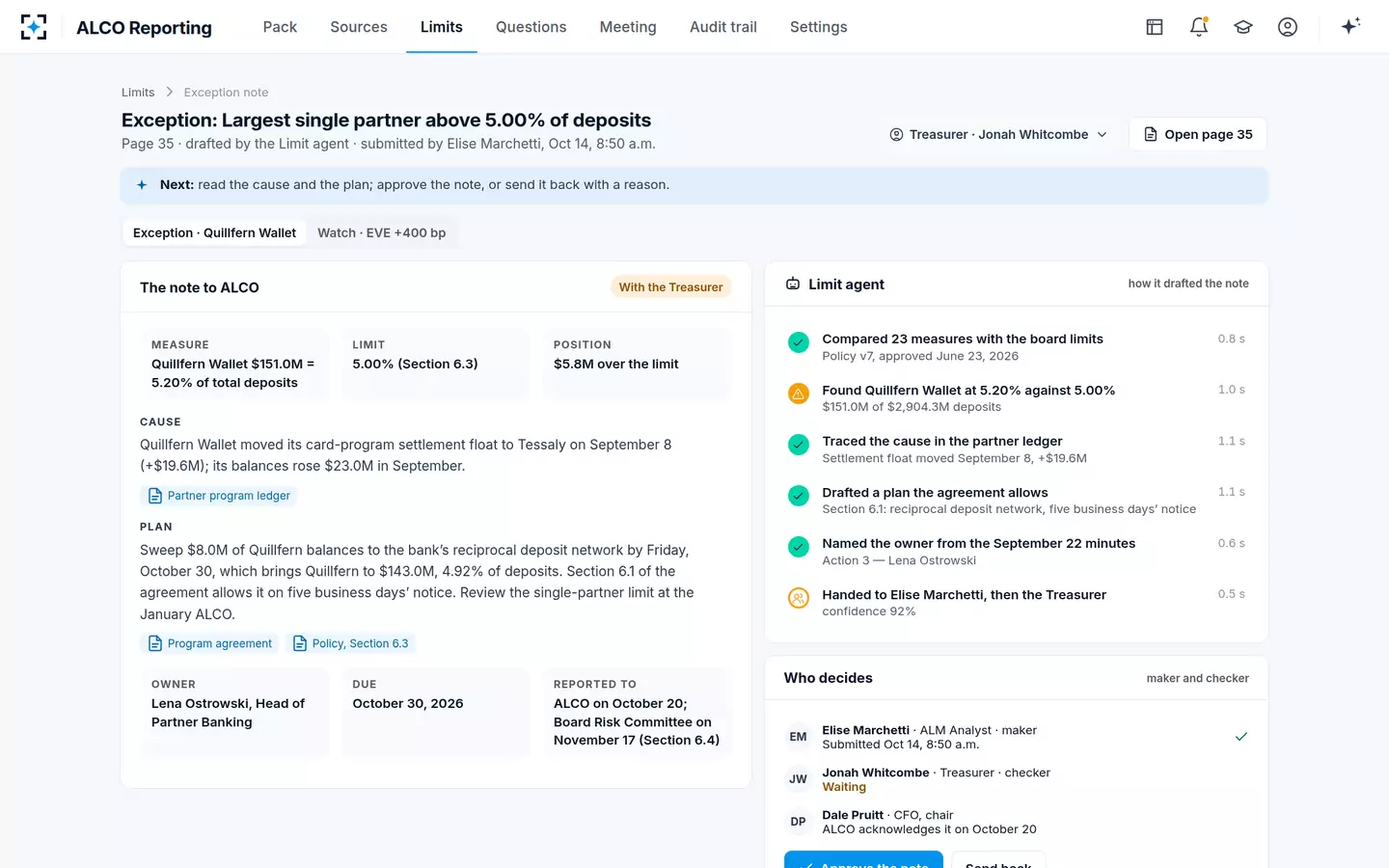
Actions follow the same pattern with less at stake. In the sample bank's September minutes, a line in the secretary's notes reads "LO: Quillfern growing fast, close to 5%. Committee wants a plan in Oct. LO owns." In the minutes it becomes an action with an owner, Lena Ostrowski, the Head of Partner Banking, and a due date, the October meeting. By September 30 the partner was over its 5.00% limit, after moving its card-program settlement float to the bank on September 8, and the exception note for October took its owner from that action.
The exception note names the owner the September minutes assigned
An ALCO meeting minutes sample, line by line
The sample bank's secretary, the ALM Analyst, took eight lines of notes at the September 22 meeting. The table shows each line and what it became in the minutes, which is the most useful way to see what an ALCO meeting minutes sample should contain: not polished prose, but every note accounted for.
Eight note lines become one decision, five actions and an attendance line
| Secretary's note | In the minutes |
|---|---|
| 1 · Present: DP (chair), JW, CH, RD, MV, TW, AF, LO. Absent: GS. Quorum 8 of 9. | Attendance: 8 of 9 members; Gideon Shaw absent. Quorum met. |
| 2 · JW: NIM 3.30, down 1. MMDA promo launched 9/1 at 3.15. DP wants to see what it does to margin next month. | Action 1: the Treasurer will report the effect of the money market promotion on the margin. Owner Jonah Whitcombe, due October 20. |
| 3 · Limits all inside. EVE +400 at 87%, nothing needed yet. | Not minuted as an item in the draft. A line noting EVE at +400 bp at 87% of its limit would have made October's watch item a trend. |
| 4 · Discount window test still not done. JW to do a test transaction before the next meeting. | Action 2: complete a discount window test transaction before the next meeting. Owner Jonah Whitcombe, due October 9. |
| 5 · LO: Quillfern growing fast, close to 5%. Committee wants a plan in Oct. LO owns. | Action 3: bring a plan for partner concentration growth. Owner Lena Ostrowski, due October 20. |
| 6 · TW asked whether the partner assumption of 3 yrs still holds. EM to look at attrition and propose, by Oct 9. | An action for the ALM Analyst to review partner attrition and propose, due October 9. |
| 7 · MV to show capital effect of buying 2-yr Treasuries with paydowns, Oct 9. | An action to show the capital effect, due October 9. |
| 8 · Motion to accept the August package: CH, second RD. Carried. | Decision: the committee accepted the August package, moved by Celia Hartwell, seconded by Ravi Desai; carried. |
Line 3 is the instructive one. The draft treated "nothing needed yet" as nothing to minute, which is defensible: there was no decision. But the committee did see a measure at 87% of its limit, and a month later the same measure stood at 90% before the proposed assumption change and 93% after it. A one-line minute, "EVE at +400 bp noted at 87% of limit; no action", is what turns October's watch item from a surprise into a trend the committee had already seen. Line 6 is the other half of the same story: the question that produced October's assumption proposal was asked, and minuted as an action, in September.
Who approves ALCO minutes, and how long are they kept?
Whoever the committee's charter names approves the minutes, most often the committee at its next meeting or the chair on its behalf. The OCC's standard for board minutes is that they "should be timely and presented for approval at the next meeting of the board", and that each director "should have the opportunity to review and, if appropriate, modify the minutes" first. In the sample bank, the CFO chairs the committee and approves the draft, in this case three days after the meeting; the Treasurer, who approves the package, cannot approve the minutes, which keeps the person who prepared the numbers from approving the account of what the committee did with them.
No agency text sets a retention period for ALCO minutes as such. Two things set a floor. The OCC's request letter asks for all minutes "since the prior examination", and the OCC's own interest rate risk statistics describe supervisory cycles of 12 to 18 months, so minutes must at least outlive one full cycle. And the OCC's warning that minutes "may be subject to discovery" argues for keeping them as long as the bank keeps its board minutes. The sample bank's setting keeps packages, minutes and the full trail of decisions for seven years and source extracts for five, under its own retention schedule; that is the bank's choice, not a regulatory number.
Quorum, the charter, and why the minutes depend on it
A quorum for ALCO is whatever the committee's charter says it is; there is no regulatory figure. The sample bank's quorum is five of its nine members, a simple majority. The charter matters to the minutes because the minutes can only prove what the charter defines: that the meeting was quorate, that the decision was within the committee's authority, and that the right person approved the result.
For board committees, the OCC is specific about what a charter covers: it "should establish requirements that include meeting frequency, conduct, attendance, minutes, and use of advisors." An ALCO is usually a management committee, not a board committee, but the same headings make a sound ALCO charter: who sits on it, what it may decide and what it must take to the board, how often it meets, what counts as a quorum, who takes and who approves the minutes, and how quickly. The rules that set how often ALCO meets belong in the same document.
Drafting ALCO minutes from the secretary's notes with ALCO Reporting
In ALCO Reporting, the Minutes agent drafts the minutes from the secretary's notes and nothing else. It reads the note lines, sets out attendance and quorum, finds each decision and action with its owner and date, and checks every item against a note line; it will not minute a decision that is not in the notes, and it cannot approve the minutes. The chair approves them, and the actions are tracked to the next meeting: they appear on page 2 of the next package, and an overdue action is escalated to the chair. In the sample, an action overdue since October 9 was escalated to the CFO on October 12.
ALCO meeting minutes drafted from the secretary's notes in ALCO Reporting
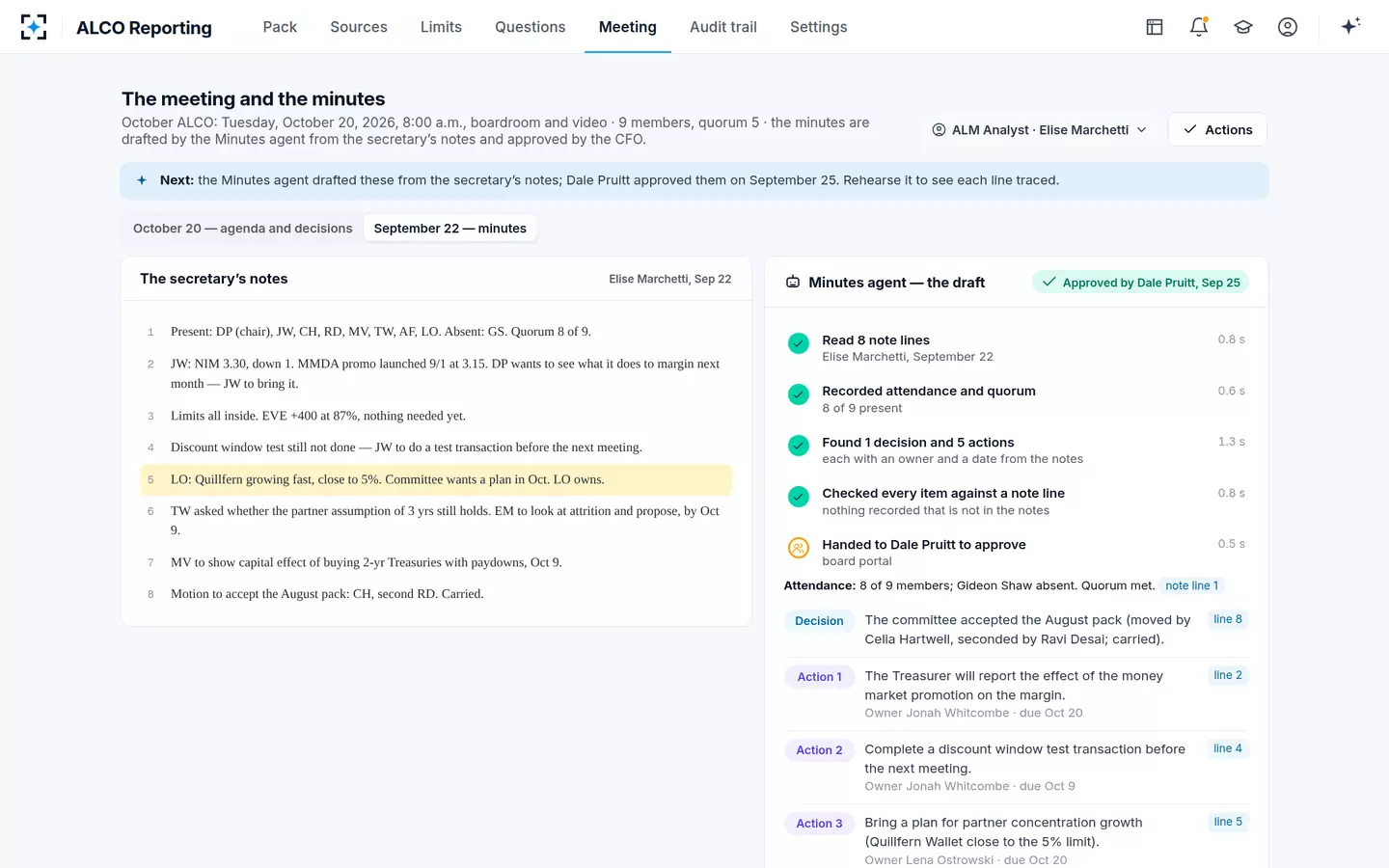
The design choice worth copying, with or without software, is the citation. A minute that names the note line it came from can be checked in seconds by the chair and, later, by an auditor; a minute written a week after the meeting from memory cannot. The ALCO package the minutes refer to is laid out in the ALCO report sample, and the limits the exceptions refer to are compared with peer banks in ALCO limits against 791 banks.
Questions people ask
What is the difference between ALCO minutes and the ALCO package?
The package is what the committee was shown; the minutes are what it did with it. The OCC requests both, and asks for minutes separately "unless already provided in the ALCO package", which is one reason to put the prior meeting's approved minutes and action list at the front of the next package.
Should ALCO minutes record dissent?
Yes, in the dissenter's words and with the vote. The OCC's standard for board minutes asks for "votes or abstentions", and for stock federal savings associations a director present at a meeting is treated as assenting unless the abstention or dissent is entered in the minutes. Writing down the challenge is also how minutes show the committee did more than receive a report.
Can the ALM analyst take the ALCO minutes?
Often the analyst who prepares the package also acts as secretary, as in the sample bank. That works if someone else approves the minutes: in the sample the CFO, as chair, approves them, and the Treasurer, who approves the package, cannot.
How soon after the meeting should ALCO minutes be finished?
No rule sets a deadline, but the OCC expects board minutes to be "timely and presented for approval at the next meeting". Minutes finished within a few days keep actions moving; minutes finished a month later reach the next meeting with their actions already overdue.
Do credit union ALCO minutes need anything different?
The content is the same with NCUA's terms: net economic value instead of EVE, shares and dividends instead of deposits and interest. NCUA's Appendix A asks that significant changes in assumptions and measurement methods be documented and brought to the attention of those responsible, and that results reach the board at least quarterly.