Loan committee meeting minutes are the first thing examiners read about a bank's credit decisions, and they read them against the approval files behind them. When examiners review a commercial loan approval, they check that the documentation and analysis were enough to make an informed decision, that the person or committee who approved it had the authority under the bank's limits, that any insider credit had prior board approval with the interested party abstaining, that policy exceptions were identified and approved with a justification, and that the committee's minutes record attendance, votes and abstentions in a way that shows real deliberation. Each of those can be written as a test and run against a file before an examiner does. Botminds' Loan Approval Workflow takes each deal from finished memo to recorded decision and keeps the evidence for every test as it goes: the route with its working, the exceptions with their sections, the questions with their sources, and the votes with their reasons.
Five tests an approval file must pass
- 1. Enough analysis to decide
Purpose, repayment source and ability to repay, documented before commitment (12 CFR 30, App. A; OCC 2026).
- 2. An approver with the authority
The approver’s limit covered the aggregate relationship under the matrix in force that day (OCC 2026; Fed CBEM).
- 3. Insider rules followed
Prior approval by a majority of the entire board where Regulation O requires it, with the insider abstaining, and the abstention minuted.
- 4. Exceptions named and approved
Each identified in the approval with its mitigant and approved by a designated authority, in writing.
- 5. Minutes that show deliberation
Attendance, votes and abstentions recorded, and enough to show members were informed and challenged where needed.
How many months of committee minutes do examiners request?
Twelve months, by default, and the report package for the most recent meeting. Examiners begin with the committee's own records and each officer's limits, and test individual files against them. The OCC's 2026 lending booklet includes a request letter that asks, for each board and management committee with credit oversight, for "meeting minutes for the last 12 months" and "a copy of the standard report package distributed at, or in advance of, each meeting". Examiners may change the date range, and ask for packages from other meetings as they go. The Federal Reserve's procedures list, among the documents to obtain, "each officer's current lending authority" and "any useful information obtained from the review of the minutes of the loan and discount committee or any similar committee".
With those in hand, examiners sample loans. The OCC tells them to "assess the extent to which new loans are underwritten within the parameters of the bank's lending policies and determine whether exceptions to policy were appropriately identified and approved", and to consider "whether exceptions were identified in the loan approval documentation along with mitigants that justify the decision". An approval file is defensible if a stranger can answer each question from the file alone.
What do examiners look for in loan committee minutes?
Five things, and the minutes carry the last two directly: authority, insiders, exceptions, a record of each vote and evidence of real deliberation. The first three are tested in the approval file, and the minutes are where an examiner checks that the committee saw what the file says it saw.
1. Enough analysis to make the decision
The interagency safety and soundness standards expect documentation that will "enable the institution to make an informed lending decision" and that will identify the purpose of a loan and the source of repayment. In the approval file that means a finished memo with spreads, the analysis behind the risk rating and the facts the approver relied on. The test is not length; it is whether each figure an approver used can be found and traced.
2. An approver with the authority
The OCC's instruction is direct: examiners "should determine if the documentation and analysis are sufficient to make an informed credit decision, and that the approver had sufficient authority based on the bank's established limits". Authority is measured on the relationship, so the file must show the aggregate exposure that set the route, not only the new money, and the version of the matrix in force on the day. A file that shows a $14 million loan approved by an officer with a $15 million limit fails if a related company's $2 million was left out of the sum.
3. Insider rules followed and minuted
Where Regulation O applies, approval must come "in advance by a majority of the entire board of directors" and the interested party must abstain. The Federal Reserve expects the approval to be "documented within the board's minutes", and the OCC's insider procedures check that "the abstention was noted in the board of directors' minutes". The same discipline applies to any member with a conflict on a committee item.
4. Exceptions named and approved
The Federal Reserve's manual expects the reason for each exception to be written down and approved by an authority the policy designates (Commercial Bank Examination Manual), and the OCC tells its examiners not to criticise a loan for the exception alone. A properly approved exception is normal credit practice; an exception that was never named is a control failure. How exceptions are tracked once approved is set out in loan exception tracking.
5. Minutes that show deliberation
The OCC's guidance to directors says minutes should "record the attendance of each director, other attendees, and directors' votes or abstentions", and include enough to show members "were fully informed about the relevant facts, carefully deliberated the issues, provided credible challenge when necessary". A minute that says "approved unanimously after discussion" passes the first half and fails the second.
Where approval files have failed
Published enforcement and failure reviews show each test failing in practice. None of these cases turned on a missing signature. They turned on authority that was too broad, insider approvals that never happened, or a condition that was never met.
Three approvals that failed a test, and what it cost
$9.5M
Federal Reserve penalty on EagleBank: nearly $100 million to entities its CEO owned or controlled, without required approvals from a majority of the board
$13M
personal lending authority First NBC’s CEO had reached by 2009, called “excessive” by the FDIC’s Inspector General
the bank failed in 2017; estimated fund loss $996.9 million
2
BancCentral officers barred in 2025 after required cash collateral was not secured, causing a legal lending limit violation
EagleBank's case is the clearest on test three. The Board found deficient internal controls that let the bank extend credit to the CEO's entities "without making appropriate disclosures to, or obtaining required approvals from, a majority of the bank's board of directors", and noted that lending staff "permitted Paul to participate in matters in which he had a conflict of interest". First NBC is test two: the Inspector General found "a dominant official with broad lending authority and limited Board of Directors (Board) oversight". BancCentral shows that an approval's conditions belong to the file too: the OCC barred two former officers for "failing to secure cash collateral required for certain new market tax credit loans, which caused the bank to violate its legal lending limit".
What makes loan committee minutes weak?
Minutes are weak when they record the outcome and nothing that led to it: "approved unanimously after discussion", no exposure figure, no exceptions, no reasons. The difference between a file that survives an exam and one that does not is rarely the decision itself. It is whether the file shows the working.
The same approval, recorded two ways
A weak file: The memo’s figure for the borrower.
A defensible file: The relationship total, facility by facility, with related interests and the matrix version applied.
A weak file: “Approved by committee.”
A defensible file: Which committee, its limit, quorum present, and who was entitled to vote.
A weak file: Silent.
A defensible file: The check run and its result; any abstention named in the minutes.
A weak file: Mentioned in the memo’s narrative.
A defensible file: Each listed with its policy section, mitigant and the vote that approved it.
A weak file: In members’ email.
A defensible file: In the file, with answers and the documents they came from.
A weak file: “Approved unanimously after discussion.”
A defensible file: Each vote with its reason, the dissent included, and the conditions.
A weak file: In the commitment letter only.
A defensible file: In the minutes, tracked to closing.
What should loan committee meeting minutes include?
For each credit item: who was present and entitled to vote, what was asked for and why this committee could decide it, who stepped out, what members asked, which exceptions were accepted and why, how each member voted and why, and the conditions. The OCC's guidance for directors sets the floor for any board or committee: minutes should cover the review and discussion of material items, actions taken, follow-up items, approval of the previous minutes, attendance, and "directors' votes or abstentions". A credit item needs more, because the examiner reading it is testing authority and exceptions as well.
A minutes template for one credit item, with sample wording
| Section | What to write | Sample wording (fictional deal) |
|---|---|---|
| Attendance and quorum | Members present and absent, others attending, quorum required | Seven members present; quorum of four present. Also present: L. Whitford (secretary), P. Raman (analyst, item 1 only). |
| The request and the authority | Borrower, amount, purpose, aggregate relationship, the limit that applies | $23,000,000 new money to acquire Ardent Tool & Die; relationship $35,800,000 including Merrow Building LLC; within the committee’s $40,000,000 limit. |
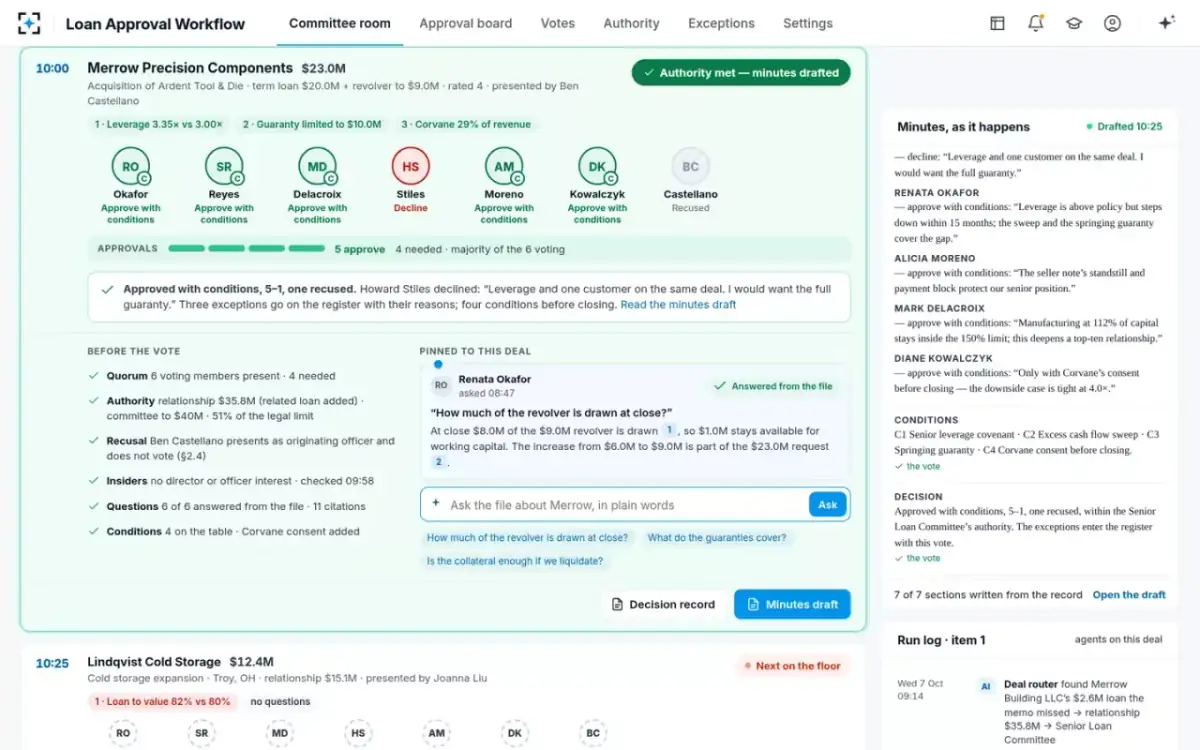
| Recusals and conflicts | Who stepped out of which item, and why | Mr. Castellano, originating officer, presented and did not vote (Credit Policy §2.4). No insider or related interest identified. |
| Questions and answers | Questions that shaped the vote, with the source of each answer | Assignment of the Corvane supply agreement requires Corvane’s written consent (§14.2); consent not in file. |
| Exceptions | Each exception, its policy section, the mitigant accepted | Senior leverage 3.35× against 3.00× (§4.3.2): accepted with a covenant stepping to 3.00× by 31 December 2027 and a 50% cash sweep. |
| Votes and reasons | Each member’s vote; reasons at least for declines and conditions | Approved with conditions 5–1, one recused. Mr. Stiles declined: leverage and one customer on the same deal; would want the full guaranty. |
| Conditions | What must happen before closing or funding, testable | C4: Corvane’s written consent to assignment received before closing. |
| Signature and approval | Who checked, who signed, when approved by the committee | Checked by the secretary; signed by the chair as a true record; to be approved at the next meeting. |
Scoring the Merrow file
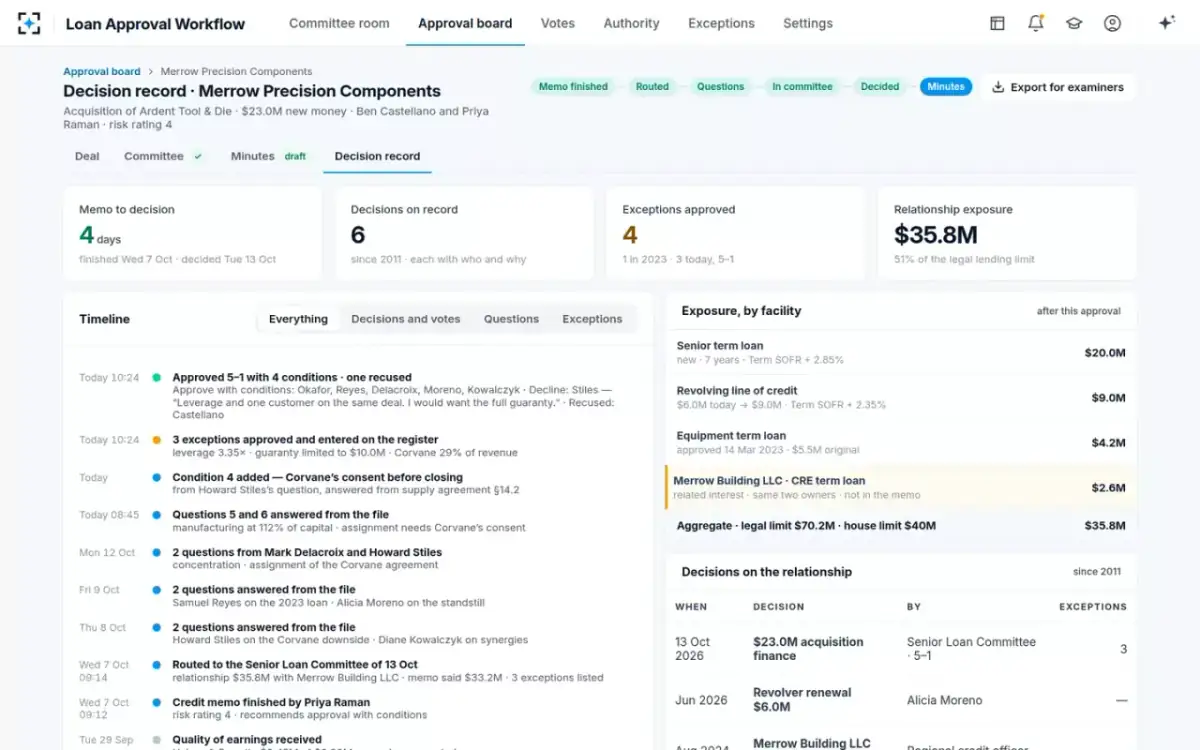
Take a fictional deal as it runs through the solution: a $23.0 million acquisition loan to Merrow Precision Components, approved by Brennwood Bank & Trust's Senior Loan Committee on Tuesday 13 October, five to one with one member recused. The decision record holds every piece an examiner would ask for, each tied to the test it answers.
The sample decision file, scored against the five tests in Loan Approval Workflow
Credit memo and spreads
Purpose, repayment source, the analysis behind the decision.
Sufficient analysis
Memo and spreads finished Wed 7 Oct by the senior analyst; risk rating 4.
Route
Relationship total, facility by facility; matrix version; authority it requires.
Authority
$35.8M with the related loan the memo missed; matrix v12; Senior Loan Committee to $40M.
Insider check
Owners, guarantors and related entities against the insider list.
Insiders
No insider or related interest of a director; originating officer recused under policy §2.4.
Exceptions
Each exception, its section, mitigant and the decision that approved it.
Exceptions
Three, each approved by the committee 5–1 with reasons, and on the register.
Questions
What members asked, the answers and their sources.
Deliberation
Six questions, eleven citations; one gap became a condition.
Minutes
Attendance, quorum, votes with reasons, abstentions, conditions, signature.
Deliberation
Drafted from the record, checked by the secretary, signed by the chair at 10:53.
Two things in that file would not exist in an email-driven process. The route caught a $2.6 million loan to a company owned by the same two people, which the memo had left out; without it the relationship read $33.2 million instead of $35.8 million. And the dissent is in the minutes with its words: one member declined because leverage and a single large customer sat on the same deal and he wanted the full guaranty. How that vote unfolded is told in how to record dissent in the minutes.
The decision record, ready to export for examiners
Are loan committee minutes discoverable in litigation?
They can be. The OCC warns directors that minutes "may be subject to discovery, for example, during stockholder derivative litigation", and the same is true when a failed loan ends in a lawsuit or an enforcement action. Minutes are written for two readers at once: the examiner who tests the decision this year, and a lawyer who may read them years later knowing how the loan turned out.
That second reader changes how minutes should be written. Facts and reasons, stated plainly, protect members: a recorded mitigant shows the committee saw the risk and priced it, and a recorded dissent shows challenge happened. Speculation, jokes and unrecorded side conversations do not. The same guidance gives each director the chance to review and, if needed, correct the minutes before the board approves them, which is why a draft should reach members while they still remember the meeting. Writing the minutes from what was recorded in the room, rather than from notes days later, is the most reliable way to make them accurate.
Building the file as the deal moves
A defensible file is cheapest to build while the deal is moving and expensive to rebuild later. Every test above depends on facts that exist only at a moment: the relationship total on the day it was routed, the matrix version in force, the members present, what each said when voting. Reconstructed weeks later from inboxes, they are guesses.
In the solution each test's evidence is written when it happens. The deal router records its sum and the matrix version when the memo is finished. The insider and conflict checker records its result before the vote. Each exception enters the register with the decision that approved it. The secretary enters each vote with its reason as it is cast, and the minutes are drafted from those entries and signed the same morning. Reasons are required for declines and for approvals with conditions. The secretary's side of this is covered in how a loan committee meeting runs.
Authority met, and the minutes drafted from the record
Questions people ask
Do loan committee minutes need to be verbatim?
No. The OCC says the board "should address the level of detail required for minutes". What the minutes must carry is attendance, votes and abstentions, and enough of the discussion to show that members were informed and challenged where needed. Reasons for declines and conditional approvals are the part most often missing.
Who should take loan committee minutes?
A secretary who does not vote, usually from credit administration or the corporate secretary's office. A member who takes notes while also arguing a deal will miss the reasons others give, which are the part of the minutes examiners value most.
Can minutes be corrected after they are signed?
Yes, at the next meeting, when the committee approves them. The correction and who asked for it belong in that meeting's minutes, so the record shows both versions. A correction that changes a vote or a reason should be confirmed by the member concerned.
Should the credit package be kept with the minutes?
Yes. The OCC's request letter asks for the standard package distributed for each meeting as well as the minutes, and an examiner testing whether members were informed needs to see what they were given, including any corrected page sent after the first distribution.
Can a loan be approved by email between meetings?
Only if the lending policy or the committee's charter allows it, and only with the same quorum and majority a meeting would need. The approval, each member's response and any recusal should then be entered in the next meeting's minutes, so the record does not depend on an inbox.